Vizhinjam’s Fast-Tracked Expansion Signals India’s Transshipment Moment — But Execution Will Decide the Prize
Maritime News, Kerala, India: Union Minister for Ports, Shipping and Waterways Sarbananda Sonowal inaugurated the capacity augmentation works of Vizhinjam International Seaport in Kerala, the message was unmistakable: India is no longer content to remain a feeder nation in global container trade.
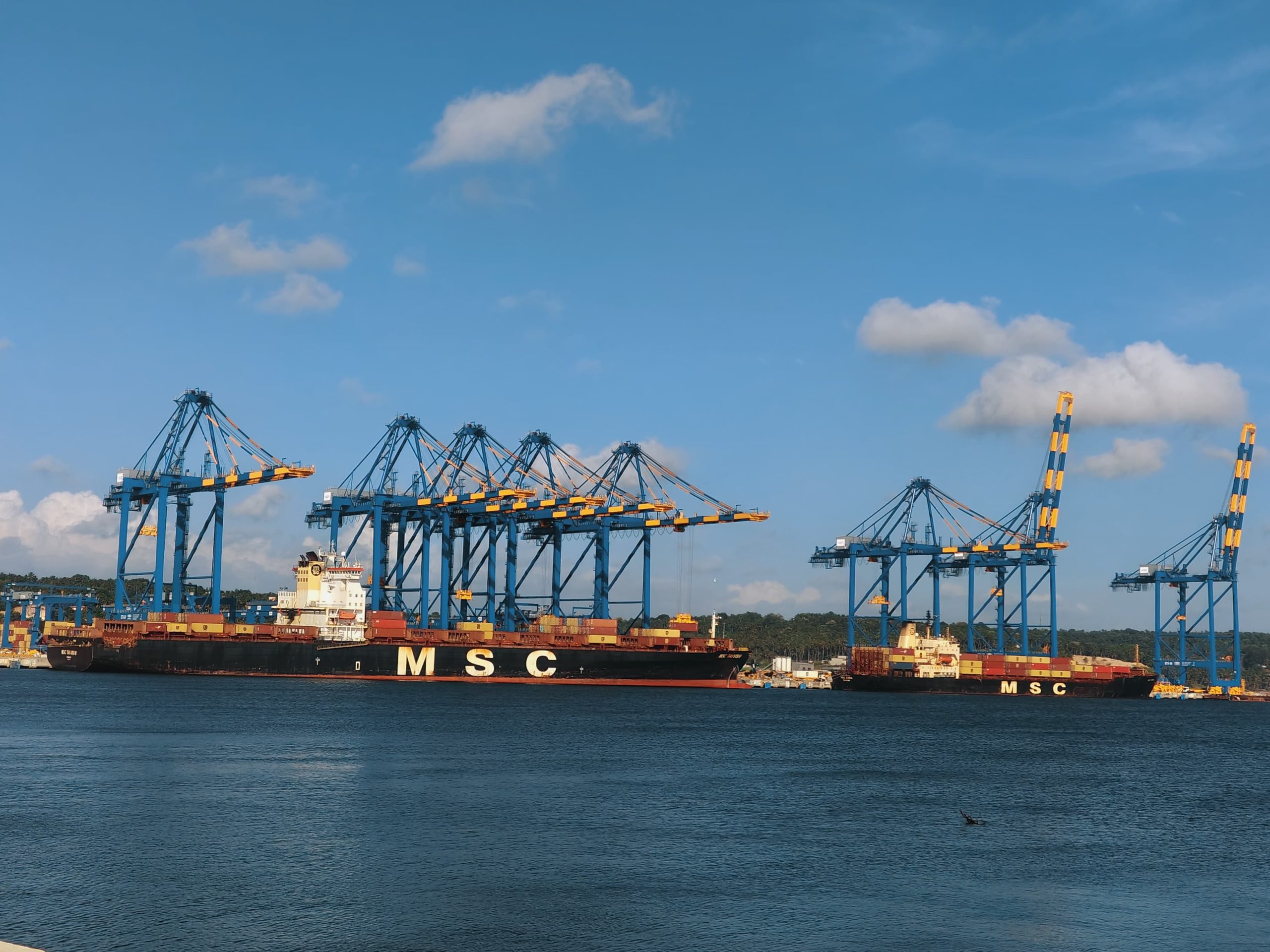
The fast-tracked expansion of Vizhinjam — covering Phases II, III, and IV — is one of the most ambitious port capacity moves undertaken in recent years. With a planned throughput of 5.7 million TEUs, a continuous 2-kilometre container berth, and the ability to handle 28,000-TEU ultra-large container vessels, Vizhinjam is being positioned not merely as another Indian port, but as a global transshipment contender.
As Minister Sonowal noted, the port’s rapid rise reflects “Hon’ble Prime Minister Shri Narendra Modi’s grand vision of exploring India’s vast maritime potential.” The numbers back that claim. Within weeks of commencing Phase I operations in December 2024, Vizhinjam handled over 1.43 million TEUs — operating at more than 130% of its designed capacity.
Yet beyond scale and speed lies a deeper question: will Vizhinjam finally allow India to reclaim control over its container transshipment flows — and will the benefits extend beyond the port gates?
Why Vizhinjam Matters More Than Any Other Port Right Now
India has long paid a strategic and economic penalty for outsourcing transshipment to foreign hubs such as Colombo, Singapore, and Port Klang. Nearly 70% of India’s containerised cargo has historically been transshipped outside the country, exposing trade to geopolitical risks, congestion, currency volatility, and rising feeder costs.
Vizhinjam directly challenges that dependence.
Its natural deep draft, proximity to east–west shipping lanes, and minimal deviation time give it a geographic advantage unmatched by most Indian ports. More importantly, it has already secured direct connectivity with major global routes across Europe, Africa, the Americas, and the Far East — a prerequisite for serious transshipment relevance.
For India’s trade strategy, Vizhinjam is not incremental infrastructure. It is strategic infrastructure.
Who Benefits Immediately
The most immediate winners are India’s containerised exporters and importers.
Reduced feeder dependence lowers overall logistics costs, improves schedule reliability, and cuts transit time — critical advantages for manufacturers operating on tight global delivery windows. Sectors such as electronics, chemicals, textiles, automotive components, and pharmaceuticals stand to gain disproportionately.
Shipping lines also benefit. The ability to deploy ultra-large container vessels at an Indian hub improves network efficiency and lowers per-unit costs. This explains why Vizhinjam’s capacity utilisation surged so quickly after Phase I operations began.
Kerala’s economy gains as well. As Chief Minister Pinarayi Vijayan pointed out, Vizhinjam is already serving Indian container ports as a transshipment node, and Phase II could elevate it into a global hub spanning Asia, Europe, Africa, and the Americas. Port-led development, logistics services, and maritime employment will follow.
Who May Still Miss Out
However, transshipment success does not automatically translate into inclusive maritime growth.
Smaller exporters, especially MSMEs, may not immediately feel the benefits unless last-mile connectivity, pricing transparency, and simplified port access are addressed. Without aggregation mechanisms, smaller cargo owners often lack bargaining power with shipping lines and terminal operators.
Regional imbalance is another risk. Vizhinjam’s rise could concentrate container flows along the southern coast unless hinterland rail and road connectivity to manufacturing clusters across Tamil Nadu, Karnataka, Telangana, and beyond keeps pace.
There is also the question of coastal communities. Large port expansions can strain local ecosystems and livelihoods if environmental and social safeguards are not continuously enforced.
Trade Competitiveness: India’s Transshipment Breakout Test
From a trade lens, Vizhinjam’s expansion is about control, credibility, and capacity.
Control — by retaining Indian cargo within Indian ports.
Credibility — by proving India can handle next-generation vessels at scale.
Capacity — by matching global hubs, not merely serving as a feeder alternative.
If Vizhinjam consistently delivers high productivity, quick turnaround, and competitive pricing, India’s exporters could gain a structural edge. If not, shipping lines will revert to established foreign hubs despite nationalist ambitions.
This is where execution matters more than vision.
Sagarmala, Maritime Vision 2030 & Amrit Kaal Alignment
Vizhinjam is one of the clearest manifestations of India’s port-led development strategy under Sagarmala, Maritime Vision 2030, and Amrit Kaal Vision 2047.
But alignment on paper must translate into coordination on the ground.
Port capacity alone will not reduce logistics costs unless inland connectivity, customs efficiency, digital port systems, and multimodal integration move in lockstep. The real test will be whether Vizhinjam becomes seamlessly embedded into PM Gati Shakti’s integrated planning framework rather than operating as a standalone mega-asset.
This is also where Sagarmala Finance Corporation Limited (SMFCL) could become relevant — by financing port-linked logistics parks, rail sidings, coastal shipping assets, and MSME participation in maritime supply chains.
Rail, Coastal Shipping & Climate Implications
Vizhinjam’s rise has implications beyond trade — it reshapes India’s logistics emissions profile.
Consolidating transshipment domestically reduces feeder voyages to foreign ports, cutting fuel consumption and emissions. If paired with stronger rail evacuation and coastal shipping, Vizhinjam could become a low-emissions logistics hub by design.
In an era where ESG compliance increasingly influences cargo routing decisions, this matters. Ports that help shipping lines reduce Scope-3 emissions will attract premium cargo and long-term commitments.
Capital Markets Signal: Why Investors Are Watching Closely
The ₹16,000 crore investment envelope — including ₹7,398 crore for expansion — sends a powerful signal to global capital markets.
Vizhinjam demonstrates that India is willing to back long-gestation maritime assets with policy support, contractual certainty, and accelerated timelines. Advancing completion by nearly 17 years under a supplementary concession agreement is not routine — it reflects strategic urgency.
For investors, the message is clear: India is serious about ports as national economic infrastructure, not just state-level projects.
What Must Change to Lock in Long-Term Gains
To ensure Vizhinjam becomes a national asset rather than a regional success story, several priorities are critical:
- Hinterland connectivity must scale as fast as berth capacity
- Transparent tariff structures are essential to attract diverse cargo owners
- Customs and digital processes must remain globally competitive
- Environmental and social safeguards must be actively enforced
- MSME and exporter access must be intentionally designed, not assumed
Without these, capacity risks outpacing utilisation quality.
A Defining Moment for India’s Maritime Ambition
Vizhinjam’s fast-tracked expansion is one of the boldest bets India has made in global maritime trade. It reflects confidence, urgency, and strategic intent.
As Minister Sonowal observed, Kerala is well positioned to shape India’s maritime future. But Vizhinjam’s true legacy will be measured not just in TEUs handled or vessels berthed — but in whether it permanently alters India’s position in global shipping networks.
If executed well, Vizhinjam could mark the moment India stopped exporting its transshipment advantage — and started owning it.