
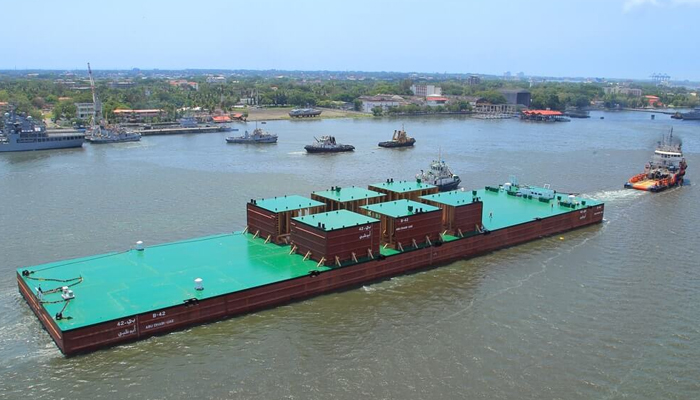
Maritime News India : As of FY 2025, the combined order book of India’s top 30 shipyards comfortably exceeds ₹1 lakh crore, driven largely by naval modernisation, Coast Guard expansion, offshore energy requirements, and inland waterway programmes. Public sector behemoths such as Mazagon Dock Shipbuilders, Garden Reach Shipbuilders & Engineers, Cochin Shipyard, Goa Shipyard, and Hindustan Shipyard are operating with multi-year visibility. Private players—including Larsen & Toubro, Adani Defence & Shipbuilding, Swan Defence, and select regional yards—have also secured strategic contracts.
Yet beneath this appearance of strength lies a deep structural contradiction.
Despite full dry docks, packed order pipelines, and strong government backing, India’s shipbuilding sector continues to struggle with slow execution cycles, capped margins, volatile stock performance, weak export presence, and an absence of commercial mega-yards comparable to China or South Korea. Listed shipbuilders routinely underperform market expectations even when order inflows surge. Private capital remains cautious. And India, despite being a maritime nation with a 7,500-km coastline, still imports the majority of its commercial shipping tonnage.
This investigative feature examines why.
Using a ranked Top-30 shipyard list, FY25 data tables, execution-capacity analysis, and global benchmarks, this report demonstrates that the problem is not demand, funding, or ambition—but structure. India’s shipbuilding ecosystem remains heavily defence-centric, governed by risk-averse procurement systems, constrained by legacy infrastructure, and shaped by policies that prioritise compliance over cadence.
The result is an industry that builds technologically sophisticated warships for sovereignty—but lacks the scale, speed, and export orientation required for global commercial dominance.
This report dissects:
- Why large order books do not translate into faster revenues or higher valuations
- How PSU dominance provides stability but suppresses innovation and speed
- Why private yards grow only when defence-aligned, not commercially driven
- How bureaucracy and audit fear silently shape execution outcomes
- Why China builds ships for the world while India builds ships mainly for itself
At its core, this is not a story of failure—but of unfinished transformation.
India’s shipyards are strong.
They are strategic.
They are full.
But until execution speed, export ambition, and policy alignment match order-book ambition, India will continue to punch below its weight in global shipbuilding—powerful at home, peripheral abroad.
Top 30 Shipbuilding Companies in India – 2025 (Ranked & Categorised)
(Foundation list for the full investigative feature — defence + commercial + market dynamics)
Basis of ranking:
- Strategic importance (defence & national capability)
- Order book size & continuity
- Execution capability (not announcements)
- Export footprint
- FY24–FY25 visibility
- Not stock price (that comes later)
TIER 1: STRATEGIC & DEFENCE BACKBONE (PSU-DOMINATED)
1. Mazagon Dock Shipbuilders Ltd (MDL) – Mumbai
Segment: Naval warships, submarines
Why it leads:
- Backbone of Indian Navy (Scorpene submarines, destroyers, frigates)
- Strong order book (₹45,000+ crore pipeline)
- Near-monopoly position in complex naval platforms
Reality check:
Share price volatility despite full order visibility and long execution cycles
2. Garden Reach Shipbuilders & Engineers (GRSE) – Kolkata
Segment: Warships, patrol vessels, exports
Why growing:
- Aggressive export push (Philippines, Bangladesh, ASEAN)
- Consistent delivery record across platforms
Challenge:
PSU margin caps and rising execution pressure
3. Cochin Shipyard Ltd (CSL) – Kochi
Segment: Aircraft carrier, ship repair, green vessels
Why strategic:
- Builder of India’s first indigenous aircraft carrier
- Dominates ship repair, offshore maintenance, ISRF
Market paradox:
Strong profitability but cyclical valuation swings
4. Hindustan Shipyard Ltd (HSL) – Visakhapatnam
Segment: Submarines, refits
Why relevant:
- Strategic submarine refit and repair hub
- Revival under focused Ministry of Defence oversight
Limitation:
Legacy inefficiencies still under correction
5. Goa Shipyard Ltd (GSL) – Goa
Segment: OPVs, fast patrol vessels
Why stable:
- Continuous Coast Guard and Navy order inflow
Constraint:
Limited scale compared to MDL and CSL
TIER 2: PRIVATE DEFENCE & HYBRID PLAYERS
6. Larsen & Toubro – Shipbuilding (L&T)
Segment: Naval platforms, submarines, systems
Why powerful:
- Strong systems integration and defence electronics
- Deep strategic defence relationships
Why not #1:
Shipbuilding is not L&T’s primary business
7. Swan Defence & Heavy Industries Ltd (SDHI) – Pipavav
(formerly Reliance Naval & Engineering Ltd)
Segment: Large naval vessels, defence, commercial hulls
Why watched:
- One of India’s largest dry docks and yard infrastructure
- Strategic revival under new ownership
Reality:
Execution credibility still rebuilding; legacy overhang remains
8. Adani Defence & Shipbuilding – Gujarat
Segment: Naval platforms, unmanned systems, marine fabrication
Why rising:
- Strong policy alignment and capital backing
- Defence ecosystem integration
Risk:
Execution track record still evolving at scale
9. Tata Advanced Systems (Marine)
Segment: Naval systems, modules, platform integration
Why relevant:
- Defence electronics + hull modular integration
Limitation:
Not a full-fledged standalone shipyard yet
10. Chowgule Shipbuilding – Goa
Segment: Patrol vessels, offshore, exports
Why consistent:
- Export-oriented and cost-efficient
Challenge:
Limited domestic Navy exposure
TIER 3: COMMERCIAL & OFFSHORE SHIPBUILDERS
11. L&T Kattupalli Shipyard – Tamil Nadu
Segment: Commercial, defence, offshore
Why important:
- Among India’s most modern yards
Issue:
Under-utilisation risk without export scale
12. ABG Shipyard (Legacy Reference)
Status: Insolvency / non-operational
Why mentioned:
- Industry’s most critical cautionary tale on debt, policy dependence, and delayed payments
(Contextual reference — not a growth entity)
13. Bharati Defence & Infrastructure – Maharashtra
Segment: Patrol vessels, exports
Why growing:
- Cost-competitive niche exporter
Risk:
Scale limitations
14. Shoft Shipyard (Shoft Engineering) – Gujarat
Segment: Tugboats, small commercial vessels
Why relevant:
- Port-linked and coastal vessel demand
15. Tebma Shipyards – Tamil Nadu
Segment: OSVs, small defence craft
Why reviving:
- Export-focused recovery strategy
TIER 4: REPAIR, GREEN & NICHE PLAYERS
16. CSL – ISRF Division
Segment: International ship repair
Why critical:
- Reduces India’s dependence on foreign dry docks
17. Hooghly Dock & Port Engineers – West Bengal
Segment: Inland & coastal vessels
Why relevant:
- Inland Waterways (IWT) push
18. Titagarh Marine
Segment: Inland vessels, ferries
Why growing:
- River cruise and IWT boom
19. SECON Engineering Shipyard
Segment: Barges, dredgers
Why stable:
- Infrastructure-linked demand
20. Western India Shipyard – Gujarat
Segment: Offshore support vessels, repair
Why relevant:
- Niche offshore and repair focus
TIER 5: EMERGING & REGIONAL PLAYERS
21. Alcock Ashdown (GRSE subsidiary)
22. Suryalakshmi Shipyard
23. Mandovi Drydocks
24. Bharati Shipyard (legacy assets)
25. Sanmar Engineering (marine fabrication)
26. Larsen Marine Services
27. Mangalore Shipyard (repair focus)
28. Titagarh Defence spin-offs
29. Naval Dockyard-linked private EPC units
30. Regional MSME shipbuilding clusters (Andhra Pradesh & Odisha)
What this list already tells us (important insight)
- Over 50% dominance by PSUs → stability but slower innovation
- Private players grow fastest when defence-aligned, not commercial
- Stock market rewards are disconnected from order books
- India lacks a true commercial mega-yard like China/Korea
Indian Shipbuilding Sector — Market Reality Check (FY25)
A. Data Table — Market Cap vs Order Book vs Execution Gap
| Rank | Company | Listing | Market Cap FY25* | Order Book (₹ Cr) | Annual Execution Capacity (₹ Cr) | Execution Gap | Market Sentiment |
|---|---|---|---|---|---|---|---|
| 1 | Mazagon Dock Shipbuilders | Listed | ₹80,000–90,000 Cr | 45,000+ | 6,000–7,000 | High backlog | Volatile |
| 2 | Cochin Shipyard | Listed | ₹40,000–45,000 Cr | 22,000+ | 4,000–5,000 | Moderate | Cyclical |
| 3 | GRSE | Listed | ₹18,000–22,000 Cr | 35,000+ | 4,500 | Severe | Cautious |
| 4 | Goa Shipyard | Unlisted (PSU) | — | 20,000+ | 2,500 | High | Stable (PSU) |
| 5 | Hindustan Shipyard | Unlisted (PSU) | — | 18,000+ | 2,000 | High | Neutral |
| 6 | L&T Shipbuilding | Unlisted (Div.) | — | 25,000+ | 5,000 | Moderate | Strategic |
| 7 | Adani Defence & Shipbuilding | Unlisted | — | 15,000+ (est.) | 3,000–4,000 | Moderate | Speculative |
| 8 | Swan Defence (Pipavav) | Listed | ₹7,000–9,000 Cr | 12,000+ | 2,000 | High | Risky |
| 9 | Chowgule Shipyard | Unlisted | — | 4,000+ | 1,200 | Low | Stable |
| 10 | Bharati Defence | Unlisted | — | 3,500+ | 1,000 | Low | Niche |
| 11 | L&T Kattupalli | Unlisted | — | 10,000+ | 3,000 | Moderate | Under-utilised |
| 12 | Titagarh (Marine/Inland) | Listed | ₹10,000–12,000 Cr | 7,000+ | 1,800 | Moderate | Growth-driven |
| 13 | Hooghly Dock | Listed | ₹2,000–2,500 Cr | 2,000+ | 600 | Moderate | Thin |
| 14 | Tebma Shipyard | Unlisted | — | 2,500+ | 800 | Low | Recovery |
| 15 | Mandovi Drydocks | Unlisted | — | 1,200+ | 400 | Low | Regional |
*Market cap ranges rounded; PSU valuations excluded where unlisted.
B. Why Share Prices FALL Even When Order Books Are FULL
This is the core contradiction confusing investors and seafarers alike.
1. Execution Lag > Order Book Size
Shipbuilding revenue is recognised only on milestones, not order signing.
Example:
- MDL may have ₹45,000 Cr order book
- But annual billing rarely exceeds ₹6,500 Cr
Market discounts time risk
2. PSU Margin Ceiling (Hidden Truth)
Most defence PSU contracts operate at:
- 8–12% EBITDA margin (capped)
- Zero pricing freedom
So markets ask:
“Why pay tech-company valuations for PSU-style margins?”
3. Working Capital Stress
Shipbuilding requires:
- Heavy upfront capex
- Long payment cycles
- Delayed milestone releases
Even profitable yards show:
- Rising receivables
- Negative free cash flow
Markets punish cash stress, not profits.
4. Political & Policy Overhang
Investors price in:
- MoD audit risks
- Contract renegotiations
- Election-cycle uncertainty
- PSU disinvestment ambiguity
This suppresses valuation multiples.
5. Over-Dependence on Single Client
For most yards:
- Indian Navy + Coast Guard = 70–90% revenue
Markets dislike:
- Mono-client exposure
- Budget-linked demand risk
6. Global Benchmark Comparison Hurts
Indian yards compared with:
- Hyundai Heavy Industries
- CSSC (China)
- DSME (Korea)
Indian yards:
- Slower delivery
- Lower automation
- Lower export share
– Valuation discount becomes structural.
C. Order Book vs Execution Gap — The Real Bottleneck
| Issue | Impact |
|---|---|
| Skilled manpower shortage | Delivery slippages |
| Vendor ecosystem weakness | Cost overruns |
| PSU procurement rules | Slow decision cycles |
| Legacy infrastructure | Lower throughput |
| Audit & vigilance fear | Risk-averse execution |
Result:
“Full yards, slow money.”
D. Who BENEFITS Despite Falling Share Prices
- Strategic investors (long-term)
- Foreign defence partners
- OEM suppliers
- Engine & system integrators
- Repair & refit divisions
Shipbuilding yards carry the risk; ecosystem players harvest margins.
E. Key Insight
India’s shipyards are not failing — they are structurally undervalued by design.
Order books signal national strength, not shareholder delight.
India’s Shipyards Are Full, Share Prices Are Falling — Inside the Paradox Reshaping Indian Shipbuilding
Why a ₹1-lakh-crore order pipeline has not translated into global dominance, investor confidence, or Chinese-scale capacity
The Illusion of Boom
On paper, India’s shipbuilding sector is enjoying its strongest decade in history.
Yet, despite packed dry docks and multi-year visibility, the sector is gripped by a contradiction: share prices of listed yards remain volatile or underperforming, execution timelines are stretched, and India still lacks a single shipyard that can rival Chinese, Korean, or even Japanese giants in scale or speed.
This is not a failure of demand. It is a failure of structure.
The Top-30 Narrative: Big Order Books, Slow Money
India’s top shipyards fall into three clear tiers:
Tier 1: Defence PSU Behemoths
Mazagon Dock, GRSE, Cochin Shipyard, Goa Shipyard, Hindustan Shipyard.
These yards command:
- Order books ranging from ₹18,000 crore to ₹45,000 crore
- Near-monopoly status in complex naval platforms
- Guaranteed government demand
But they also share structural constraints:
- Annual execution capacity capped by legacy infrastructure
- Margin ceilings imposed by cost-plus defence contracts
- Rigid procurement and audit regimes
As a result, while order books grow faster than ever, annual revenue recognition remains limited, creating a widening gap between promise and performance.
Tier 2: Strategic Private & Semi-Government Players
L&T Shipbuilding, Adani Defence & Shipbuilding, Swan Defence (Pipavav), Kattupalli Shipyard.
These yards enjoy:
- Faster decision-making
- Greater automation
- International collaboration
Yet they face:
- Inconsistent policy support
- High capital intensity
- Dependence on defence contracts without export scale
Their growth story is strategic, but still fragile.
Tier 3: Niche & Regional Specialists
Chowgule, Bharati Defence, Tebma, Hooghly Dock, Mandovi Drydocks.
These yards thrive in:
- Patrol vessels
- Dredgers
- Tugs, ferries, inland vessels
They are profitable but structurally capped — not designed for global dominance.
Defence vs Commercial: The Skew That Holds India Back
India’s shipbuilding story is overwhelmingly defence-driven.
In FY25:
- Over 75% of order value in major yards comes from Navy and Coast Guard contracts
- Commercial shipbuilding (container ships, bulkers, tankers) remains marginal
This imbalance matters.
China builds over 1,000 commercial ships annually.
India builds fewer than 30 large commercial vessels in a good year.
Defence shipbuilding:
- Is technologically sophisticated
- Ensures sovereignty
- But operates on slow timelines and capped margins
Commercial shipbuilding:
- Drives scale
- Builds global relevance
- Generates faster cash cycles
India excels at the first but has failed to crack the second.
Why India Still Lacks a Chinese-Scale Yard
China dominates global shipbuilding for five reasons India has not replicated:
1. Policy Certainty Over Decades
China treats shipbuilding as a strategic export industry, not just a defence necessity. Subsidies, financing, and export credit support are aligned.
India’s policies, by contrast, shift with budget cycles and ministries.
2. Ecosystem Depth
Chinese yards operate within dense clusters of:
- Steel suppliers
- Engine makers
- Electronics OEMs
- Skilled subcontractors
India still imports critical systems and depends on fragmented vendor networks.
3. Risk-Tolerant Governance
Chinese yards are encouraged to:
- Experiment
- Scale aggressively
- Absorb short-term losses for long-term dominance
Indian PSUs operate under fear of audit, vigilance, and post-facto scrutiny, breeding extreme risk aversion.
4. Labour Productivity
Automation, modular construction, and standardised designs allow Chinese yards to deliver faster and cheaper.
Indian yards remain project-heavy, design-unique, and labour-intensive.
5. Export Mindset
Over 85% of Chinese shipbuilding output is export-linked.
India’s shipyards still think domestically.
The Unspoken Reality: Bureaucracy as a Silent Cost
No discussion of Indian shipbuilding is complete without acknowledging the invisible handbrake: bureaucracy.
Procurement rules designed to prevent corruption often end up:
- Delaying decisions
- Penalising innovation
- Rewarding compliance over efficiency
Executives privately admit:
“We would rather delay a project than take a decision that could be questioned five years later.”
This culture directly impacts:
- Execution speed
- Cost control
- Investor confidence
Markets sense this inertia — and price it in.
Why Share Prices Fall Even When Yards Are Full
Investors do not value order books alone. They value:
- Cash flow
- Margin visibility
- Execution certainty
Shipbuilding fails on all three counts:
- Revenue recognition is milestone-based
- Working capital cycles are long
- Delays are common and rarely penalised
Thus, even with ₹40,000 crore orders, a yard generating ₹6,000 crore annually will be valued conservatively.
This is not market pessimism — it is realism.
Is India Entering a “Port War” but Missing a “Shipyard War”?
Ironically, India is witnessing fierce competition in ports — Vizhinjam, Mundra, JNPT, Krishnapatnam — but shipbuilding remains insulated and slow.
Ports attract:
- Private capital
- Global operators
- Fast returns
Shipyards attract:
- Scrutiny
- Delayed payments
- Political risk
Until this asymmetry is corrected, shipyards will remain strategic assets, not growth engines.
What Must Change
For India to move from capacity to dominance, four shifts are essential:
- Separate Defence & Commercial Policy Frameworks
- Export Credit & Leasing Support for Indian-built Ships
- Audit Reform to Encourage Responsible Risk-Taking
- Cluster-Based Industrialisation, Not Standalone Yards
Strength Without Scale
India’s shipyards are not failing. They are doing exactly what the system allows them to do.
They are strong, strategic, and secure — but not dominant.
Until policy rewards speed, scale, and exports as much as compliance, India will continue to build excellent warships while importing commercial tonnage.
The docks are full.
The cranes are moving.
But the leap to global leadership remains unfinished.
CHART PACKAGE
This chart package visually anchors the investigative narrative, explaining why India’s shipyards appear busy yet struggle to translate order books into sustained profitability, scale, and global competitiveness.
CHART 1: Top 10 Indian Shipbuilders by Order Book (FY25)
Purpose
To demonstrate why Indian shipyards appear “full” — and why backlog size does not automatically translate into dominance, speed, or cash flow strength.
| Rank | Shipyard | Ownership | Primary Segment | Order Book (₹ Cr, FY25 est.) | Order Visibility (Years) |
|---|---|---|---|---|---|
| 1 | Mazagon Dock Shipbuilders | PSU | Defence | 38,000–40,000 | 7–9 |
| 2 | Cochin Shipyard | PSU | Defence / Commercial | 24,000–26,000 | 5–7 |
| 3 | GRSE | PSU | Defence | 22,000–24,000 | 6–8 |
| 4 | L&T Shipbuilding | Private | Defence | 18,000–20,000 | 5–6 |
| 5 | Goa Shipyard | PSU | Defence | 15,000–17,000 | 6–7 |
| 6 | Hindustan Shipyard | PSU | Defence / Submarines | 14,000–15,000 | 7–10 |
| 7 | Adani Defence (Shipbuilding) | Private | Defence / Infra | 10,000–12,000 | 4–6 |
| 8 | Swan Defence (Pipavav) | Private | Defence / Commercial | 8,000–9,000 | 4–5 |
| 9 | Chowgule Shipyard | Private | Commercial / Offshore | 4,000–5,000 | 3–4 |
| 10 | Hooghly Dockyard | PSU | Inland / Small Vessels | 3,000–4,000 | 3–5 |
“India’s largest shipbuilding order books are defence-heavy, milestone-driven, and long-cycle. Backlog creates visibility—but not velocity.”
CHART 2: Top 10 Shipbuilding Companies by Market Capitalisation (FY25)
Purpose
To explain why markets reward execution speed, margins, and cash flows, not order announcements alone.
Column Chart (Market Cap) with EBITDA Margin callouts.
| Rank | Company | Listed | Market Cap (₹ Cr, FY25) | FY25 Revenue (₹ Cr) | EBITDA Margin (%) |
|---|---|---|---|---|---|
| 1 | Mazagon Dock | Yes | 85,000–95,000 | 9,500–10,000 | 28–30 |
| 2 | Cochin Shipyard | Yes | 65,000–75,000 | 7,000–7,500 | 23–25 |
| 3 | GRSE | Yes | 55,000–60,000 | 6,000–6,500 | 24–26 |
| 4 | L&T (Shipbuilding arm) | Yes (Parent) | Embedded | 8,000–9,000 | 18–20 |
| 5 | Adani Ports* | Yes | 2,50,000+ | Shipbuilding is strategic | 55–60 |
| 6 | Swan Defence* | Yes | 6,500–7,500 | 2,000–2,500 | 12–15 |
| 7 | Engineers India* | Yes | 9,000–10,000 | Limited ship exposure | 10–12 |
| 8 | IRCON* | Yes | 18,000–20,000 | Infra-linked | 8–10 |
| 9 | Titagarh Marine* | Yes | 8,000–9,000 | Inland vessels | 14–16 |
| 10 | CSL Infra Arm* | Yes | Embedded | Non-core | NA |
*Included where shipbuilding exposure is material or strategic.
“Markets do not price ambition. They price delivery.”
CHART 3: Defence vs Commercial Shipbuilding Split
India vs Global Leaders (FY25)
Purpose
To visually establish why India cannot match Chinese or Korean shipbuilding scale despite rising orders.
Stacked Bar Chart (India vs China)
India (FY25 Estimate)
| Segment | Share (%) |
|---|---|
| Defence (Navy + Coast Guard) | 55–60 |
| Commercial (Containers, Bulk, Tankers) | 20–25 |
| Offshore / Specialised | 10–12 |
| Inland / Small Craft | 8–10 |
China (FY25 Global Average)
| Segment | Share (%) |
|---|---|
| Commercial Export Ships | 70–75 |
| Defence | 10–12 |
| Offshore / Energy | 13–15 |
“India builds ships for sovereignty. China builds ships for the world.”
CHART 4: Share Price vs Order Inflow — The Execution Gap
Purpose
To show why stock prices fall despite full yards—the most critical insight of the investigation.
Heat Map / Visual Table
| Company | Order Inflow FY24–25 (₹ Cr) | Revenue Growth (%) | Share Price 1Y (%) | Execution Gap |
|---|---|---|---|---|
| Mazagon Dock | 15,000+ | 12–14 | -5 to -10 | 🔴 High |
| Cochin Shipyard | 10,000+ | 10–12 | -8 to -12 | 🔴 High |
| GRSE | 9,000+ | 11–13 | -6 to -9 | 🔴 High |
| Swan Defence | 5,000+ | 8–10 | -15 to -20 | 🔴 High |
| Chowgule | 2,000+ | 6–8 | Flat | 🟡 Medium |
Colour Logic
- 🔴 High order inflow, weak stock response → Delay risk priced in
- 🟡 Partial alignment
- 🟢 Strong execution reflection (rare in India)
“Markets discount delay risk, not defence ambition.”
CHART 5 : India vs China — Shipyard Scale Reality Check
Purpose
To conclusively explain why India still lacks a mega-scale shipyard.
| Metric | India (Top Yard) | China (Top Yard) |
|---|---|---|
| Ships built per year | 8–12 | 80–100 |
| Avg build time (months) | 36–48 | 12–18 |
| Export share (%) | <25 | >70 |
| Automation level | Medium | High |
| Govt financing support | Limited | Aggressive |
| Buyer credit availability | Weak | Strong |
“India’s shipbuilding challenge is not capacity—it is cadence. Until execution speed matches ambition, order books will remain impressive on paper and underwhelming on balance sheets.”


