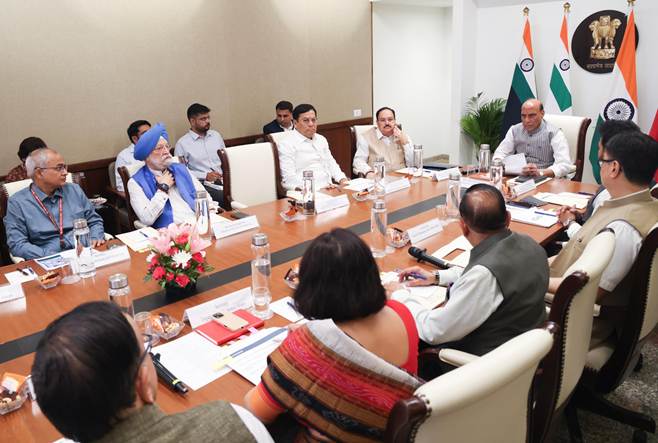
Maritime news, Delhi, India: As tensions continue to escalate in West Asia, the Government of India has intensified monitoring of maritime trade routes, fuel reserves and supply chains, while assuring citizens that the country remains adequately prepared to handle any prolonged geopolitical disruption.
At the fifth meeting of the Informal Group of Ministers (IGoM) on West Asia, chaired by Defence Minister Rajnath Singh, the government reviewed India’s preparedness to minimise the impact of the conflict on energy security, maritime trade and the domestic economy.
The meeting brought together senior ministers including Sarbananda Sonowal, Hardeep Singh Puri, Ashwini Vaishnaw and JP Nadda, reflecting the government’s whole-of-government approach toward the evolving regional crisis.
India Holds 60-Day Crude Oil and Natural Gas Reserves
Officials informed the ministers that India currently maintains:
- 60 days of crude oil reserves
- 60 days of natural gas reserves
- 45 days of LPG rolling stock
The government also highlighted that India’s foreign exchange reserves remain strong at approximately $703 billion, providing additional economic stability during the ongoing geopolitical uncertainty.
India, currently the world’s third-largest oil refiner and fourth-largest exporter of petroleum products, exports fuel products to more than 150 countries while continuing to meet domestic demand.
Maritime Trade Routes Remain a Strategic Priority
Defence Minister Rajnath Singh stressed that India’s immediate priority is to ensure:
- uninterrupted energy flows
- stable economic activity
- secure maritime trade routes
The statement comes at a time when commercial shipping lanes across the Strait of Hormuz and the Gulf region are witnessing increasing security concerns, vessel attacks and operational disruptions.
The government has directed all stakeholders to remain vigilant as geopolitical tensions continue to impact global shipping and energy markets.
Oil Companies Absorbing Massive Losses
Despite rising international crude prices, India has managed to maintain stable domestic fuel prices for more than 70 days since the conflict escalated.
Officials revealed that Indian oil marketing companies are currently absorbing losses of nearly:
- ₹1,000 crore per day
- with total under-recoveries approaching ₹2 lakh crore in Q1 2026
The government said these measures were aimed at protecting Indian consumers from the global price surge.
In several countries, fuel prices have reportedly increased by 30 to 70 percent during the same period.
Government Appeals for Fuel Conservation
Prime Minister Narendra Modi has appealed to citizens to reduce unnecessary fuel consumption and adopt conservation measures.
The government urged citizens to:
- use public transport and carpooling
- reduce non-essential foreign travel
- prioritise domestic tourism
- avoid unnecessary fuel wastage
Officials said the conservation efforts are intended not only for the current crisis but also for long-term national energy resilience.
Fertiliser and Supply Chain Position Stable
The IGoM was also informed that essential commodity supplies and fertiliser stocks remain stable.
As of May 11, 2026, India’s total fertiliser stock stood at approximately 199.65 lakh tonnes, significantly higher than the 178.58 lakh tonnes recorded during the same period last year.
For the upcoming Kharif 2026 season, current stock levels already account for more than 51 percent of projected demand, compared to the usual preparedness level of around 33 percent.
The government attributed the improved position to better logistics management and advance planning.
Strategic Preparedness Beyond the Current Conflict
Rajnath Singh emphasised that the West Asia conflict should not be viewed as an isolated regional issue, warning that global crises increasingly affect interconnected economies and maritime trade systems.
He called for:
- strategic crisis anticipation
- early warning assessments
- scenario planning
- stronger national preparedness systems
The government also highlighted efforts to accelerate renewable energy adoption, diversify energy supplies and improve long-term energy security infrastructure.
Industry Relief Measures Announced
To support businesses affected by the crisis, the Union Cabinet recently approved the Emergency Credit Line Guarantee Scheme (ECLGS) 5.0, aimed at facilitating an additional ₹2.55 lakh crore in credit flow for MSMEs, airlines and industry sectors.
The Finance Ministry has also enabled force majeure-related relief measures in public procurement contracts due to the ongoing geopolitical situation.
Maritime Industry Closely Monitoring Gulf Developments
With commercial vessels increasingly facing operational disruptions in Gulf waters, maritime stakeholders continue to closely monitor developments across key shipping routes.
Industry analysts believe the evolving situation could have wider implications for:
- tanker movement
- container shipping
- energy trade
- marine insurance
- freight rates
- port operations
particularly across the Indian Ocean and Gulf shipping corridors.