A Safety Upgrade or an Elitist Purge?
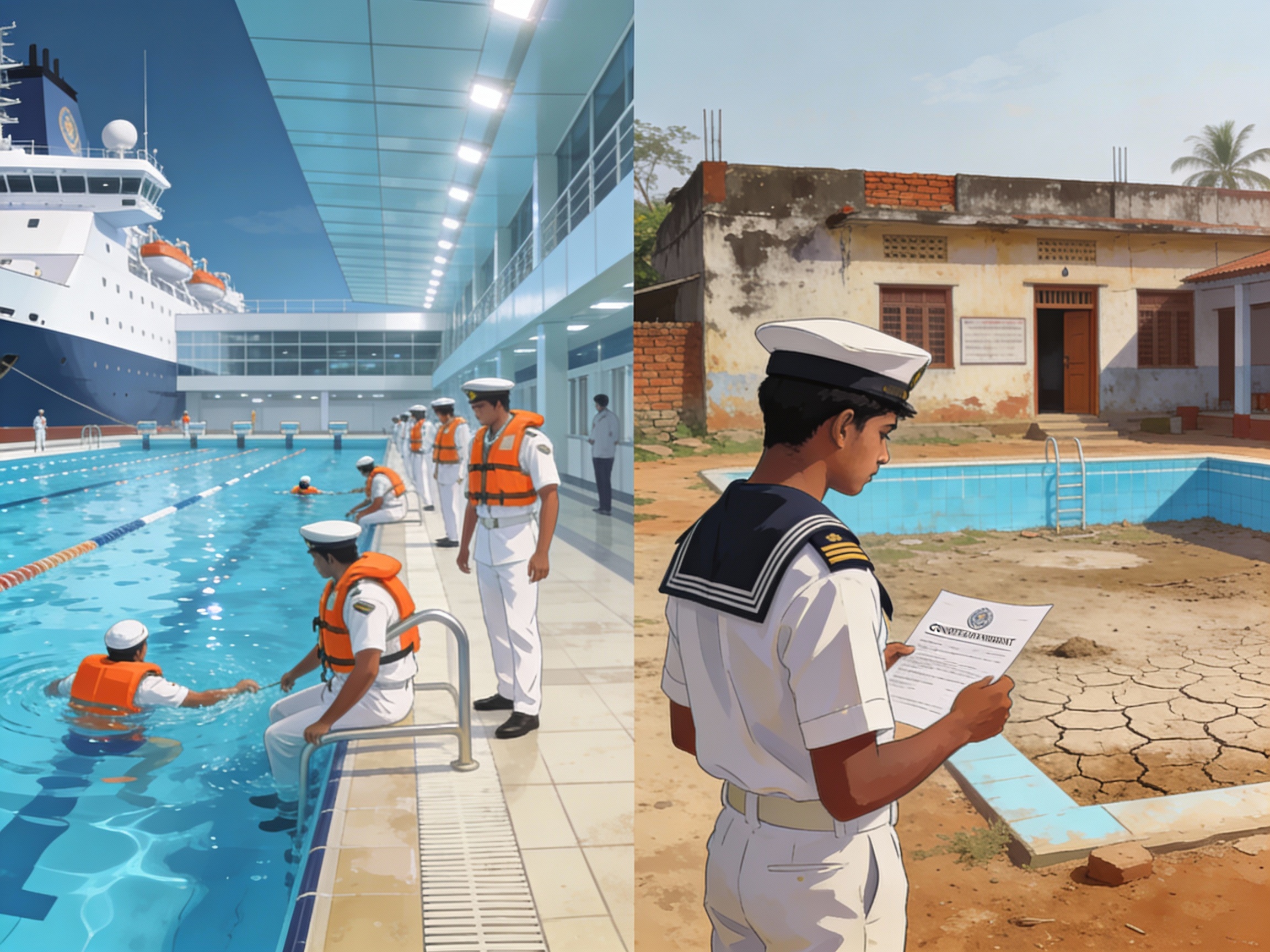
Maritime News India: On December 12 and 15, 2025, the Directorate General (DG) of Shipping issued a stringent Addendum to Training Circular No. 06 of 2025, mandating that all Maritime Training Institutes (MTIs) must own an on-campus swimming pool by January 1, 2026. This directive abolishes the previous “tie-up” system that allowed smaller institutes to share facilities. While the stated goal is to standardize safety training in compliance with the STCW Convention, the sudden enforcement and rigid “no-sharing” clause threaten to close dozens of small institutes. This move risks creating a “maritime caste system” where students from rural and economically weaker sections are priced out of a career at sea, reinforcing the criticism that the government often acts unilaterally without consulting vulnerable stakeholders.
1. History: A Legacy of Non-Compliance and Regulatory Inertia
The requirement for swimming pools is not new, but its enforcement has been historically erratic.
-
2018 Origins: DG Shipping Circulars No. 04 and 07 of 2018 first mandated that pre-sea institutes must have pools of specific dimensions (50ft x 30ft, varying depth 3-12ft).
-
Judicial Intervention: High Courts, such as the Madras High Court in 2020, have previously upheld these requirements, forcing individual institutes to comply or lose approval.wmu
-
The “Tie-up” Era: For seven years, the regulator allowed a “tie-up” system where institutes without pools could rent external facilities. This allowed smaller players to survive.
-
The 2025 Crackdown: The new Addendum (Circular No. 59/2025) explicitly ends this flexibility. After December 31, 2025, no tie-ups are permitted. The regulator admits implementation “has been lagging,” yet has chosen a “cliff-edge” deadline of January 2026 rather than a phased transition.westernmaritimetraining
2. Beneficiaries: Who Wins?
The policy shift creates a clear divide between winners and losers in the maritime ecosystem.
-
Large, Elite MTIs: Established institutes in metros (Mumbai, Chennai, Kochi) that already possess pools will see reduced competition as smaller rivals shut down. They will likely absorb the displaced student demand, potentially raising fees.
-
Pool Contractors & Suppliers: The mandate creates an immediate, desperate demand for pool construction, filtration systems, and maintenance contracts, estimated at ₹40–90 lakh per unit.legalbabu+1
-
DG Shipping Credibility: By enforcing strict infrastructure norms, the regulator aligns India with international standards, shielding itself from global audit criticisms (e.g., EMSA or IMO audits).
3. Challenges: The Justice Gap
The primary victims of this policy are those with the least resilience.
-
Small & Rural MTIs: Institutes in the hinterlands (Bihar, Odisha, interior Maharashtra) lack the capital (₹1-2 crore) and land to build semi-Olympic pools immediately. With the tie-up option removed, they face existential closure.legalbabu+1
-
Economically Weaker Students:
-
Cost Escalation: If local MTIs close, students must migrate to cities, incurring hostel and travel costs that push the total course expense above ₹2 lakh—unaffordable for families from fishing or farming backgrounds.
-
Access Denied: The ban on sharing facilities restricts access. A student in a landlocked state may lose their only nearby training center because it cannot afford a private pool.
-
-
Infrastructure Reality: The requirement to maintain a pool with 2.0 ppm chlorine and 24/7 filtration is operationally intensive. Many small institutes struggle with basic power and water supply, let alone maintaining “resort-standard” pools.westernmaritimetraining
4. Government Responsibility: Steps to Ensure Justice
To prevent this mandate from becoming an exclusionary tool, the government must intervene:
-
Infrastructure Subsidies: Instead of a bare mandate, the government should offer low-interest loans or grants to help small MTIs upgrade, similar to how other sectors receive “viability gap funding.”
-
Public Maritime Pools: The government should build shared, state-of-the-art “Maritime Training Hubs” in key clusters where multiple small MTIs can conduct training for a fee, rather than forcing every small college to dig its own pool.
-
Phased Extension: A grace period of 12–24 months should be granted to institutes that can prove they have secured land and funding, rather than the immediate cutoff in January 2026.
5. ESG Analysis
The policy has significant Environmental, Social, and Governance implications.
-
Environmental (High Risk): Mandating 100+ separate pools increases water consumption and chemical discharge (chlorine/pH regulators). A shared “hub” model would be far more water-efficient than hundreds of underutilized private pools.
-
Social (Negative Impact): The policy fails the inclusivity test. By raising entry barriers (costs and geography), it disproportionately impacts Scheduled Tribes (ST) and coastal communities who rely on low-cost local training. It threatens to homogenize the workforce to only those who can afford elite education.
-
Governance (Critical Failure): The sudden shift after years of lax oversight raises questions of “regulatory capture.” The lack of transparency in previous inspections—where only 127 of 176 MTIs were inspected—suggests a systemic failure. The “case-by-case” exception clause in the new circular is prone to opacity and potential favoritism.wmu+1
6. Global Case Studies: Inclusive Policies vs. Exclusion
To understand the gap in India’s approach, we look at global peers:
-
Philippines (MARINA): The Maritime Industry Authority (MARINA) explicitly allows the “sharing of facilities and equipment” provided it is documented in the course approval. This “Resource Sharing” model ensures that smaller training centers can operate legally by renting high-quality facilities, maintaining safety without destroying small businesses.stcw.marina+1
-
Singapore (MPA): The Maritime and Port Authority of Singapore supports the industry through the Maritime Cluster Fund (MCF) and MINT Fund, injecting millions (e.g., S$150M) into training infrastructure and development. Unlike India’s “pay or perish” model, Singapore actively subsidizes the cost of high-tech training infrastructure to maintain competitiveness.wmu
-
United Kingdom (MCA): Training providers often utilize specialized, dedicated survival centers (like those at fire service colleges or standalone survival centers) rather than every classroom provider being forced to build wet infrastructure on-site. This ensures high-quality training without redundant infrastructure.maritime.solent+1
7. Way Forward
The DG Shipping must recognize that Safety and Inclusivity are not mutually exclusive.
-
Adopt the “Hub-and-Spoke” Model: Allow small MTIs to formally “adopt” a government-certified shared pool within an 80km radius, similar to the Philippines model. This ensures safety compliance without capital redundancy.
-
Financial Support Mechanism: Utilize the welfare fund or industry levies to provide zero-interest infrastructure loans for pool construction in rural areas.
-
Transparent Audits: Before closing institutes, publish a transparent “compliance audit” of all institutes, including the elite ones, to ensure the law is applied equally and not just to cull the small players.
Conclusion:
Without these corrective steps, the Addendum will not just filter out “unsafe” institutes—it will filter out the poor. India’s maritime dream cannot be built by burning the bridge for its most aspiring, yet vulnerable, youth.
- https://commons.wmu.se/cgi/viewcontent.cgi?article=1009&context=imla2021
- https://westernmaritimetraining.co.uk/personal-survival-techniques/
- https://www.legalbabu.com/learn/dgs-guidelines-on-swimming-pool-standards-compliance-for-maritime-training-institutes/
- https://stcw.marina.gov.ph/wp-content/uploads/2016/02/Proposed-Revised-Circular-on-the-Accreditation-of-Training-Courses-as-of-19-Aug-2021.docx
- https://stcw.marina.gov.ph/wp-content/uploads/2016/02/PUBCON-Revised-Circular-on-the-Accreditation-of-MTIs-and-ACs_clean-copy.docx
- https://maritime.solent.ac.uk/courses/stcw-safety-and-security/personal-survival-techniques
- https://betadgs.dgshipping.gov.in/download/1758280343_68cd3a97be26a_202502060208444213926trainingcir-no6of2025-swmmingpool.pdf
- https://www.sailing.gi/mca-stcw-courses/mca-stcw-personal-survival-techniques/
- https://globalmaritimeforum.org/insight/national-and-regional-policy-for-green-shipping-corridors/
- https://www.oecd.org/content/dam/oecd/en/publications/reports/2019/10/maritime-subsidies_0a4dc90f/919d4222-en.pdf