A Logistics Breakthrough — If Inclusion Keeps Pace
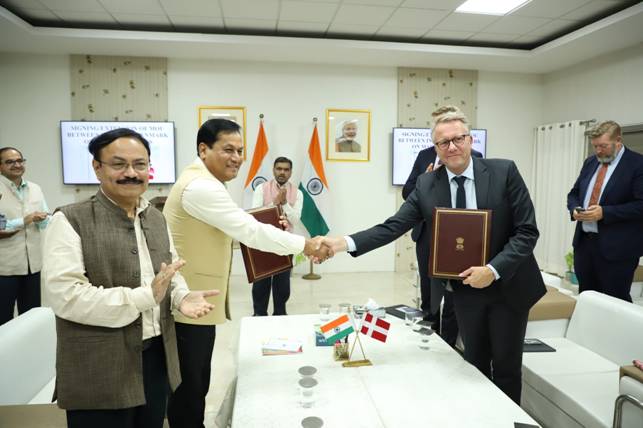
Maritime News, Madhya Pradesh, India: When DP World signed an agreement with the Government of Madhya Pradesh at Davos to develop the Powarkheda Logistics Composite Hub, it was framed as a major infrastructure milestone. On paper, it is exactly that: an 88-acre, rail-centric inland logistics gateway designed to cut transit times to Jawaharlal Nehru Port Authority (JNPA), strengthen export supply chains, and reduce post-harvest losses across Central India.
But beyond the ceremonial handshake and investment headlines, the Powarkheda hub represents something more consequential — a test of whether India’s next phase of logistics development can deliver inclusive trade competitiveness, not just faster cargo movement.
The project arrives at a moment when India’s logistics narrative is shifting from capacity creation to efficiency, resilience, and access. The real question is no longer whether India can build logistics infrastructure, but who gets to use it, who benefits first, and who risks being left behind.
Who Benefits First — And Why
The immediate beneficiaries of the Powarkheda hub are clear.
Export-oriented MSMEs, agri-processors, and manufacturers in districts such as Indore, Dhar, and Raisen stand to gain from faster, more reliable containerised access to JNPA. For these firms, logistics costs are often the thin line between export viability and price disadvantage. A 30–40% reduction in transit time compared to road transport is not incremental — it is transformational.
Farmers linked to organised supply chains also stand to benefit. Madhya Pradesh is one of India’s leading producers of vegetables and part of the country’s second-largest basmati rice belt. Integrated warehousing and cold-chain infrastructure can significantly reduce the 20–25% post-harvest losses that continue to erode farm incomes. For Farmer Producer Organisations (FPOs) and contract farming networks, the hub offers a pathway to higher-value markets rather than distress sales.
Logistics players — especially rail operators, container service providers, and warehouse operators — are another first-order beneficiary. As cargo shifts from fragmented road movement to planned rail-based flows, service providers aligned with integrated logistics models gain volume, predictability, and scale.
In short, Powarkheda strengthens those already plugged into formal trade and logistics ecosystems.
Who May Still Miss Out
That is precisely where the risk lies.
Small and marginal farmers outside organised aggregation structures may struggle to access the hub’s benefits. Without FPO membership, cold-chain linkages, or contractual off-take arrangements, faster rail connectivity alone does little to improve market access.
Informal aggregators and mandi-based traders — who still dominate large parts of India’s agri-trade — may find themselves bypassed as supply chains formalise. While efficiency improves, displacement risks rise unless transition pathways are built.
Geography also matters. Districts without rail sidings, feeder connectivity, or container handling capabilities may remain excluded from the Powarkheda ecosystem. Inland logistics hubs tend to concentrate benefits unless last-mile planning is explicit.
This is not a flaw unique to Powarkheda. It is a structural challenge across India’s logistics push — one that determines whether infrastructure becomes an equaliser or a divider.
Trade Competitiveness: Why This Hub Matters
From a trade perspective, the Powarkheda hub addresses three chronic weaknesses in India’s export logistics: cost, time, and reliability.
Indian exporters often lose competitiveness not because their products lack quality, but because logistics variability erodes margins and credibility with overseas buyers. Rail-based container connectivity to JNPA offers predictable schedules, reduced handling, and insulation from road congestion and seasonal disruptions.
For agri-exports, reliability is as important as speed. Cold-chain-enabled logistics allows exporters to target premium markets rather than bulk destinations, shifting India’s export mix from volume-driven to value-driven trade.
However, trade gains will remain uneven unless smaller exporters and first-time exporters can access these systems. Without aggregation support and simplified onboarding, inland hubs risk becoming tools for established players rather than ladders for new entrants.
Policy Alignment: More Than Just One Project
The Powarkheda hub fits neatly into India’s broader logistics policy stack — but that alignment must be made operational, not just rhetorical.
Under PM Gati Shakti, the emphasis is on integrated planning across rail, road, ports, and industrial clusters. Powarkheda exemplifies this approach by linking central geography with port access.
From a Sagarmala perspective, the hub extends port-led development inland, recognising that ports alone cannot drive trade unless hinterlands are efficiently connected.
What remains under-utilised is the role of Sagarmala Finance Corporation Limited (SMFCL) as a financing bridge. Large logistics players can raise capital, but smaller aggregators, cold-chain operators, and rural logistics entrepreneurs cannot. Without targeted finance for last-mile connectivity, storage, and aggregation, inclusion remains aspirational.
Rail Over Road: An ESG and Climate Imperative
The shift from road to rail is not just an efficiency choice — it is an environmental one.
Rail-based logistics significantly reduces emissions per tonne-kilometre, lowers fuel consumption, and eases highway congestion. As global buyers increasingly factor Scope-3 emissions into sourcing decisions, exporters using rail-centric supply chains gain a competitive edge.
For India, inland rail logistics hubs like Powarkheda quietly become climate infrastructure. They enable greener exports without imposing additional compliance costs on producers — provided access is broad.
The risk is that ESG benefits accrue to large exporters while smaller players remain locked into high-cost, high-emission road logistics.
Capital Markets Signal: Why Investors Are Watching
Infrastructure of this nature sends a strong signal to capital markets.
Private investment in inland logistics reflects confidence in India’s long-term trade volumes and policy continuity. For investors, Powarkheda is not just a hub — it is a replicable model. If successful, similar rail-centric inland gateways could emerge across Central and Eastern India.
This matters because logistics has historically been fragmented, under-invested, and dominated by public spending. Private participation indicates maturity.
But capital markets also reward utilisation, not assets. Under-used hubs quickly lose investor confidence. Inclusion, therefore, is not just a social objective — it is a financial one.
What Must Change to Ensure Inclusive Access
For Powarkheda to become a true trade enabler rather than an elite logistics node, several shifts are necessary:
- Farmer aggregation must be strengthened, with FPOs actively linked to hub operations.
- Last-mile connectivity financing — including rail sidings, feeder roads, and pack-houses — must be prioritised.
- Cold-chain access models should accommodate small volumes, not just large exporters.
- MSME onboarding frameworks must simplify documentation, pricing, and scheduling.
- Decentralised outreach through state agencies and logistics partners is essential to prevent geographic exclusion.
These are policy and design choices — not structural impossibilities.
A Logistics Project That Tests India’s Trade Vision
The Powarkheda Logistics Composite Hub is a welcome and necessary investment. It strengthens India’s export backbone, aligns with national logistics reforms, and signals growing private confidence in inland trade infrastructure.
But its long-term success will not be measured by acreage, rail lines, or throughput statistics alone.
It will be measured by whether a small farmer can access a cold chain, whether a first-time exporter can ship reliably, and whether districts beyond the obvious winners are drawn into global trade networks.
India has built infrastructure before. What it now needs to build is access.
If Powarkheda gets that balance right, it will be remembered not just as a logistics hub — but as a template for inclusive trade growth in the heart of India.