
Customs House Agents flag cargo delays, payment restrictions, labour shortages and container congestion; CWC issues a written response as stakeholders seek operational improvements.
Key Takeaways
- Customs House Agents (CHAs) at ICD Patparganj, New Delhi, raised concerns over operational inefficiencies and infrastructure-related constraints.
- The association’s representation highlighted delays in container loading and direct delivery, restrictions on preparing payment sheets after 5:00 PM, labour shortages and container congestion.
- The Central Warehousing Corporation (CWC) issued a written response on 16 November 2026, addressing the concerns and outlining proposed corrective measures, according to the information shared with Maritime News.
- A follow-up meeting was scheduled for 17 November 2026 to discuss outstanding issues.
- The concerns have wider implications for customs brokers, freight forwarders, importers, exporters and other stakeholders in India’s EXIM logistics chain.
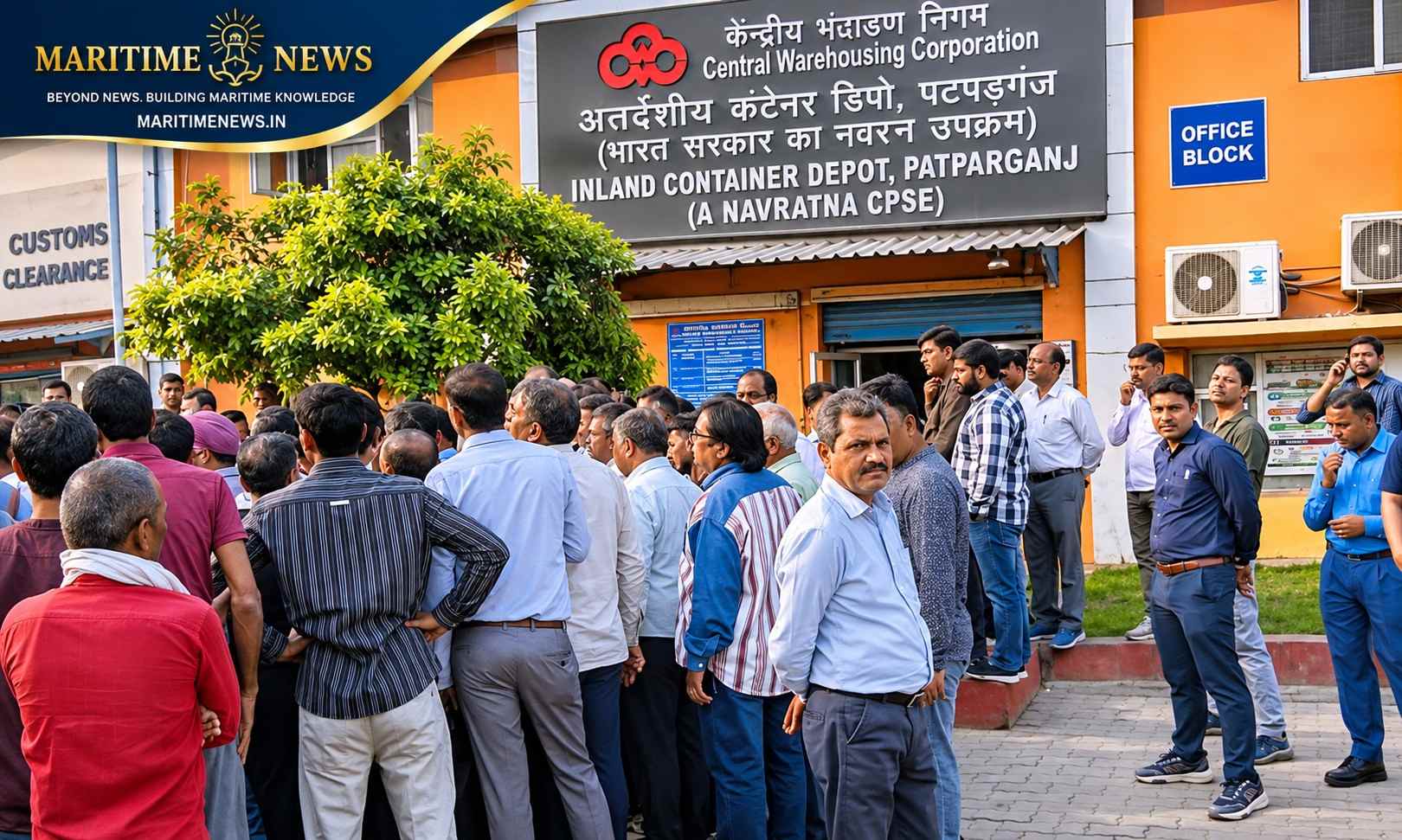
New Delhi, India November 18, 2026 (Maritime News): Operational concerns at the Inland Container Depot (ICD) Patparganj have brought the working relationship between Customs House Agents and the facility’s administration into focus, after members of the association staged a protest on 16 November 2026.
The protest followed concerns over delays, restrictions affecting documentation and payment-related processes, shortages of labour and handling facilities, and congestion affecting container movement.
The association submitted a formal representation to the Central Warehousing Corporation (CWC), seeking attention to issues that it said were affecting the smooth handling of import and export cargo.
CWC issued a written response on the same day, setting out proposed corrective measures. A further meeting was scheduled for 17 November 2026 to discuss the outstanding concerns.
What Are the CHAs Demanding?
The representation highlighted several operational issues at ICD Patparganj.
Delays in container loading and direct delivery: Delays in loading and direct delivery can disrupt cargo movement schedules, increase turnaround time and create additional costs for businesses dependent on timely clearance and transportation.
Restrictions on payment-sheet preparation: The association raised concerns about restrictions on preparing payment sheets after 5:00 PM. Such a time restriction can create difficulties for stakeholders dealing with cargo and documentation processes that extend beyond conventional office hours.
Shortage of labour and handling facilities: The reported shortage of labour and handling resources raises questions about the facility’s ability to manage operational demand efficiently, particularly during periods of higher cargo movement.
Container congestion and infrastructure constraints: Congestion can affect the movement of containers within an inland depot, creating delays for transporters and other service providers. The association has called for improvements to infrastructure and operational coordination.
These concerns are not isolated from the wider challenges faced by the customs brokerage and freight forwarding community. Maritime News has previously examined the challenges faced by India’s freight forwarders and customs brokers, including the operational pressures affecting these important trade intermediaries.
CWC Issues Written Response; Follow-up Meeting Scheduled
Following the protest and the association’s representation, CWC issued a written response dated 16 November 2026, addressing the concerns and outlining proposed corrective measures.
A further meeting was scheduled for 17 November 2026 to discuss the issues that remained unresolved.
The scheduled meeting provides an opportunity for both sides to move beyond the exchange of representations and examine practical solutions. However, the effectiveness of the response will ultimately depend on the measures implemented, the timelines established and the monitoring of operational improvements.
The contents of CWC’s written response have not been independently reviewed by Maritime News. Accordingly, the specific commitments, implementation timelines and status of individual grievances require confirmation from the relevant documents and stakeholders.
Why Does the Issue Matter Beyond ICD Patparganj?
The concerns raised at Patparganj have wider implications for India’s logistics and trade ecosystem.
An Inland Container Depot is an important link in the movement of international cargo. Its operational efficiency affects multiple stakeholders across the trade chain.
For an export consignment, the chain can involve the manufacturer or exporter, export documentation, Customs House Agents and customs brokers, Customs, freight forwarders, NVOCCs, ICDs or container freight stations, transport and logistics providers, ports and terminals, shipping lines and overseas buyers. Import operations involve the corresponding processes in the reverse direction.
A delay at the inland depot can therefore extend beyond the immediate facility. It can affect container availability, transport scheduling, delivery commitments, shipping connections and the overall cost of moving goods.
Maritime News has also reported on the impact of vessel bunching on Indian exporters and Customs House Agents, highlighting how congestion and disruptions at one point in the cargo chain can create consequences for multiple stakeholders.
Customs House Agents and customs brokers perform an important coordination role within this system. Their operational concerns deserve consideration because the efficiency of cargo movement depends on cooperation among the administration, service providers and trade participants.
Maritime News Analysis: Operational Efficiency Must Match Infrastructure Ambitions
India’s ambition to strengthen its position as a global logistics and trading hub requires more than investment in ports, highways, rail connectivity and logistics parks. The operational systems connecting these assets must function efficiently as well.
An inland depot’s performance depends on predictable processes, adequate manpower, functional handling infrastructure, transparent procedures and timely coordination between the facility administration and trade stakeholders.
The concerns raised at ICD Patparganj point to the importance of addressing operational bottlenecks at the facility level. Even where infrastructure is available, restrictions or delays in routine processes can undermine the benefits of that investment.
The Dedicated Freight Corridor’s operational expansion illustrates the importance of connecting infrastructure development with efficient customs brokerage, freight forwarding and cargo-handling processes. Physical connectivity alone cannot guarantee seamless trade if operational bottlenecks persist at inland facilities.
The immediate priority should be to establish which grievances can be resolved through administrative changes, which require additional manpower or equipment, and which demand infrastructure upgrades.
CWC and the association should also consider a documented mechanism for tracking grievances, assigning responsibility and reviewing progress. This would help ensure that discussions result in measurable improvements rather than repeated representations.
What Should Stakeholders Expect Next?
The meeting scheduled for 17 November 2026 was an important next step. Stakeholders need clarity on the status of each issue, the corrective measures proposed by CWC and the timelines for implementation.
A transparent follow-up process could include:
- A point-wise review of the association’s representation.
- Clear decisions on payment-sheet preparation and related operating hours.
- Assessment of labour and cargo-handling requirements.
- Measures to reduce container congestion and improve movement.
- Defined responsibilities for implementing corrective measures.
- Periodic consultations between CWC and the trade association.
These are recommendations for consideration, not confirmed decisions taken at the scheduled meeting.
Maritime Perspective
The protest at ICD Patparganj highlights a basic requirement of an efficient logistics ecosystem: infrastructure must be supported by responsive administration and practical operating procedures.
The concerns raised by the CHA association warrant a constructive response, while CWC’s written reply should be assessed against the actual improvements delivered on the ground.
For importers, exporters, customs brokers, freight forwarders, transporters and shipping lines, the objective is straightforward—predictable cargo movement, transparent procedures and fewer avoidable delays.
The dialogue between the association and CWC offers an opportunity to address immediate grievances and establish a more consistent operational framework at the facility.
Efficient Logistics. Stronger Trade. Stronger India.
Sources and References
External Sources
The protest details and the reported CWC response in this article are based on information supplied to Maritime News. The underlying representation and written response were not available for independent examination at the time of drafting.