

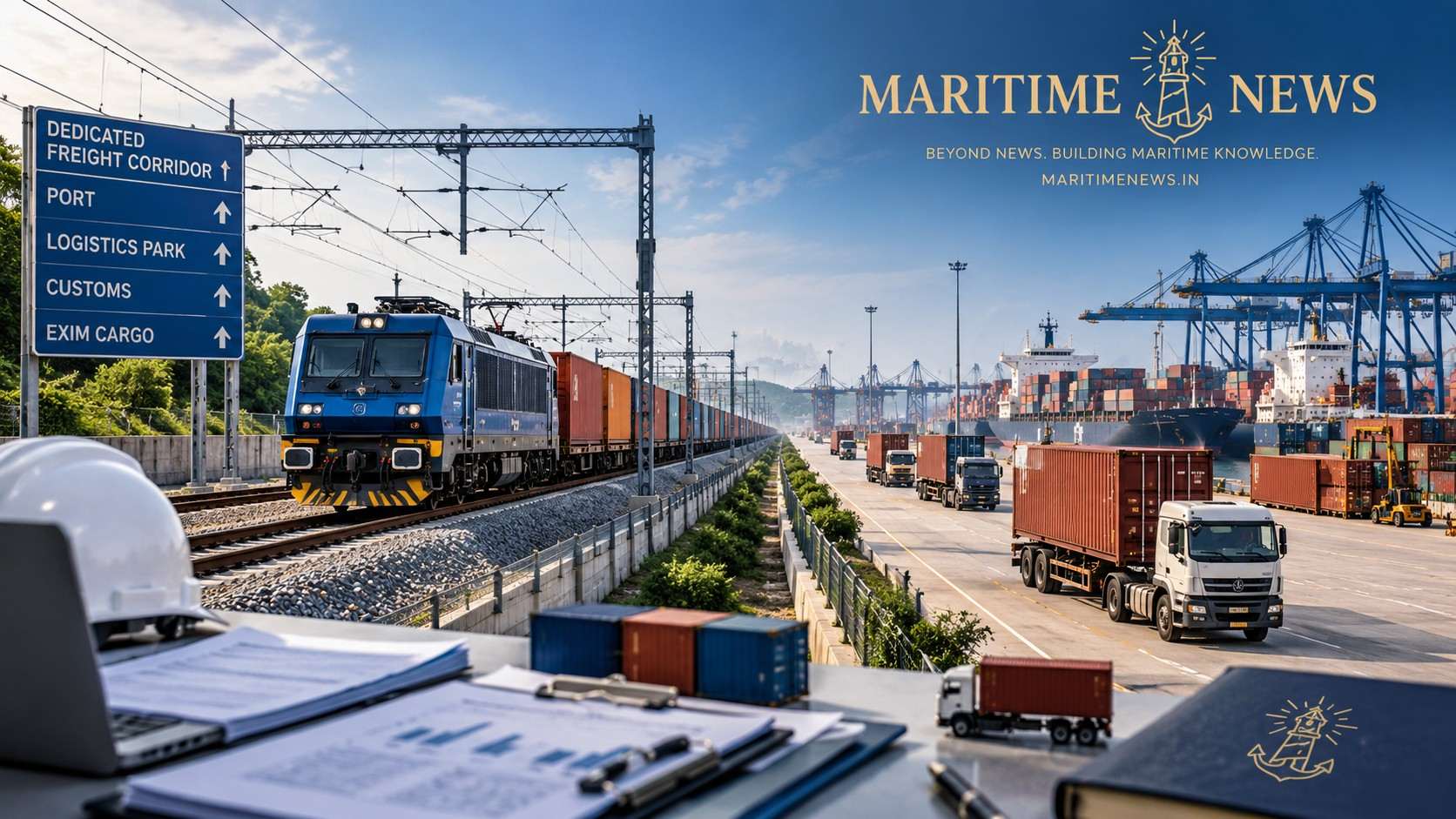
JNPT’s direct connection to the 1,506-km Western Dedicated Freight Corridor (WDFC) creates new multimodal opportunities—but also adds coordination, documentation, compliance and livelihood challenges across the EXIM logistics chain
Make us preferred source on Google
Key Takeaways
- JNPT is now directly connected to the 1,506-km Western Dedicated Freight Corridor, linking the port with Dadri and the northern hinterland. (JICA)
- Three newly commissioned sections cover 326 km and cost ₹20,703 crore. (JICA)
- The DDI-Konkan release states that approximately 178 route kilometres of the corridor pass through Raigad, Thane and Palghar, with more than ₹10,000 crore invested in Maharashtra including land costs.
- Prime Minister Modi highlighted the first double-stack freight movement from JNPT and said a single freight train could carry cargo equivalent to more than 250 trucks, according to the DDI-Konkan release.
- For Customs Brokers, the DFC does not change customs procedures but can make cargo-release coordination, information flow and post-clearance movement more important.
- For Freight Forwarders, rail becomes another major component of the sea–rail–road multimodal logistics chain.
- The operational process can become more complicated: customs clearance → port → rail → inland terminal → truck → final delivery.
- More interfaces also mean more documents, compliance checks, handovers, scheduling and potential points of delay.
- Truck owners may face pressure on some long-distance routes, but new opportunities can emerge in first-mile, last-mile, port drayage and regional distribution.
- Drivers and cleaners/helpers could experience changes in work patterns if long-haul trucking reduces on particular routes.
- JNPA handled 3,826,820 TEUs between April and August 2026, up 15.45% from the corresponding period, making efficient inland evacuation increasingly important. (JN Port)
- Government and JNPA now have an opportunity to focus not only on infrastructure capacity but also on industry capacity-building and livelihood transition.
Nhava Sheva, Uran, Raigad, Maharashtra, India, September 10, 2026 (Maritime News): The completion of the Western Dedicated Freight Corridor (WDFC) has created a new operating environment for India’s EXIM logistics industry, particularly for Customs Brokers (Customs House Agents/CHAs), Freight Forwarders, truck owners, drivers and other road-freight workers connected with Jawaharlal Nehru Port Authority (JNPA).
Prime Minister Narendra Modi on September 8 dedicated three WDFC sections covering 326 route kilometres, developed at a cost of more than ₹20,700 crore. The sections are New Sanand North–New Makarpura, New Umbergaon–New Saphale and New Saphale–JNPT. Their commissioning completes the 1,506-km Western Dedicated Freight Corridor between Dadri and JNPT. (PM India)
The direct connection to JNPT is expected to facilitate faster EXIM cargo movement, strengthen links between industrial centres and ports, reduce logistics costs and ease pressure on Mumbai’s conventional railway network. (PM India)
But for the logistics industry, the completion of the railway is only the beginning.
The more important question is:
Can the new rail capacity be integrated with customs clearance, port operations, documentation, compliance, terminals, trucking and final delivery without creating new bottlenecks—or leaving existing logistics businesses and workers behind?
What Has Changed for JNPT and the EXIM Trade?
The newly operational sections provide direct dedicated-freight connectivity between JNPT and the wider DFC network.
JICA describes the completed WDFC as a high-capacity, fully electrified freight corridor connecting Dadri in Uttar Pradesh with JNPT, linking industrial hubs in Maharashtra and northern and western India with ports and national markets. (JICA)
The Prime Minister’s Office says the JNPA connection will facilitate faster EXIM cargo movement, strengthen industrial-port connectivity and reduce logistics costs. (PM India)
The corridor therefore creates a stronger alternative to moving every long-distance container entirely by road.
For the logistics industry, the emerging model could increasingly become:
Port → Rail → Inland Terminal → Truck → Customer
rather than:
Port → Long-Distance Truck → Customer
That difference has major implications for the people and businesses managing the cargo.
Also Read: Mumbai Port Showcases Cruise Infrastructure, Marina Plans to Seychelles Parliamentary Delegation
What Does This Mean for Customs Brokers?
The DFC does not change customs clearance procedures.
Customs assessment, examination, documentation, declarations and release remain governed by the applicable customs framework.
However, the physical movement of a container after or around the clearance process can become more complex.
A conventional movement could look like:
Customs Clearance → Truck Booking → Port Pickup → Delivery
The multimodal model could become:
Customs Clearance → Cargo Release → Terminal Coordination → Rail Booking → Rail Movement → Inland Terminal → Truck Booking → Final Delivery
For the Customs Broker, the challenge is not necessarily taking responsibility for transportation.
It is ensuring that customs-related information and cargo status remain accurate and properly communicated to the parties responsible for subsequent movement.
The New Challenge: More Interfaces for Freight Forwarders
For Freight Forwarders, the change can be much more direct.
Earlier, a long-distance movement could be arranged relatively simply:
Clearance → Hire Truck → Deliver
The new multimodal movement may require:
Clearance → Port/Terminal → Rail Booking → Container Handover → DFC → Inland Terminal → Truck → Customer
This can introduce:
- More service providers
- More contracts
- More handovers
- More scheduling
- More documentation
- More compliance interfaces
- More tracking requirements
- More customer communication
- More potential points of failure
The DFC can therefore make the physical long-distance movement more efficient while making logistics coordination more sophisticated.
Documentation and Compliance Become More Important
The movement of a container through several transport modes requires information to remain consistent throughout the journey.
Depending on the shipment and service arrangement, information can flow between:
Shipping Line → Customs Broker → Port/Terminal → Rail Operator → Inland Terminal → Truck Operator → Consignee
Relevant information can include:
- Container number
- Seal details
- Cargo description
- Customs status
- Cargo release information
- Transport instructions
- Rail booking
- Terminal information
- Truck assignment
- Delivery details
- Proof of delivery
The exact documentation will vary according to the cargo, transport arrangement and applicable requirements.
The important point is that more handovers create more opportunities for mismatched information, incomplete documentation or delayed approvals.
A container can therefore be physically capable of moving faster while its documentation remains a bottleneck.
The industry’s challenge is to achieve:
Fast rail movement + accurate documentation + compliance + coordinated trucking = faster end-to-end delivery.
Who Is Responsible When Something Goes Wrong?
The multimodal chain also raises a practical question of responsibility.
Suppose customs clearance is completed but:
- the container misses its train;
- the rail booking is changed;
- terminal handling is delayed;
- the container reaches the inland terminal before the truck arrives;
- the truck is unavailable;
- the consignee cannot receive the cargo;
- additional storage or detention charges arise.
The customer will ultimately want to know:
Where did the delay occur, and who was responsible?
This makes clearly defined:
- Handover points
- Service responsibilities
- Documentation responsibilities
- Cargo custody
- Tracking responsibility
- Exception management
- Customer communication
- Liability arrangements
increasingly important.
Also Read: National Shipping Board’s First Sagar Samvad Starts With “IF”
The Cost Calculation Also Changes
Freight Forwarders cannot simply compare:
Rail freight rate vs Truck freight rate.
The relevant calculation becomes the total end-to-end logistics cost.
That can involve:
Rail freight + terminal handling + origin/destination movement + first-mile trucking + last-mile trucking + storage + other applicable charges
Potential additional costs can arise from:
- Missed train schedules
- Waiting time
- Terminal storage
- Detention/demurrage
- Additional handling
- Container repositioning
- Emergency trucking
- Re-booking
A cheaper rail movement does not automatically produce a cheaper logistics solution.
The Freight Forwarder’s job becomes increasingly about optimising the entire chain.
What Happens to Truck Owners?
This is one of the most important questions that needs to be addressed honestly.
If long-distance cargo between JNPT and northern destinations shifts to rail on commercially viable routes, some truck owners could see a reduction in:
- Long-haul trips
- Kilometres per vehicle
- Vehicle utilisation on affected routes
- Revenue from traditional port-to-destination movements
But their fixed costs remain.
Loan repayments, insurance, permits, maintenance, tyres and other operating expenses do not automatically decline because a portion of the cargo has shifted to rail.
For truck owners, therefore, the central question becomes:
How do I keep my truck economically productive in a rail-linked logistics system?
The Opportunity for Truck Owners: Change the Business Model
The DFC does not eliminate the need for trucks.
It can change the role of trucks.
Instead of:
JNPT → Northern India
the truck may increasingly operate:
Factory → Rail Terminal
or:
Rail Terminal → Factory/Warehouse
or:
JNPT → Nearby Logistics Facility
or:
ICD → Regional Customer
This creates opportunities in:
- First-mile transport
- Last-mile transport
- Port drayage
- CFS movement
- ICD connectivity
- Regional distribution
- Empty-container repositioning
- Short-haul container operations
The challenge will be whether the revenue generated from multiple shorter movements can compensate for the loss of some long-distance trips.
Also Read: From Adani Ports CEO to Allcargo MD: The Pranav Choudhary
What About Truck Drivers?
The impact on drivers needs separate consideration.
A driver whose income depends on long-distance container trips could experience a change in:
- Number of long-distance trips
- Trip-based earnings
- Time spent away from home
- Working hours
- Route patterns
- Payment structures
However, shorter regional operations could also have benefits, including potentially more predictable routes and less time away from home.
The transition may therefore not simply be a question of job loss versus job creation.
It may be a question of changing the nature of trucking employment.
Drivers may increasingly work on:
- Port-to-terminal routes
- Factory-to-ICD routes
- ICD-to-warehouse routes
- Regional distribution
- Container repositioning
- First/last-mile operations
That transition may require training, employment linkage and new remuneration models.
And the Cleaners and Helpers?
The impact on truck cleaners/helpers should not be overlooked.
Where long-haul trucking reduces, the requirement for workers accompanying long-distance trips could also change.
Some workers may find opportunities in:
- Fleet maintenance
- Vehicle servicing
- Container yards
- Terminal support
- Warehousing
- Regional logistics
- Distribution operations
But these opportunities will not automatically materialise.
This is precisely why a transition towards rail should be accompanied by skills mapping and livelihood-transition planning.
Also Read: Mormugao Port: From Iron-Ore Gateway to Multi-Commodity Port
The DFC Creates Opportunities for Freight Forwarders
The positive side is substantial.
Freight Forwarders can potentially expand from a predominantly road-linked inland model towards multimodal cargo management.
A forwarder could offer:
Ocean Freight + Customs Coordination + Rail + Truck + Inland Terminal + Final Delivery
This can potentially provide customers with:
- More routing choices
- Better long-distance capacity
- Alternative to road-only transportation
- Potentially lower total logistics costs
- More predictable cargo planning
But the opportunity comes with a higher coordination requirement.
The Opportunity for Customs Brokers
For Customs Brokers, the opportunity is not necessarily to become transporters.
Instead, it is to strengthen their role within a more integrated EXIM ecosystem.
That could mean closer operational coordination with:
- Freight Forwarders
- Shipping Lines
- Port terminals
- CFSs
- ICDs
- Rail operators
- Transporters
- Importers/exporters
The Customs Broker’s value remains rooted in customs expertise, but accurate and timely cargo-status information becomes increasingly important to the wider logistics chain.
Also Read: From Flood Recovery to Maritime Connectivity: New Assam Development Push Takes Shape
JNPT’s Growing Cargo Volumes Make This More Urgent
JNPA’s official performance data shows that the port handled 3,826,820 TEUs between April and August 2026, compared with 3,314,608 TEUs during the corresponding period of the previous financial year—a 15.45% increase. JNPA also reported its highest-ever monthly container throughput of 831,956 TEUs in August 2026. (JN Port)
This matters because greater port throughput requires equally efficient cargo evacuation.
If cargo volumes rise while inland evacuation remains constrained, congestion can simply move from one part of the supply chain to another.
The DFC provides additional capacity.
The next requirement is coordinated utilisation of that capacity.
The First and Last Mile Will Determine the Real Benefit
A container can travel rapidly on the DFC and still experience delays because of:
- Customs clearance
- Port handling
- Terminal congestion
- Rail scheduling
- Inland terminal capacity
- Truck availability
- Road congestion
- Warehouse receiving schedules
- Documentation
- Cargo-release procedures
Therefore, the real performance measure should not be:
“How fast did the train travel?”
It should be:
“How long did the container take from origin to final destination?”
That is the number that matters to an importer, exporter and Freight Forwarder.
Also Read: Can Assam Build a Global Export Economy on One of the World’s Most Dynamic Floodplains?
Government’s Role: Capacity Building Must Accompany Infrastructure Capacity
India has now built the freight infrastructure.
The next challenge is to build the industry capacity to use it effectively.
The government should consider structured capacity-building programmes for:
Customs Brokers
Training and awareness on:
- Multimodal cargo flows
- Rail-linked cargo movement
- Digital information systems
- Documentation interfaces
- Cargo-status visibility
- Coordination with inland logistics providers
Freight Forwarders
Programmes covering:
- Rail freight planning
- Multimodal contracting
- Terminal operations
- End-to-end cost calculation
- Digital tracking
- Risk and liability management
- Exception management
Truck Operators
Support for:
- Multimodal logistics awareness
- Digital fleet systems
- GPS/container tracking
- First/last-mile business models
- Fleet restructuring
- Access to financing where appropriate
The objective should be to ensure that small and medium logistics businesses are not excluded from the new freight ecosystem.
Also Read: India’s Trade Performance Highlights Goods and Markets Requiring Attention
JNPA Can Play a Coordinating Role
JNPA is at the maritime end of this new logistics chain and can help bring the different stakeholders together.
A structured stakeholder mechanism could include:
- Customs Brokers/CHAs
- Freight Forwarders
- Shipping Lines
- CFS operators
- ICD operators
- Container train operators
- Truck associations
- Truck owners
- Driver representatives
- Importers and exporters
Such engagement could identify operational problems before they become systemic bottlenecks.
JNPA could also facilitate industry awareness and capacity-building programmes explaining how the new DFC connectivity can be integrated into JNPT’s cargo ecosystem.
Livelihood Security Must Be Part of the Transition
A major infrastructure project should be assessed not only by the additional tonnes or containers it can move.
It should also be assessed by what happens to the people whose livelihoods are connected to the existing system.
If long-distance road cargo shifts to rail, government and industry should assess:
For truck owners
- Fleet utilisation
- Revenue impact
- Financing burden
- Opportunities for route diversification
- Access to new logistics contracts
For drivers
- Employment transition
- Skill requirements
- Income changes
- Regional driving opportunities
- Port and terminal-related employment
For cleaners/helpers
- Alternative employment
- Skills development
- Fleet-maintenance opportunities
- Warehouse and terminal employment
- Regional logistics jobs
This is not an argument against rail.
It is an argument for responsible transition planning.
Also Read: India Trade Deficit Widens Despite Strong Export Growth
Should There Be Compensation?
The DDI-Konkan press release does not establish any specific compensation scheme for truck owners, drivers or cleaners whose work may be affected by increased rail freight.
However, where a demonstrable livelihood impact occurs, government can examine appropriate forms of transition assistance, depending on demand, evidence and policy design.
This could include:
- Reskilling
- Alternative livelihood programmes
- Access to financing for fleet restructuring
- Support for technology adoption
- Employment placement
- Preferential access to suitable logistics opportunities
- Training for multimodal transport operations
The objective should not necessarily be to compensate every business for market competition.
It should be to ensure that workers and viable small businesses are not structurally excluded from the new logistics economy.
A Livelihood Transition Framework Could Be Considered
Before large-scale modal shifts occur, the government could consider establishing a baseline:
How many trucks currently serve long-distance JNPT routes?
How many drivers depend primarily on those routes?
How many cleaners/helpers are associated with those operations?
Which routes are most likely to shift to rail?
What alternative work will be available?
This would allow policy to move from assumption to evidence.
The principle should be:
Capacity creation should be accompanied by capacity building.
And:
Logistics transition should be accompanied by livelihood transition.
Also Read: Development of Non-Major Ports in India through Convergence
Way Forward: Building a Seamless Multimodal System
The WDFC should now be followed by a second phase of institutional integration.
1. Create multimodal operating protocols
Clearly define documentation, handover, custody, tracking and responsibility at each stage.
2. Strengthen digital integration
The objective should be a continuous information chain:
Customs → Port → Rail → Inland Terminal → Truck → Customer
3. Improve first- and last-mile connectivity
Rail efficiency will have limited value if containers wait for trucks at either end.
4. Build industry capability
Regular programmes should train Customs Brokers, Freight Forwarders, transporters and smaller logistics companies.
5. Monitor livelihood impacts
Government should track the effect of modal shifts on truck owners, drivers and helpers.
6. Encourage business adaptation
Truck operators should be supported in developing first-mile, last-mile and regional logistics capabilities.
7. Establish stakeholder consultation
JNPA, rail authorities and the logistics industry should regularly review bottlenecks and cargo-flow changes.
8. Measure the outcome
The ultimate indicators should include:
Transit time + total logistics cost + reliability + cargo volume + truck utilisation + employment impact.
India-Japan Cooperation Behind the DFC
The WDFC is also a major India-Japan infrastructure partnership.
According to JICA, cumulative Official Development Assistance loans provided to DFCCIL for the Western DFC total JPY 620.787 billion, equivalent to ₹37,658 crore. JICA says the corridor is intended to accelerate logistics, enhance industrial competitiveness, reduce greenhouse-gas emissions and ease congestion on passenger railway lines. (JICA)
JICA also describes the corridor as a high-capacity national logistics artery connecting industrial centres with ports and national markets. (JICA)
The infrastructure investment is therefore substantial.
The next investment requirement is in people, systems and coordination.
Maharashtra’s 178-km DFC Link
According to information shared by the Deputy Director of Information, Konkan Division (DDI-Konkan), around 178 route kilometres of the corridor pass through Raigad, Thane and Palghar, with more than ₹10,000 crore invested in Maharashtra including land costs.
The Maharashtra portion is particularly important to JNPT because it connects the port with the wider freight network while strengthening the logistics relationship between the port, industrial areas and inland markets.
JICA also identifies Palghar, Thane and Raigad among the industrial hubs connected through the WDFC. (JICA)
What This Means for the Wider EXIM Ecosystem
| Stakeholder | Opportunity | Challenge |
|---|---|---|
| Customs Brokers / CHAs | Better integration with cargo movement | More coordination and information interfaces |
| Freight Forwarders | Multimodal sea–rail–road solutions | More service providers, documentation and liability points |
| Truck Owners | First/last-mile and regional business | Possible reduction in some long-haul routes |
| Drivers | Potential regional/terminal work | Change in trip patterns and earnings |
| Cleaners/Helpers | New logistics/maintenance opportunities | Possible reduction in long-haul employment |
| Shipping Lines | Stronger hinterland connectivity | Need for efficient inland evacuation |
| CFS/ICD Operators | Greater role in multimodal cargo | Capacity and congestion management |
| Rail Operators | Higher freight utilisation | Reliable schedules and terminal coordination |
| JNPA | Wider hinterland reach | Managing growing cargo evacuation |
| Importers/Exporters | More routing choices | Need to select the right multimodal solution |
| Government | Lower logistics costs and greater freight capacity | Managing transition and livelihood impacts |
Also Read: Stakeholders Expectations From Sagarmala Finance Corporation
MaritimeNews Insight
The completion of the Western Dedicated Freight Corridor is a major infrastructure achievement, but its real success will be determined after the train leaves the station.
For a Customs Broker, the challenge is ensuring that customs-related information and cargo status integrate smoothly with the next stage of movement.
For a Freight Forwarder, the challenge is greater: the logistics chain may become more efficient physically but more complex operationally.
Earlier, a long-distance container movement could often be organised around one truck service provider.
The emerging model can involve:
Customs Broker → Freight Forwarder → Port → Rail Operator → Inland Terminal → Truck Operator → Consignee.
That means more coordination, more documentation, more compliance interfaces and more potential points of delay.
For truck owners, the transition may reduce some long-haul opportunities while creating new first-mile, last-mile and regional opportunities.
For drivers and cleaners/helpers, the question is whether the transition creates new livelihoods or simply removes old ones.
This is where government and JNPA have an important role.
India has created freight capacity.
Now it needs to create the human, digital and institutional capacity to use that freight infrastructure effectively.
And if cargo moves from road to rail, the policy objective should be clear:
Make the logistics system more efficient without making the people dependent on that system economically invisible.
The ultimate measure of the DFC should therefore be broader than kilometres of railway, number of trains or containers moved.
It should be:
Lower total logistics cost + faster reliable delivery + stronger multimodal businesses + productive trucking integration + secure livelihoods.
That is the next phase of India’s freight-corridor story.
Frequently Asked Questions (FAQs)
Does the DFC change Customs clearance?
No. It is freight infrastructure and does not itself change customs laws or clearance procedures.
Will every JNPT container move by rail?
No. Mode selection will depend on destination, cargo, service availability, cost, schedule and customer requirements.
Will Freight Forwarders have more work?
Potentially, but the nature of the work can change. Multimodal transportation may create more opportunities while also increasing coordination, documentation and exception-management responsibilities.
Will truck owners lose business?
Some long-distance movements could shift to rail where rail is commercially competitive. However, trucks remain essential for first-mile, last-mile, drayage and regional distribution.
What happens to truck drivers?
Their work may shift from long-distance routes towards shorter regional, port, terminal and first/last-mile operations. The transition could require new skills and employment models.
What about cleaners and helpers?
Their livelihoods may also be affected if long-haul truck utilisation declines. Alternative employment, skills development and logistics-sector placement should therefore be considered.
Should government provide compensation?
No specific compensation scheme for these groups is established by the DDI-Konkan release. Where demonstrable livelihood displacement occurs, government could consider appropriate transition support, reskilling, alternative livelihood and fleet/business adaptation measures.
What should Customs Brokers focus on?
Accurate customs information, cargo-release coordination, communication with Freight Forwarders and clear delineation between customs responsibilities and transportation responsibilities.
What should Freight Forwarders focus on?
End-to-end cost, transit time, rail availability, terminal operations, documentation, compliance, trucking arrangements, cargo visibility and exception management.
What is the biggest opportunity for truck operators?
Integrating with the rail system through first-mile, last-mile, port drayage, ICD/CFS connectivity and regional distribution.
Sources
Primary source: Deputy Director of Information, Konkan Division (DDI-Konkan) — Marathi press release supplied for this report.
- Prime Minister of India — Western Dedicated Freight Corridor and JNPA connectivity
- JICA — Western Dedicated Freight Corridor completion and India-Japan cooperation
- JNPA — August 2026 and April–August 2026 performance data
- Prime Minister of India — DFC network completion and logistics transformation
Editorial note: The Maharashtra-specific figures, including the 178-km Maharashtra route and ₹10,000+ crore investment, are attributed to the DDI-Konkan release you supplied. The analysis concerning operational challenges, capacity building and livelihood transition is presented as MaritimeNews analysis/recommendation, not as an existing government commitment.
Make us preferred source on Google
Reporting by MaritimeNews Bureaus, Writing and Editing by Jaspal Singh Naol.
5 thoughts on “WDFC Fully Operational: What It Means for Customs Brokers, Freight Forwarders and Trucking Businesses”