

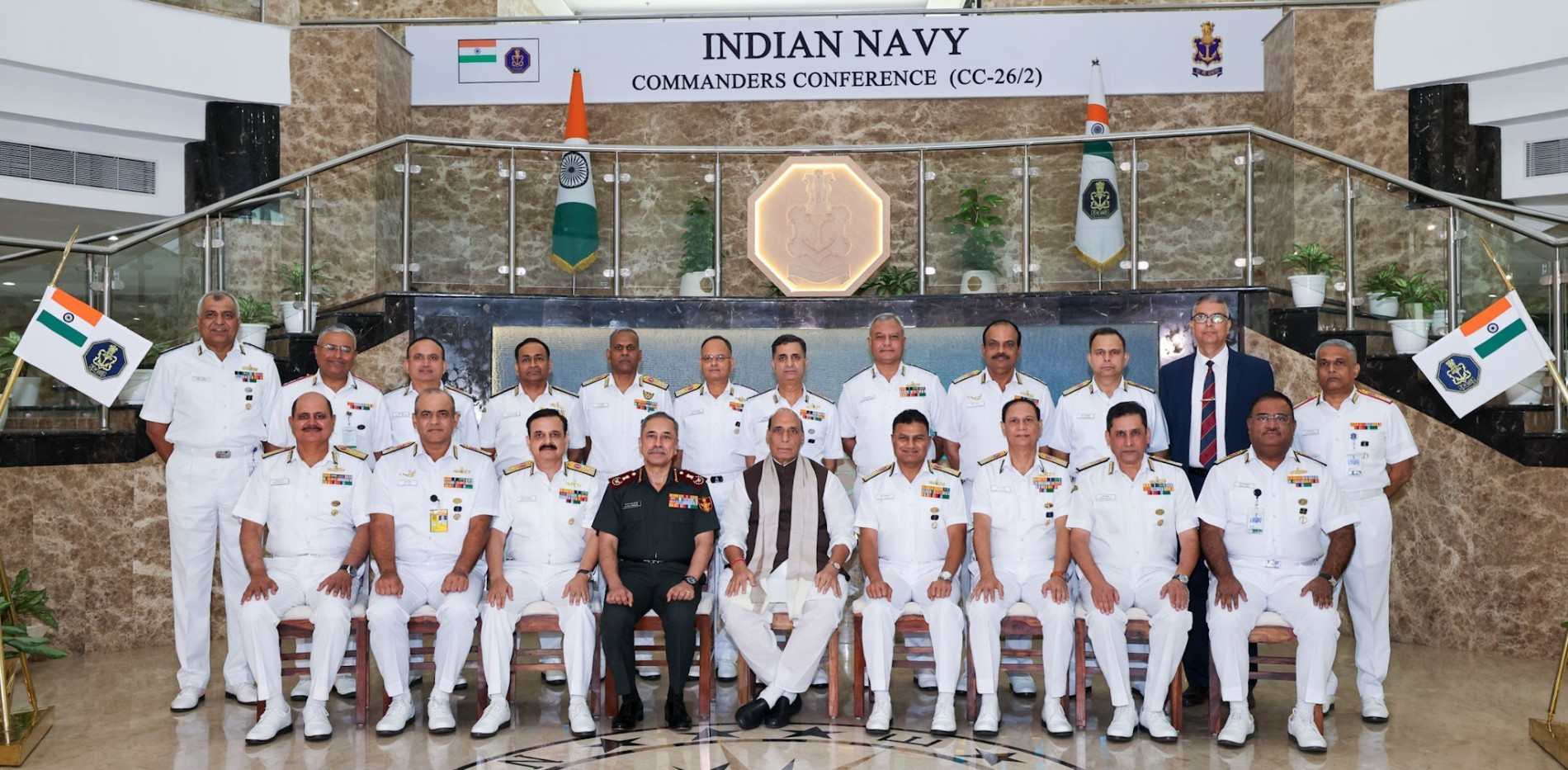
Defence Minister Rajnath Singh has described India as a first responder and preferred security partner in the Indian Ocean Region, highlighting the Navy’s overseas deployments, West Asia operations, indigenous warship production and maritime diplomacy. Addressing the Navy’s Commanders’ Conference in New Delhi, he called for stronger surveillance and response capabilities amid increasingly complex maritime threats.
Make us preferred source on Google
Key Takeaways
- Defence Minister Rajnath Singh addressed the Indian Navy’s second Commanders’ Conference of 2026 on September 29 in New Delhi.
- He highlighted India’s role as a first responder and security partner in the Indian Ocean Region, while calling for upgraded maritime monitoring and response mechanisms.
- The presence of Indian warships in the South China Sea, Mediterranean and Atlantic was cited as evidence of India’s blue-water naval capability.
- The Minister praised the Navy’s role in facilitating safe transit of Indian-flagged merchant vessels, particularly LPG tankers, through the Strait of Hormuz under Operation Urja Suraksha.
- He said 18 warships were planned for induction or commissioning in 2026, describing it as the largest single-year force accretion in the Navy’s history.
- More than 75% indigenous content in recently commissioned warships was highlighted as a milestone in domestic defence manufacturing.
- The address also covered women’s participation, Combined Maritime Forces leadership, naval diplomacy and the need for more advanced maritime surveillance.
In his address, Singh said India’s role as a first responder and preferred security partner had expanded alongside its strategic responsibilities. He identified congestion, deception and grey-zone activities as growing complexities in the maritime domain and called for stronger monitoring and response mechanisms.
The conference comes amid continuing security concerns in West Asia and the importance of protecting maritime energy supplies. Its agenda includes operational readiness, energy security, technology absorption and the Navy’s future force requirements.
Blue-Water Capability and Overseas Naval Presence
Singh highlighted the deployment of Indian warships beyond the Indian Ocean, including in the South China Sea, Mediterranean and Atlantic Ocean, describing these deployments as evidence of the Navy’s blue-water force capability.
Blue-water capability involves the ability to operate naval forces at significant distances from home waters and sustain deployments across wider maritime regions. Such operations require vessels, logistics, maintenance, communications, trained personnel and coordination with partner countries.
The Defence Minister said the Navy’s role extends beyond guarding India’s maritime boundaries to protecting economic interests, supporting regional stability and contributing to maritime security.
India’s stated role as a preferred security partner builds on the Navy’s operational and cooperative activities in the Indian Ocean Region. In a 2024 address, Singh had also described the Navy as a first responder in the region and highlighted its contribution to protecting trade and economic interests. pib.gov.in
A central part of Singh’s address was the Navy’s role in the West Asia crisis, particularly the safe transit of Indian-flagged merchant vessels, including LPG tankers, through the Strait of Hormuz under Operation Urja Suraksha.
The Defence Minister said India imports approximately 85–90% of its crude oil and around 50% of its natural gas through maritime routes, making the security of sea lanes directly relevant to the economy, energy supplies and defence preparedness.
The Strait of Hormuz is a strategically important passage connecting the Persian Gulf with the Gulf of Oman and the wider Indian Ocean. Disruption to shipping in the region can affect energy cargo movements, freight and insurance costs, vessel scheduling and the supply chains that depend on imported fuels.
The Navy’s role in supporting safe passage is therefore connected to a wider national system involving merchant shipping, shipowners, seafarers, energy importers, port operators, maritime regulators and diplomatic channels.
The Ministry’s conference preview had identified energy security amid the West Asia conflict as a key focus, including the Navy’s ongoing Operation Urja Suraksha.
Indigenous Warship Production and Defence Self-Reliance
Singh highlighted progress in India’s naval shipbuilding ecosystem, stating that recently commissioned warships contain more than 75% indigenous content.
He called for the Navy to move beyond meeting domestic requirements and work towards exporting warships to friendly foreign countries.
The address places domestic shipbuilding within the broader objectives of defence self-reliance, industrial capability and technological development. The shipbuilding ecosystem involves public and private shipyards, equipment manufacturers, engineering firms, steel suppliers, electronics companies, small and medium enterprises, research institutions and skilled workers.
Higher indigenous content can expand domestic participation in ship construction and equipment supply. However, the extent of industrial benefit depends on the depth of local manufacturing, technology ownership, quality standards, supply-chain capacity and sustained orders.
The conference agenda also includes materiel, logistics, human resources, training and the induction of emerging technologies, reflecting the range of capabilities required to support naval platforms throughout their operational life.
Also Read: Edible Oil Import Duty Cut: Who Gets the Benefit — Importers, Refiners, Farmers or Consumers?
18 Warships Planned for Induction or Commissioning in 2026
Singh described 2026 as a historic year for the Indian Navy, with 18 warships planned for induction or commissioning. He characterised this as the largest single-year force accretion in the Navy’s history.
The announcement reflects the scale of the Navy’s planned fleet expansion and the contribution of India’s domestic shipbuilding ecosystem.
Induction and commissioning milestones, however, represent only part of force development. Operational availability also depends on crew training, maintenance, spare parts, logistics, weapons and sensor integration, infrastructure and sustained support.
The three-day conference provides an opportunity for the Navy’s senior leadership to review operational preparedness and future capability requirements. The Ministry’s pre-conference announcement also identified technology absorption, logistics, training and combat readiness among the subjects for review.
Maritime Surveillance and Emerging Grey-Zone Threats
Singh called for a significant upgrade of India’s maritime surveillance architecture, noting that the growing volume and complexity of maritime traffic require stronger analytical capabilities.
He identified congestion, deception and grey-zone activities as challenges affecting the maritime domain. Grey-zone activities generally refer to actions that fall below the threshold of conventional armed conflict but may still create security, legal or operational challenges.
Effective maritime surveillance depends on the integration of information from multiple sources, including coastal radar, satellite imagery, vessel tracking, intelligence networks, maritime patrol aircraft and information-sharing arrangements.
The conference’s wider technology agenda includes artificial intelligence, Big Data Analysis, autonomous and uncrewed systems, and cyber operations. These areas were identified in the Ministry’s pre-conference briefing as subjects for senior naval leadership to review.
The operational challenge is to turn information into timely, accurate and coordinated responses while maintaining appropriate oversight, secure information systems and interoperability among maritime agencies.
Women’s Participation and the “All Ranks, All Roles” Approach
The Defence Minister commended the Navy’s efforts towards women’s empowerment, recruitment and innovation under its “All Ranks, All Roles” approach.
He highlighted the deployment of women officers on frontline warships and aircraft, as well as their participation in naval navigational expeditions, including Navika Sagar Parikrama.
The initiative reflects the expansion of women’s participation in naval operations and professional roles. Its long-term implementation also involves training, career progression, operational opportunities, support infrastructure and institutional policies.
The conference provides a senior-level forum for reviewing human-resource development and training alongside operational and technological priorities.
India Assumes Command of Combined Maritime Force Task Group
Singh congratulated the Indian Navy on assuming command of Combined Task Force 154 (CTF-154) under the Combined Maritime Forces (CMF), describing it as a contribution to regional cooperative security.
He also highlighted Operation Southern Readiness, conducted in Kochi during India’s command tenure of CTF-154. According to the PIB release, the activity involved 276 personnel from 27 countries, 76 facilitators and subject-matter experts, and four international organisations.
Multinational maritime cooperation provides opportunities for participating forces to develop interoperability, professional skills and shared understanding of maritime-security challenges.
Such engagement complements naval deployments and bilateral cooperation, while placing importance on coordination, common procedures and sustained institutional relationships.
Also Read: India’s Shipbuilding Modernisation Gets New Project Management Unit Under SbDS
INS Sudarshini’s Lokayan-26 Maritime Diplomacy
Singh also commended the deployment of INS Sudarshini for Lokayan-26, which he said strengthened India’s maritime diplomacy and engagement with the Indian diaspora across the United States, Atlantic and Mediterranean regions.
The deployment was presented as an opportunity to showcase India’s maritime heritage and extend engagement beyond conventional naval operations.
Maritime diplomacy can include port visits, professional exchanges, training, cultural engagement and interaction with overseas communities. These activities complement operational deployments by supporting international relationships and visibility.
Tri-Service Coordination and the Three-Day Conference
The conference is also a platform for coordination among the armed services. Singh interacted with the Chief of Defence Staff and the Chief of the Army Staff during the event.
The three-day meeting, running from September 29 to October 1 at Nausena Bhawan, brings together the Navy’s senior leadership to review operational preparedness, maritime security and future capability development.
The Ministry’s conference preview identified jointness, self-reliance and innovation as foundational priorities, alongside reviews of operations, materiel, logistics, human resources, training and emerging technologies.
Also Read: Vadhavan Port Tender Advances as NAPM Demands Project Halt and Independent Impact Assessment
Maritime Stakeholders: The Wider Impact of Naval Security
The Defence Minister’s address focused on naval capability and national security, but its themes also connect with the wider maritime economy.
|
Stakeholder |
Relevance to the issues raised |
|---|---|
|
Indian Navy |
Maritime security, surveillance, deployments, deterrence and protection of national interests |
|
Merchant shipowners and operators |
Safe and reliable vessel operations across international routes |
|
Indian seafarers |
Personal safety, emergency response, vessel security and continuity of maritime employment |
|
Energy importers |
Reliable movement of crude oil, natural gas and LPG through international sea lanes |
|
Ports and terminals |
Secure cargo handling, vessel calls and continuity of port operations |
|
Shipping lines |
Route planning, vessel deployment, operational risk and schedule reliability |
|
Customs Brokers and freight forwarders |
Cargo documentation, coordination and the trade effects of maritime disruption |
|
Shipyards and manufacturers |
Naval construction, equipment supply, maintenance and domestic industrial participation |
|
Maritime regulators and government agencies |
Safety oversight, surveillance coordination, international engagement and policy implementation |
|
Coastal communities |
Maritime safety, environmental protection, local livelihoods and security around coastal areas |
The table identifies the connections between naval priorities and maritime stakeholders; it does not imply that each stakeholder was individually discussed at the conference.
Why Maritime Security Is Also an Economic Issue
India’s dependence on maritime routes for energy imports makes sea-lane security relevant to more than defence planning. Disruption can affect the movement of energy cargoes, vessel schedules, insurance and freight costs, port operations and downstream economic activity.
The Navy’s role in supporting safe passage through high-risk areas is therefore connected to the functioning of the wider maritime trade chain.
For seafarers, maritime security has a direct human dimension: safe passage, effective communication, emergency preparedness and coordination during incidents. For shipowners and cargo interests, security affects operational continuity and commercial risk.
The Defence Minister’s remarks on the Strait of Hormuz underline the relationship between maritime security and national energy interests. The extent of economic effects from any particular disruption, however, needs to be assessed using actual shipping, cargo, insurance and trade data.
MaritimeNews Insight
The Commanders’ Conference brings together three closely linked priorities for India’s maritime future: operational readiness, technological capability and the protection of maritime economic interests.
The Defence Minister’s address highlighted overseas naval deployments, energy security operations, indigenous shipbuilding, surveillance modernisation, women’s participation and multinational maritime cooperation.
The announced plan for 18 warships in 2026 and the reported indigenous content of recently commissioned vessels point to the scale of the Navy’s capability-development ambitions. The operational value of these developments will also depend on trained personnel, maintenance, logistics, technology integration and sustained readiness.
The growing complexity of maritime activity makes surveillance and information analysis increasingly important. At the same time, the security of sea lanes remains directly connected to merchant shipping, energy imports, seafarer safety and the continuity of international trade.
The conference’s significance will ultimately be reflected in how its reviews and priorities translate into operational capabilities, measurable preparedness and coordinated maritime responses.
What to Watch
- Surveillance modernisation: specific technology, integration and implementation measures arising from the conference.
- Fleet development: progress towards the announced 18 warship induction or commissioning milestones in 2026.
- Indigenous shipbuilding: the depth of domestic content, supply-chain participation and potential export readiness.
- Energy security: continuing naval support for merchant-vessel movements through sensitive maritime corridors.
- Emerging technologies: adoption of AI, Big Data Analysis, autonomous systems and cyber capabilities.
- Human resources: training, operational opportunities and career development under the “All Ranks, All Roles” approach.
- Multinational cooperation: outcomes and follow-up activities associated with India’s CTF-154 leadership.
- Operational readiness: the extent to which conference deliberations lead to measurable improvements in preparedness, logistics and coordination.
Frequently Asked Questions (FAQs)
What did Rajnath Singh say at the Indian Navy’s Commanders’ Conference?
He described India as a first responder and preferred security partner in the Indian Ocean Region, highlighted the Navy’s blue-water deployments and energy-security operations, and called for stronger maritime surveillance and response mechanisms.
When and where was the conference held?
The second Indian Navy Commanders’ Conference of 2026 began on September 29 and is scheduled to run until October 1 at Nausena Bhawan, New Delhi. Akashvani News
What is India’s blue-water naval capability?
Blue-water capability refers to the ability to deploy and sustain naval forces far from national waters, including in distant maritime regions. Singh cited Indian warship presence in the South China Sea, Mediterranean and Atlantic as evidence of this capability.
What is Operation Urja Suraksha?
It is the operation referenced in the Defence Minister’s address in connection with the safe transit of Indian-flagged merchant vessels, particularly LPG tankers, through the Strait of Hormuz amid the West Asia crisis.
How many warships are planned for induction or commissioning in 2026?
Singh said 18 warships were planned for induction or commissioning during 2026, describing the figure as the largest single-year force accretion in the Navy’s history.
What did the Defence Minister say about indigenous warship production?
He said recently commissioned warships contain more than 75% indigenous content and urged the Navy to work towards meeting domestic requirements while developing the potential to export warships to friendly countries.
What is the purpose of maritime surveillance modernisation?
The objective is to strengthen monitoring and response capabilities as maritime traffic and security challenges become more complex. The address highlighted the need for enhanced analytical capabilities, while the wider conference agenda includes emerging technologies such as AI and autonomous systems.
What is Combined Task Force 154?
CTF-154 is a task force under the Combined Maritime Forces. Singh congratulated the Indian Navy on assuming its command and highlighted Operation Southern Readiness, conducted in Kochi during India’s command tenure.
Why is the conference relevant to merchant shipping?
The conference addressed maritime security and energy supply routes, including the Strait of Hormuz. These issues affect merchant-vessel safety, cargo movement, shipping operations and the security of India’s energy imports.
The second Indian Navy Commanders’ Conference of 2026 has placed operational readiness, maritime surveillance, energy security and future capability development at the centre of India’s naval agenda.
Defence Minister Rajnath Singh’s address highlighted the Navy’s overseas deployments, its role in protecting merchant shipping through the Strait of Hormuz, indigenous warship production, multinational cooperation and women’s participation. His call for stronger monitoring and response mechanisms reflects the increasingly complex demands placed on maritime forces.
The conference also links naval capability with India’s wider maritime interests: secure energy supplies, reliable shipping routes, a resilient shipbuilding ecosystem and the safety of seafarers.
The practical measure of progress will be the implementation of the priorities discussed — through operational preparedness, technology integration, trained personnel, effective logistics and coordinated responses across the maritime domain.
Sources
- Press Information Bureau — India Stands as the First Responder, Preferred Security Partner in the Indian Ocean Region: Rajnath Singh, September 29, 2026
- News On AIR — Indian Navy to Host Second Edition of Commanders’ Conference 2026 in New Delhi
- India Strategic — Navy Commanders to Review Operational Preparedness at Three-Day Conference
- Outlook India — West Asia Crisis, Drones, AI: Inside the Indian Navy’s Commanders’ Meet
- PIB — India Is Now Seen as a Preferred Security Partner in the Indian Ocean Region, September 19, 2024
Make us preferred source on Google
Reporting by MaritimeNews Bureaus, Writing by Harpal S Naol; Editing by Jaspal Singh Naol.


One thought on “Indian Navy’s Blue-Water Role Expands as Rajnath Singh Calls for Stronger Maritime Surveillance”