
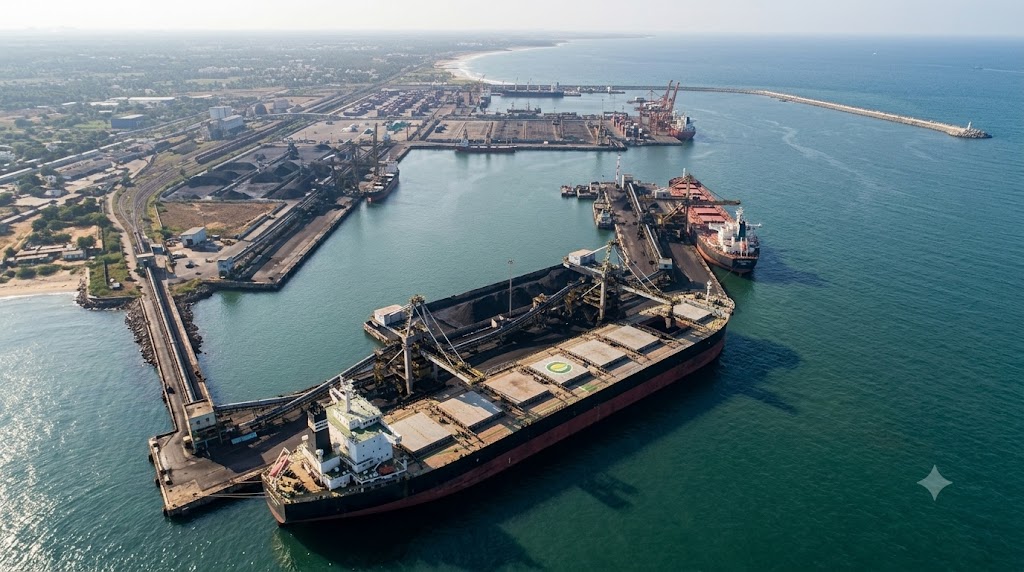
Completion of Capital Dredging Phase VI makes Kamarajar Port India’s second major port with an 18-metre operational draft, enabling fully laden Capesize vessels and reinforcing India’s long-term maritime infrastructure strategy
Make us preferred source on Google
Key Takeaways
- Kamarajar Port has completed Capital Dredging Phase VI at an investment of approximately ₹440 crore.
- The Port now offers an 18-metre operational draft, making it India’s second Major Port to achieve this capability.
- The enhanced draft enables fully laden Capesize vessels carrying up to 170,000 DWT to call directly at the port.
- Larger vessel operations are expected to improve cargo-handling efficiency, reduce freight costs and strengthen India’s EXIM trade competitiveness.
- The project supports national initiatives including Maritime India Vision 2030, Maritime Amrit Kaal Vision 2047, Sagarmala, and the National Logistics Policy.
Coromandel Coast, Chennai, Tamil Nadu, India, July 04 (Maritime News) – India has taken another significant step towards strengthening its maritime infrastructure with the successful completion of Capital Dredging Phase VI at Kamarajar Port Limited (KPL). The ₹440 crore project has increased the port’s operational draft to 18 metres, enabling it to handle fully laden Capesize bulk carriers of up to 170,000 Deadweight Tonnage (DWT). With this achievement, Kamarajar Port becomes only the second Major Port in India, after Visakhapatnam Port, capable of offering an 18-metre operational draft. The development enhances India’s bulk cargo handling capability, lowers logistics costs through economies of scale and strengthens the country’s competitiveness in international maritime trade while advancing the objectives of Maritime India Vision 2030 and Maritime Amrit Kaal Vision 2047.
Also Read: Mormugao Port Emerges as India’s Green Port Benchmark with ₹3,300-Crore Infrastructure Push
India’s Deep-Draft Port Network Continues to Expand
India’s ambition to become a globally competitive maritime nation depends not only on increasing cargo volumes but also on developing ports capable of handling the world’s largest commercial vessels efficiently.
The completion of Capital Dredging Phase VI at Kamarajar Port represents an important milestone in that journey. By achieving an operational draft of 18 metres, the port joins an exclusive group of Indian major ports capable of accommodating fully laden Capesize bulk carriers without significant draft restrictions.
The project involved comprehensive deepening of critical navigational infrastructure, including:
- Outer approach channel from 20 metres to 23 metres
- Inner entrance channel from 19 metres to 22 metres
- Berth pockets designed to accommodate 18-metre draft vessels
- Harbour basin and associated navigational areas
The works were completed at an estimated investment of ₹440 crore, transforming Kamarajar Port into a Cape Compliant gateway for bulk cargo operations.
Why an 18-Metre Draft Matters
For many readers, increasing a port’s draft from previous operating levels to 18 metres may appear to be an engineering upgrade.
In reality, it fundamentally changes the type of vessels the port can serve.
A deeper draft allows ships with greater cargo loads to enter and depart without waiting for favourable tidal conditions or reducing cargo before arrival. This enables ports to receive fully laden Capesize vessels, which are among the largest bulk carriers operating in international trade.
The ability to accommodate these vessels translates into several commercial advantages:
- Higher cargo volumes per vessel call.
- Reduced transportation cost per tonne.
- Improved economies of scale.
- Greater operational efficiency.
- Lower vessel turnaround times.
- Enhanced attractiveness for international shipping lines.
For exporters and importers, these efficiencies can ultimately reduce logistics costs while improving supply-chain reliability.
Also Read: Goa Opens New Captain of Ports Terminal to Strengthen Maritime Governance and River Navigation
What Does “Cape Compliant” Mean?
One of the most significant outcomes of the project is that Kamarajar Port has become Cape Compliant.
The term refers to ports capable of safely handling Capesize bulk carriers, vessels traditionally considered too large to transit the original Panama and Suez Canal dimensions and therefore designed to sail around the Cape of Good Hope or Cape Horn during earlier decades of international shipping.
Modern Capesize vessels typically transport:
- Iron ore
- Thermal coal
- Coking coal
- Limestone
- Bauxite
- Fertilisers
- Bulk minerals
- Other high-volume dry bulk commodities
Many of these cargoes are essential inputs for India’s steel industry, power generation sector and heavy manufacturing economy.
By enabling fully laden Capesize vessels to berth directly, Kamarajar Port strengthens its position as a strategic gateway for bulk commodity imports and exports.
India’s Second 18-Metre Major Port
With this achievement, Kamarajar Port joins Visakhapatnam Port as one of only two Major Ports in India offering an operational draft of 18 metres.
The milestone reflects India’s gradual transition towards deeper and more globally competitive port infrastructure capable of accommodating larger vessels that increasingly dominate international bulk shipping.
While many Indian ports continue to invest in channel deepening and berth modernisation, relatively few currently possess the combination of navigational depth, basin dimensions and operational infrastructure necessary for unrestricted Capesize operations.
The emergence of Kamarajar Port therefore represents not only a regional infrastructure upgrade but also a strategic addition to India’s national maritime capability.
Also Read: Goa Water Metro Receives Phase-I Priority as Centre Accelerates Sustainable Inland Water Transport
Lower Logistics Costs, Higher Cargo Efficiency: Why Deep-Draft Ports Matter
The completion of Capital Dredging Phase VI is more than an engineering milestone—it is an economic intervention that directly influences the cost, efficiency and competitiveness of India’s international trade.
As global shipping increasingly relies on larger vessels to reduce transportation costs, ports with deeper operational drafts are becoming critical infrastructure assets. By enabling fully laden Capesize vessels to berth directly, Kamarajar Port strengthens India’s ability to participate in this evolving maritime landscape.
Economies of Scale Drive Modern Shipping
One of the defining characteristics of modern maritime transport is the pursuit of economies of scale.
Shipping companies seek to maximise cargo carried per voyage because operating costs such as fuel, crew wages, insurance and navigation charges do not increase proportionately with vessel size. Consequently, larger ships generally reduce transportation costs on a per-tonne basis.
With an operational draft of 18 metres, Kamarajar Port can now accommodate Capesize vessels carrying cargo parcels of up to 170,000 DWT, allowing importers and exporters to move significantly larger cargo volumes in a single voyage.
For cargo owners, this can translate into:
- Lower ocean freight costs.
- Reduced cargo handling expenses.
- Fewer vessel calls for equivalent cargo volumes.
- Improved scheduling efficiency.
- Better inventory planning.
- Enhanced supply-chain reliability.
These efficiencies ultimately contribute to reducing India’s overall logistics costs—an important objective under the National Logistics Policy.
Also Read: Politics of Jetties in Goa: A Tug of War
Strengthening India’s EXIM Trade
India’s economic growth depends heavily on efficient maritime connectivity.
More than 90% of India’s merchandise trade by volume and around 70% by value moves through the country’s ports, making maritime infrastructure a critical component of national economic development.
Kamarajar Port’s enhanced draft capability is expected to support both imports and exports by improving the efficiency of handling large-volume bulk cargoes.
Major commodities expected to benefit include:
Imports
- Thermal coal
- Coking coal
- Limestone
- Fertilisers
- Industrial minerals
- Energy commodities
Exports
- Iron ore (where applicable under prevailing export policies)
- Industrial minerals
- Bulk commodities
- Project cargo associated with heavy industries
The ability to receive larger vessels without cargo restrictions improves operational flexibility for shipping companies while providing Indian industries with more efficient access to international markets.
Why Shipping Lines Prefer Deep-Water Ports
Shipping companies evaluate ports based on multiple operational parameters.
Among the most important are:
- Navigational depth.
- Berth availability.
- Vessel turnaround time.
- Port productivity.
- Cargo handling efficiency.
- Hinterland connectivity.
A deeper operational draft reduces the need for ships to arrive partially loaded or undergo cargo lightening operations before entering port.
For shipping lines, this means:
- Higher utilisation of vessel capacity.
- Reduced operational delays.
- Better voyage economics.
- Improved schedule reliability.
- Lower fuel consumption per tonne transported.
As international shipping continues to deploy larger bulk carriers, ports capable of accommodating these vessels gain a competitive advantage in attracting cargo and shipping services.
Supporting India’s Steel and Energy Economy
The significance of Kamarajar Port extends well beyond the maritime sector.
India’s steel, cement, power generation and heavy manufacturing industries rely extensively on imported bulk raw materials.
Large quantities of thermal coal, coking coal and limestone are transported by sea before being distributed to industrial consumers across the country.
By allowing fully laden Capesize vessels to discharge cargo directly, Kamarajar Port can improve supply-chain efficiency for these industries by reducing transportation costs and increasing cargo availability.
Lower logistics costs can strengthen industrial competitiveness, particularly for sectors where raw material transportation represents a substantial proportion of total production costs.
Competing with Regional Maritime Hubs
Across Asia, several ports have invested heavily in deep-water infrastructure to accommodate increasingly larger commercial vessels.
Ports such as Singapore, Port Klang, Tanjung Pelepas, Qingdao, Ningbo-Zhoushan, Port Hedland, and Richards Bay have demonstrated how deep-draft capabilities can attract bulk cargo, improve vessel utilisation and strengthen international competitiveness.
India’s strategy is not necessarily to replicate these ports but to ensure that its own maritime infrastructure remains capable of supporting evolving vessel sizes and international trade requirements.
The emergence of Kamarajar Port as India’s second Major Port with an operational draft of 18 metres represents an important step towards enhancing the country’s competitiveness within the Indian Ocean region.
Beyond Infrastructure: Building a Competitive Port Ecosystem
Deepening a harbour channel alone does not create a globally competitive port.
To maximise the benefits of larger vessel operations, complementary investments are equally important, including:
- High-capacity mechanised cargo handling systems.
- Efficient rail connectivity.
- Modern road infrastructure.
- Digital port community systems.
- Customs facilitation.
- Smart logistics integration.
- Sustainable port operations.
The Government’s broader initiatives under PM Gati Shakti, Sagarmala, the National Logistics Policy, and Maritime India Vision 2030 seek to integrate these elements into a unified logistics ecosystem.
Kamarajar Port’s enhanced draft therefore complements a wider national strategy aimed at reducing logistics costs and improving India’s position in global supply chains.
MaritimeNews Insight
The completion of Capital Dredging Phase VI demonstrates how maritime infrastructure projects generate benefits that extend far beyond the port itself.
Every additional metre of navigational depth has the potential to improve freight economics, increase industrial competitiveness, strengthen supply-chain resilience and support national economic growth.
As shipping continues its long-term trend towards larger and more efficient vessels, investments in deep-water infrastructure are becoming strategic national assets rather than purely engineering projects. Kamarajar Port’s transformation into a Cape Compliant facility illustrates how targeted infrastructure investments can improve India’s ability to compete within an increasingly scale-driven global maritime economy.
Aligning with India’s Maritime Vision: How Kamarajar Port Supports the Next Generation of Port Infrastructure
The completion of Capital Dredging Phase VI is not an isolated infrastructure project. It reflects India’s broader strategy of developing ports that are deeper, smarter, more efficient and globally competitive.
As international shipping transitions towards larger vessels, integrated logistics and digital supply chains, deep-water ports are becoming strategic national assets. Kamarajar Port’s transformation into a Cape Compliant facility aligns closely with several flagship Government of India initiatives aimed at strengthening the country’s maritime ecosystem over the next two decades.
Advancing Maritime India Vision 2030
Launched by the Ministry of Ports, Shipping and Waterways, Maritime India Vision (MIV) 2030 provides a roadmap for transforming India’s maritime sector through modern infrastructure, enhanced port productivity, digitalisation and private investment.
One of its principal objectives is to improve port efficiency while reducing logistics costs to make Indian exports more globally competitive.
Kamarajar Port’s enhanced draft capability contributes directly to these objectives by:
- Enabling larger vessel operations.
- Increasing cargo-handling efficiency.
- Reducing freight costs through economies of scale.
- Strengthening India’s bulk cargo infrastructure.
- Improving overall port competitiveness.
Rather than merely increasing physical capacity, projects such as Capital Dredging Phase VI enhance the quality of India’s maritime infrastructure by ensuring ports can accommodate evolving vessel sizes and international trade requirements.
Also Read: MEA Steps Up Diplomatic Efforts for Indian Seafarers as Gulf Evacuation Enters Final Phase
Contributing to Maritime Amrit Kaal Vision 2047
While Maritime India Vision 2030 focuses on medium-term development, Maritime Amrit Kaal Vision 2047 aims to position India among the world’s leading maritime nations by the centenary of Independence.
The long-term vision encompasses:
- World-class ports.
- Globally competitive shipbuilding.
- Modern logistics.
- Sustainable maritime development.
- Digital transformation.
- Greater integration with global supply chains.
Deep-water ports capable of handling next-generation commercial vessels form an essential component of this strategy.
By becoming India’s second Major Port with an operational draft of 18 metres, Kamarajar Port contributes towards building the maritime infrastructure necessary to support India’s growing trade ambitions over the coming decades.
Supporting Sagarmala’s Port-Led Development Model
The Sagarmala Programme seeks to reduce logistics costs by promoting port-led industrialisation and improving multimodal connectivity between ports, industries and inland markets.
Within this framework, deeper ports generate benefits beyond maritime transport.
They encourage:
- Industrial investment.
- Coastal manufacturing.
- Bulk commodity movement.
- Energy security.
- Regional economic development.
Kamarajar Port serves one of India’s most industrialised regions, providing maritime connectivity to manufacturing clusters, thermal power stations, steel plants and logistics corridors across Tamil Nadu and neighbouring states.
The improved draft capability therefore strengthens not only the port but also the wider industrial ecosystem it supports.
Integration with PM Gati Shakti
The success of a modern port depends as much on hinterland connectivity as on waterfront infrastructure.
The PM Gati Shakti National Master Plan emphasises integrated planning across:
- Ports.
- Railways.
- Highways.
- Inland logistics.
- Industrial corridors.
- Freight terminals.
Handling larger vessels generates maximum value only when cargo can move efficiently beyond the port gate.
As vessel sizes increase, simultaneous improvements in rail connectivity, road transport, warehousing and logistics infrastructure become increasingly important to avoid bottlenecks within the supply chain.
Kamarajar Port’s continued integration into these multimodal networks will determine how effectively it can capitalise on its new deep-water capability.
Lower Logistics Costs: A National Priority
India has consistently sought to reduce logistics costs as part of its broader competitiveness agenda.
Efficient ports play a central role in this effort.
When larger vessels transport greater cargo volumes in a single voyage, the resulting economies of scale can lower transportation costs throughout the supply chain.
Potential benefits include:
- Reduced freight expenditure.
- Improved inventory management.
- Faster cargo movement.
- Greater supply-chain predictability.
- Enhanced export competitiveness.
- Lower import costs for critical raw materials.
While logistics costs depend on multiple factors beyond maritime transport, efficient deep-water ports remain one of the most effective long-term investments for improving national trade competitiveness.
Environmental Benefits of Larger Vessel Operations
Deep-water infrastructure also has environmental implications.
Although larger vessels consume more fuel overall, they generally transport significantly greater cargo volumes than smaller ships.
Consequently, emissions per tonne of cargo transported are often lower.
Additional operational efficiencies may include:
- Fewer vessel calls for equivalent cargo volumes.
- Reduced waiting time outside ports.
- Lower anchorage congestion.
- Improved berth utilisation.
- Better fuel efficiency through optimised voyages.
These efficiencies support broader industry efforts to improve operational sustainability while maintaining commercial competitiveness.
Strategic Importance on India’s East Coast
Kamarajar Port occupies an important position along India’s eastern seaboard.
Located near Chennai, it serves one of the country’s most significant industrial and manufacturing regions while providing access to major shipping routes across:
- The Bay of Bengal.
- Southeast Asia.
- East Asia.
- Australia.
- The broader Indo-Pacific region.
Its enhanced draft capability strengthens India’s ability to support growing trade with these regions while complementing other major east coast ports.
As India’s Act East Policy and Indo-Pacific engagement continue to expand, strategically located deep-water ports are likely to assume increasing importance within regional maritime networks.
Also Read: Port Authorities Are More Than Landlords: Kolkata Warehouse Collapse Raises New Questions
Should India Develop More Cape Compliant Ports?
The completion of Capital Dredging Phase VI naturally raises a broader strategic question.
Should India continue investing in additional Cape Compliant ports?
There are compelling arguments in favour.
As global shipping increasingly favours larger vessels to reduce transportation costs, countries with sufficient deep-water infrastructure are better positioned to attract international shipping services and support large-scale industrial growth.
However, developing deep-draft ports requires significant investment and must be aligned with cargo demand, environmental considerations, navigational safety and commercial viability.
Rather than pursuing depth as an objective in itself, future investments should be guided by long-term trade patterns, industrial requirements and regional logistics strategies.
MaritimeNews Insight
Kamarajar Port’s transformation demonstrates that maritime competitiveness depends on strategic infrastructure planning rather than isolated engineering projects.
Deep-water capability, multimodal connectivity, efficient cargo handling and supportive policy frameworks together create the conditions necessary for sustained maritime growth.
As India continues implementing Maritime India Vision 2030 and Maritime Amrit Kaal Vision 2047, projects such as Capital Dredging Phase VI illustrate how targeted investments can enhance not only individual ports but the resilience and competitiveness of the nation’s entire maritime logistics system.
Also Read: Why India’s Largest Container Port Is Bringing AI Into Treasury Management
How Does Kamarajar Compare Globally?
Although Kamarajar Port has now joined India’s elite group of deep-draft ports, the global maritime industry continues to invest in even larger and more sophisticated port infrastructure capable of handling the world’s biggest bulk carriers and container vessels.
Leading bulk cargo ports such as Port Hedland (Australia), Richards Bay (South Africa), Qingdao (China) and Ningbo-Zhoushan (China) have demonstrated how deep-water infrastructure can become a catalyst for industrial growth, export competitiveness and regional economic development.
Similarly, major transshipment hubs including Singapore, Rotterdam, Jebel Ali and Port Klang continue to deepen channels and modernise terminals to accommodate the evolving requirements of international shipping.
While India’s maritime priorities differ from those of these ports, Kamarajar Port’s transformation illustrates that Indian ports are increasingly being developed with long-term vessel trends and global trade competitiveness in mind.
Rather than merely increasing cargo capacity, projects such as Capital Dredging Phase VI enhance India’s ability to participate more efficiently in international bulk shipping networks.
A Strategic Asset for South India’s Industrial Economy
Kamarajar Port occupies a unique position within India’s industrial landscape.
Located near Chennai and connected to one of the country’s largest manufacturing regions, the port supports industries including:
- Steel manufacturing
- Thermal power generation
- Cement production
- Automobile manufacturing
- Engineering industries
- Petrochemicals
- Heavy industrial projects
The ability to receive fully laden Capesize vessels allows these industries to access imported raw materials more efficiently while strengthening supply-chain resilience.
As industrial production continues to expand across southern India, Kamarajar Port is well positioned to serve as one of the region’s principal deep-water bulk gateways.
Also Read: VOC Port Emerges as Model for Green Maritime Growth
Looking Ahead: The Next Phase of Port Competitiveness
Infrastructure development alone does not determine a port’s future competitiveness.
To maximise the benefits of its enhanced draft capability, Kamarajar Port will continue to require:
- High-productivity cargo handling systems.
- Efficient multimodal connectivity.
- Digital port community platforms.
- Smart vessel traffic management.
- Sustainable environmental practices.
- Reliable hinterland logistics.
- Competitive turnaround times.
As global shipping continues to evolve, ports that combine physical infrastructure with operational excellence are likely to emerge as preferred gateways for international trade.
The completion of Capital Dredging Phase VI therefore represents an important foundation rather than the final stage of Kamarajar Port’s development.
MaritimeNews Editorial Verdict
The successful completion of Capital Dredging Phase VI marks far more than the completion of a ₹440 crore dredging project.
It represents a strategic investment in India’s long-term maritime competitiveness.
By becoming the country’s second Major Port capable of handling vessels with an operational draft of 18 metres, Kamarajar Port strengthens India’s ability to attract larger bulk carriers, reduce logistics costs, improve supply-chain efficiency and support industrial growth.
The project also reflects the broader transformation taking place across India’s maritime sector under Maritime India Vision 2030, Maritime Amrit Kaal Vision 2047, Sagarmala, PM Gati Shakti, and the National Logistics Policy.
As global shipping increasingly favours larger vessels and integrated logistics networks, investments in deep-water infrastructure will continue to play an essential role in determining the competitiveness of maritime nations.
For India, Kamarajar Port’s emergence as a Cape Compliant facility is not simply an engineering milestone—it is another step towards building a more resilient, efficient and globally competitive maritime economy.
Frequently Asked Questions (FAQs)
What is the operational draft of Kamarajar Port after Capital Dredging Phase VI?
Kamarajar Port now has an operational draft of 18 metres, enabling it to handle fully laden Capesize vessels carrying cargo parcels of up to 170,000 DWT.
Why is an 18-metre draft important?
An 18-metre draft allows larger vessels to berth fully loaded, improving cargo efficiency, reducing freight costs through economies of scale and strengthening international trade competitiveness.
What does “Cape Compliant” mean?
A Cape Compliant port is capable of handling Capesize bulk carriers, among the world’s largest dry bulk vessels, commonly used for transporting coal, iron ore, limestone, bauxite and other bulk commodities.
Which is the first Major Port in India with an 18-metre draft?
Visakhapatnam Port was the first Major Port in India to achieve an operational draft of approximately 18 metres. Kamarajar Port is now the second.
How much was invested in Capital Dredging Phase VI?
The project was completed at an investment of approximately ₹440 crore.
Which industries are expected to benefit?
Major beneficiaries include:
- Steel
- Power generation
- Mining
- Cement
- Manufacturing
- Bulk commodity importers
- Exporters
- Shipping companies
- Logistics providers
How does this project support Maritime India Vision 2030?
The enhanced draft improves port efficiency, enables larger vessels, reduces logistics costs, strengthens EXIM trade and contributes towards India’s long-term maritime infrastructure objectives.
Make us preferred source on Google
Source: PIB Delhi
Reporting Basis: Official Government Release and MaritimeNews Analysis
Reporting by MaritimeNews Bureaus, Writing by Harpal S Naol; Editing by Jaspal Singh Naol.