
Following months of conflict, diplomatic negotiations and competing claims over one of the world’s most strategic waterways, the Strait of Hormuz has emerged as more than a regional flashpoint. For the global maritime industry, it now represents a test of how shipping, sovereignty and international navigation rights may coexist in an increasingly complex geopolitical environment.
Key Takeaways
- The Strait of Hormuz remains one of the world’s most strategically important maritime chokepoints for energy and commercial shipping.
- The 2026 conflict significantly disrupted established navigation patterns and introduced new operational uncertainties.
- Technical negotiations between the United States and Iran are addressing future navigation arrangements, maritime services and broader peace mechanisms.
- Iran has publicly asserted an expanded role in the administration of navigation through the Strait following the conflict.
- Commercial shipping has resumed, but operators continue to navigate an environment characterised by heightened security awareness, operational caution and evolving diplomatic discussions.
- The developments raise broader questions about the future governance of strategic international waterways and their implications for global maritime trade.
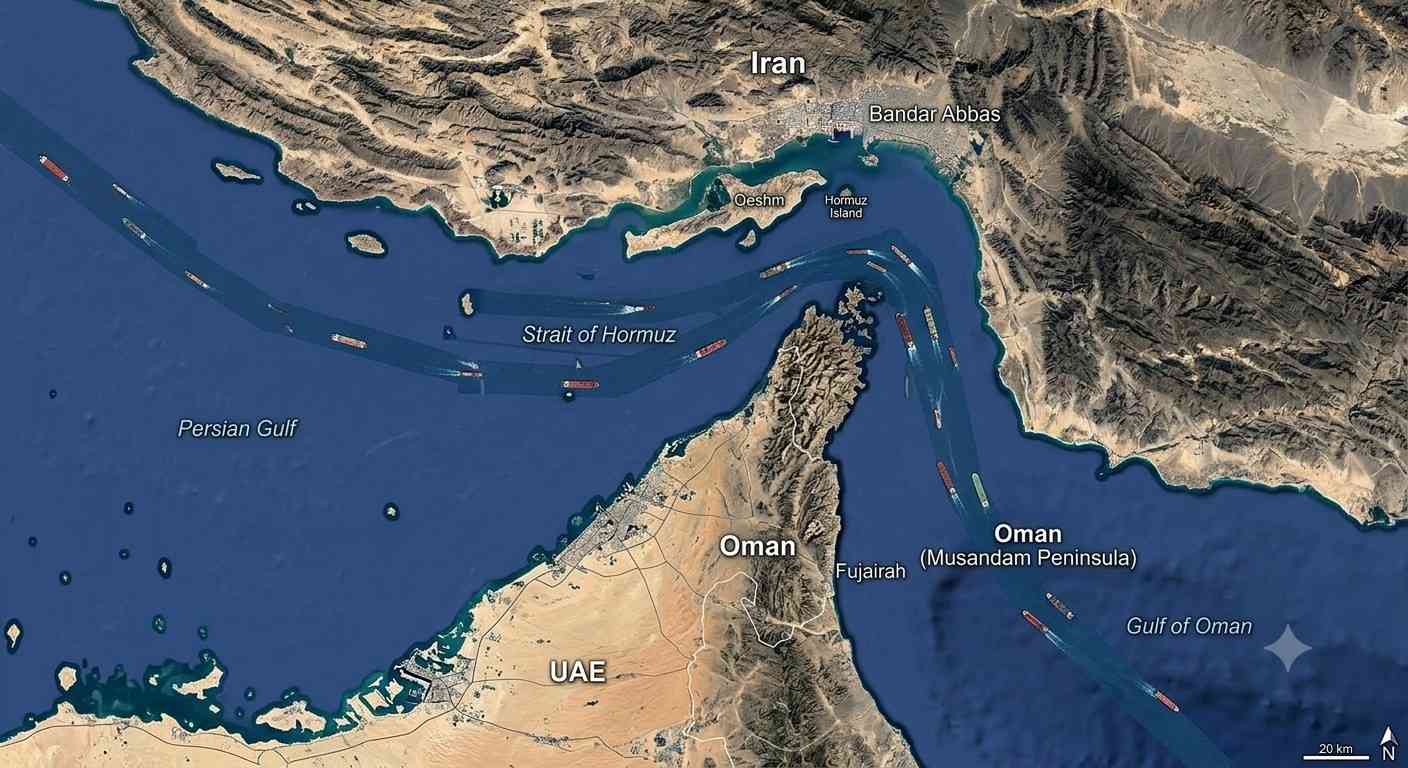
Iran / India, July 01 (Maritime News) –Few waterways carry as much strategic importance as the Strait of Hormuz. Connecting the Persian Gulf with the Gulf of Oman and the Arabian Sea, the narrow passage serves as one of the world’s most critical maritime chokepoints, supporting a substantial share of global crude oil, liquefied natural gas (LNG) and petroleum product shipments. For decades, despite recurring geopolitical tensions, commercial shipping continued to rely on the principle that vessels could transit the Strait with relative predictability under established international maritime practices.
The events of 2026 have altered that assumption.
The conflict that began following U.S. and Israeli military operations against Iran in February was followed by months of military escalation, diplomatic negotiations and evolving arrangements concerning navigation through the Strait. While a Memorandum of Understanding created the basis for restoring maritime traffic, questions surrounding the future administration of the waterway, navigation procedures and the interpretation of coastal state rights remain unresolved. Reports from Doha indicate that these issues are now central to ongoing technical negotiations between the United States and Iran, with mediators seeking a longer-term framework. At the same time, Iran has publicly asserted a greater role in managing navigation through the Strait and indicated that discussions concerning future maritime services and possible charges may follow the interim arrangements.
For the maritime industry, the debate extends far beyond regional politics.
Shipowners, charterers, insurers, ports, energy companies and governments are all attempting to understand whether the Strait is returning to its pre-conflict operating environment or entering a new phase where commercial navigation may increasingly be shaped by evolving geopolitical and regulatory realities.
A Waterway That Connects the World
The Strait of Hormuz is not simply a regional shipping lane.
It is one of the principal arteries of the global energy system.
Every day, tankers carrying crude oil, refined petroleum products, liquefied petroleum gas (LPG), liquefied natural gas (LNG) and other cargoes pass through this narrow corridor on their way to markets across Asia, Europe and beyond.
For major energy-importing nations—including India, China, Japan and South Korea—the uninterrupted movement of vessels through Hormuz remains fundamental to energy security and economic stability.
Its importance is therefore measured not only by geography but also by the confidence it provides to international commerce.
When shipping companies can predict safe passage, global supply chains function efficiently.
When uncertainty increases, freight costs, insurance premiums and operational risks begin to rise across the maritime sector.
From Military Conflict to Maritime Uncertainty
Before the outbreak of hostilities in February 2026, vessels routinely transited the Strait under established navigation practices.
Although geopolitical tensions periodically influenced risk assessments, commercial shipping generally continued without sustained interruption.
The conflict fundamentally changed that operating environment.
Military operations, heightened security concerns and competing assertions regarding navigation introduced new uncertainties for shipowners and cargo interests.
Subsequent diplomatic efforts resulted in an interim Memorandum of Understanding intended to reduce hostilities and facilitate the gradual resumption of maritime traffic.
However, while vessel movements have increasingly resumed, the discussions have evolved beyond ceasefire arrangements.
They now encompass broader questions concerning the future management of navigation, maritime services and long-term regional stability.
For the shipping industry, this represents a significant shift.
The issue is no longer solely whether vessels can transit the Strait safely today.
It is increasingly about the framework under which they may operate tomorrow.
Shipping Returns, but Confidence Recovers More Slowly
Recent weeks have seen a gradual increase in commercial vessel movements through the Strait.
Several India-bound crude oil tankers, LPG carriers and bulk vessels have successfully completed transits, while shipping companies continue to implement enhanced security procedures for crews operating in the region.
The return of traffic, however, should not be interpreted as a complete return to pre-conflict normality.
Maritime risk assessments remain dynamic.
Operators continue to monitor diplomatic negotiations, regional security developments, navigational guidance and insurance requirements before committing vessels to voyages through the area.
In shipping, confidence is restored incrementally.
Safe passages completed today contribute to confidence tomorrow, but strategic uncertainty can persist long after military operations have ended.
A Debate That Extends Beyond One Strait
The current discussions surrounding the Strait of Hormuz are attracting global attention because they touch upon fundamental questions relevant to international shipping.
How should strategic waterways be managed after periods of conflict?
How should the interests of coastal states be balanced with the expectations of international maritime commerce?
What role should diplomacy, international law and operational safety play in maintaining confidence within global shipping networks?
These questions extend beyond the Gulf region.
They are relevant to every maritime chokepoint supporting international trade.
For this reason, the outcome of the current negotiations is being followed not only by governments but also by shipowners, insurers, classification societies, energy companies and logistics providers around the world.
MaritimeNews Insight
The most important development is not that shipping has resumed through the Strait of Hormuz.
The more significant development is that the maritime industry is now confronting a broader discussion about the future governance of one of the world’s most important strategic waterways.
Commercial shipping depends upon predictability.
Whenever navigation arrangements evolve following major geopolitical events, the implications extend well beyond regional diplomacy.
They influence freight markets, insurance, investment decisions, energy security and confidence across global maritime trade.
The Strait of Hormuz has therefore become more than a passage connecting two bodies of water.
It has become a case study in how geopolitics and maritime commerce increasingly intersect in the twenty-first century.
Is the Strait of Hormuz Entering a New Era?
For decades, the Strait of Hormuz has operated under a practical understanding shared by the international maritime community.
Regardless of recurring political tensions, commercial vessels generally expected that the Strait would remain open to international navigation, allowing energy supplies and commercial cargoes to move between the Persian Gulf and global markets with a reasonable degree of predictability.
The developments following the 2026 conflict have introduced a new dimension to that long-standing assumption.
The discussion is no longer limited to reopening the Strait after military hostilities.
It has expanded into broader questions concerning navigation management, maritime services, coastal state responsibilities and the future governance of one of the world’s most strategically significant waterways.
For the maritime industry, these questions carry implications extending well beyond the Middle East.
The Debate Is No Longer Only About Access
Commercial shipping has gradually resumed through the Strait.
Several crude oil tankers, LNG carriers, LPG vessels and bulk carriers have completed successful voyages following the interim understanding reached between the parties.
However, operational access represents only one element of the evolving situation.
Public statements emerging alongside the negotiations indicate that discussions are increasingly focused on how navigation through the Strait may be administered in the future, including the role of coastal states, navigational management and maritime services.
For shipowners, these discussions introduce a new layer of operational planning.
The industry is now monitoring not only regional security developments but also the possibility of changes in navigational procedures, administrative arrangements and the practical implementation of any future agreements.
Predictability has become as important as physical access.
Freedom of Navigation and Coastal State Interests
One of the central issues emerging from the post-conflict negotiations concerns the relationship between two principles that have long existed within international maritime practice.
The first is the expectation that international shipping should enjoy reliable passage through strategic waterways connecting different parts of the world’s oceans.
The second recognises that coastal states possess rights and responsibilities relating to waters adjacent to their territory, including matters concerning safety, environmental protection and maritime administration.
Balancing these principles has never been simple.
Strategic straits around the world often require cooperation between neighbouring states while simultaneously supporting uninterrupted international commerce.
The Strait of Hormuz now finds itself at the centre of renewed discussion regarding how these principles should be interpreted in an evolving geopolitical environment.
Rather than representing a purely regional issue, the debate has relevance for the wider maritime community because similar questions may arise wherever international shipping depends upon narrow and strategically important waterways.
Maritime Services May Become Part of Future Discussions
Among the issues receiving attention during recent diplomatic exchanges is the broader concept of maritime services associated with navigation through the Strait.
While public debate has frequently focused on possible transit-related charges, the larger maritime question concerns how future navigation management could be organised if new administrative arrangements are eventually introduced.
Around the world, commercial shipping already interacts with various maritime services depending on the operational characteristics of particular waterways.
These may include vessel traffic management, navigational assistance, hydrographic support, pilotage requirements where applicable, environmental monitoring and emergency response coordination.
Whether any future framework for the Strait of Hormuz ultimately incorporates additional administrative mechanisms remains subject to diplomatic negotiations.
At present, no permanent arrangement has been concluded.
For the shipping industry, the key issue is not speculation but clarity.
Operators require transparent, internationally understood procedures that allow voyage planning, contractual obligations and insurance arrangements to function without unnecessary uncertainty.
Shipping Thrives on Predictability
International shipping is built upon long-term planning.
Voyages are scheduled months in advance.
Cargo contracts are negotiated before ships leave port.
Charter rates, insurance premiums, bunker planning and port rotations all depend upon reasonably predictable operating conditions.
When uncertainty enters a major maritime corridor, the effects extend far beyond the ships navigating that waterway.
Additional security measures.
Higher insurance assessments.
Revised voyage planning.
Crew welfare considerations.
Freight market volatility.
Each of these factors influences the wider economics of international trade.
For this reason, the maritime industry generally places enormous value on stable and clearly understood navigation arrangements.
The Strait of Hormuz illustrates how strategic waterways function not only as physical passages but also as foundations of commercial confidence.
Lessons for Other Strategic Chokepoints
The significance of the current developments extends beyond the Persian Gulf.
Other strategically important waterways—including the Bab el-Mandeb Strait, the Strait of Malacca, the Bosporus, the Suez Canal and the Panama Canal—each occupy essential positions within global maritime trade.
Although every waterway operates under its own legal, geographic and political circumstances, the discussions surrounding Hormuz are likely to be closely observed by governments, maritime administrations and shipping companies around the world.
Any evolution in the governance of one major international chokepoint inevitably attracts attention because it may influence future thinking on maritime resilience, navigational management and regional cooperation elsewhere.
For that reason, the implications of the current negotiations extend well beyond a single region.
MaritimeNews Insight
The Strait of Hormuz is no longer simply a question of whether ships can sail through safely.
It has become a broader discussion about how strategic waterways may be governed in an era where geopolitical competition, energy security and international commerce increasingly intersect.
For the maritime industry, the greatest requirement is not necessarily a particular political outcome.
It is the establishment of stable, transparent and internationally understood navigation arrangements that allow commercial shipping to operate with confidence while respecting applicable international law and the legitimate interests of the states bordering these critical waterways.
The future competitiveness of global shipping depends as much upon governance certainty as it does upon navigational safety.
Excellent. We now move into what I consider the commercial core of the report. Unlike Parts 1 and 2, this chapter will explain how developments in the Strait of Hormuz affect the economics of global shipping, rather than focusing on diplomacy or maritime law.
When Uncertainty Becomes the Costliest Cargo
For the global maritime industry, the Strait of Hormuz has never been merely a narrow stretch of water connecting the Persian Gulf with the Gulf of Oman.
It is one of the world’s most indispensable commercial shipping corridors, carrying a substantial share of internationally traded crude oil, liquefied natural gas (LNG), liquefied petroleum gas (LPG), refined petroleum products and petrochemical cargoes. Every day, hundreds of vessels depend upon the uninterrupted functioning of this strategic passage to connect Gulf producers with energy-hungry markets across Asia, Europe and beyond.
The events of 2026 have demonstrated that the vulnerability of the Strait extends beyond the possibility of physical disruption.
The greater challenge for the maritime industry is operational uncertainty.
Commercial shipping can often adapt to temporary disruptions through revised schedules, contingency planning and alternative commercial arrangements. Uncertainty, however, is far more difficult to manage because it affects every stage of voyage planning, commercial negotiations and risk assessment long before a ship approaches the Strait.
For shipowners, charterers and cargo interests, predictability is often as valuable as physical access.
The World’s Energy Lifeline Cannot Be Easily Replaced
The importance of the Strait of Hormuz lies not only in the volume of cargo that passes through it but also in the limited availability of practical alternatives.
The waterway serves as the principal maritime outlet for several of the world’s largest hydrocarbon exporters. Crude oil, LNG, LPG, condensates and petrochemical products destined for major importing economies depend heavily upon uninterrupted transit through the Strait.
While some pipeline infrastructure exists within the Gulf region, these systems cannot fully substitute for the capacity provided by maritime transportation.
For this reason, shipping remains the dominant mode for moving Gulf energy exports to global markets.
This dependence means that developments in Hormuz are quickly reflected in freight markets, insurance assessments, commodity prices and commercial planning across the international maritime sector.
Tanker Operators Navigate More Than Geography
For operators of Very Large Crude Carriers (VLCCs), Suezmax tankers and Aframax vessels, voyage planning increasingly involves geopolitical analysis alongside navigational considerations.
Every transit through a strategically sensitive waterway requires careful evaluation of:
- Regional security conditions.
- Voyage timing.
- Insurance requirements.
- Crew safety procedures.
- Communication protocols.
- Port scheduling.
- Commercial obligations.
Even when navigation remains possible, uncertainty influences operational decision-making.
Shipowners may choose to delay departures pending updated security assessments.
Charterers may negotiate revised contractual terms to accommodate evolving risks.
Cargo interests may adjust loading schedules to reduce potential exposure.
These commercial decisions rarely attract public attention, yet collectively they shape the efficiency and resilience of global energy transportation.
LNG and LPG Shipping Operate on Precision
Liquefied gas shipping is particularly sensitive to operational disruption.
Unlike many dry bulk commodities, LNG cargoes are transported under highly specialised contractual arrangements with carefully coordinated loading and discharge schedules.
Any uncertainty affecting voyage planning may influence not only vessel operations but also downstream energy supply chains.
LPG carriers and chemical tankers face similar considerations.
Refineries, petrochemical complexes and industrial consumers depend upon timely deliveries that often support continuous production processes.
Consequently, even relatively short periods of uncertainty can create ripple effects extending well beyond the maritime sector.
This explains why developments in the Strait of Hormuz receive such close attention from global energy markets.
Marine Insurance Responds Before Markets Stabilise
Marine insurers are among the first stakeholders to reassess conditions following geopolitical developments.
Changes in regional security can influence:
- War-risk assessments.
- Additional insurance premiums.
- Voyage reporting requirements.
- Risk monitoring procedures.
- Operational guidance issued to ship operators.
For shipowners, these adjustments translate directly into commercial costs.
Higher insurance premiums increase voyage expenses.
Additional security measures require greater operational planning.
Longer decision-making processes may influence vessel availability and charter market dynamics.
Insurance therefore functions not only as financial protection but also as an indicator of how the maritime industry collectively evaluates evolving operational risk.
Freight Markets Reflect Confidence
Shipping markets respond rapidly to changes in confidence.
Periods of uncertainty often contribute to fluctuations in freight rates as market participants reassess risk, vessel availability and voyage economics.
Charter negotiations increasingly incorporate considerations extending beyond fuel consumption and voyage duration.
Security conditions.
Insurance costs.
Potential delays.
Crew welfare.
Operational flexibility.
All become elements of commercial negotiations.
The Strait of Hormuz therefore influences freight economics not simply through physical access but through market expectations regarding future stability.
Confidence itself becomes an economic variable.
Seafarers Remain at the Centre of Maritime Resilience
Every commercial vessel transiting the Strait ultimately depends upon its crew.
Periods of heightened geopolitical tension place additional responsibilities upon seafarers who must continue operating safely while complying with enhanced security procedures and evolving navigational guidance.
Bridge teams monitor security advisories alongside weather reports.
Masters coordinate with company security officers.
Crews participate in additional preparedness measures designed to reduce operational vulnerability.
The professionalism demonstrated by seafarers during such periods often receives limited public recognition.
Yet their ability to maintain safe navigation under uncertain conditions remains fundamental to the continuity of global trade.
Any discussion of maritime resilience must therefore recognise that shipping depends not only upon ships and infrastructure but also upon the competence and wellbeing of those serving at sea.
Supply Chains Depend on Confidence as Much as Connectivity
Modern supply chains are designed around reliability.
Energy importers, refiners, manufacturers and industrial consumers all rely upon predictable maritime transportation to maintain inventories and production schedules.
When confidence in a strategic shipping corridor declines, businesses frequently respond by reviewing inventory strategies, procurement plans and logistics arrangements.
These responses may increase costs throughout the supply chain even if physical cargo movements continue.
In this respect, the commercial impact of uncertainty often extends far beyond the immediate geographic area of a geopolitical crisis.
Strategic waterways support more than maritime transportation.
They underpin global economic stability.
MaritimeNews Insight
The events surrounding the Strait of Hormuz illustrate an important reality of modern shipping.
The greatest commercial disruption does not necessarily occur when ships stop sailing.
It often begins much earlier—when confidence begins to erode.
Every increase in insurance costs.
Every revision of voyage plans.
Every additional security assessment.
Every delayed charter decision.
Each represents the economic cost of uncertainty.
For the maritime industry, preserving confidence in strategic waterways is therefore as important as preserving physical access.
Stable governance, transparent navigation arrangements and effective diplomacy contribute not only to maritime safety but also to the efficient functioning of global commerce.
Why the Strait of Hormuz Is More Than a Shipping Lane—It Is India’s Maritime Lifeline
For India, the Strait of Hormuz is not merely an international maritime chokepoint situated thousands of kilometres from its coastline.
It is one of the most strategically significant sea lanes underpinning the country’s energy security, industrial growth, maritime trade and economic stability.
While the international debate surrounding the Strait often focuses on geopolitics, sovereignty and international law, India’s perspective is necessarily more practical. Every tanker that safely transits Hormuz contributes directly to keeping Indian refineries operational, industries productive, transport systems functioning and households supplied with essential energy.
In many respects, India’s economic resilience begins well before cargo reaches an Indian port.
It begins with uninterrupted navigation through the Strait of Hormuz.
India’s Energy Security Starts at Sea
India is among the world’s largest importers of crude oil, and a substantial proportion of those imports originate from Gulf producers whose exports pass through the Strait of Hormuz.
Every day, crude oil tankers carrying cargoes from countries such as Saudi Arabia, Iraq, the United Arab Emirates, Kuwait and, where applicable under prevailing policy frameworks, other regional suppliers navigate this strategic waterway before proceeding towards Indian ports.
The significance extends beyond crude oil alone.
The Strait also serves as a critical maritime corridor for:
- Liquefied Natural Gas (LNG)
- Liquefied Petroleum Gas (LPG)
- Petrochemical feedstocks
- Sulphur
- Fertiliser raw materials
- Chemical products
- Industrial gases
These commodities support India’s electricity generation, fertiliser production, manufacturing sector, transportation network and domestic energy requirements.
Consequently, any prolonged disruption—or even sustained uncertainty—in Hormuz has implications that reach far beyond maritime logistics.
It influences national energy security itself.
The Refining Sector Depends Upon Maritime Stability
India has developed one of the world’s largest refining industries, serving both domestic demand and international export markets.
Modern refineries require uninterrupted supplies of crude oil delivered according to carefully planned schedules.
Refining operations cannot simply pause because geopolitical uncertainty affects shipping routes.
Even relatively modest delays in tanker arrivals can influence inventory planning, refinery utilisation and supply chain efficiency.
Should shipping costs rise due to increased insurance premiums, enhanced security requirements or operational uncertainty, the economic effects eventually cascade through the broader energy sector.
The Strait of Hormuz therefore represents not only an international shipping concern but also an operational consideration for India’s refining ecosystem.
Maritime stability supports refining stability.
Strategic Petroleum Reserves Reduce Risk—But Do Not Eliminate It
India has invested in Strategic Petroleum Reserves (SPR) to strengthen national preparedness against external supply disruptions.
These reserves provide an important buffer during periods of international instability and demonstrate the country’s recognition that energy security requires long-term planning.
However, strategic reserves are designed to absorb temporary shocks rather than replace sustained maritime supply.
The continued movement of commercial tankers through the Strait remains indispensable for maintaining normal economic activity.
Strategic reserves buy time.
They do not replace uninterrupted maritime commerce.
This distinction reinforces why developments in Hormuz are closely monitored not only by policymakers but also by energy companies, refiners and shipping operators across India.
Indian Ports Feel the Effects Long Before Cargo Arrives
The consequences of developments in the Strait extend to India’s major ports.
Energy terminals handling crude oil, LNG and LPG rely upon predictable vessel arrivals to optimise berth allocation, cargo discharge and downstream logistics.
Ports including:
- Jawaharlal Nehru Port region (energy logistics ecosystem)
- Kandla
- Mundra
- Mangalore
- Kochi
- Paradip
- Visakhapatnam
- Chennai and associated petroleum infrastructure
all operate within supply chains that are ultimately connected to maritime stability in the Gulf.
When voyage schedules become uncertain, ports must adjust operational planning, terminal utilisation and landside logistics.
Although Indian ports possess significant operational resilience, efficient port management depends upon reliable shipping schedules rather than continual contingency planning.
Indian Shipping Companies Face Commercial Exposure
Indian shipping companies engaged in tanker transportation, offshore logistics and energy-related maritime services operate within the same commercial environment affecting international shipowners.
Periods of heightened geopolitical tension influence:
- Voyage planning.
- Charter negotiations.
- Insurance costs.
- Operational risk assessments.
- Crew management.
- Contractual flexibility.
Even operators not directly trading through the Strait may experience indirect effects as freight markets respond to changing global conditions.
The interconnected nature of maritime commerce means that regional geopolitical developments frequently influence worldwide shipping economics.
For Indian shipowners, commercial resilience increasingly depends upon the ability to anticipate and adapt to evolving geopolitical risk.
Indian-Flag Vessels and Seafarers
India is one of the world’s leading suppliers of skilled maritime professionals.
Thousands of Indian seafarers serve aboard tankers, LNG carriers, bulk carriers, container ships and offshore support vessels operating throughout the Gulf region.
For these professionals, developments in the Strait of Hormuz are not abstract geopolitical events.
They influence daily operational realities.
Periods of heightened regional tension require:
- Enhanced ship security procedures.
- Additional navigational vigilance.
- Closer communication with company security officers.
- Continuous monitoring of maritime advisories.
- Greater psychological resilience while operating in high-risk environments.
The safety and wellbeing of Indian seafarers therefore remain an integral component of India’s maritime security interests.
Protecting shipping also means protecting the people who operate it.
India’s Energy Diplomacy Balances Multiple Relationships
India’s approach to the Strait of Hormuz reflects a broader diplomatic philosophy centred on strategic autonomy and practical engagement.
The country maintains important relationships with Gulf energy producers, Iran, the United States and other international partners whose interests intersect in the region.
Rather than framing the issue through geopolitical rivalry, India has consistently emphasised dialogue, regional stability and uninterrupted maritime commerce.
This balanced approach serves multiple national objectives:
- Energy security.
- Stable trade.
- Maritime safety.
- Regional stability.
- Economic growth.
By maintaining constructive engagement across diverse partners, India seeks to reduce strategic vulnerability while preserving long-term access to essential energy supplies.
For India, diplomacy and maritime security are increasingly interconnected.
Freedom of Navigation Is a Strategic National Interest
For some countries, freedom of navigation is principally a legal concept.
For India, it is also an economic necessity.
Secure access through international shipping corridors enables:
- Energy imports.
- Industrial production.
- Export competitiveness.
- Supply chain resilience.
- Consumer price stability.
- National economic growth.
The Strait of Hormuz therefore represents far more than an international maritime route.
It is one of the principal arteries connecting India’s economy with global energy markets.
Any prolonged uncertainty affecting this corridor inevitably becomes a matter of national strategic importance.
This explains why India consistently advocates peaceful resolution of disputes, respect for international maritime law and the uninterrupted movement of commercial shipping.
Freedom of navigation is not merely a principle.
For India, it is a prerequisite for long-term economic resilience.
MaritimeNews Insight
India’s maritime interests in the Strait of Hormuz extend well beyond the safe arrival of oil tankers.
They encompass an entire ecosystem comprising ports, refineries, shipping companies, energy infrastructure, industrial production, seafarers and diplomatic engagement.
As India continues its journey towards becoming one of the world’s leading economies, the stability of strategic maritime chokepoints will become increasingly important to national development.
The future of India’s maritime strategy will therefore depend not only upon expanding port capacity or strengthening domestic shipping but also upon supporting a stable, rules-based international maritime environment where commercial navigation can continue without unnecessary disruption.
A Watershed Moment for International Maritime Governance
The events that unfolded in the Strait of Hormuz during 2026 may ultimately be remembered not simply as another regional geopolitical crisis, but as a defining moment in the evolution of international maritime governance.
For more than four decades, global shipping operated under an assumption that certain strategic waterways, while geographically located within the territorial seas of coastal states, would continue to function under broadly accepted international norms that ensured predictable commercial navigation.
The Strait of Hormuz represented one of those assumptions.
Following the 2026 conflict, however, a different model has begun to emerge.
Rather than debating whether ships may transit the Strait, the discussion has shifted toward how that transit should be administered, monitored, regulated and potentially monetised by the coastal states themselves.
This represents an important conceptual change.
The debate is no longer about closure.
It is about governance.
That distinction may shape international maritime policy for decades.
From Open Passage to Managed Passage
For decades, maritime commerce relied upon a relatively simple operational expectation.
Ships complied with international regulations, respected coastal state laws applicable under international law and transited strategic waterways with minimal political intervention.
The Hormuz experience suggests that future governance may become considerably more sophisticated.
Future transit arrangements could increasingly involve:
- Mandatory traffic management systems.
- Digital voyage reporting.
- Security coordination.
- Environmental compliance.
- Vessel identification protocols.
- Emergency response integration.
- Cooperative maritime surveillance.
- Cost-sharing mechanisms for navigational services.
Rather than reducing freedom of navigation, such systems may seek to organise it within a more structured operational framework.
The challenge will be ensuring that these governance mechanisms remain transparent, non-discriminatory and consistent with international maritime law.
Could Other Chokepoints Follow?
The implications extend far beyond the Persian Gulf.
Several of the world’s most important maritime chokepoints share characteristics similar to the Strait of Hormuz.
Bab el-Mandeb
Connecting the Red Sea with the Gulf of Aden, Bab el-Mandeb has already experienced security challenges associated with regional conflict, piracy and attacks on commercial shipping.
Future governance discussions may increasingly combine security management with coordinated international oversight.
Strait of Malacca
As one of the busiest shipping lanes in the world, the Strait of Malacca already depends upon close cooperation between Indonesia, Malaysia and Singapore.
Growing vessel traffic, environmental concerns and geopolitical competition may encourage even more integrated governance arrangements without compromising navigational efficiency.
Bosporus and Turkish Straits
The Turkish Straits demonstrate that strategic waterways can already operate under specialised international legal regimes balancing national sovereignty with international commercial navigation.
Hormuz may encourage renewed examination of similar governance principles elsewhere.
Suez Canal
Unlike natural international straits, the Suez Canal represents an engineered maritime corridor administered by a sovereign state.
Nevertheless, recent disruptions have highlighted how global trade increasingly depends upon resilient governance structures capable of maintaining uninterrupted international commerce.
Panama Canal
Climate variability, water availability and transit scheduling have already transformed governance discussions surrounding the Panama Canal.
Future maritime governance may place equal emphasis upon infrastructure resilience and commercial predictability.
Arctic Shipping Routes
As polar navigation expands, entirely new governance questions will emerge regarding environmental protection, coastal jurisdiction, navigation safety and commercial access.
The lessons learned from Hormuz may influence policy development in regions where legal frameworks continue to evolve.
UNCLOS Remains the Foundation—But Interpretation Is Evolving
The 1982 United Nations Convention on the Law of the Sea (UNCLOS) remains the cornerstone of modern maritime law.
Its provisions governing transit passage, innocent passage, coastal state jurisdiction and navigational rights continue to provide the legal architecture supporting international shipping.
Yet international law does not operate in isolation from geopolitical realities.
The Hormuz experience illustrates that while legal principles may remain constant, their practical implementation increasingly depends upon diplomacy, regional security conditions and operational cooperation between coastal and user states.
Future maritime governance is therefore likely to depend less upon rewriting international law than upon developing practical mechanisms for implementing existing legal principles under changing strategic circumstances.
The Expanding Role of the IMO
As shipping becomes increasingly interconnected with geopolitics, the International Maritime Organization (IMO) may find its role expanding beyond traditional regulatory functions.
Future priorities could include:
- Best practices for strategic waterway governance.
- Enhanced navigational risk management.
- Digital vessel reporting standards.
- Integrated maritime security coordination.
- Environmental safeguards for congested sea lanes.
- Guidance on balancing navigational freedom with coastal state responsibilities.
Although the IMO is not a security organisation, its technical expertise may become increasingly important as governments seek internationally accepted operational standards for complex maritime environments.
Maritime Governance in the Twenty-First Century
The future of maritime governance is unlikely to be defined by absolute control or unrestricted freedom.
Instead, it will probably be characterised by continuous cooperation between coastal states, user states, shipping companies, international organisations and maritime regulators.
The objective will remain unchanged:
Safe.
Predictable.
Efficient.
Environmentally responsible.
Commercially viable navigation.
The mechanisms for achieving those objectives, however, are likely to become considerably more sophisticated than those developed during the twentieth century.
Hormuz may simply be the first major test of this emerging governance model.
MaritimeNews Policy Perspective
The Strait of Hormuz should not be viewed solely as a regional geopolitical flashpoint.
It should be understood as the beginning of a broader transformation in how the international community governs strategic maritime infrastructure.
The Hormuz Doctrine, as proposed by MaritimeNews, suggests that the future of international shipping will increasingly depend upon collaborative governance rather than binary debates between unrestricted navigation and absolute sovereignty.
The next generation of maritime policy will therefore be shaped by four complementary pillars:
- Respect for international maritime law.
- Recognition of legitimate coastal state interests.
- Protection of uninterrupted global commerce.
- Institutional cooperation through international maritime governance.
Successfully balancing these principles may become one of the defining challenges for maritime policymakers during the coming decades.
The Strait of Hormuz Has Not Changed Geography—It Has Changed Maritime Thinking
For decades, the Strait of Hormuz has been viewed primarily through the lens of geopolitics. Governments debated regional rivalries, military deployments and diplomatic tensions, while the global maritime industry continued to treat the waterway as an indispensable, if occasionally volatile, commercial corridor.
The events of 2026 have altered that perspective.
The conflict has demonstrated that the future of strategic maritime chokepoints cannot be understood solely through military or political analysis. Their significance lies equally in their ability to sustain uninterrupted global commerce, preserve energy security and maintain confidence in the international maritime system.
The Strait of Hormuz is no longer merely a passage connecting the Persian Gulf with the Arabian Sea.
It has become a global test of how international shipping, coastal-state sovereignty and international maritime law can coexist within an increasingly complex geopolitical environment.
Shipping Depends on Predictability More Than Certainty
One of the most important lessons from the 2026 Hormuz crisis is that commercial shipping is fundamentally built upon predictability.
Ships can adapt to adverse weather.
Ports can recover from temporary disruptions.
Supply chains can adjust to operational delays.
What is far more difficult to manage is uncertainty over the rules governing international navigation.
Every voyage begins long before a vessel leaves port.
Shipowners negotiate charter parties.
Cargo interests commit to delivery schedules.
Marine insurers assess operational exposure.
Ports allocate berths.
Refineries plan crude intake.
Industries schedule production.
When uncertainty surrounds one of the world’s most important shipping corridors, its effects ripple across the entire maritime value chain.
In this respect, confidence becomes as valuable as physical access.
Maritime Governance Is Becoming as Important as Maritime Infrastructure
Historically, investment in maritime development focused on ports, ships, canals and logistics infrastructure.
The Strait of Hormuz demonstrates that governance itself has become critical infrastructure.
Transparent navigation arrangements.
Clearly understood legal frameworks.
Effective maritime diplomacy.
Reliable security cooperation.
Predictable operational procedures.
These are now essential components of efficient global shipping.
The resilience of maritime trade will increasingly depend not only upon physical infrastructure but also upon the quality of governance supporting international navigation.
The Future Lies in Cooperation, Not Confrontation
The commercial shipping industry has a fundamental interest that transcends geopolitics.
Safe.
Secure.
Predictable.
Efficient navigation.
These objectives cannot be achieved through unilateral action alone.
Nor can they be sustained through perpetual confrontation.
The future governance of strategic maritime corridors will require continuous cooperation among:
- Coastal states.
- Maritime user states.
- International organisations.
- Port authorities.
- Shipping companies.
- Marine insurers.
- Classification societies.
- Maritime administrations.
Balancing sovereign rights with the collective interests of international commerce will remain one of the defining policy challenges of the twenty-first century.
Why This Matters Beyond the Gulf
The significance of Hormuz extends well beyond West Asia.
Every nation dependent upon maritime trade has an interest in how this evolving governance model develops.
The questions raised today in Hormuz may tomorrow arise in:
- Bab el-Mandeb.
- The Strait of Malacca.
- The Turkish Straits.
- The Suez Canal.
- The Panama Canal.
- Emerging Arctic shipping routes.
As geopolitical competition, climate change and maritime trade continue to reshape global commerce, strategic waterways will increasingly become focal points where law, economics, security and diplomacy intersect.
The international maritime community must therefore prepare for a future in which governance of these corridors becomes progressively more sophisticated and cooperative.
The MaritimeNews Editorial Position
MaritimeNews believes that the lessons emerging from the Strait of Hormuz should encourage stronger—not weaker—commitment to a rules-based maritime order.
International shipping depends upon freedom of navigation, but that freedom must coexist with legitimate coastal-state responsibilities, navigational safety, environmental protection and regional stability.
Neither unrestricted unilateralism nor excessive restriction serves the long-term interests of global commerce.
Instead, the maritime community should pursue governance models that are:
- Consistent with international maritime law.
- Operationally transparent.
- Commercially predictable.
- Technically robust.
- Internationally cooperative.
- Respectful of both sovereign rights and global trade.
Such an approach offers the strongest foundation for preserving confidence in international shipping while adapting to evolving geopolitical realities.
Final Reflection
The Strait of Hormuz has not fundamentally changed because ships continue to pass through it.
It has changed because the assumptions underpinning international maritime navigation are being re-examined.
The debate has evolved from whether the Strait should remain open to how one of the world’s most strategically significant waterways should be governed in an era defined by geopolitical competition, energy transition and increasingly interconnected global supply chains.
History may ultimately judge the 2026 Hormuz crisis not as the moment when global shipping was interrupted, but as the moment when the international maritime community recognised that governance, cooperation and predictability are every bit as important as ships, ports and sea lanes themselves.
MaritimeNews Final Verdict
Has the Strait of Hormuz entered a new era where shipping, sovereignty and international law must coexist under a more complex framework than existed before the 2026 conflict?
The evidence suggests that it has.
Whether this evolution strengthens or weakens global maritime commerce will depend not upon any single nation or institution, but upon the collective ability of governments, international organisations and the shipping industry to uphold a rules-based maritime order while accommodating legitimate security and governance concerns.
The future of global shipping will therefore be determined not only by the movement of vessels across strategic waterways, but also by the wisdom with which those waterways are governed.
For the international maritime community, the Strait of Hormuz is no longer simply a chokepoint.
It is the first major case study of twenty-first-century maritime governance.
MaritimeNews Editorial Certification
This report has been prepared as an independent maritime policy analysis synthesising diplomatic developments, commercial shipping considerations, international maritime law, energy security, strategic governance and India’s maritime interests. It does not advocate the legal or political claims of any state or party. Its purpose is to contribute to informed discussion on the future governance of strategic maritime chokepoints from the perspective of the global maritime industry.
Reporting Basis: International Newspapers and MaritimeNews Analysis
Reporting by MaritimeNews Bureaus, Writing by Jaspal Singh Naol