

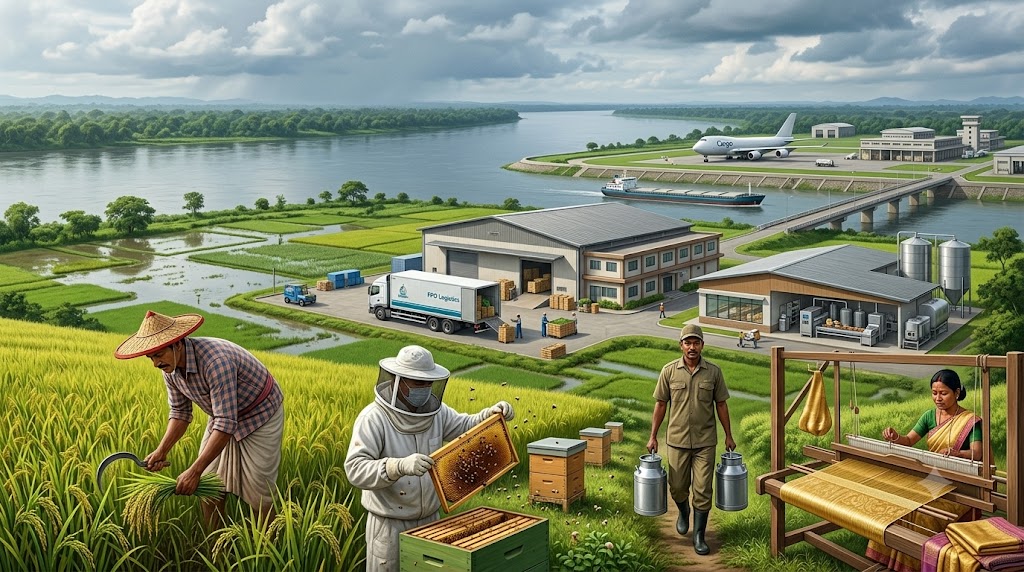
Assam’s export ambitions and climate resilience are now inseparable, making resilient rural value chains a critical foundation for sustainable economic growth and global competitiveness
Make us preferred source on Google
Key Takeaways
- Assam is emerging as a producer of premium, value-added exports, supported by GI products, food processing, branding and market diversification.
- Floods and riverbank erosion remain structural economic challenges, affecting agriculture, infrastructure, livelihoods and long-term productivity.
- Export competitiveness begins in villages, where farmers, dairy producers, beekeepers, weavers and cooperatives form the first link in every international value chain.
- Climate resilience is becoming an economic necessity, requiring investment in resilient infrastructure, logistics, storage and producer organisations.
- Future export growth will depend as much on adaptation and resilience as on trade promotion, branding and international market access.
Assam, India, July 29 (Maritime News) – From GI-tagged Joha Rice and Tezpur Litchi to Baksa Honey, Purabi Ice Cream and premium Muga Silk, Assam is steadily expanding its presence in global markets through value-added agricultural and rural products. Yet the state’s recurring floods and riverbank erosion continue to threaten the landscapes, livelihoods and infrastructure that sustain these emerging export value chains. As climate risks intensify, Assam’s export ambitions may increasingly depend not only on market access, but on building a resilient rural economy capable of withstanding one of India’s most dynamic river systems.
Assam is witnessing a significant transformation in its export landscape. Recent international shipments of GI-tagged Joha Rice, Tezpur Litchi, Baksa Honey and Purabi Ice Cream, coupled with initiatives such as Mission Senehjori to promote Muga Silk, reflect a strategic shift from exporting raw commodities towards branding, value addition and premium international markets.
However, this economic transition is unfolding against the backdrop of one of India’s most flood-prone regions. Nearly 40% of Assam’s geographical area is vulnerable to flooding, while decades of riverbank erosion have permanently reduced productive agricultural land. The severe floods witnessed in 2026 once again highlighted the vulnerability of rural communities, agricultural production systems and transport infrastructure.
The central question facing policymakers is therefore no longer whether Assam can produce globally competitive products. The larger challenge is whether the state can build climate-resilient production systems, logistics networks and rural institutions capable of sustaining export growth in an increasingly uncertain environmental landscape.
Also Read: India’s Trade Performance Highlights Goods and Markets Requiring Attention
Assam’s Export Story Is Changing
For decades, Assam’s economic identity has been shaped largely by tea, petroleum, coal and traditional agricultural commodities. While these sectors continue to remain important contributors to the state’s economy, recent developments indicate that Assam is gradually entering a new phase of export-led growth centred on premium agricultural products, geographical indications (GI), food processing and value addition.
Over the past few months alone, Assam has recorded a series of notable export milestones. GI-tagged Joha Rice has reached consumers in the United Kingdom and Italy. Premium Tezpur Litchi has entered markets in Dubai. Honey produced by beekeepers in Baksa district has found buyers in the United States. Purabi Ice Cream, manufactured by the West Assam Milk Producers’ Cooperative Union Limited (WAMUL), has crossed the international border into Bhutan. At the same time, Mission Senehjori has been launched to strengthen Assam’s globally renowned Muga Silk ecosystem through improved production, branding and market development.
Viewed individually, these appear to be isolated export success stories. Viewed collectively, however, they reveal something more significant—a deliberate attempt to reposition Assam from a supplier of primary commodities to a producer of high-value, premium products capable of competing in international markets.
This transformation reflects a broader national strategy that emphasises value addition, Geographical Indication (GI) branding, Farmer Producer Organisations (FPOs), export-oriented agriculture, food processing and market diversification. Supported by institutions such as the Agricultural and Processed Food Products Export Development Authority (APEDA), the Department of Commerce and various state-level initiatives, Assam is increasingly integrating its traditional strengths with modern export ecosystems.
For a state endowed with exceptional biodiversity, distinctive agricultural products and centuries-old artisanal traditions, this presents a unique economic opportunity. Premium rice varieties, organic honey, horticultural produce, dairy products and luxury silk possess characteristics that are increasingly valued in international markets where consumers seek authenticity, traceability and geographical uniqueness.
Yet export success is measured not merely by consignments leaving airports or crossing international borders. It depends on the resilience of the production systems that make those shipments possible.
And that is where Assam’s greatest challenge begins.
Also Read: India Trade Deficit Widens Despite Strong Export Growth
A Geography That Shapes Every Economic Ambition
Unlike many Indian states where floods are occasional natural disasters, flooding in Assam is a defining geographical reality that influences agriculture, infrastructure, settlement patterns and economic planning.
The state lies within the vast Brahmaputra and Barak river basins, supported by more than fifty tributaries descending from the Himalayas and surrounding hill ranges. During the southwest monsoon, heavy rainfall across Assam and neighbouring states rapidly increases river discharge. As these rivers flow through Assam’s expansive floodplains, they deposit enormous quantities of sand and silt, reducing channel capacity and increasing the likelihood of seasonal inundation.
According to official assessments, approximately 31.05 lakh hectares—or 39.58% of Assam’s geographical area—is classified as flood-prone. This is nearly four times higher than the national average for flood-prone land, making Assam one of India’s most environmentally vulnerable states.
Floods are not isolated events. Many districts experience multiple waves during a single monsoon season, affecting agriculture, transport, housing and public infrastructure. Alongside flooding, riverbank erosion presents an even more persistent challenge. Since 1950, more than 4.27 lakh hectares of land have reportedly been lost to erosion caused by the Brahmaputra and its tributaries, while the river itself has widened dramatically in several locations.
These geographical realities have shaped Assam’s development trajectory for decades. Governments have invested in embankments, disaster response systems and rehabilitation programmes, yet floods and erosion continue to influence rural livelihoods and economic activity across large parts of the state.
The severe floods witnessed in 2026 once again demonstrated the scale of this challenge. Large numbers of people were affected across multiple districts, transport links were disrupted and relief operations became the immediate priority. Beyond the humanitarian response, however, the floods also raised an important economic question.
As Assam seeks to establish itself as a producer of premium export products, can recurring climate-related disruptions affect the long-term resilience of the very rural economies that sustain these emerging value chains?
That question lies at the heart of Assam’s next phase of economic development.
When Floods Interrupt Value Chains
Economic development is often measured by export volumes, market access and foreign exchange earnings. Yet every export consignment has a much longer story that begins far from ports, airports or customs checkpoints. It begins in villages.
A shipment of GI-tagged Joha Rice destined for Europe starts in paddy fields cultivated by small farmers. Premium Tezpur Litchi exported to Dubai depends on orchard owners, seasonal workers and careful harvesting practices. Baksa Honey originates from thousands of bee colonies managed by rural beekeepers. Purabi Ice Cream exported to Bhutan relies on milk collected daily from dairy farmers through cooperative networks. Similarly, Assam’s globally renowned Muga Silk begins with silkworm rearers, host plant cultivation and traditional weaving communities that have preserved their craft for generations.
By the time these products reach an international buyer, they have already passed through a complex ecosystem involving farmers, producer organisations, processors, quality certification agencies, logistics providers and exporters. Every stage depends on the smooth functioning of the one before it.
This is why export competitiveness begins not at a port or airport, but in rural production landscapes.
For Assam, this distinction is particularly important because many of its emerging export products originate in flood-prone districts where agriculture and allied activities remain closely linked to seasonal river systems. When floods disrupt these production landscapes, the impact can extend well beyond immediate crop damage or temporary displacement. They can influence the entire value chain that supports export-oriented industries.
Floodwaters may delay harvesting, interrupt procurement schedules, affect access to collection centres, damage rural roads, disrupt power supply or slow the movement of perishable produce towards processing facilities. Dairy cooperatives may face temporary challenges in milk collection if village connectivity is affected. Orchard owners may encounter difficulties transporting fresh fruit within the narrow window required to preserve export quality. Honey producers, silk rearers and small processors may also experience disruptions in local supply networks.
Whether these challenges translate into reduced exports depends on the scale, duration and location of flooding, as well as the resilience of the production and logistics systems. However, the broader lesson remains clear: climate events can create vulnerabilities at multiple points in the value chain, making resilience an important component of export planning.
This represents a significant shift in how natural disasters should be viewed. Floods are no longer only humanitarian emergencies requiring relief and rehabilitation. They are increasingly becoming economic events capable of influencing productivity, supply reliability and market confidence.
As Assam expands its footprint in premium agricultural exports, strengthening value chain resilience may become just as important as securing new international buyers.
Also Read: India’s Exports to Tanzania Surge 146.89%, Driven by Energy and Manufacturing
From Production to Global Markets: Every Link Matters
The success of Assam’s new export economy depends on a sequence of interconnected activities rather than a single event.
A simplified export value chain illustrates this relationship:
Farmer or Producer → Producer Organisation / Cooperative → Processing & Quality Testing → Packaging & Certification → Cold Chain & Storage → Road, Rail, Air or Inland Waterway Logistics → Export → International Buyer
Each stage adds value, but each stage also introduces potential points of vulnerability.
A delay in harvesting may affect processing schedules. Disrupted rural roads can postpone collection from villages. Temporary interruptions in electricity may affect cold storage facilities. Transport bottlenecks can reduce the shelf life of perishable products such as fresh fruit or dairy products. In premium export markets where quality standards are stringent and delivery schedules matter, even short disruptions can increase costs across the supply chain.
This does not mean exports inevitably fail during floods. Rather, it highlights the importance of designing systems that can continue functioning despite climatic disruptions.
The evolution of Assam’s export economy therefore requires equal attention to production resilience, logistics planning and institutional coordination.
Riverbank Erosion: The Silent Economic Challenge
While floods often dominate headlines because of their immediate human impact, riverbank erosion presents a quieter but potentially more enduring challenge for Assam’s rural economy.
Unlike seasonal floodwaters, which generally recede, erosion permanently alters landscapes.
Official assessments indicate that more than 4.27 lakh hectares of land have been lost to erosion since 1950, representing a significant reduction in productive agricultural land. The Brahmaputra has widened considerably in several stretches over the decades, while numerous villages have experienced repeated displacement as riverbanks continue to retreat.
For rural households, erosion often means more than the loss of land. It can affect orchards developed over many years, agricultural fields supporting family incomes, grazing areas for livestock and infrastructure connecting villages to local markets. Communities forced to relocate may also face disruptions to established production systems and social networks.
From an export perspective, erosion represents a long-term risk because it gradually reduces the natural resource base on which many agricultural value chains depend.
As Assam seeks to promote premium rice, horticulture, dairy, apiculture and sericulture, protecting productive landscapes becomes closely linked with protecting future export capacity.
This is why discussions on export competitiveness cannot remain confined to trade policy alone. They must also include land conservation, watershed management, river engineering, climate adaptation and resilient rural infrastructure.
The sustainability of exports ultimately depends on the sustainability of the landscapes where those exports originate.
From Disaster Management to Export Resilience
Traditionally, flood management has focused on forecasting, rescue operations, relief distribution and post-disaster rehabilitation. These remain essential responsibilities and will continue to be central to protecting lives and property.
However, Assam’s evolving export profile introduces another dimension that deserves policy attention.
The question is no longer limited to how quickly communities recover after floods. It is increasingly about how rapidly agricultural production, procurement systems, processing facilities and logistics networks can return to normal operations without undermining the confidence of domestic and international markets.
This broader perspective reflects the concept of export resilience—the ability of an economic system to absorb climatic shocks while maintaining production capacity, quality standards and supply continuity.
Building such resilience requires coordinated action across multiple sectors rather than isolated interventions.
Agriculture departments, disaster management authorities, logistics agencies, producer organisations, food processors, export promotion bodies and infrastructure planners all become part of the same ecosystem.
In this context, resilience should not be viewed as an additional policy objective. It is gradually becoming a prerequisite for sustaining Assam’s long-term export transformation.
The state’s journey from a traditional commodity producer to a supplier of premium global products will therefore depend not only on expanding market access but also on ensuring that every link in its rural value chains can withstand the environmental realities of the Brahmaputra basin.
From Export Promotion to Climate-Resilient Competitiveness
The recent export achievements from Assam are not isolated commercial successes. They reflect the convergence of national trade policy, state-level initiatives, producer participation and institutional support aimed at integrating the state’s rural economy with global markets.
Over the past few years, India’s export strategy has increasingly focused on value addition, geographical indication (GI) branding, One District One Product (ODOP), Farmer Producer Organisations (FPOs), food processing and market diversification through Free Trade Agreements (FTAs) and targeted export promotion initiatives. Within this broader framework, Assam has emerged as a promising contributor by leveraging products that possess strong regional identity, premium quality and growing international demand.
The export of GI-tagged Joha Rice, Tezpur Litchi, Baksa Honey and Purabi Ice Cream illustrates this transition from commodity-based agriculture towards differentiated, value-added products. Mission Senehjori further strengthens this approach by seeking to enhance the competitiveness of Assam’s Muga Silk ecosystem through improved production, branding, skill development and market access.
Together, these initiatives indicate that Assam’s export strategy is no longer centred solely on increasing production. It is increasingly focused on improving quality, strengthening traceability, enhancing branding and creating greater value for producers.
However, sustaining this momentum requires recognising that export promotion and climate resilience are no longer separate policy domains.
Also Read: Development of Non-Major Ports in India through Convergence
Climate Resilience Must Become Export Policy
For decades, discussions on exports and discussions on disaster management have largely evolved along separate tracks.
Trade policy has traditionally concentrated on market access, quality standards, certification, logistics and competitiveness.
Disaster management has focused on forecasting, rescue operations, rehabilitation and infrastructure restoration.
Assam’s experience suggests that these two policy domains are becoming increasingly interconnected.
When repeated flooding affects agricultural production, transport connectivity or processing infrastructure, export ecosystems may also experience disruption. Similarly, investments in resilient infrastructure can simultaneously strengthen disaster preparedness and improve long-term trade competitiveness.
This calls for a broader policy approach where climate adaptation becomes an integral component of export planning rather than an independent environmental objective.
In practical terms, export resilience begins with resilient production systems.
Climate-resilient agricultural practices, diversified cropping systems, improved drainage, scientific water management and better advisory services can help producers reduce vulnerability to weather-related disruptions.
The next layer involves resilient aggregation systems.
Farmer Producer Organisations, dairy cooperatives, beekeeping collectives and sericulture clusters play a critical role in maintaining continuity between producers and processors. Strengthening these institutions can improve coordination during periods of disruption while also enhancing market access throughout the year.
Infrastructure represents the third pillar.
Resilient rural roads, reliable electricity, scientific storage facilities, cold-chain infrastructure, processing centres and multimodal transport networks enable products to move efficiently even under challenging conditions. These investments support not only disaster recovery but also improve the competitiveness of everyday trade.
Finally, resilient governance becomes essential.
Export promotion agencies, agriculture departments, disaster management authorities, logistics providers and local administrations increasingly need coordinated planning rather than sector-specific interventions. Building resilience therefore becomes a governance challenge as much as an engineering one.
Stakeholders in Assam’s Export Transformation
The evolution of Assam’s export economy is supported by an ecosystem of stakeholders whose roles extend far beyond individual transactions.
At the foundation are farmers, dairy producers, orchard owners, beekeepers and Muga silk rearers, whose knowledge, labour and traditional practices create the products that eventually reach international consumers.
Supporting them are Farmer Producer Organisations (FPOs), dairy cooperatives, self-help groups and producer collectives, which aggregate produce, improve bargaining power and facilitate market participation.
The processing industry adds value through grading, packaging, food safety compliance and quality assurance, while exporters connect these products with international buyers and distribution networks.
Government institutions such as APEDA, the Department of Commerce, the Government of Assam, agricultural universities, horticulture departments and sericulture agencies contribute through policy support, capacity building, technical guidance and market development.
Logistics providers—including road transport operators, rail networks, airports and the emerging inland waterway ecosystem on the Brahmaputra—form another critical component of the export chain by ensuring products reach domestic and international markets efficiently.
Financial institutions and insurers support investment and risk management, while research institutions contribute innovations in climate adaptation, production technology and post-harvest management.
Ultimately, international buyers and consumers complete the value chain by creating demand for Assam’s premium products.
The success of this ecosystem depends on coordination across all these stakeholders rather than the performance of any single institution.
From Competitive Products to Competitive Systems
Much of the discussion surrounding exports naturally focuses on products.
Can Assam produce premium honey?
Can Joha Rice compete internationally?
Can Muga Silk strengthen its position in luxury markets?
These are important questions.
But an equally important question is whether Assam can build competitive systems.
International buyers increasingly evaluate more than product quality. Reliability of supply, traceability, sustainability, food safety, environmental standards and climate resilience are becoming equally important components of competitiveness.
A region capable of consistently delivering high-quality products despite environmental challenges is likely to inspire greater confidence among global buyers than one dependent solely on favourable seasonal conditions.
This suggests that Assam’s comparative advantage in the coming decades may not lie only in the uniqueness of its products but also in the resilience of the systems that produce them.
Building resilient systems therefore becomes an investment in long-term competitiveness rather than merely an expenditure on disaster preparedness.
Looking Ahead: Building an Export Ecosystem for the Future
Assam’s recent export milestones demonstrate that the state possesses the natural resources, entrepreneurial capacity and institutional support required to expand its presence in global markets.
The challenge now is to ensure that this momentum remains sustainable in an era characterised by increasingly frequent climatic uncertainties.
Future policy priorities could include strengthening climate-resilient agricultural practices, modernising rural logistics, expanding scientific storage and cold-chain infrastructure, enhancing producer organisations, promoting digital traceability, improving access to insurance and integrating climate risk assessments into export planning.
Equally important will be continued investment in research, innovation and capacity building so that rural communities are equipped to adapt to changing environmental conditions without compromising productivity or product quality.
These measures are not simply responses to climate change.
They are investments in economic resilience.
The Future of Assam’s Exports Will Be Built in Its Villages
Assam stands at an important moment in its economic journey.
Its recent export achievements demonstrate that products rooted in local geography, traditional knowledge and rural enterprise can successfully compete in international markets. From aromatic Joha Rice and premium honey to Muga Silk, dairy products and horticultural produce, the state’s rural economy is steadily becoming part of global value chains.
At the same time, Assam’s geography continues to remind policymakers that economic development cannot be separated from environmental realities. Floods and riverbank erosion remain enduring challenges that influence agriculture, infrastructure, livelihoods and long-term planning.
Rather than viewing these realities as competing narratives, Assam’s next phase of development requires bringing them together.
Export promotion and climate resilience should no longer be seen as parallel agendas. They are increasingly becoming mutually reinforcing pillars of sustainable growth.
The future of Assam’s export economy will therefore depend not only on opening new international markets, securing trade partnerships or promoting premium products. It will also depend on protecting the farmers, dairy producers, beekeepers, silk rearers, cooperatives and rural landscapes that form the foundation of every export value chain.
In one of the world’s most dynamic river systems, the true measure of export competitiveness will not simply be the number of consignments shipped overseas. It will be the resilience of the communities and institutions that make those consignments possible.
As Assam looks towards a more globally integrated future, its greatest competitive advantage may ultimately lie not only in what it produces, but in how successfully it builds an export ecosystem capable of thriving alongside the rivers that have shaped its history for centuries.
MaritimeNews Insight
Climate resilience is becoming trade infrastructure.
Export competitiveness is often measured through market access, trade agreements, quality standards and branding. However, in climate-vulnerable regions like Assam, another factor is becoming equally important—the resilience of rural production systems and logistics networks.
Every export begins with farmers, producer organisations and village-level infrastructure. If these first links in the value chain are repeatedly disrupted by floods and riverbank erosion, the competitiveness of the entire export ecosystem may be affected.
For Assam, investments in resilient agriculture, storage, transport and producer institutions are therefore not only disaster management measures—they are long-term investments in trade competitiveness.
Also Read: Port Authorities Are More Than Landlords: Kolkata Warehouse Collapse Raises New Questions
Stakeholder Matrix
| Stakeholder | Role | Impact | Opportunity | Priority |
|---|---|---|---|---|
| Farmers | Produce agricultural commodities | Flood damage, crop loss, erosion | Higher export income | High |
| Dairy Farmers | Supply milk to cooperatives | Milk collection disruptions | Premium dairy products | High |
| Orchard Owners | Produce GI Litchi and fruits | Weather-related production risks | Export diversification | High |
| Beekeepers | Produce premium honey | Colony and flowering cycle disruptions | Growing global demand | High |
| Muga Silk Rearers & Weavers | Produce luxury silk | Host plant and livelihood vulnerability | Global luxury market | High |
| Farmer Producer Organisations (FPOs) | Aggregate and market produce | Procurement interruptions | Scale and market access | High |
| Cooperatives | Collection and processing | Supply-chain disruptions | Strengthen producer incomes | High |
| APEDA | Export promotion | Maintaining export continuity | Market diversification | High |
| Department of Commerce | National export strategy | Export competitiveness | Policy integration | High |
| Government of Assam | Agriculture, infrastructure, disaster management | Flood response and long-term planning | Sustainable development | High |
| Logistics Providers | Transport and distribution | Infrastructure disruption | Efficient multimodal logistics | Medium |
| Financial Institutions | Credit and insurance | Agricultural risk exposure | Climate finance | Medium |
| Research Institutions | Technology and innovation | Need for adaptive solutions | Climate-smart agriculture | Medium |
| International Buyers | Purchase Assam’s products | Supply continuity concerns | Long-term sourcing | Medium |
| Consumers | End users | Limited direct impact | Premium regional products | Low |
Stakeholder Priority Matrix
High Influence – High Interest
- Government of Assam
- Department of Commerce
- APEDA
- Exporters
- FPOs
- Cooperatives
High Influence – Medium Interest
- Infrastructure agencies
- Financial institutions
- Logistics providers
Medium Influence – High Interest
- Farmers
- Dairy producers
- Orchard owners
- Beekeepers
- Silk rearers
Medium Influence – Low Interest
- Consumers
- Academic institutions
Policy Watch
Current Policy Direction
- Promotion of GI-tagged products
- One District One Product (ODOP)
- Export Promotion Mission
- APEDA export facilitation
- Mission Senehjori
- Farmer Producer Organisations (FPOs)
Emerging Challenge
Climate variability is increasingly affecting agricultural production, logistics and rural infrastructure that support export ecosystems.
Policy Gap
Current export promotion programmes and disaster management strategies often operate independently. Greater coordination could help strengthen resilience across production, processing and logistics.
Suggested Policy Priorities
- Climate-resilient agriculture
- Flood-resilient rural roads
- Modern storage infrastructure
- Cold-chain expansion
- Scientific post-harvest management
- Producer organisation strengthening
- Crop and livestock insurance
- Climate risk integration into export planning
- Digital supply-chain visibility
- Faster restoration of logistics after disasters
Quick Facts
| Indicator | Value |
|---|---|
| Flood-prone area | 31.05 lakh hectares |
| Share of Assam vulnerable to floods | 39.58% |
| Tributaries feeding Brahmaputra & Barak | 50+ |
| Land lost to erosion since 1950 | 4.27 lakh hectares |
| Average annual land loss | ~8,000 hectares |
| Major export products highlighted | Joha Rice, Tezpur Litchi, Baksa Honey, Purabi Ice Cream, Muga Silk |
Fact Box
Assam’s Emerging Export Economy
Recent Export Milestones
- GI Joha Rice → UK & Italy
- Tezpur Litchi → Dubai
- Baksa Honey → USA
- Purabi Ice Cream → Bhutan
- Mission Senehjori → Strengthening global Muga Silk positioning
Competitive Advantages
- Rich biodiversity
- GI-certified products
- Traditional knowledge
- Premium agricultural products
- Growing food processing sector
- Expanding export ecosystem
Structural Challenges
- Annual flooding
- Riverbank erosion
- Climate variability
- Rural infrastructure vulnerability
- Logistics disruptions
- Agricultural risks
Also Read: Why India’s Largest Container Port Is Bringing AI Into Treasury Management
Frequently Asked Questions (FAQs)
1. Why is Assam becoming an important export state?
Assam is expanding exports by promoting value-added agricultural products, GI-tagged commodities, food processing and premium rural products with support from APEDA, the Government of Assam and the Department of Commerce.
2. Which products from Assam are reaching international markets?
Recent export milestones include GI-tagged Joha Rice, Tezpur Litchi, Baksa Honey, Purabi Ice Cream and premium Muga Silk through various export promotion initiatives.
3. Why are floods significant for Assam’s export economy?
Floods can affect agricultural production, procurement, transport, storage and processing. Since many export products originate in rural areas, resilient value chains become important for sustaining long-term competitiveness.
4. What is riverbank erosion and why does it matter?
Riverbank erosion permanently removes productive agricultural land, damages settlements and changes river courses. Unlike seasonal flooding, erosion can reduce long-term production capacity.
5. What is Mission Senehjori?
Mission Senehjori is an initiative aimed at strengthening Assam’s Muga Silk ecosystem through production enhancement, branding, skill development and improved market access.
6. How does APEDA support Assam’s exporters?
APEDA facilitates export promotion by supporting market access, quality standards, branding, capacity building and international trade opportunities for agricultural and processed food products.
7. What are Farmer Producer Organisations (FPOs)?
FPOs are collective organisations that help farmers aggregate produce, improve bargaining power, access markets, reduce costs and participate more effectively in value-added supply chains.
8. Why is climate resilience becoming an export issue?
International competitiveness increasingly depends on reliable production, efficient logistics and consistent supply. Climate resilience helps reduce disruptions caused by floods and extreme weather.
9. How can logistics strengthen Assam’s export competitiveness?
Improved roads, railways, airports, inland waterways, storage facilities and cold chains can reduce delays, lower logistics costs and improve supply-chain reliability.
10. What is the key message of this analysis?
Assam’s future export success will depend not only on expanding international markets but also on building resilient rural production systems, infrastructure and institutions capable of adapting to recurring environmental challenges.
Make us preferred source on Google
Editorial Credits
Source: Press Information Bureau, Official Government Sources, APEDA, Government of Assam, Department of Commerce, and Public Domain Information
Reporting Basis: MaritimeNews Premium Analysis based on official data, policy documents, export developments and editorial research.
Reporting by: MaritimeNews Bureaus, Writing & Editing by: Jaspal Singh Naol, Editor-in-Chief



6 thoughts on “Can Assam Build a Global Export Economy on One of the World’s Most Dynamic Floodplains?”