India held maritime discussions with seven countries on port investment, green shipping, seafarer training and regional connectivity on the second day of Sagarmanthan: The Great Oceans Dialogue 2026. The bilateral engagements covered Saudi Arabia, Belgium and Bhutan through Union Minister Sarbananda Sonowal, and Greece, Lithuania, Mozambique and Myanmar through Minister of State Shantanu Thakur. The government also reported growth in port capacity, cargo volumes and the Indian seafarer workforce.
Make us preferred source on Google
Key Takeaways
- Port investment: Saudi Arabia expressed interest in investing in Indian port projects, including through discussions involving Vadhavan, Galathea Bay and the Maritime Development Fund. No confirmed investment commitment was announced in the release.
- Green shipping: India and Belgium discussed exploring a green shipping corridor linking Indian ports with Antwerp-Bruges, alongside green fuels, smart-port technology and dredging.
- Regional connectivity: India and Bhutan discussed National Waterway-2, the Jogighopa terminal and the potential of the Manas and Sankosh rivers for cargo movement.
- International cooperation: Talks with Greece, Lithuania, Mozambique and Myanmar covered maritime cooperation, direct shipping links, port development, shipbuilding, ship repair and seafarer training.
- Seafarer workforce: The government reported that Indian seafarers increased from 1.27 lakh to 3.23 lakh over 12 years, while active women seafarers rose from 1,599 in 2021 to 7,033 in 2025.
- Port performance: The Ministry reported that port capacity increased from 1,561 MTPA to 2,817 MTPA over 12 years, while median container vessel turnaround time fell from 35 hours to 23 hours.
Saudi Arabia: Port projects and Maritime Development Fund
Sonowal met a delegation from the Saudi Ports Authority, Mawani, to discuss potential Saudi participation in Indian port projects, including Vadhavan and Galathea Bay. Shipbuilding, seafarer training and resilient supply chains were also on the agenda.
The release states that Saudi Arabia expressed interest in investing in Indian port projects and the Maritime Development Fund (MDF). This is an expression of interest, not evidence that an investment has been finalised. The PIB announcement does not specify an investment amount, project-level commitment or timeline.
The discussions could provide a basis for future cooperation, but their commercial significance will depend on whether they progress to formal agreements, financing arrangements and defined project commitments.
Sonowal met Annick De Ridder, Flemish Minister for Mobility, Public Works, Ports and Sport. The discussions covered green fuels, smart-port technology and dredging, with Sonowal proposing that the two sides explore a green shipping corridor linking Indian ports with Antwerp-Bruges.
The PIB release also states that VOC Port signed an agreement with Port of Antwerp Port for training and capacity-building in green shipping and green fuel.
The announcement identifies several areas for cooperation, but does not specify a route, participating shipping lines, implementation schedule, emissions targets or the fuels to be deployed commercially. Those details would be necessary to assess the scale and operational implications of a future corridor.
Bhutan: Inland waterways and access to global trade
India and Bhutan discussed the potential of National Waterway-2 and the Jogighopa terminal as a route for Bhutanese cargo to reach wider markets. The talks also examined the potential of the Manas and Sankosh rivers and their connectivity with India’s national waterways.
Maritime training for Bhutanese youth at the Centre of Excellence in Dibrugarh, which is under development, was another subject of discussion.
For this proposed connectivity to translate into cargo movement, the relevant stakeholders would need to coordinate waterway infrastructure, terminal operations, cargo handling, cross-border procedures and onward logistics. The PIB release records the discussions but does not announce a completed logistics arrangement or committed cargo volumes.
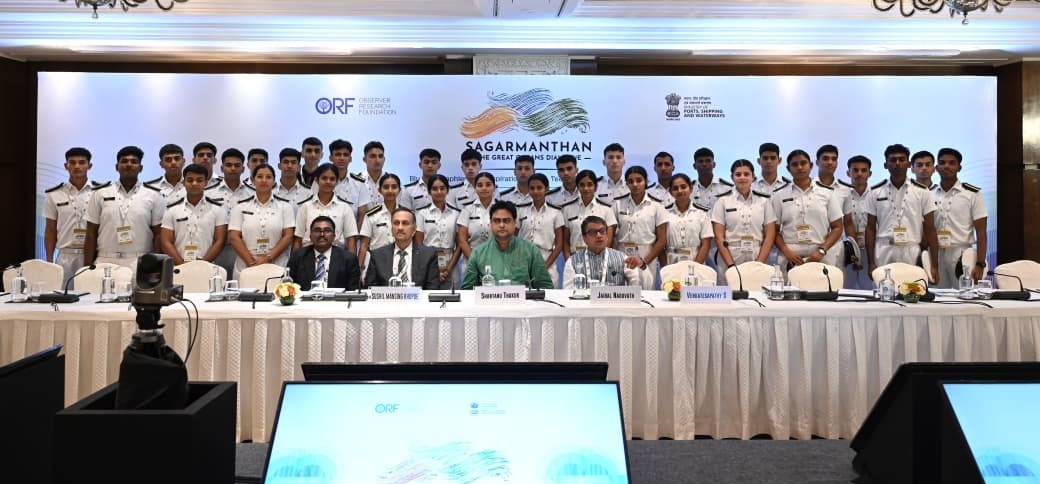
Sagarmanthan’s second day also featured sessions titled The Future is Blue: The Next Maritime Generation and Ocean Changemakers: Women, Youth and India’s Maritime Journey. The sessions heard from young Indians and women about their aspirations for the maritime sector. An all-women tri-service sailing expedition also participated, inspiring women cadets, according to the Ministry.
The government reported the following workforce figures in the official PIB release.
| Indicator | Earlier figure | Latest figure cited |
|---|---|---|
| Indian seafarers | 1.27 lakh | 3.23 lakh over 12 years |
| India’s global seafarer-supply position | Fifth in 2015 | Second-largest supplier |
| Share of global seafarer workforce | — | Over 12% |
| Active women seafarers | 1,599 in 2021 | 7,033 in 2025 |
The Ministry attributed the increase in women’s participation in part to the Sagar Mein Samman initiative. It also stated that India aims to raise women’s share through Mission 20% by 2030. The release does not clarify the precise denominator for this target, so it should not be interpreted as 20% of every maritime occupation without further documentation.
Training and the transition from classroom learning to employment were also highlighted. Shipyard–ITI partnerships reportedly provide 150 hours of on-the-job training, while a structured six-month onboard programme for GP Rating and Maritime Catering trainees is intended to bridge pre-sea training and life at sea.
These programmes address an important link in maritime workforce development: training must be connected to practical exposure and the transition into onboard work. The PIB release, however, does not provide placement rates, trainee completion rates or post-training employment data.
Minister of State Shantanu Thakur held separate bilateral meetings with representatives from four countries, extending the discussions beyond the three countries engaged by Sonowal.

Greece — Maritime cooperation
Thakur met Stefanos Gkikas, Deputy Minister of Maritime Affairs and Insular Policy of the Hellenic Republic. The meeting focused on strengthening India–Greece maritime cooperation. The release does not detail specific projects or commitments.

Lithuania — Direct shipping links and green ports
Discussions with Transport and Communications Minister Juras Taminskas included a proposed work plan for a memorandum of understanding between Jawaharlal Nehru Port Authority and the Port of Klaipėda, as well as direct shipping links and green-port cooperation. A proposed work plan is not itself a completed MoU.

Mozambique — Port and shipbuilding expertise
Thakur met Transport and Logistics Minister João Jorge Matlombe and offered India’s expertise in ports, shipbuilding, ship repair and seafarer training. The announcement does not identify a specific project or financial arrangement.

Myanmar — Sittwe Port and Bay of Bengal links
Discussions with Deputy Minister of Transport U Tun Lu covered the next phase of Sittwe Port, cross-border inland-water trade and maritime safety in the Bay of Bengal. The release does not provide a completion schedule or details of the next phase.
Thakur said India was ready to share its capabilities in ports, shipbuilding and seafarer skills, describing cooperation in green shipping, connectivity and capacity-building as areas for further engagement. The official announcement records the discussions and proposals; it does not establish that all the initiatives have moved into implementation.
Also Read: Edible Oil Import Duty Cut: Who Gets the Benefit — Importers, Refiners, Farmers or Consumers?
India Reports Higher Port Capacity and Cargo Volumes
At a press conference during Sagarmanthan, Sonowal presented figures on changes in India’s maritime sector over the preceding 12 years.
| Performance indicator | Earlier figure | Latest figure cited |
|---|---|---|
| Port capacity | 1,561 MTPA | 2,817 MTPA |
| Cargo handled | 1,052 million tonnes | 1,668 million tonnes |
| Inland waterways cargo | 29 million tonnes | 218 million tonnes |
| Median container vessel turnaround | 35 hours | 23 hours |
Source: Ministry of Ports, Shipping and Waterways, PIB release dated 8 October 2026. MTPA means million tonnes per annum. The release describes the comparison as covering the last 12 years but does not give the individual reference years for every indicator.
The figures point to reported increases in installed port capacity, cargo handled and inland waterways cargo, alongside a reduction in median container vessel turnaround time. These indicators measure different aspects of the maritime system: capacity reflects potential throughput, cargo handled measures activity, and turnaround time reflects how quickly vessels are processed.
The release does not provide port-by-port performance, the methodology for the turnaround-time calculation, or the utilisation rate of the added capacity. The national figures therefore do not, by themselves, establish that performance improved uniformly across all ports.
Sagarmanthan’s international participation
Sonowal also reported that Sagarmanthan had grown from more than 1,700 delegates representing 61 countries in 2024 to participation from more than 70 countries in 2026, including 10 visiting ministers. The Ministry said the dialogue had produced more than 100 publications and described this as strengthening India’s role in the global maritime order.
These are government-reported measures of the dialogue’s reach. The release does not identify the publications or provide an independent assessment of their policy or industry impact.
Green-Fuel Bunkering: From Policy Ambition to Port Infrastructure
The Ministry said India was pushing to build capacity in green hydrogen, ammonia and methanol, with the aim of developing Indian ports as green-fuel bunkering hubs. Sonowal linked the initiative to India’s Net Zero 2070 commitment and called for dialogue to lead to joint research, investment and technology partnerships.
The bilateral discussions with Belgium on a potential green shipping corridor provide one possible area for further cooperation. However, the PIB announcement does not identify commissioned green-fuel bunkering facilities, contracted fuel volumes, specific corridor routes or investment amounts.
For the ambition to become operational, ports, fuel producers, shipping lines, storage and bunkering operators, and safety and regulatory authorities would need to align infrastructure, fuel availability, technical standards and commercial demand. The announcement sets out the direction of engagement, rather than evidence that a complete green-fuel shipping network is already in place.
MaritimeNews Analysis: The Next Test Is Implementation
The PIB release presents three connected strands of India’s maritime agenda: attracting international investment, improving physical and commercial connectivity, and developing the workforce needed to operate a growing maritime sector.
The seven-country engagements are significant as a record of diplomatic and institutional discussions, but their practical outcomes will depend on the next steps. For port investment, that means formal commitments, financing and project schedules. For green shipping, it means defined routes, fuel supply, infrastructure and measurable emissions objectives. For inland waterways and cross-border trade, it means operational connectivity and coordinated logistics. For workforce development, it means training completion, onboard placements and sustained employment.
The performance figures reported by the Ministry provide a national overview, but they do not replace project-level information or independent operational data. Future announcements will need to establish which proposals become agreements, which agreements receive funding, and which projects begin delivering measurable outcomes.
The central development to watch is the conversion of bilateral dialogue into funded projects, operating links and verifiable results.
Also Read: India’s Shipbuilding Modernisation Gets New Project Management Unit Under SbDS
Frequently Asked Questions (FAQs)
1. What was announced on Day 2 of Sagarmanthan 2026?
The Ministry of Ports, Shipping and Waterways reported bilateral discussions with Saudi Arabia, Belgium, Bhutan, Greece, Lithuania, Mozambique and Myanmar. The subjects included port investment, green shipping, inland-water connectivity, shipbuilding, seafarer training and maritime safety.
2. Has Saudi Arabia committed investment in Indian ports?
The PIB release says Saudi Arabia expressed interest in investing in Indian port projects and the Maritime Development Fund. It does not announce a final investment commitment, amount or implementation schedule.
3. What is the proposed India–Belgium green shipping corridor?
Sonowal proposed exploring a corridor linking Indian ports with Antwerp-Bruges. The discussions also covered green fuels, smart-port technology and dredging. The release does not specify the route, participating shipping lines or launch date.
4. How many Indian seafarers are reported in the release?
The Ministry says the number increased from 1.27 lakh to 3.23 lakh over 12 years, making India the world’s second-largest supplier of seafarers, with over 12% of the global workforce.
5. How has women’s participation in India’s seafaring workforce changed?
The release reports that active women seafarers increased from 1,599 in 2021 to 7,033 in 2025. It cites the Sagar Mein Samman initiative and Mission 20% by 2030, although it does not define the target’s denominator.
6. What did India and Bhutan discuss about inland waterways?
The discussions covered National Waterway-2, the Jogighopa terminal, the potential of the Manas and Sankosh rivers, and links with national waterways to improve cargo movement. The release does not announce committed cargo volumes or a completed cross-border arrangement.
7. What did the government report about port performance?
The Ministry reported that port capacity rose from 1,561 to 2,817 MTPA, cargo handled increased from 1,052 to 1,668 million tonnes, inland waterways cargo increased from 29 to 218 million tonnes, and median container vessel turnaround fell from 35 to 23 hours over the last 12 years.
Sources
Make us preferred source on Google
Reporting by MaritimeNews Bureaus, Writing by Harpal S Naol; Editing by Jaspal Singh Naol.