
One Indian seafarer remains missing and two are hospitalised after the Panama-flagged LPG tanker was attacked and its crew forced to abandon ship; India has condemned the targeting of commercial shipping and called for the restoration of safe navigation.
Key Takeaways
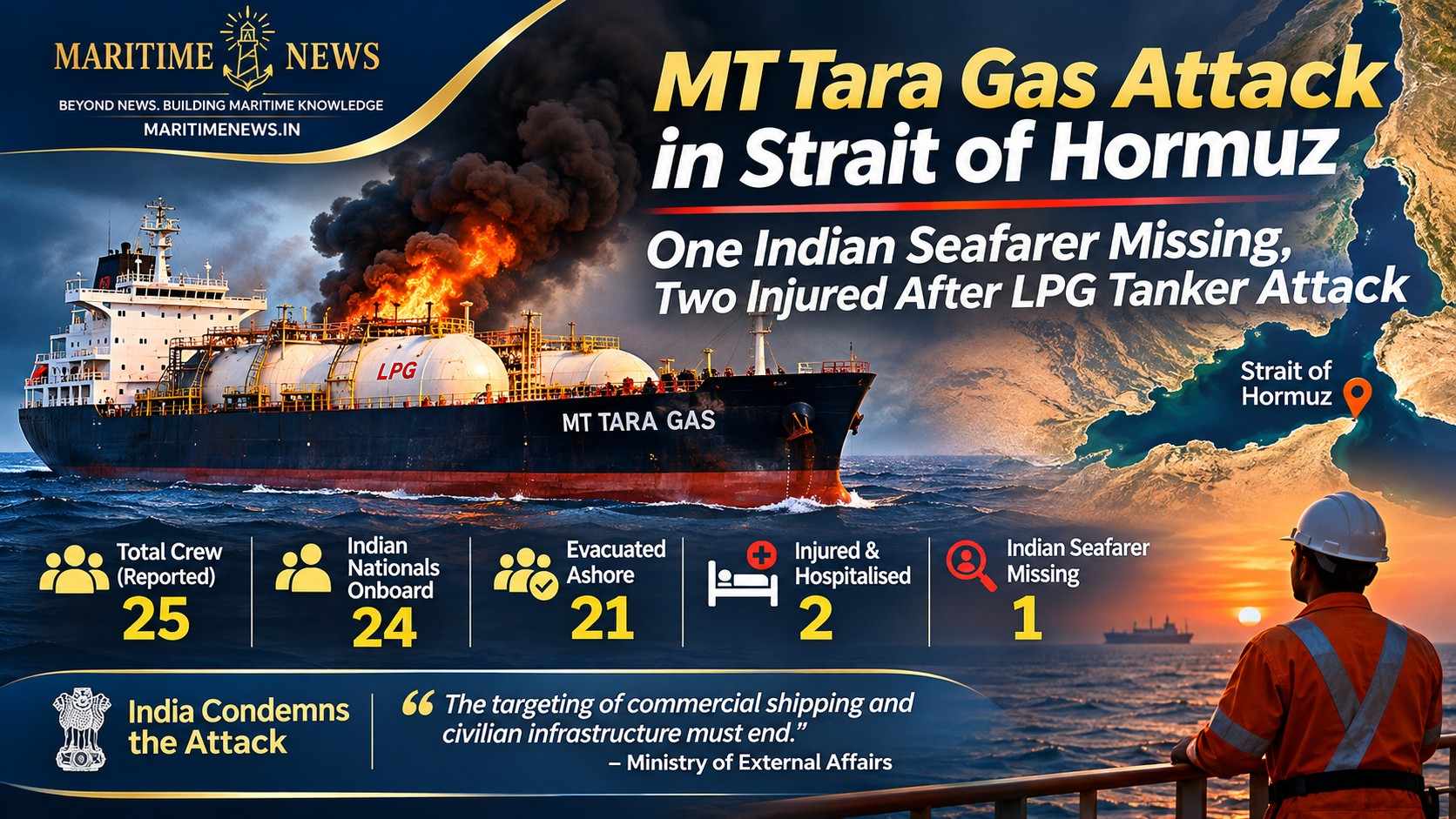
- The Panama-flagged LPG tanker MT Tara Gas, carrying 24 Indian nationals among its 25-member crew, was attacked in the Strait of Hormuz on 16 November 2026.
- The vessel reportedly suffered a subsequent attack, caught fire and was abandoned by its crew.
- According to India’s Ministry of External Affairs, 21 Indian nationals were evacuated ashore at Khasab, two injured Indian crew members were hospitalised and one Indian national remained missing as of 17 November.
- Oman assisted in the rescue operation, while the Indian Embassy in Oman coordinated with Omani authorities on the search and rescue effort.
- The incident follows other attacks involving merchant vessels and Indian crew in the wider West Asian maritime security crisis.
- The episode raises questions about the protection of civilian seafarers, the security of commercial shipping and the practical effectiveness of emergency response arrangements in high-risk waters.
Strait of Hormuz / New Delhi, India November 18, 2026 (Maritime News): The attack on the Panama-flagged LPG tanker MT Tara Gas in the Strait of Hormuz has once again placed Indian seafarers at the centre of the escalating maritime security crisis in West Asia.
The incident began on 16 November 2026, when the tanker was reportedly struck while transiting the strategic waterway. The situation subsequently deteriorated after a further attack, a fire onboard and the evacuation of the crew. The incident left one Indian national missing and two Indian crew members requiring hospital treatment, according to the Ministry of External Affairs (MEA).
The initial public communication from Union Minister for Ports, Shipping and Waterways Sarbananda Sonowal stated that all 24 Indian nationals and the entire 25-member crew were safe. A subsequent update, however, confirmed that the vessel had suffered another attack, forcing the crew to abandon ship, with one Indian seafarer still missing.
The changing situation demonstrates why maritime incident reporting must distinguish between an initial safety assessment and the final outcome of a rescue operation.
What Happened to MT Tara Gas?
MT Tara Gas is a Panama-flagged liquefied petroleum gas carrier. According to the statements reported by the media, the vessel was carrying 24 Indian nationals as part of a total crew of 25 when it came under attack in the Strait of Hormuz on 16 November.
The UK Maritime Trade Operations (UKMTO) recorded an attack involving a tanker approximately seven nautical miles north of Khasab, Oman, at around 1900 UTC on 16 November. The initial warning stated that the vessel had been disabled and that an engine-room fire had broken out. The crew were initially reported safe, while the extent of damage and environmental impact remained unknown.
UKMTO subsequently updated its warning after receiving information from a maritime security agency that the vessel had sustained a second strike, causing another fire. At that stage, the crew’s whereabouts were reported as unaccounted for.
The UKMTO warning did not initially identify the vessel by name. Subsequent statements from the Indian government and reports by international media identified the affected tanker as MT Tara Gas.
Sources: UKMTO Warning 208-26; UKMTO Recent Incidents; Reuters, 17 November 2026.
One Missing, Two Injured: What Is the Confirmed Crew Position?
The most important development is the distinction between the total crew, the Indian nationals onboard and the people accounted for after the evacuation.
The MEA statement of 17 November confirmed that 21 of the 24 Indian nationals had been safely evacuated ashore at Khasab, Oman. Two injured Indian crew members were admitted to hospital, while one Indian national remained missing.
This means that 23 Indian nationals had been accounted for through evacuation or hospital admission, while the search for the remaining Indian seafarer was continuing.
The distinction matters because some early reports carried the initial assurance that all 24 Indian nationals were safe. That information was overtaken by the subsequent attack and abandonment of the vessel. The later MEA statement provides the more authoritative position on the Indian nationals.
The Press Trust of India report carried by ThePrint also quoted Sonowal confirming that the subsequent attack forced the entire crew to abandon the tanker. He stated that 24 crew members had been safely accounted for while one Indian seafarer remained missing.
Reuters separately reported that Oman evacuated 24 crew members from the vessel after it caught fire off the Musandam Peninsula. These figures should not be casually treated as interchangeable: the MEA’s statement specifically accounts for the 24 Indian nationals, while the vessel had a reported total crew of 25.
As of the latest official information available for this report, the missing Indian seafarer had not been confirmed rescued.
Sources: MEA statement reported by Hindustan Times, updated 18 November; ThePrint/PTI, 17 November; Reuters, 17 November.
India’s Response: Condemnation and Coordination with Oman
India has condemned the attack and expressed concern over the continuing incidents involving commercial vessels in the region.
In its statement, the MEA described the attacks on shipping as deeply worrisome and said they posed a serious threat to the safety of civilian seafarers. It also called for an end to the targeting of commercial shipping and civilian infrastructure.
The ministry emphasised that free and unimpeded navigation and commerce through international waterways, in accordance with international law, must be restored at the earliest.
The Indian Embassy in Oman is monitoring the ongoing search and rescue operations in coordination with Omani authorities. India also acknowledged the assistance extended by the Government of Oman during the rescue effort.
Sonowal separately said that the government was coordinating with the ship management company and regional rescue authorities to locate the missing seafarer and ensure the safety, welfare and logistical support of the rescued crew.
The response involves two immediate priorities: locating the missing Indian national and ensuring appropriate medical and logistical support for the rescued crew.
Sources: MEA statement reported by Hindustan Times; DD India, 17 November 2026; ThePrint/PTI.
A Repeated Pattern: Indian Seafarers Exposed to the West Asia Crisis
The Tara Gas incident is not an isolated concern for India’s maritime workforce.
In September 2026, Maritime News reported that three foreign-flagged vessels carrying 42 Indian crew members had been involved in separate incidents in the West Asian conflict zone. The same reporting highlighted that 173 Indian seafarers remained aboard 14 vessels in the Persian Gulf west of the Strait of Hormuz.
Earlier, on 16 September, Maritime News reported that one Indian seafarer remained missing after an attack on the Panama-flagged MT El Gaia off Oman, while 13 of the 14 Indian seafarers onboard had been rescued.
These incidents demonstrate the exposure of Indian seafarers serving on foreign-flagged vessels. Their safety depends not only on India’s diplomatic engagement but also on the actions of shipowners, ship managers, flag administrations, coastal authorities and regional rescue agencies.
The fact that a vessel is foreign-flagged does not reduce the importance of the welfare and protection of Indian nationals working onboard. It does, however, make coordination across multiple jurisdictions essential.
Previous Maritime News reporting: Three Foreign-Flagged Ships With 42 Indian Crew Hit in West Asia Conflict; 173 Seafarers Remain in Gulf; One Indian Seafarer Missing After Attack on MT El Gaia Off Oman.
Why the Strait of Hormuz Matters to Indian Shipping
The Strait of Hormuz is a critical maritime passage connecting the Persian Gulf with the Gulf of Oman and the wider Indian Ocean. It is an important route for international energy shipments, including oil and liquefied petroleum gas.
For India, the security of this waterway has implications beyond the safety of individual vessels. Disruption can affect energy transportation, shipping schedules, insurance costs, freight rates and the operational decisions of shipowners and charterers.
An attack on an LPG carrier is particularly significant because it involves a vessel transporting a potentially hazardous energy cargo. A fire, structural failure or loss of containment can create risks extending beyond the crew to nearby vessels, coastal communities and the marine environment.
UKMTO’s initial warning on the Tara Gas incident recorded that the vessel had been disabled and an engine-room fire had broken out, while the environmental impact was not yet known. The available reports do not establish the final extent of vessel damage, any cargo loss or the cause of the fire.
The incident therefore raises concerns about both navigational security and the risks associated with attacks on energy-carrying commercial vessels.
Maritime News Analysis: The Seafarer Must Remain at the Centre
The most important measure of the response to the Tara Gas incident will not be the number of statements issued or the strength of diplomatic condemnation. It will be whether the missing seafarer is located, whether the rescued crew receive the required support and whether the wider maritime workforce receives meaningful protection.
India has a substantial seafaring workforce and a large number of its nationals serve on international vessels. Their employment across different flag states and shipping companies creates a complex chain of responsibility during emergencies.
A seafarer onboard a commercial vessel cannot independently control the geopolitical risks surrounding a voyage. Decisions about routing, voyage continuation, security assessments and emergency response are generally taken through the ship’s command structure, company procedures and applicable regulatory requirements.
This makes the responsibilities of shipowners, managers, flag administrations and relevant authorities particularly important.
The Tara Gas incident also raises several questions that require answers:
- What security assessment was undertaken before the vessel transited the affected area?
- What information was available to the ship management company regarding the threat environment?
- What emergency communication and evacuation arrangements were in place?
- What assistance is being provided to the rescued crew and their families?
- What is the status of the search for the missing Indian seafarer?
- Will the incident be subject to a transparent investigation, including an assessment of the vessel’s damage and the circumstances of the attacks?
These are legitimate maritime safety and accountability questions. They should not be treated as allegations against the vessel’s management or any authority without verified evidence.
India’s wider maritime response must also consider seafarers serving aboard foreign-flagged ships. A coordinated system of emergency communication, vessel monitoring, rescue support and family assistance is essential when commercial vessels operate in conflict-affected waters.
Stakeholder Impact
Seafarers and their families: The immediate concern is the missing Indian national, the recovery of the injured crew members and the welfare of those evacuated. Families require timely, verified information rather than conflicting media updates.
Shipowners and ship managers: The incident reinforces the importance of voyage-specific risk assessments, emergency procedures, communication systems and coordination with flag-state and coastal authorities.
Flag-state administration: As a Panama-flagged vessel, Tara Gas also falls within the responsibilities of its flag-state framework. The available reports do not yet establish the full extent of any flag-state investigation or response.
Indian maritime authorities: The incident underlines the need for effective coordination between the government, maritime administration, ship management companies and overseas missions when Indian nationals are involved in emergencies.
Energy and shipping markets: Repeated attacks in the Strait of Hormuz can increase operational uncertainty for vessels transporting energy cargoes. The eventual commercial impact will depend on the frequency of incidents, security assessments and the response of shipping and insurance markets.
Strategic Outlook: From Condemnation to a Seafarer-First Response
India’s call for safe and unimpeded navigation is consistent with the broader need to protect civilian shipping and maritime workers. However, diplomatic statements alone cannot secure vessels operating in a high-risk maritime environment.
A stronger response requires coordination between government agencies, shipowners, ship managers, flag administrations, coastal states and international maritime security mechanisms.
For Indian seafarers, a practical response should include reliable emergency contact channels, timely information to families, access to medical assistance, support for evacuation where required and clear procedures for reporting missing crew members.
The government should also ensure that lessons from successive incidents are examined collectively. Repeated attacks involving Indian crew should contribute to a structured assessment of the risks faced by Indian nationals serving on international merchant vessels.
The immediate priority remains the search for the missing seafarer from MT Tara Gas. Until that person is located and the circumstances are established, the incident cannot be described as a successful rescue operation for all Indian nationals onboard.
Maritime Perspective
The attack on MT Tara Gas is another reminder that the human cost of maritime conflict is borne by seafarers who are not parties to the hostilities.
The 24 Indian nationals onboard were carrying out their professional responsibilities aboard a commercial energy vessel. The fact that 21 were evacuated ashore, two required hospital treatment and one remains missing must remain the central focus of the response.
India’s maritime strength is not measured only by its ports, shipbuilding capacity, shipping fleet or international trade. It must also be measured by how effectively it protects the people who operate vessels and sustain maritime commerce.
For now, the priority is clear: locate the missing seafarer, support the rescued crew and establish the facts surrounding the attack.
Frequently Asked Questions (FAQs)
What happened to MT Tara Gas in the Strait of Hormuz?
The Panama-flagged LPG tanker was attacked on 16 November 2026. It subsequently suffered another attack, caught fire and was abandoned by its crew.
How many Indian seafarers were onboard MT Tara Gas?
The vessel was carrying 24 Indian nationals as part of a reported total crew of 25.
What is the latest reported position of the Indian crew?
The MEA stated that 21 Indian nationals were evacuated ashore at Khasab, two injured Indian crew members were admitted to hospital and one Indian national remained missing.
Which country assisted in the rescue operation?
Oman assisted in the rescue operation. The Indian Embassy in Oman coordinated with Omani authorities during the search and rescue effort.
Who condemned the attack on MT Tara Gas?
The Government of India, through the Ministry of External Affairs, condemned the attack and called for an end to the targeting of commercial shipping and civilian infrastructure.
Why is the Strait of Hormuz important to India?
The Strait of Hormuz is a major international energy shipping route. Disruption can affect energy transportation, maritime trade, freight operations and the safety of seafarers.
Sources and References
External Sources
- Ministry of External Affairs statement on the attack on MT Tara Gas – reported by Hindustan Times, updated 18 November 2026
- UK Maritime Trade Operations – Warning 208-26, 16 November 2026
- UK Maritime Trade Operations – Recent Incidents
- Reuters – Crew abandons gas tanker off Oman after being hit by projectile, 17 November 2026
- ThePrint/PTI – Panama-flagged tanker targeted in Hormuz, 24 Indians aboard safe: Sarbananda Sonowal, 17 November 2026
- DD India – India condemns attack on LPG tanker in Strait of Hormuz; one Indian sailor missing, 17 November 2026
- The Indian Express – MEA condemns Hormuz attack on ship with 24 Indians onboard
- The Times of India – Missile attack targets LPG tanker with 24 Indians in Strait of Hormuz, 17 November 2026