

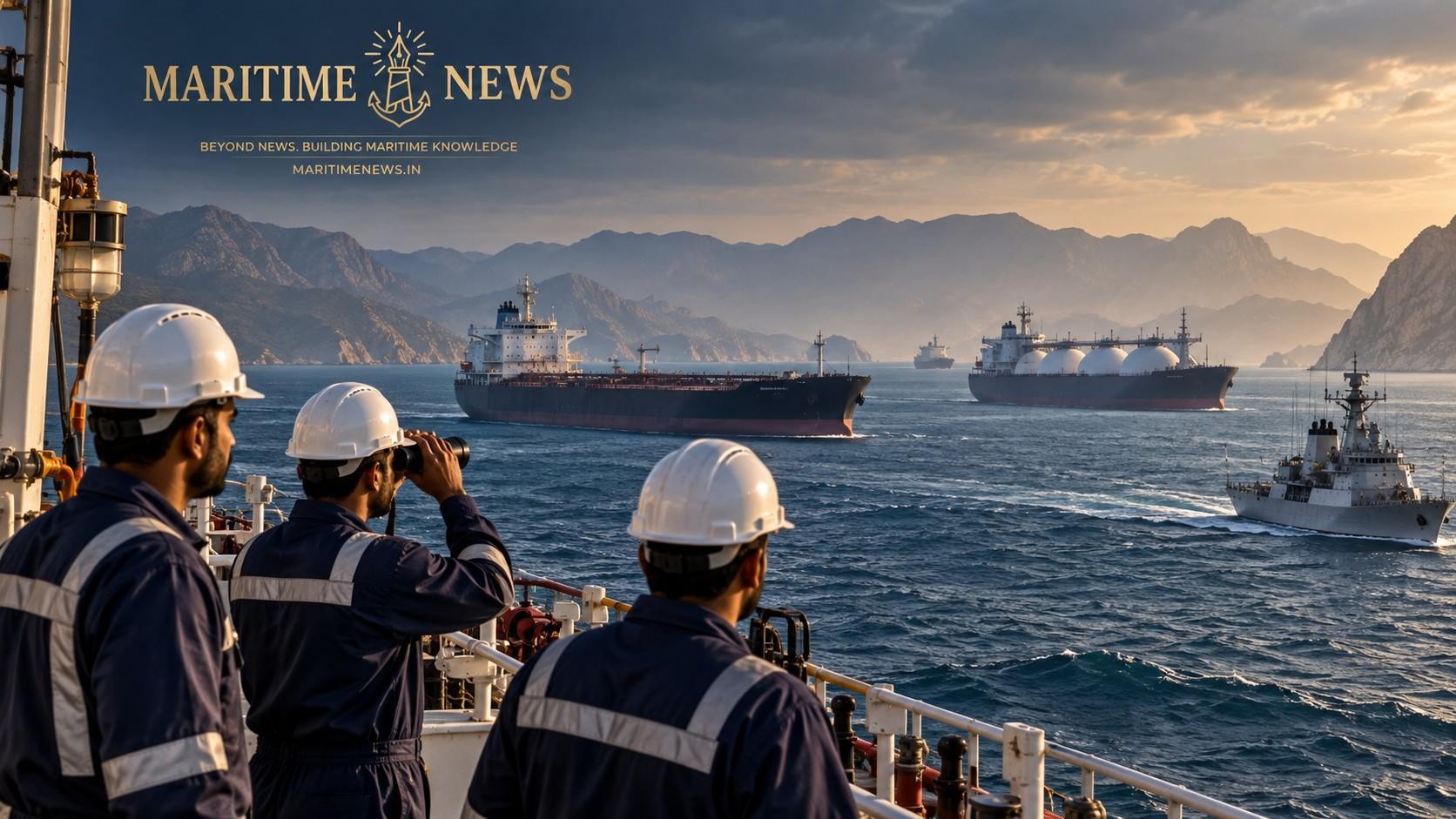
Three foreign-flagged vessels carrying 42 Indian seafarers were hit in separate incidents on September 8 and 9, while 173 Indian seafarers remain aboard 14 vessels in the Persian Gulf west of the Strait of Hormuz, according to maritime administration data cited by multiple reports
Make us preferred source on Google
Key Takeaways
- Three foreign-flagged vessels carrying Indian crew were involved in separate incidents on September 8 and 9, 2026.
- The vessels were the Zimbabwe-flagged crude tanker Riesco, Palau-flagged LPG carrier Horizon 1 and Liberian-flagged crude tanker Mersin Prosperity.
- The individual crew figures reported for the three vessels total 42 Indian seafarers.
- All crew members involved in the three latest incidents were reported safe and accounted for.
- The 21 Indian crew aboard Riesco had evacuated the vessel before the reported strike and reached a safe shelter at an Iranian port.
- Horizon 1 carried 14 Indian crew among its 16-member crew; all 16 were rescued by another vessel.
- Mersin Prosperity had seven Indian crew aboard when it was reportedly hit by a projectile near Fujairah.
- 173 Indian seafarers remain aboard 14 vessels in the Persian Gulf west of the Strait of Hormuz.
- The 14 vessels comprise six Indian-flagged vessels and eight foreign-flagged vessels of Indian interest.
- Ten vessels of Indian interest have been identified for possible evacuation.
- The wider maritime administration data cited in the reports records four incidents involving Indian-flagged vessels and 50 involving foreign-flagged vessels carrying Indian crew, alongside reported seafarer fatalities and injuries.
- India has established a Seafarer-First response framework covering monitoring, emergency communication, coordination and evacuation.
- Prime Minister Narendra Modi has also raised freedom of navigation, maritime commerce and seafarer safety in discussions with Iran.
Also Read: Hormuz Crisis Reshapes Gulf Shipping: What It Means for Indian Trade, Freight and Seafarers
Strait of Hormuz / Goa, India September 13, 2026 (Maritime News): India’s maritime community is facing another serious warning from the continuing West Asia conflict after three foreign-flagged commercial vessels carrying Indian crew were involved in separate incidents on September 8 and 9.
The three vessels were Riesco, Horizon 1 and Mersin Prosperity.
The incidents occurred in and around the Gulf of Oman and the Gulf region, placing Indian seafarers directly in the path of a deteriorating maritime-security environment.
The detailed vessel-by-vessel account was reported by ETEnergyWorld, while the broader figures have also been reported independently by Hindustan Times, Marine Insight and NDTV Profit.
42 Indian Seafarers Were Aboard the Three Vessels
The individual crew numbers reported for the three vessels are:
| Vessel | Flag | Vessel Type | Indian Crew | Reported Incident |
|---|---|---|---|---|
| Riesco | Zimbabwe | Crude oil tanker | 21 | Reportedly struck in Gulf of Oman |
| Horizon 1 | Palau | LPG carrier | 14 | Attacked near Khor Fakkan |
| Mersin Prosperity | Liberia | Crude oil tanker | 7 | Reportedly hit near Fujairah |
| Total | — | — | 42 | Three incidents |
The total is 42 Indian seafarers, based on the individual figures in the reporting: 21 + 14 + 7.
This figure is important because some reports have referred to a different combined number. MaritimeNews is using the mathematically consistent total derived from the individual vessel-level figures.
The latest incidents themselves did not result in a reported loss of life among the crews involved.
Riesco: 21 Indian Crew Evacuated Before Reported Strike
The first vessel was the Zimbabwe-flagged crude oil tanker Riesco.
According to the maritime administration information reported by ETEnergyWorld, the vessel was reportedly struck on September 8 at approximately 11 pm IST in the Gulf of Oman.
However, the 21 Indian seafarers aboard the tanker had already evacuated the vessel.
They had moved to a safe shelter at an Iranian port because of the deteriorating security situation.
This detail is particularly important from a maritime-safety perspective.
The incident demonstrates how early evacuation decisions can become critical when a commercial vessel operates in an increasingly unpredictable conflict environment.
The available reports describe the strike as having been carried out by US naval forces, but that attribution should remain reported rather than presented by MaritimeNews as an independently established finding. (ETEnergyWorld)
Horizon 1: 14 Indians Among 16 Crew
The second vessel was the Palau-flagged LPG carrier Horizon 1.
It was reportedly attacked on September 8 at approximately 11:30 pm IST at the Khor Fakkan Outer Port Limit.
The vessel had a 16-member crew:
- 14 Indians
- 2 Georgians
All 16 crew members were reported to have been rescued by another vessel.
The incident highlights another important element of maritime emergency response: merchant ships can themselves become immediate sources of assistance to other vessels in distress.
When commercial vessels operate in high-risk waters, the ability to communicate quickly and coordinate rescue can make a critical difference.
Mersin Prosperity Reportedly Hit Near Fujairah
The third incident involved the Liberian-flagged crude oil tanker Mersin Prosperity.
The vessel was reportedly hit by a projectile near Fujairah on September 9.
Seven Indian seafarers were aboard.
All seven were reported safe and accounted for.
The available reporting does not establish the precise nature of the projectile or independently establish responsibility for the incident. MaritimeNews therefore treats those details as reported information pending further official clarification. (Hindustan Times)
Also Read: Cabinet Approves Development of National Maritime Heritage Complex at Lothal, Gujarat
173 Indian Seafarers Remain in the Persian Gulf
The most serious continuing concern is not limited to the three latest incidents.
According to the maritime administration information reported by ETEnergyWorld, 173 Indian seafarers remain aboard 14 vessels in the Persian Gulf west of the Strait of Hormuz.
The 14 vessels comprise:
- 6 Indian-flagged vessels
- 8 foreign-flagged vessels of Indian interest
The same information says that 10 vessels of Indian interest have been identified for possible evacuation.
The figure has also been reported by NDTV Profit, Hindustan Times and Marine Insight.
This is now a continuing Indian seafarer-protection operation, not simply a series of isolated vessel incidents.
Foreign Flag Does Not Mean Indian Seafarers Are Outside India’s Maritime Responsibility
One of the most important lessons from the current crisis is that Indian seafarers serve on ships registered under many different flags.
The ship may be:
Liberian-flagged.
Palau-flagged.
Zimbabwe-flagged.
But the person operating that ship may still be an Indian citizen.
India’s response has increasingly recognised this distinction.
Union Minister Sarbananda Sonowal has directed a Seafarer-First approach, with vessel-by-vessel monitoring and coordination intended to account for Indian seafarers irrespective of the flag of the vessel on which they are serving.
The Government’s formal framework provides for real-time reporting, monitoring and emergency coordination. (PIB)
This principle is fundamental.
Seafarer nationality and vessel nationality are two different things.
A national maritime safety system must account for both.
Also Read: Cochin Shipyard and Drydocks World Sign 50:50 JV to Build India’s Global Ship Repair Ambition
India’s Seafarer-First Framework Faces Its Biggest Test
The Ministry of Ports, Shipping & Waterways has established a Seafarer-First framework for Indian nationals affected by the West Asia crisis.
According to the Government, the mechanism includes:
- real-time reporting;
- vessel and seafarer tracking;
- continuous monitoring;
- a 24-hour control room;
- situation reports;
- emergency communication;
- coordination with Indian missions;
- evacuation mechanisms; and
- grievance support.
The Government has also said that digital maritime systems, including eNavik, support casualty reporting, crisis management and seafarer grievance mechanisms. (PIB)
The latest three incidents demonstrate why this system needs to remain active around the clock.
DG Shipping Had Already Issued Security Advisories
India’s maritime regulator had already issued security guidance for Indian vessels and seafarers operating in the affected region.
The Directorate General of Shipping has issued circulars covering:
- heightened vigilance;
- voyage-specific risk assessment;
- Ship Security Plans;
- security drills;
- Ship Security Alert System;
- reporting of suspicious activity;
- crew monitoring; and
- coordination with relevant authorities.
The DGS’s Circular No. 10 of 2026 provides security guidance concerning operations in the Persian Gulf, Strait of Hormuz and Gulf of Oman.
The latest incidents reinforce the importance of ensuring that those advisories are converted into actual voyage-level decisions.
The Bigger Casualty Picture Is Alarming
The latest three incidents form part of a much wider pattern.
The maritime administration information cited by ETEnergyWorld and other reports records:
- 4 incidents involving Indian-flagged vessels
- 50 incidents involving foreign-flagged vessels carrying Indian crew
- 9 reported seafarer fatalities
- 12 injuries
- 1 person presumed dead
These figures refer to the broader conflict period and not specifically to the three September 8–9 incidents.
The distinction is important because all crew members in the three latest incidents were reported safe.
Nevertheless, the cumulative figures demonstrate the scale of the maritime exposure faced by Indian seafarers. (ETEnergyWorld)
Three Different Vessel Types, One Common Risk
The three latest incidents involve:
Crude oil tanker → LPG carrier → crude oil tanker
That is significant.
These are not recreational vessels or vessels operating outside the mainstream commercial system.
They are part of the energy and commodity supply chain.
Crude tankers transport energy.
LPG carriers transport essential fuel.
The people operating these vessels are therefore simultaneously:
maritime workers + commercial operators + essential supply-chain personnel.
An attack on such a vessel can consequently create several layers of risk:
crew safety → vessel safety → cargo safety → energy supply → insurance → freight → trade.
Also Read: India Moves to Build a Global Hub for Ship Ownership, Leasing and Maritime Finance Through GIFT City
Maersk’s Emergency Freight Measures Show the Commercial Consequence
The seafarer-security crisis is also connected to the freight disruption now affecting Gulf shipping.
Maersk has imposed emergency freight charges on certain Gulf cargoes and introduced alternative routing arrangements because of the increased cost and risk associated with the regional situation.
The company’s measures include additional costs associated with:
- rerouting;
- temporary storage;
- additional charters;
- inland transportation;
- insurance; and
- crew-risk compensation.
The latest attacks provide the human context behind those commercial measures.
Higher risk to crews becomes higher operational cost for ships.
That ultimately becomes a higher cost for cargo.
Indian Exporters and Importers Are Also Exposed
Indian businesses connected with Gulf markets can experience the consequences through:
- higher freight rates;
- increased insurance;
- alternative ports;
- additional storage;
- landbridge transportation;
- longer transit times;
- cargo-handling costs;
- supply-chain uncertainty; and
- inventory pressure.
The effect can move through the entire chain:
Indian exporter → shipping line → Gulf gateway → storage → landbridge → final destination.
Every additional stage introduces another handover and another potential point of delay.
Seafarer Safety and Commercial Shipping Cannot Be Separated
The current crisis demonstrates why maritime risk assessment must consider both the ship and the people aboard it.
A route may be commercially attractive.
But if the risk to crew becomes unacceptable, the economics of that route must be reconsidered.
That is why the industry’s decision-making framework increasingly needs to ask:
Is the route commercially viable?
Is the route operationally feasible?
Is the cargo protected?
Is insurance available?
Is the vessel protected?
And most importantly, is the crew safe?
The final question cannot be treated as an afterthought.
What Should Shipping Companies Do?
The latest attacks reinforce the need for rigorous implementation of existing security measures.
Conduct voyage-specific risk assessments
Risk must be evaluated based on the actual voyage and current intelligence.
Maintain continuous communication
Ships operating in high-risk areas must maintain reliable emergency contact with shore management and authorities.
Keep crew information current
Authorities must have accurate and timely crew lists.
Ensure emergency drills are effective
Crew members should know what to do in the event of an attack or emergency evacuation.
Review safe-port options
Companies should identify alternative safe ports and evacuation points before a crisis occurs.
Maintain family communication
Families should not have to depend exclusively on social media or unverified reports to know whether a seafarer is safe.
The Family Is Also Part of the Emergency Response
A maritime emergency does not affect only the people aboard the ship.
It affects their families on shore.
When a vessel comes under attack, families immediately want answers:
Is my family member safe?
Where is the vessel?
Has the crew been evacuated?
Where will they be taken?
When can they return home?
That means a genuine Seafarer-First framework must include family communication alongside vessel tracking and rescue coordination.
The proposed BRICS Seafarers’ Emergency Support Network could also become relevant here, particularly in providing distress alerts, medical assistance, family communication and evacuation support.
Modi Raises Freedom of Navigation and Seafarer Safety With Iran
The issue has also reached the highest level of India’s diplomatic engagement.
Prime Minister Narendra Modi met Iranian President Masoud Pezeshkian in New Delhi on September 11 on the sidelines of the BRICS Summit.
According to the Press Information Bureau, Modi reiterated India’s position that regional disputes should be addressed through dialogue and diplomacy and emphasised the need to safeguard freedom of navigation and commerce and the safety and well-being of seafarers.
That diplomatic message now has direct relevance to Indian merchant crews operating in the region.
The Maritime Industry Needs a Clear Evacuation Threshold
One of the most difficult questions in a conflict environment is determining when a vessel should leave an area.
Waiting until an attack occurs can dramatically reduce the available options.
An effective framework could therefore use predefined risk thresholds based on:
- frequency of attacks;
- location;
- vessel type;
- cargo;
- threat intelligence;
- available safe ports;
- weather;
- naval protection;
- crew exposure;
- insurance;
- evacuation options; and
- communication availability.
The objective should be to move from:
reaction after attack
to:
risk assessment before exposure.
173 Seafarers: The Immediate Human Priority
The most important number in the latest development may therefore be 173.
Not 14 vessels.
Not 50 previous incidents.
Not the number of attacks.
173 Indian seafarers.
They are individuals currently operating in a high-risk maritime environment.
The Government says that monitoring and evacuation mechanisms are active.
The next critical requirement is maintaining a transparent, continuously updated picture of:
who is aboard → where they are → vessel status → security status → evacuation status.
Operational security must naturally be protected, and sensitive vessel positions should not be publicly disclosed.
But families need confidence that the system knows where their relatives are.
Also Read: Mumbai Port Showcases Cruise Infrastructure, Marina Plans to Seychelles Parliamentary Delegation
What India Can Build From This Crisis
The present crisis could also produce long-term improvements in India’s maritime governance.
National Seafarer Emergency Registry
A secure real-time system linking:
seafarer → vessel → flag → location → emergency contact → status.
International Seafarer Coordination
Closer cooperation with:
- flag states;
- shipowners;
- ship managers;
- coastal states;
- Indian missions;
- IMO; and
- other maritime authorities.
Pre-Agreed Evacuation Corridors
Evacuation arrangements should ideally be established before emergencies occur.
Family Information System
Verified updates should reach families quickly.
Post-Incident Learning
Every attack or near-miss should generate lessons for future voyages.
MaritimeNews Accountability Questions
The latest incidents warrant continued public reporting and official updates on several questions.
For the Government of India
- How many of the 173 Indian seafarers have been contacted individually?
- How frequently is the vessel-by-vessel risk assessment updated?
- What is the current status of the 10 vessels identified for possible evacuation?
For DG Shipping
- What additional measures have been introduced following the latest incidents?
- Are existing voyage restrictions being reviewed?
- How are foreign-flagged vessels carrying Indian nationals being monitored?
For shipowners and managers
- What risk assessments are being conducted before entering or remaining in affected waters?
- What evacuation plans are available for Indian crew?
- Are families receiving timely verified information?
For international maritime authorities
- What mechanisms are available for coordinated protection of merchant shipping?
- How can freedom of navigation be protected without exposing commercial crews to unacceptable risk?
These questions are not allegations.
They are necessary components of maritime safety accountability.
Also Read: National Shipping Board’s First Sagar Samvad Starts With “IF”
MaritimeNews Insight
The latest three attacks change the scale of the conversation.
This is no longer simply a geopolitical conflict occurring somewhere near an important maritime chokepoint.
It is now a direct Indian seafarer safety issue.
Three foreign-flagged vessels carrying 42 Indian seafarers were involved in incidents within two days.
All were reported safe.
But 173 Indian seafarers remain aboard 14 vessels in the Persian Gulf west of the Strait of Hormuz.
That is the number India must keep watching.
The most important principle emerging from the crisis is simple:
The nationality of the ship and the nationality of the seafarer are not the same thing.
An Indian seafarer aboard a Liberian, Palau or Zimbabwe-flagged vessel remains an Indian seafarer.
India’s Seafarer-First framework recognises that reality.
The next challenge is execution: real-time monitoring, early warning, safe-voyage decisions, evacuation readiness, family communication and post-incident accountability.
And there is a wider lesson for global maritime governance.
When conflict reaches commercial sea lanes, protecting freedom of navigation is not enough.
The international system must protect the people who make navigation possible.
Because behind every vessel is a crew.
And behind every crew is a family waiting for them to come home.
Frequently Asked Questions (FAQs)
Which three vessels carrying Indian crew were attacked?
The vessels were the Riesco, Horizon 1 and Mersin Prosperity. (ETEnergyWorld)
How many Indian seafarers were aboard these three vessels?
Based on the individual crew numbers reported, 42 Indian seafarers: 21 aboard Riesco, 14 aboard Horizon 1 and seven aboard Mersin Prosperity. (ETEnergyWorld)
Were the crews safe?
The available reports state that the crews involved in the three latest incidents were safe and accounted for. (Hindustan Times)
How many Indian seafarers remain in the Persian Gulf?
The maritime administration information cited by multiple reports puts the number at 173 Indian seafarers aboard 14 vessels west of the Strait of Hormuz. (NDTV Profit)
How many of the 14 vessels are Indian-flagged?
Six are Indian-flagged and eight are foreign-flagged vessels of Indian interest. (NDTV Profit)
How many vessels have been identified for possible evacuation?
The reported figure is 10 vessels of Indian interest. (ETEnergyWorld)
What is India’s Seafarer-First framework?
It is a government response mechanism involving real-time monitoring, reporting, emergency communication and coordination to protect Indian seafarers affected by the West Asia maritime-security situation. (PIB)
Did Prime Minister Modi discuss seafarer safety with Iran?
Yes. Modi raised freedom of navigation and commerce and the safety and well-being of seafarers during his September 11 meeting with Iranian President Masoud Pezeshkian. (PIB)
The latest attacks on Riesco, Horizon 1 and Mersin Prosperity demonstrate how rapidly geopolitical conflict can become a maritime emergency.
The immediate outcome was positive: the 42 Indian seafarers aboard the three vessels were reported safe.
But the wider situation remains serious.
173 Indian seafarers are still aboard 14 vessels in the Persian Gulf west of the Strait of Hormuz, with 10 vessels identified for possible evacuation. (NDTV Profit)
India has established a Seafarer-First framework, DG Shipping has issued security advisories, and the issue has reached diplomatic discussions between India and Iran.
The next phase must focus on prevention rather than reaction.
Every Indian seafarer must be accounted for. Every high-risk voyage must be assessed. Every evacuation option must be prepared before it is needed. And every casualty must produce lessons for the next vessel and the next crew.
For India’s maritime industry, the message from the Gulf is unmistakable:
maritime security begins with the safety of the seafarer.
Sources & External References
Current Incident — Multiple Independent Reports
- ETEnergyWorld — Three foreign-flagged ships with Indian crew attacked amid West Asia conflict
ETEnergyWorld — Three Ships With Indian Crew Attacked - Hindustan Times — 3 ships with Indian crew hit amid West Asia conflict
Hindustan Times — Three Ships With Indian Crew Hit - Marine Insight — 3 ships carrying Indian crew attacked near Gulf amid West Asia conflict
Marine Insight — Three Ships Attacked Near Gulf - News18 — Three foreign-flagged ships with Indian crew aboard hit in Gulf of Oman
News18 — Three Ships With Indian Crew Hit - NDTV Profit — 173 Indian seafarers in Persian Gulf as vessels come under attack
NDTV Profit — 173 Indian Seafarers in Persian Gulf
Indian Government / Maritime Authorities
- Press Information Bureau — Seafarer-First Framework
PIB — Seafarer-First Framework - Press Information Bureau — Prime Minister Modi meets Iranian President Pezeshkian
PIB — Modi-Pezeshkian Meeting - Press Information Bureau — Government response to Indian seafarer safety
PIB — Indian Seafarer Safety Response - Directorate General of Shipping — DGS Circular No. 10 of 2026
DG Shipping — Maritime Security Advisory - Directorate General of Shipping — DGS Circular No. 08 of 2026
DG Shipping — Security Advisory
Related Maritime-Security Context
- Indian Express — Proposed BRICS Seafarers’ Emergency Support Network
Indian Express — BRICS Seafarers Emergency Support Network - International Maritime Organization — Middle East and Strait of Hormuz
IMO — Middle East and Strait of Hormuz
Editorial Note: MaritimeNews has used the individual vessel-level crew figures to calculate the total of 42 Indian seafarers aboard the three latest vessels. The reported circumstances of individual attacks, particularly attribution of responsibility, are presented as reported information where an independent official determination is not available. The broader figures concerning previous incidents, fatalities and injuries refer to the wider conflict period and are not attributed to these three latest incidents.
Make us preferred source on Google
Reporting by MaritimeNews Bureaus, Writing and Editing by Jaspal Singh Naol.


One thought on “Three Foreign-Flagged Ships With 42 Indian Crew Hit in West Asia Conflict; 173 Seafarers Remain in Gulf”