
The National Maritime Heritage Complex at Lothal is moving beyond the concept of a museum, with plans encompassing maritime research, lighthouse heritage, tourism, ecological experiences and modern connectivity as India seeks to present its maritime civilisation to the world
Make us preferred source on Google
Key Takeaways
- The National Maritime Heritage Complex (NMHC) at Lothal, Gujarat, is being developed as a major maritime heritage destination.
- The proposed complex includes a Lighthouse Museum, Maritime Research Institute, Museotel and Eco Resort, along with museums, galleries and theme parks.
- The proposed Lighthouse Museum is planned to be the world’s tallest lighthouse museum.
- A Maritime Research Institute is being developed as part of the project’s wider research and education vision.
- Archaeological excavation at Lothal by the Archaeological Survey of India (ASI) is reported to have reached about 70%.
- The completed Dholera Expressway and planned rail connectivity are expected to strengthen access to the complex.
- Gujarat is supporting the project through connectivity, power, water and visitor amenities.
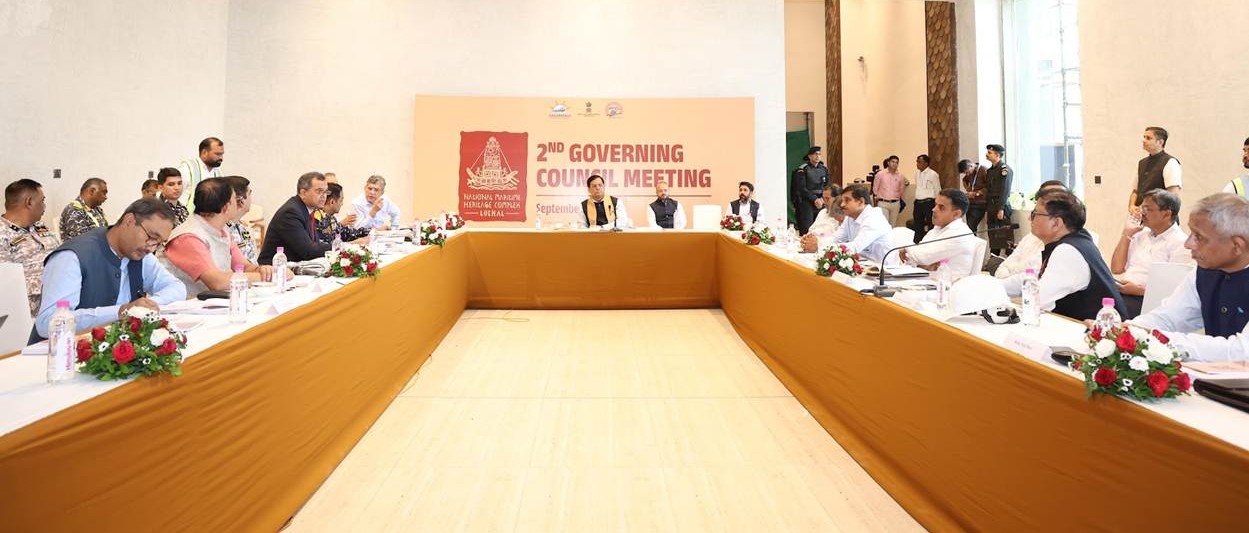
- The NMHC Governing Council has approved the proposed NMHC Bye-laws, establishing a governance framework for the Society’s transition into a fully operational institution.
- Union Minister Sarbananda Sonowal has described NMHC as part of the effort to revive and present India’s maritime civilisation to the world.
- The project is increasingly being positioned as a combination of maritime heritage, archaeology, research, education, tourism and India’s contemporary maritime aspirations.
Also Read: Cabinet Approves Development of National Maritime Heritage Complex at Lothal, Gujarat
Lothal, Ahmedabad. Gujarat, India, September 12, 2026 (Maritime News): The National Maritime Heritage Complex at Lothal is taking shape as a broader maritime heritage and knowledge destination rather than a conventional museum.
The Union Cabinet approved the development of NMHC in October 2024, with the project planned in phases. According to the Press Information Bureau’s Cabinet announcement, Phase 1A includes the main museum, six galleries, an Indian Navy and Coast Guard gallery, a recreation of Lothal township, an open aquatic gallery and a jetty walkway.
The subsequent phases substantially expand the concept.
Phase 1B includes eight additional galleries and the Lighthouse Museum, while Phase 2 envisages Coastal States Pavilions, maritime-themed hospitality facilities, a recreated Lothal city, a maritime institute and hostel, and four theme parks. (PIB Cabinet Decision)
The result is a project that combines heritage interpretation with research, education, tourism and recreation.
Also Read: Cochin Shipyard and Drydocks World Sign 50:50 JV to Build India’s Global Ship Repair Ambition
Lothal and India’s Ancient Maritime Civilisation
Lothal is central to the project’s identity because of its archaeological association with the ancient Indus Valley civilisation and maritime trade.
The Government has previously described the NMHC as a facility intended to showcase India’s maritime heritage from ancient to modern times through technology-driven and immersive experiences.
The Ministry of Ports, Shipping & Waterways’ earlier NMHC release describes the project as an international tourist destination incorporating a National Maritime Heritage Museum, Lighthouse Museum, heritage theme park, museum-themed hotels, maritime-themed eco-resorts and a maritime institute.
The same government material identifies the recreation of ancient Lothal city as a distinctive component of the project.
This gives NMHC an important advantage: the museum is not being built around an abstract maritime story. It is being developed in the vicinity of an archaeological site that provides the historical foundation for the narrative.
Proposed Lighthouse Museum Could Become the World’s Tallest
One of the most ambitious elements of NMHC is the proposed Lighthouse Museum, associated with the Directorate General of Lighthouses and Lightships (DGLL).
The Union Cabinet’s approval specifically provided for the construction of the Lighthouse Museum under Phase 1B, with funding from DGLL. The government described it as being planned as the world’s tallest lighthouse museum. (PIB)
The proposed museum also connects the NMHC project with India’s modern history of maritime navigation and coastal safety.
This is particularly relevant because the Government has separately been promoting lighthouse tourism across India.
In an August 2026 release on Lighthouse Tourism and Maritime Heritage, the Ministry of Ports, Shipping & Waterways said lighthouse museums had already been established at Chennai, Mahabalipuram, Alappuzha, Kannur, Muttom, Dwarka and Gopnath, while tourism facilities had been developed at 75 lighthouses. (PIB — Lighthouse Tourism and Maritime Heritage)
The Lothal Lighthouse Museum can therefore become the flagship component of a broader national effort to preserve and interpret India’s lighthouse and navigation heritage.
Maritime Research Institute Adds a Knowledge Dimension
Another important component is the proposed Maritime Research Institute, which forms part of the project’s wider research and education architecture.
Earlier government plans for NMHC included a maritime institute and hostel, while more recent institutional collaborations have strengthened the research dimension.
In July 2026, the National Maritime Heritage Complex and the School of Integrated Coastal and Maritime Security Studies at Rashtriya Raksha University signed an MoU covering maritime education, research, training, heritage studies and capacity building. (PIB — RRU and NMHC MoU)
This illustrates how NMHC can evolve beyond an exhibition space.
Its potential knowledge ecosystem can encompass:
- maritime archaeology;
- ancient ports and trade;
- shipbuilding traditions;
- navigation;
- maritime security;
- coastal heritage;
- seafaring;
- maritime technology;
- maritime education; and
- contemporary maritime policy.
Also Read: India Moves to Build a Global Hub for Ship Ownership, Leasing and Maritime Finance Through GIFT City
Museotel and Eco Resort Expand the Visitor Experience
The proposed visitor ecosystem includes a Museotel and maritime-themed Eco Resort.
The government’s NMHC master-plan description identifies a hospitality zone containing maritime-themed eco-resorts and Museuotel facilities. (PIB)
These facilities indicate that Lothal is being conceived as a destination rather than a short-duration museum visit.
Visitors could potentially experience the archaeological site, museum galleries, maritime attractions, recreated historical environments, research-oriented facilities and hospitality infrastructure as one integrated destination.
That has implications for the surrounding economy.
A successful destination can generate opportunities in:
- hospitality;
- transportation;
- food services;
- local tourism;
- cultural interpretation;
- handicrafts;
- visitor services;
- maintenance; and
- local entrepreneurship.
Lothal Excavation Remains the Archaeological Foundation
The archaeological component remains central to the project’s credibility.
The Governing Council took note of continuing excavation at Lothal by the Archaeological Survey of India, with excavation reported at around 70%.
This work is important because the NMHC narrative ultimately needs to remain connected to archaeological evidence.
The stronger the documentation, conservation and interpretation of the site, the stronger the foundation for the museum and associated visitor experience.
The Government has previously stated that the Ministry of Culture and its associated institutions, including ASI, would support documentation, artefact-related work, research and other heritage activities connected with NMHC. (PIB — NMHC and Ministry of Culture cooperation)
Connectivity Will Determine How Accessible Lothal Becomes
A world-class heritage destination also needs reliable connectivity.
The Governing Council reviewed external infrastructure including the completed Dholera Expressway, the finalised plan for a high-speed rail corridor and continuing support from the Gujarat Government for connectivity, power, water and visitor amenities.
Rail connectivity is also being addressed through a major project approved by the Union Government.
In May 2026, the Cabinet Committee on Economic Affairs approved the Ahmedabad (Sarkhej)-Dholera Semi High-Speed Double Line project, estimated at ₹20,667 crore. The Ministry of Railways said the project would provide faster connectivity between Ahmedabad, Dholera SIR, the upcoming Dholera Airport and the Lothal National Maritime Heritage Complex.
This connectivity is important because NMHC’s potential audience extends far beyond the immediate region.
The complex will need to be accessible to:
- domestic tourists;
- international visitors;
- school and university groups;
- researchers;
- maritime professionals;
- historians;
- naval and defence communities; and
- families and general visitors.
NMHC Governance Framework Moves Forward
The Governing Council has also considered and approved the proposed NMHC Bye-laws.
The bye-laws provide the governance framework for the Society’s transition into a fully operational institution.
This is an important stage in the development of a project of this scale.
Infrastructure alone cannot sustain a national heritage institution.
NMHC will require:
- institutional governance;
- financial management;
- museum management;
- research partnerships;
- conservation systems;
- visitor management;
- technology management;
- tourism partnerships; and
- long-term operational planning.
The Government’s earlier framework envisaged a separate Society governed by a Governing Council headed by the Minister of Ports, Shipping & Waterways for the development, management and operation of NMHC. (PIB Cabinet approval)
Sonowal: Not Just a Museum, But a Revival of Maritime Civilisation
Union Minister Sarbananda Sonowal attributed the momentum behind the project to Prime Minister Narendra Modi’s vision of placing India’s maritime heritage at the centre of national policy.
Sonowal said:
“Under the dynamic leadership of Prime Minister Modi, we are not just building a museum at Lothal, we are reviving five thousand years of India’s maritime civilisation and presenting it to the world.”
The statement reflects the broader ambition attached to the project.
NMHC is being developed at a time when India is simultaneously seeking to strengthen its contemporary maritime position through ports, shipbuilding, ship repair, shipping, logistics, maritime education and maritime finance.
From Ancient Lothal to Maritime India 2047
The most significant dimension of NMHC may ultimately be the connection between India’s maritime past and its maritime future.
Lothal represents an ancient period in which communities participated in maritime trade and developed sophisticated urban and port-related systems.
Modern India is again seeking a larger role in global maritime commerce.
That includes:
- modern ports;
- shipbuilding;
- ship repair;
- shipping;
- logistics;
- maritime finance;
- coastal shipping;
- inland waterways;
- maritime education;
- seafarer development; and
- maritime technology.
NMHC can become the historical bridge between these two periods.
The project can tell visitors not only that India had an ancient maritime civilisation, but also how that maritime tradition connects with India’s contemporary ambitions.
Also Read: Mumbai Port Showcases Cruise Infrastructure, Marina Plans to Seychelles Parliamentary Delegation
A Maritime Knowledge Ecosystem Around Lothal
The different components of NMHC can potentially complement one another.
| Component | Potential Role |
|---|---|
| Maritime Heritage Museum | Present India’s maritime history |
| Lighthouse Museum | Explain navigation and lighthouse heritage |
| Maritime Research Institute | Research and academic knowledge |
| Archaeological Site | Provide primary historical evidence |
| Museotel | Extend visitor experience |
| Eco Resort | Tourism and ecological experience |
| Theme Parks | Public education and engagement |
| Coastal State Pavilions | Present India’s diverse coastal heritage |
| Connectivity Infrastructure | Improve access to the destination |
The Government’s original project framework envisaged pavilions for India’s coastal States and Union Territories, allowing regional maritime traditions and artefacts to be represented within the complex. (PIB — NMHC)
This could make NMHC a national rather than Gujarat-specific representation of maritime heritage.
The People Around Lothal Must Benefit
The development of a major heritage destination should ultimately be measured not only by visitor numbers or the scale of the buildings, but also by its impact on local communities.
Potential opportunities include:
- tourism employment;
- hospitality;
- local transportation;
- food and catering;
- cultural interpretation;
- handicrafts;
- local products;
- guides;
- maintenance;
- landscaping; and
- visitor services.
The Government has previously highlighted the potential for NMHC to create employment and contribute to the socio-economic transformation of the surrounding region. (PIB — Prime Minister reviews NMHC)
The next challenge is ensuring that those opportunities translate into actual local participation.
Also Read: National Shipping Board’s First Sagar Samvad Starts With “IF”
Maritime Heritage Is Also About Living Communities
India’s maritime heritage cannot be limited to ancient structures and artefacts.
It also includes generations of:
- fishermen;
- seafarers;
- boat builders;
- coastal traders;
- port workers;
- marine craftsmen;
- navigators; and
- coastal communities.
NMHC has the opportunity to bring these living traditions into the wider narrative.
Doing so could make the complex more representative of India’s maritime civilisation across different periods rather than treating maritime history solely as archaeology.
Lothal Can Become a Global Maritime Knowledge Landmark
Prime Minister Narendra Modi has previously described NMHC as a future hub for tourism, research, education and skill development, while noting that the completed complex would be the world’s largest maritime museum. (PIB — Prime Minister reviews NMHC)
That ambition places a high responsibility on the project.
Global recognition will depend not simply on the size of the museum or the height of the Lighthouse Museum, but on:
- Archaeological authenticity.
- Quality of conservation.
- Historical accuracy.
- Museum and visitor experience.
- Research output.
- Educational programmes.
- International collaboration.
- Local community participation.
- Connectivity.
- Long-term institutional governance.
MaritimeNews Insight
Lothal gives India something few maritime projects can provide: a physical connection between an ancient maritime civilisation and the country’s contemporary maritime ambitions.
The museum can tell the story.
The archaeological excavation can provide the evidence.
The Maritime Research Institute can deepen the knowledge.
The Lighthouse Museum can preserve India’s navigation heritage.
The Navy, DGLL, IMU and other maritime institutions can add specialised dimensions.
The Museotel and Eco Resort can bring visitors into the experience.
And improved road and rail connectivity can bring that story to audiences from across India and around the world.
The real opportunity is therefore to create a place where India’s maritime past is not presented as a closed historical chapter, but as part of an ongoing national maritime journey.
Lothal once stood within an ancient trading world connected to the sea.
The challenge for modern India is to ensure that the new Lothal becomes connected not only to India’s tourism map, but also to the global maritime knowledge map.
Also Read: From Adani Ports CEO to Allcargo MD: The Pranav Choudhary
Frequently Asked Questions
What is the National Maritime Heritage Complex?
NMHC is a major maritime heritage project being developed at Lothal, Gujarat, to showcase India’s maritime history and civilisation through museums, immersive experiences, research, education and tourism.
What facilities are planned at NMHC?
The phased master plan includes museums and galleries, a Lighthouse Museum, Coastal State Pavilions, recreation of Lothal city, maritime research/institute facilities, Museotel, maritime-themed Eco Resorts and theme parks. (PIB)
Will the Lighthouse Museum be the world’s tallest?
The Government’s project plan identifies the proposed Lighthouse Museum as being planned as the world’s tallest.
What is the role of DGLL?
The Directorate General of Lighthouses and Lightships is responsible for the Lighthouse Museum component under Phase 1B, including its funding as approved under the project framework.
Is there a research component?
Yes. The project includes a maritime institute/research dimension, with institutional collaborations increasingly being developed around maritime education, research, training and heritage studies.
How much excavation at Lothal has been completed?
The latest project update cited by the Governing Council places the ongoing ASI excavation at approximately 70%.
How will visitors reach NMHC?
Connectivity is being strengthened through road and rail infrastructure, including the Dholera Expressway and the approved Ahmedabad-Sarkhej–Dholera semi-high-speed rail project connecting towards Lothal NMHC.
Why is NMHC important for India’s maritime sector?
It can connect India’s ancient maritime heritage with its present-day ambitions in shipping, ports, shipbuilding, ship repair, logistics, maritime education and maritime research.
Also Read: Mormugao Port: From Iron-Ore Gateway to Multi-Commodity Port
The National Maritime Heritage Complex is entering a phase in which heritage, archaeology, research, tourism, connectivity and institutional governance are beginning to converge.
The proposed Lighthouse Museum, Maritime Research Institute, Museotel and Eco Resort expand the project well beyond a conventional museum.
At the same time, continuing archaeological work at Lothal provides the historical foundation, while road and rail connectivity can determine whether the complex becomes genuinely accessible to national and international visitors.
For India, the opportunity is larger than preserving the past.
It is to use Lothal to explain to the world where India’s maritime journey came from, how it evolved and where the country intends to go next.
If delivered with historical authenticity, strong governance, world-class interpretation and meaningful local participation, NMHC could become a global landmark — and one of the most visible symbols of India’s maritime past meeting its maritime future.
Also Read: From Flood Recovery to Maritime Connectivity: New Assam Development Push Takes Shape
Sources & External References
Primary Government Sources
- Press Information Bureau — Cabinet approves development of National Maritime Heritage Complex at Lothal, Gujarat
PIB — NMHC Cabinet Approval - PIB — Cabinet Decision: National Maritime Heritage Complex, Lothal
PIB Cabinet Decision PDF - PIB — Prime Minister reviews progress of National Maritime Heritage Complex at Lothal
PIB — PM reviews NMHC - PIB — Union Minister Sarbananda Sonowal reviews NMHC progress
PIB — NMHC Progress Review, May 2026 - PIB — Lighthouse Tourism and Maritime Heritage
PIB — Lighthouse Tourism - PIB — Rashtriya Raksha University and NMHC MoU for maritime education, research and heritage
PIB — RRU-NMHC MoU - PIB — Ahmedabad-Sarkhej–Dholera Semi High-Speed Rail Project
PIB — Dholera Rail Connectivity - PIB — National Maritime Heritage Complex and Ministry of Culture cooperation
PIB — NMHC and Ministry of Culture - PIB — National Maritime Heritage Complex background
PIB — NMHC Background - PIB — Prime Minister’s earlier review of NMHC
PIB — NMHC Maritime Heritage Vision - PIB — NMHC as a future hub for tourism, research, education and skill development
PIB — NMHC Future Vision
Additional Official Government Reference
- PIB — National Maritime Heritage Complex overview and phased development
PIB — NMHC Project Overview - PIB — 2026 update on India’s maritime heritage and NMHC
PIB — Lothal Maritime Heritage Update
Editorial note: The latest project-specific figures and statements above are attributed to the Government/PIB material. Where the NMHC master plan describes proposed or future facilities, the article uses terms such as “proposed,” “planned,” “envisaged” or “potential” rather than presenting them as already operational.
Make us preferred source on Google
Reporting by MaritimeNews Bureaus, Writing by Harpal S Naol; Editing by Jaspal Singh Naol.


3 thoughts on “National Maritime Heritage Complex at Lothal: India’s Maritime Legacy Takes Shape as a Global Landmark”