

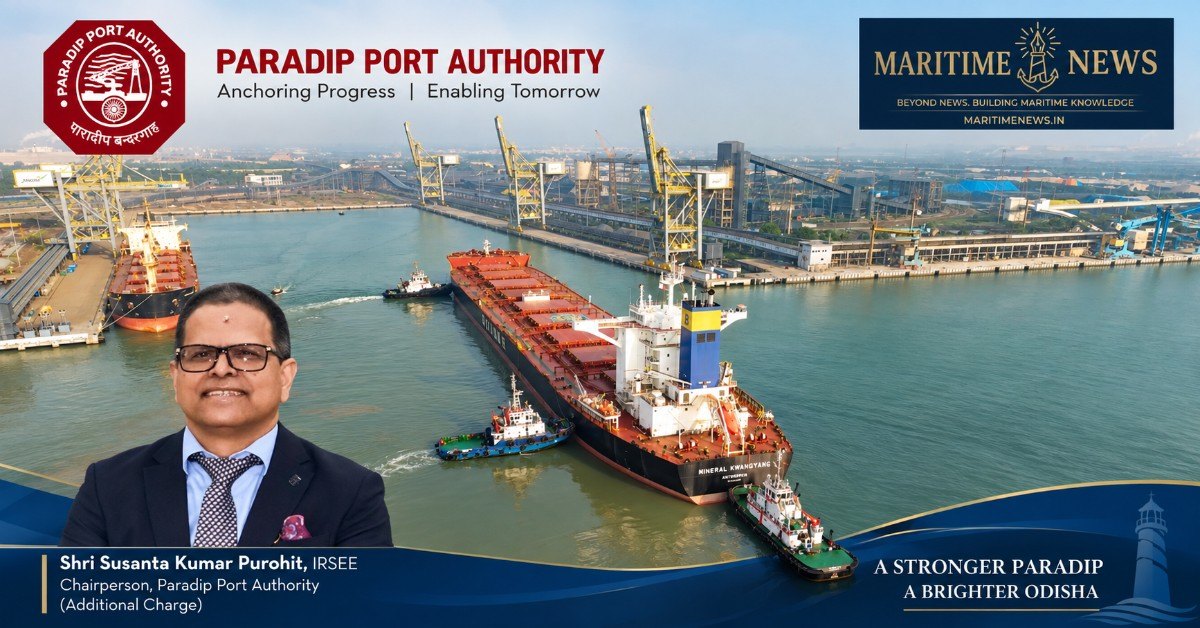
Within days of assuming additional charge, Susanta Kumar Purohit begins engaging Odisha’s top administrative and infrastructure leadership as Paradip moves from capacity expansion to execution
Make us preferred source on Google
Key Takeaways
- Susanta Kumar Purohit assumed additional charge of PPA on September 1, 2026.
- Within days, he engaged the Odisha Chief Secretary and senior officials handling Home, Revenue, Commerce & Transport, Water Resources and other critical portfolios.
- Railway connectivity and cargo evacuation were separately discussed with East Coast Railway.
- PPA has recently demonstrated its deeper-draft capability by berthing a 16.5-metre-draft Capesize vessel at Western Dock-1.
- The port is targeting 27 berths by 2030, compared with 19 currently.
- PPA reported 156.45 MMT cargo handling in FY2025-26, making it India’s No. 2 Major Port and No. 1 on the East Coast.
- The port is pursuing 100% berth mechanisation by 2030, with three recent mechanisation concessions worth ₹1,580.36 crore.
- Paradip’s future is increasingly linked to green hydrogen, liquid cargo, shipbuilding, ship repair, containers, logistics and industrial development.
- But expansion also brings challenges involving safety, environmental protection, worker welfare, governance, land, water, road and rail connectivity and local stakeholder participation.
Also Read: Mormugao Port: From Iron-Ore Gateway to Multi-Commodity Port
Paradip, Odisha, India, September 8, 2026 (Maritime News) : Paradip Port Authority (PPA) has entered a new phase of expansion with its newly appointed Chairperson, Susanta Kumar Purohit, IRSEE, moving quickly to strengthen coordination with the Odisha Government, railway authorities and port stakeholders.
Purohit, who is already serving as Chairperson of V.O. Chidambaranar Port Authority, assumed the additional charge of PPA on September 1, 2026. Within days, he held a series of meetings with senior Odisha Government officials and East Coast Railway, followed by a visit to Paradip Port to review operations and ongoing development projects. (Paradip Port Authority)
The timing is significant. Paradip is simultaneously expanding its deep-draft capability, Western Dock infrastructure, berth capacity and mechanisation, while the State is positioning the port as an anchor for a much wider industrial, energy, logistics and maritime ecosystem.
That expansion has already produced a major operational result.
On September 6, PPA successfully berthed MV Mineral Kwangyang, its first Capesize vessel with a 16.5-metre draft, at Western Dock-1. The 292-metre-long vessel, with a breadth of 45 metres, arrived carrying 152,702 tonnes of coking coal from Hay Point, Australia. (Paradip Port Authority)
The sequence — a new chairman taking charge, immediate coordination with the State and railway authorities, followed by an actual deep-draft Capesize operation — gives a clearer picture of the next phase of Paradip’s development: turning infrastructure investment into sustained operational capacity and regional economic value.
Also Read: From Flood Recovery to Maritime Connectivity: New Assam Development Push Takes Shape
Why Purohit’s First Week Matters
The first meetings of a port chairman can sometimes appear routine. In Paradip’s case, however, the portfolio of officials contacted by Purohit provides an indication of how closely port development is tied to the wider administration of Odisha.
PPA itself said the September 3 interactions were intended to strengthen coordination between the Port Authority and the State Government for the development of Odisha’s maritime sector. (Paradip Port Authority)
1. Anu Garg, IAS — Chief Secretary, Government of Odisha
The meeting with Chief Secretary Anu Garg is the broadest of the engagements.
The Chief Secretary sits at the centre of coordination across departments of the State Government. For PPA, this matters because Paradip’s development increasingly extends beyond the port boundary into transport, industry, land, utilities, disaster preparedness, environmental management and regional economic development.
Paradip’s future projects — from expanded cargo infrastructure to industrial corridors and new maritime facilities — cannot be implemented by the Port Authority alone.
The Chief Secretary-level engagement therefore provides a mechanism for aligning the port’s infrastructure programme with Odisha’s wider development priorities.
2. Hemant Sharma, IAS — Additional Chief Secretary, Home Department
The meeting with Hemant Sharma, Additional Chief Secretary, Home Department, is relevant to the operational security environment surrounding one of India’s largest cargo gateways.
Paradip handles large volumes of bulk cargo, liquid cargo and increasingly large vessels. Its prohibited areas, cargo terminals, industrial interfaces and surrounding communities require coordination among the port, police, security and civil administration.
This becomes particularly important when viewed against previous incidents involving accidents, protests and operational disruptions.
In May 2025, two workers died following an accident inside the port area, after which contractual workers blocked all four gates and cargo operations were disrupted for about 14 hours. Workers alleged safety lapses and sought compensation and employment for the victims’ families. (The New Indian Express)
For a port expanding rapidly in both scale and complexity, security and operational continuity cannot be separated from safety and labour relations.
3. Dr Arabinda Kumar Padhee, IAS — Additional Chief Secretary, Revenue & Disaster Management
The Revenue and Disaster Management portfolio becomes increasingly important as Paradip expands physically and handles larger ships and more cargo.
Land availability, future expansion, emergency preparedness, disaster response and resilience are all relevant to a major port located on Odisha’s cyclone-prone coast.
PPA’s own development programme includes major expansion of its physical footprint and infrastructure. The port has also been developing water-security infrastructure and other supporting facilities.
As vessel sizes and industrial activity increase, the ability to respond to cyclones, flooding, industrial accidents, cargo incidents and other emergencies becomes an essential component of port capacity — not merely an administrative matter.
4. Usha Padhee, IAS
PPA’s engagement with Usha Padhee, IAS, forms part of the wider State-level coordination effort reported by the port.
For Paradip, such senior-level coordination matters because the port’s expansion is increasingly being connected with regional infrastructure, industrial development and economic opportunities beyond the traditional port estate.
The significance is particularly visible in the State’s larger plans for Paradip and Odisha’s maritime economy, where port infrastructure is expected to support manufacturing, logistics, energy and employment.
5. NBS Rajput, IAS — Principal Secretary, Commerce & Transport
This is perhaps one of the most directly relevant State-level engagements for Paradip’s immediate growth.
Commerce & Transport connects the port with the movement of cargo beyond the waterfront — including road, rail, logistics and industrial supply chains.
Paradip’s cargo growth cannot be sustained simply by adding berths. Cargo must also be evacuated efficiently from the port and delivered to industries and markets across Odisha and the wider hinterland.
This explains why Purohit’s subsequent meeting with East Coast Railway is significant.
PPA said discussions with General Manager Parmeshwar Funkwal and Sanjay Kumar Mishra, PCOM and Member, PPA Board, focused on strengthening rail connectivity and improving cargo evacuation. (Paradip Port Authority)
The two engagements therefore fit together: State transport coordination and railway capacity are essential to converting additional berth capacity into actual cargo throughput.
6. Satyabrata Sahu — Member, Board of Revenue
The interaction with Satyabrata Sahu, Member, Board of Revenue, is relevant to the land and administrative dimension of Paradip’s expansion.
Port development requires land not only for berths but also for road and rail corridors, storage, logistics, industrial interfaces and future expansion.
This becomes increasingly important as PPA moves beyond incremental improvements to a much larger regional development model.
7. Shubha Sarma — Department of Water Resources
Water is another critical but less visible component of port-led development.
PPA has already identified water security as part of its long-term development programme, including additional water allocation, a new reservoir and a water treatment plant.
Engagement with the Water Resources Department therefore has a direct infrastructure dimension: ensuring that the expansion of the port, its township and associated industrial activity does not create a parallel water-security constraint.
Also Read: From Adani Ports CEO to Allcargo MD: The Pranav Choudhary
The Deep-Draft Test Has Now Become Operational
The most important development since the announcement of Paradip’s 18.5-metre capability is that the port has now demonstrated the capability in an actual vessel operation.
On September 6, MV Mineral Kwangyang became the first Capesize vessel with a 16.5-metre draft to berth at Western Dock-1.
The vessel’s specifications underline the scale involved:
| Particular | Details |
|---|---|
| Vessel | MV Mineral Kwangyang |
| Vessel type | Capesize |
| Length | 292 m |
| Breadth | 45 m |
| Draft | 16.50 m |
| Cargo | Coking coal |
| Cargo quantity | 152,702 MT |
| Cargo origin | Hay Point, Australia |
| Berth | Western Dock-1 |
| Arrival | September 5, 2026 |
| Berthing | September 6, 2026, 06:00 hrs |
PPA described the operation as a significant step in its ability to handle deeper-draft, larger-capacity bulk carriers. (Paradip Port Authority)
The operation also demonstrates the importance of the public-private operating model. The milestone involved coordination between PPA and Jindal Paradip Port Ltd. (JPPL), with PPA Traffic Manager Rajendra Kumar and JPPL Deputy CEO Sandeep Jaiswal associated with the operation. (Paradip Port Authority)
For cargo owners, importers and industrial users, the practical question is straightforward: Can larger vessels carry more cargo into Paradip efficiently, safely and consistently?
The September 6 operation is an important first answer.
Also Read: National Shipping Board’s First Sagar Samvad Starts With “IF”
From 19 Berths to 27 by 2030
PPA’s expansion programme is much broader than the Western Dock.
At its Independence Day programme, the Port Authority said cargo handling had reached 156.45 MMT in FY2025-26, around 4% higher than the previous year.
Paradip ranked No. 2 among India’s Major Ports, while retaining the No. 1 position on the East Coast and No. 1 position in coastal shipping, with 65.81 MMT of coastal cargo.
The port also reported berth productivity of approximately 37,000 tonnes, more than twice the national average.
PPA plans to increase the number of berths from 19 to 27 by 2030.
The 25-MMT Western Dock Project, comprising five berths, is nearing completion and, according to PPA, is expected to be completed two years ahead of schedule.
The port’s mechanisation programme is equally ambitious.
On August 21, Union Minister for Ports, Shipping and Waterways Sarbananda Sonowal inaugurated seven projects worth ₹427.80 crore and witnessed concession agreements worth ₹1,580.36 crore for three mechanisation projects. (Press Information Bureau)
The three projects comprise:
- 5 MTPA South Quay mechanisation — ₹498.69 crore;
- 8 MTPA Multipurpose Berth mechanisation — ₹630.67 crore;
- 10 MTPA captive CQ-III mechanisation — ₹451 crore.
PPA has stated its objective of achieving 100% berth mechanisation by 2030.
Paradip Is Becoming More Than a Bulk Cargo Port
The port’s development agenda is also becoming increasingly diversified.
The State has identified Paradip as a major platform for industrial and energy development, while the Centre has approved a ₹797.17-crore dedicated jetty with allied facilities for green hydrogen, ammonia and other liquid cargo, with an annual handling capacity of four million tonnes. (The New Indian Express)
The development is intended to connect Odisha’s emerging green-hydrogen production clusters with international markets.
The State has also spoken of major port-linked investments around Paradip, including petrochemicals, green hydrogen, shipbuilding and ship repair. The New Indian Express reported in November 2025 that the Odisha government had cited ₹1.45 lakh crore in approved investment for port-based development and a petrochemical hub in the Paradip region. (The New Indian Express)
PPA’s own longer-term programme includes:
- additional berths;
- container infrastructure;
- green-hydrogen facilities;
- shipbuilding and ship repair;
- improved road and rail connectivity;
- digital port systems;
- additional water infrastructure;
- the Kalinga Maritime Heritage Complex; and
- wider industrial development beyond the traditional port boundary.
Also Read: Can Assam Build a Global Export Economy on One of the World’s Most Dynamic Floodplains?
The Local Economy Is Part of the Port’s Expansion Story
Paradip’s transformation is also being presented as an employment and skills-development programme.
PPA has reported support for placement-linked training of unemployed Odisha youth through the Centre of Excellence in Maritime and Shipbuilding (CEMS).
It has also supported skill-development programmes for fishing communities through the Marine Products Export Development Authority (MPEDA), covering fish hygiene, responsible fishing, improved fishing practices and related measures.
The proposed shipbuilding and ship-repair ecosystem is expected to create additional employment opportunities.
This is important for a port whose expansion is taking place in a working coastal region rather than in an isolated industrial zone.
For local residents, the success of Paradip cannot be measured only in million tonnes of cargo. It also has to be measured through jobs, skills, safer workplaces, better connectivity, reliable water supply, environmental quality and opportunities for local businesses and communities.
The Challenges That Cannot Be Lost in the Expansion
Paradip’s growth story is substantial, but its next phase also brings a demanding governance and safety agenda.
Safety and worker welfare
The 2024 death of a surveyor at the Paradip International Cargo Terminal triggered protests and allegations concerning unsafe working conditions. The New Indian Express reported that workers had raised concerns about pressure to meet operational targets and safety practices. (The New Indian Express)
In May 2025, two more workers died in an accident inside the port area, followed by a 14-hour disruption of cargo operations as workers protested. (The New Indian Express)
These incidents matter because mechanisation and higher productivity cannot be separated from occupational safety.
Environmental and hazardous-cargo management
In May 2026, a pipeline reportedly burst while petrol was being transferred from a vessel to an Indian Oil terminal, resulting in thousands of litres of petrol spilling into nearby water bodies and the sea, according to The New Indian Express. The leakage was subsequently plugged and no casualty was reported. (The New Indian Express)
As Paradip expands liquid cargo, green fuels and industrial activity, pipeline integrity, emergency response, pollution prevention and monitoring will become even more important.
Governance and procurement
Paradip has also faced serious governance-related scrutiny.
In March 2025, the CBI investigated alleged cheating and forgery relating to a ₹65.76-crore PPA housing project, including allegations involving fake bank guarantees. The investigation covered the project for 350 residential quarters and land associated with future port expansion. (The New Indian Express)
Earlier, in 2022, the CBI arrested the then Chief Mechanical Engineer of Paradip Port Trust and others in an alleged bribery case concerning benefits to private stakeholders and repair of a damaged conveyor belt. (The New Indian Express)
These cases do not define the entire institution, but they underline why transparent procurement, contract management, verification systems and vigilance mechanisms become more important as the value of port projects increases.
Seafarer and vessel-interface issues
In November 2024, The New Indian Express reported that 21 crew members aboard the detained vessel MV Debi had gone on strike after prolonged confinement and non-payment of salaries. The vessel had remained under Customs detention following a drug seizure. (The New Indian Express)
Although the matter involved Customs detention rather than a normal port operation, it illustrates the complexity of the human interface surrounding a major port: seafarers, shipowners, Customs, immigration, terminal operators and port authorities can all become part of the same operational ecosystem.
Also Read: THE COST OF SILENCE
The Real Test for PPA 2.0
The scale of Paradip’s ambitions is now clear.
The port is handling more than 156 MMT annually, deepening its channel, adding berths, mechanising existing facilities, developing Western Dock, preparing for larger Capesize vessels and positioning itself for green fuels and industrial cargo.
The first 16.5-metre-draft Capesize call at WD-1 provides an important operational demonstration of that transformation.
But the next stage will require something more difficult than building capacity: integrating capacity.
That means ensuring that:
berths connect to rail and road;
larger ships connect to reliable cargo evacuation;
industrial expansion connects to local employment;
mechanisation connects to worker safety;
liquid-cargo growth connects to environmental safeguards;
land expansion connects to transparent governance;
and port growth connects to the communities living around Paradip.
This is also why Purohit’s early meetings with Odisha’s Chief Secretary, Home, Revenue & Disaster Management, Commerce & Transport and Water Resources leadership — followed by discussions with East Coast Railway — are more consequential than a series of ceremonial courtesy calls.
They represent the administrative architecture required to support the next stage of Paradip’s expansion.
MaritimeNews Insight
Paradip is no longer simply trying to become a larger cargo port. It is attempting to become an integrated maritime-industrial platform for eastern India.
The numbers show strong momentum. The 18.5-metre capability, Western Dock, mechanisation programme and first 16.5-metre Capesize operation show that infrastructure is moving into operational use.
The harder question is whether the systems around that infrastructure will mature at the same speed.
For port users, that means turnaround time, draft, reliability and cargo evacuation.
For shipping lines and vessel operators, it means navigational safety, berth availability and predictable port operations.
For industry, it means dependable rail, road, energy and liquid-cargo infrastructure.
For workers and seafarers, it means safety, welfare and fair working conditions.
For Paradip residents, it means jobs, skills, water, connectivity and environmental protection.
For Odisha, it means converting the port into a wider economic multiplier rather than simply a cargo-handling location.
And for PPA’s new leadership, the challenge is to make all these pieces work together.
Also Read: The Sea Doesn’t Forgive Silence
What Comes Next?
The immediate watch points for Paradip are therefore:
- Completion and utilisation of the Western Dock’s five berths.
- Regular handling of deeper-draft Capesize vessels, following the September 6 milestone.
- Progress towards 27 berths by 2030.
- Implementation of 100% berth mechanisation.
- Rail and road capacity keeping pace with cargo growth.
- Execution of the green hydrogen, ammonia and liquid-cargo infrastructure.
- Shipbuilding and ship-repair development near the Mahanadi.
- Worker and terminal safety following previous accidents.
- Stronger environmental safeguards as hazardous and liquid cargo volumes grow.
- Transparent procurement and stronger contract-governance systems.
- Local employment and skills development.
- Water security and resilience against extreme weather.
Also Read: THE PROMISE BEFORE BOARDING
Frequently Asked Questions
Who is the new Chairperson of Paradip Port Authority?
Susanta Kumar Purohit, IRSEE (1996 batch), who continues as Chairperson of V.O. Chidambaranar Port Authority, assumed additional charge as Chairperson of Paradip Port Authority on September 1, 2026. (Paradip Port Authority)
What was Purohit’s first major priority at Paradip?
His early engagements focused on strengthening coordination with the Odisha Government and East Coast Railway, followed by a review of PPA operations and development projects. (Paradip Port Authority)
Why is the 16.5-metre Capesize vessel important?
It was the first-ever Capesize vessel with a 16.5-metre draft to berth at Western Dock-1. MV Mineral Kwangyang carried 152,702 tonnes of coking coal, demonstrating Paradip’s ability to handle a larger, deeper-draft bulk carrier. (Paradip Port Authority)
How much cargo did Paradip Port handle in FY2025-26?
PPA reported 156.45 million tonnes, approximately 4% higher than the previous year.
What is Paradip’s target for berth expansion?
PPA has stated that the number of berths is planned to increase from 19 to 27 by 2030.
What is the target for mechanisation?
PPA is working towards 100% berth mechanisation by 2030.
What is the new green-fuel infrastructure?
The Centre approved a ₹797.17-crore dedicated jetty and allied facilities for green hydrogen, ammonia and other liquid cargo, with an annual capacity of four million tonnes. (The New Indian Express)
Sources and Further Reading
This report has been prepared using official PPA and Government of India releases, PPA project and historical information, and independent reporting on developments and challenges around Paradip Port.
- Paradip Port Authority — Official Website
- PPA: Shri Susanta Kumar Purohit assumes charge
- PPA: Leadership Visit & Interaction
- PPA: Historic Maritime Milestone — First 16.5-metre Capesize vessel
- Press Information Bureau: ₹427.80-crore projects and 18.5-metre deep-draft capability
- The New Indian Express: IOCL pipeline burst and petrol spill at Paradip
- The New Indian Express: ₹797-crore liquid-cargo jetty
- The New Indian Express: Port-based investment in Paradip
- The New Indian Express: Worker deaths and cargo-operation disruption
- The New Indian Express: CBI investigation into ₹65.76-crore PPA housing project
- The New Indian Express: Surveyor’s death at PICT
- The New Indian Express: Crew strike aboard MV Debi
- The New Indian Express: 2022 CBI bribery case involving Paradip Port officials
Editorial note: The challenges cited above are included to provide context to the port’s expansion and are based on reported incidents; they should not be read as allegations against the present PPA Chairperson or as evidence that the current administration caused those historical events.
Make us preferred source on Google
Reporting by MaritimeNews Bureaus, Writing and Editing by Jaspal Singh Naol.
5 thoughts on “Paradip Port Authority’s New Leadership Push: State Coordination, Rail Connectivity and Deep-Draft Expansion”