
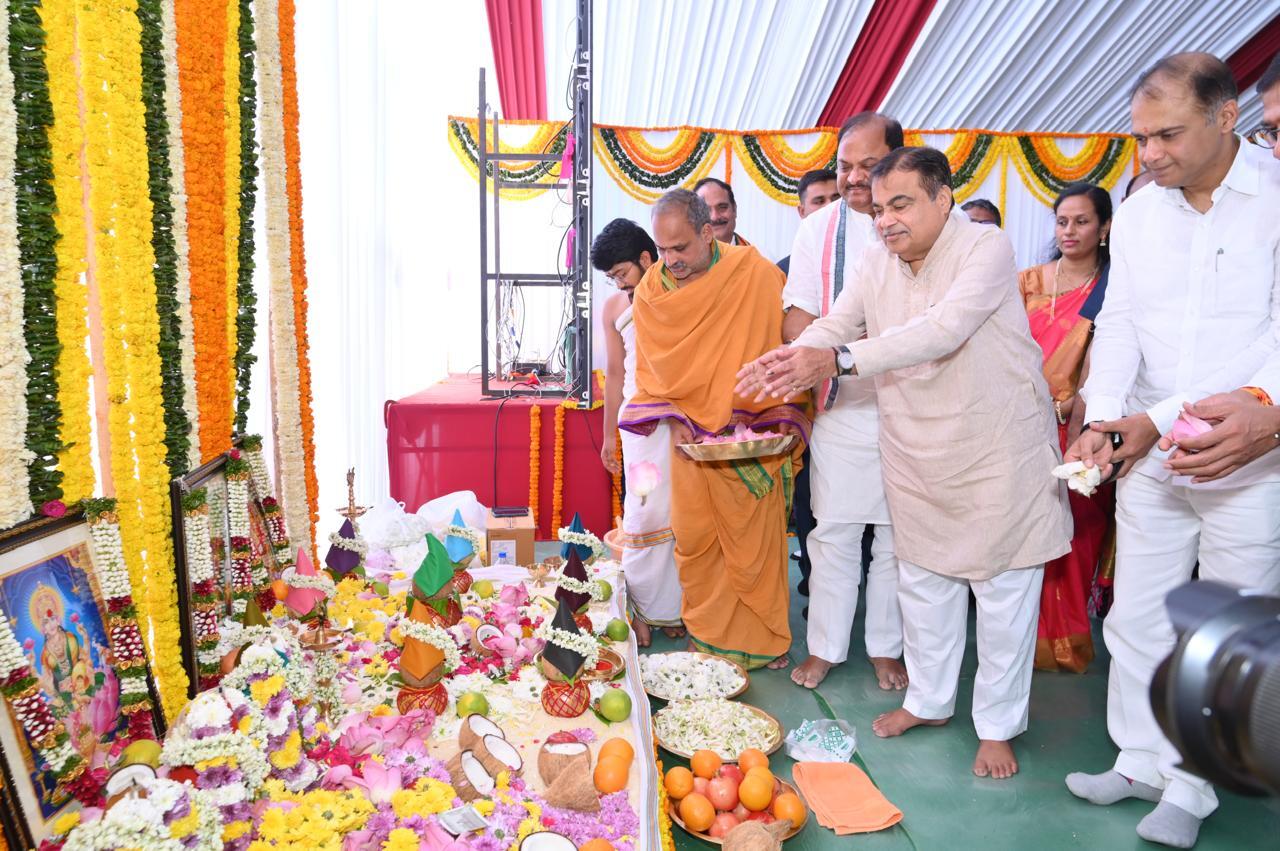
Union Minister Nitin Gadkari has performed the bhoomipujan for a Multi-Modal Logistics Park at Sindi Railway in Maharashtra’s Wardha district. The project is intended to connect Vidarbha’s cotton, textiles and agricultural produce with international markets through rail-linked logistics and Jawaharlal Nehru Port Authority (JNPA). The government says transportation costs could fall from ₹1.5 lakh to ₹1 lakh per container, although the projected savings will need to be assessed against actual operating performance.
Key Takeaways
- New development milestone: Union Minister Nitin Gadkari performed the bhoomipujan for the Sindi Railway Multi-Modal Logistics Park on 1 November 2026.
- 150-acre project: The facility is being developed near Sindi Railway station on the Nagpur–Wardha district border, with the involvement of National Highways Logistics Management Limited (NHLML) and JNPA.
- Export gateway for Vidarbha: The project is intended to facilitate exports of cotton, cotton lint, yarn, textiles, oranges and vegetables.
- Projected savings: The government expects transportation costs to fall from ₹1.5 lakh to ₹1 lakh per container—a potential saving of ₹50,000, or approximately 33.3%.
- Rail and port connectivity: The project aims to connect inland producers with port-based export networks and reduce reliance on routing certain cargo through Mumbai.
- Supporting infrastructure: Planned facilities include warehouses, cold storage, exporter clusters and a customs office.
- Implementation question: The scale of the benefits will depend on actual cargo volumes, operating arrangements, transit times and whether the projected cost savings are achieved.
Wardha, Maharashtra, India, November 2, 2026 (Maritime News): India’s effort to improve export competitiveness is increasingly extending beyond seaports to the inland logistics infrastructure that connects manufacturers, farmers and exporters with international markets.
The Sindi Railway Multi-Modal Logistics Park in Wardha district is intended to serve this purpose for Vidarbha, a region with agricultural and industrial production that can benefit from more efficient access to rail and port-based logistics.
Union Minister for Road Transport and Highways Nitin Gadkari performed the bhoomipujan for the project on 1 November 2026. According to the Government of India’s Press Information Bureau (PIB), the facility is expected to support direct exports of cotton, cotton lint, yarn, oranges and vegetables through Jawaharlal Nehru Port Authority.
The government also expects the project to reduce transportation costs per container from ₹1.5 lakh to ₹1 lakh and improve cargo movement through logistics routes connecting India with international markets.
The project is being developed with the involvement of National Highways Logistics Management Limited, a special-purpose vehicle of the National Highways Authority of India, and JNPA. AMARA TRANZ Solution is identified in the PIB announcement as being involved in the development.
The project highlights an important dimension of maritime trade: a port’s export capability depends not only on its own infrastructure but also on the efficiency of the inland transport network feeding cargo into it.
Primary source: Government of India, PIB — Union Minister Nitin Gadkari Performs Bhoomipujan of Multi-Modal Logistics Park at Sindi Railway.
1. The Project: A 150-Acre Logistics Hub Near Sindi Railway Station
The Sindi Railway Multi-Modal Logistics Park is being developed across approximately 150 acres near Sindi Railway station, on the Nagpur–Wardha district border.
According to the PIB announcement, the project involves National Highways Logistics Management Limited (NHLML) and Jawaharlal Nehru Port Authority. NHLML is a special-purpose vehicle associated with the National Highways Authority of India (NHAI).
The proposed facility is intended to bring together cargo handling, storage, consolidation and export-related services in an inland location.
Rather than requiring every consignment to travel separately to a seaport before being organised for export, a logistics park can allow eligible cargo to be consolidated and prepared closer to its place of production.
The proposed facilities include:
- Warehouses for cargo storage and consolidation.
- Cold storage for suitable agricultural and perishable products.
- Exporter clusters to bring businesses and logistics services together.
- A customs office to support export and import procedures.
- Connections to the dry port and rail-based freight network.
The practical benefits will depend on the facilities being commissioned, the services made available to exporters and the efficiency of the connections between the logistics park, rail network and destination ports.
The PIB release identifies the project’s intended functions but does not provide a complete commissioning schedule, detailed operating tariff or forecast of annual cargo-handling capacity.
2. Vidarbha’s Agricultural and Industrial Products Could Gain Export Access
The government has identified several products from Vidarbha that could benefit from the logistics park.
These include cotton, cotton lint, yarn, textiles, oranges and vegetables.
For agricultural producers and manufacturers, the cost and reliability of moving goods to export gateways can influence whether international markets are commercially accessible.
The proposed facility could help consolidate shipments from different producers, provide storage and connect cargo with rail-based transport and port services.
Cotton, cotton lint and yarn
Cotton and textile-related products are among the commodities identified by Gadkari as potential beneficiaries.
The project could provide a common logistics point for collecting and consolidating cargo before it moves towards export destinations. The extent of the benefit will depend on the volume of cargo handled, the availability of rail services and the overall cost of moving goods through the logistics chain.
Oranges and vegetables
Agricultural products have different storage and handling requirements from many industrial goods.
The proposed cold-storage infrastructure could help accommodate products that require temperature-controlled storage, subject to the facility’s actual capabilities and operating arrangements.
Cold storage alone, however, does not guarantee lower spoilage or faster exports. Benefits would depend on appropriate handling, storage conditions, transport schedules and coordination with buyers and onward logistics providers.
Textiles and other industrial cargo
The proposed consolidation of industries from Nagpur and Wardha could create opportunities for manufacturers that need regular access to domestic and international markets.
If exporters can combine logistics services and secure dependable transport arrangements, they may be able to improve planning and reduce avoidable handling or transportation costs.
These remain potential benefits. Actual outcomes will depend on cargo volumes, service availability and the commercial terms offered to users.
3. JNPA Connection: Why the Inland Link Matters
Jawaharlal Nehru Port Authority is central to the government’s stated export strategy for the Sindi Railway project.
The PIB announcement says the logistics park is intended to facilitate exports from Vidarbha to international markets through JNPA.
This connection highlights the role of inland logistics infrastructure in supporting seaport operations.
A port may have the terminal capacity to handle export cargo, but exporters also need efficient connections from factories, farms and distribution centres to the port. Delays, repeated handling, limited storage or expensive inland transportation can increase the total cost of an export shipment.
An inland logistics park can potentially address some of these constraints by providing cargo consolidation, storage and links to rail-based transport.
For exporters, the relevant measure is the total cost and reliability of moving goods from their origin to the overseas buyer—not simply the distance to the port.
For JNPA, a well-functioning inland network could support cargo aggregation from a wider hinterland. Whether this results in additional throughput at the port will depend on the actual cargo attracted to the facility and the shipping and export arrangements selected by businesses.
The key maritime link is therefore operational: the logistics park must connect inland production with reliable onward transport and port services for its potential benefits to materialise.
4. Government Projects a ₹50,000 Saving per Container
One of the most significant claims in the PIB announcement concerns the expected reduction in transportation costs.
Gadkari said transportation costs per container could fall from ₹1.5 lakh to ₹1 lakh for the cargo movement described in the release.
Projected transportation cost comparison
| Indicator | Amount |
|---|---|
| Existing cost cited in the announcement | ₹1,50,000 per container |
| Expected cost after the proposed logistics arrangement | ₹1,00,000 per container |
| Potential saving | ₹50,000 per container |
| Potential reduction | Approximately 33.3% |
Source: Government of India, PIB announcement dated 1 November 2026. The saving is a government-stated expectation, not an independently verified operating result.
A reduction of ₹50,000 per container would be commercially significant if achieved consistently for the relevant cargo and routes.
Lower logistics costs could improve the competitiveness of exporters, particularly where transportation forms a substantial part of the delivered cost of goods.
However, the comparison requires careful interpretation. The announcement does not provide a detailed breakdown of the existing and projected costs, identify all included services or establish the cargo and route conditions under which the comparison applies.
A reliable assessment would need to establish whether the figures include inland transport, rail freight, handling, storage, terminal charges, customs-related costs and other applicable expenses.
The comparison would also need to account for differences between cargo types and shipment arrangements.
Until actual operating data is available, the ₹50,000 figure should be treated as a projected saving rather than a verified reduction already achieved by exporters.
5. Proposed Route to Bangladesh Through Haldia
The PIB release says cotton, cotton lint, textiles and oranges from Vidarbha will be transported to Bangladesh through Haldia in Kolkata, without first travelling to Mumbai.
The announcement presents this arrangement as a way to reduce transportation costs and improve the movement of cargo from the region.
The commercial rationale is to connect inland production with an export route that may avoid an additional movement to Mumbai for the specified cargo.
The route’s effectiveness will depend on the actual rail services, cargo-handling arrangements, customs procedures, onward transport and international shipment connections available to exporters.
The announcement also refers to reducing transportation time for cargo moving from Vidarbha through the Mumbai–Colombo–Dhaka route.
These are distinct route descriptions in the source. The precise operational arrangements, eligible cargo, transit schedules and route-by-route cost comparisons are not detailed in the announcement.
It would therefore be premature to conclude that every shipment will avoid Mumbai or that the same cost reduction will apply to all export destinations.
For exporters, the relevant comparison is between complete origin-to-destination logistics options, including handling, transit time, reliability and total cost.
6. Cold Storage, Warehousing and Exporter Clusters
The planned facilities at Sindi Railway are intended to bring multiple logistics functions together.
Warehousing
Warehouses can provide space to store goods before dispatch, consolidate shipments and coordinate cargo movements with transport schedules.
For industrial users, warehousing can help organise cargo from different suppliers or production facilities. For agricultural exporters, storage may provide a buffer between harvest, collection and shipment, depending on the commodity and storage conditions.
Cold storage
Cold storage is particularly relevant to products that require temperature-controlled conditions.
Its value will depend on the types of products supported, the capacity available, the quality of temperature management and the coordination between storage and onward transportation.
Exporter clusters
The government says exporter clusters will be developed at the location.
Bringing exporters and related services together could create opportunities for shared logistics infrastructure and closer coordination between producers, transport operators and export-service providers.
However, the announcement does not identify the participating exporters, committed cargo volumes or the detailed arrangements through which clusters will be developed.
The commercial outcome will depend on whether businesses use the facilities and whether the services meet their operational requirements.
7. Customs Office: Bringing Export Procedures Closer to Inland Cargo
A customs office is planned at Sindi Railway, according to the PIB announcement.
The facility is intended to handle containers from across India and abroad, strengthening the region’s export and logistics infrastructure.
The potential benefit is procedural convenience for businesses whose cargo can be processed through the facility under the applicable customs arrangements.
The establishment of a customs office does not, by itself, establish that all export clearances will be completed at Sindi Railway or that all cargo will qualify for the same procedures.
The practical effect will depend on the scope of the customs facilities, the services authorised there, the documentation requirements and the coordination with other authorities and transport providers.
For exporters, the most useful performance indicators will include the time required for processing, the reliability of clearances and the total cost of completing export formalities.
8. First Rake of Maruti Cars: A Sign of Rail-Based Cargo Activity
The PIB release states that the first rake carrying Maruti cars had already commenced operations from the project.
This indicates that vehicle cargo has been associated with rail movement from the location.
The reference is relevant because it suggests that the logistics facility is not being discussed exclusively as an agricultural export gateway. The announcement also points to potential industrial cargo movements involving the Nagpur and Wardha region.
Rail-based movement can be suitable for certain cargoes when shipment volumes, loading arrangements, schedules and destination requirements align.
However, the source does not provide the number of vehicles carried, the frequency of services, the destination of the rake or the current scale of operations.
Nor does the statement establish the facility’s overall container-handling capacity or the volume of export cargo it will handle in the future.
Those details will be important in assessing how far rail operations can expand and how the facility may serve different categories of cargo.
9. Project Timeline Requires Clarification
The latest PIB announcement describes the bhoomipujan held on 1 November 2026 and reports that the first rake carrying Maruti cars had already commenced operations.
Earlier official records also describe activity at the Sindi facility. A PIB release dated 30 April 2025 reported that commercial operations had begun at the Multi-Modal Logistics Park in Nagpur at Sindi, near Wardha, following the arrival of a rake carrying 123 Maruti cars on 28 April 2025. Read the earlier PIB release.
JNPA’s project information also describes a proposed Multi-Modal Logistics Park at Sindi being developed through an arrangement involving JNPA and NHAI’s NHLML. JNPA project information.
These records indicate that Sindi has been part of a logistics development initiative for several years. The available announcements do not fully explain how the November 2026 bhoomipujan relates to the earlier commercial operations, or whether it concerns a new phase, additional infrastructure or a separate milestone within the wider project.
This distinction matters for reporting progress accurately. A ceremony, commencement of initial operations and completion of the full planned logistics park are different milestones.
Clarification needed: The implementing agencies should specify the scope of the development marked by the November 2026 ceremony, the infrastructure already operational, the facilities still to be completed and the expected timeline for the remaining works.
10. Stakeholder Impact: Who Could Benefit?
The project could influence several parts of the logistics chain, but the scale of the benefits will depend on how the facility operates.
| Stakeholder | Potential benefit | What needs to be verified |
|---|---|---|
| Farmers and agricultural cooperatives | Potential access to export logistics and storage | Actual usage, handling costs and market access |
| Textile and cotton businesses | Cargo consolidation and rail-based transport options | Route costs, schedules and shipment reliability |
| Exporters | Potential reduction in inland logistics costs | Complete origin-to-destination cost comparisons |
| Freight forwarders | Additional inland logistics and cargo coordination options | Service availability, operating terms and volumes |
| Rail freight operators | Potential demand for cargo movement | Train frequency, cargo commitments and utilisation |
| Warehousing and cold-storage operators | Demand for storage and cargo-handling services | Commissioned capacity and customer uptake |
| Customs and export-service providers | Opportunities to support regional export activity | Scope of authorised services and clearance performance |
| JNPA and port-linked operators | Potential cargo aggregation from a wider hinterland | Actual cargo routed through the port |
| Shipping lines | Potential additional export cargo | Shipment volumes, cargo mix and service demand |
| Local residents and businesses | Potential employment and related economic activity | Jobs created, local procurement and project implementation |
The table describes potential effects rather than confirmed benefits. The project announcement does not provide an employment estimate, a detailed cargo forecast or a quantified assessment of the impact on JNPA’s throughput.
The extent of the benefit to each stakeholder will need to be assessed using operational and commercial data as the facility develops.
11. Reality Check: Infrastructure Must Translate into Lower Logistics Costs
The Sindi Railway project addresses a recognised logistics challenge: connecting inland production with international trade routes. But infrastructure alone does not guarantee that exporters will pay less or reach overseas buyers faster.
Several questions remain important.
Will the projected cost saving be achieved?
The government has cited a potential reduction of ₹50,000 per container. The underlying cost assumptions and the route-specific comparison have not been provided in the announcement.
Actual bills and route comparisons will be needed to establish whether the saving is achieved and for which cargo categories.
How much cargo will use the facility?
The source identifies potential agricultural and industrial products, but does not provide committed volumes or annual throughput forecasts.
Without sustained cargo demand, warehouses, rail services and other facilities may not operate at the scale needed to achieve the anticipated economies.
Will the alternative routes be reliable?
Exporters need dependable schedules, predictable handling and effective coordination between inland facilities, rail operators, customs and port services.
A route that is cheaper in principle may not be commercially attractive if it introduces delays, additional handling or uncertainty.
What infrastructure is already operational?
Earlier official records reported initial commercial activity at Sindi in April 2025. The November 2026 announcement does not fully explain how that operational status relates to the development marked by the latest bhoomipujan.
Clear information on completed facilities, remaining works and operating arrangements would help stakeholders understand the project’s current status.
Will benefits reach farmers and smaller exporters?
Lower logistics costs could improve export competitiveness, but the distribution of benefits will depend on commercial arrangements, access to services, charges and the ability of smaller producers to aggregate cargo.
The project will need to demonstrate benefits through actual use, not only through projected savings.
12. What Maritime Stakeholders Should Monitor
MaritimeNews identifies the following indicators as important for evaluating the project’s performance:
- Project milestones: The scope of works covered by the November 2026 bhoomipujan and the timeline for completing the remaining facilities.
- Operating status: Which warehouses, cold-storage facilities, customs services and cargo-handling systems are operational.
- Rail services: The frequency of cargo trains, types of cargo carried and destinations served.
- Cost performance: Actual per-container costs compared with the ₹1.5-lakh baseline cited in the announcement.
- Transit time: Measured door-to-door or origin-to-destination performance for the relevant routes.
- Cargo volumes: Actual quantities of cotton, textiles, agricultural produce, vehicles and other goods handled.
- Exporter participation: The number of businesses using the facility and the frequency of their shipments.
- Port connectivity: The volume of cargo routed through JNPA and other export gateways.
- Employment: Verified jobs created directly and indirectly through project operations.
- Local economic impact: Participation by local suppliers, transport operators and service providers.
These indicators would help establish whether Sindi Railway becomes a commercially effective inland export gateway.
Frequently Asked Questions
1. What is the Sindi Railway Multi-Modal Logistics Park?
It is a logistics development near Sindi Railway station in Wardha district, Maharashtra, intended to connect inland cargo with rail-based transport, storage, customs services and international markets through port-linked logistics.
2. Who is developing the project?
The PIB announcement identifies National Highways Logistics Management Limited (NHLML), a special-purpose vehicle of NHAI, and Jawaharlal Nehru Port Authority as joint developers. It identifies AMARA TRANZ Solution as being involved in the development.
3. How large is the project?
The 1 November 2026 PIB announcement describes a development across 150 acres near Sindi Railway station.
4. Which products could benefit?
The government identifies cotton, cotton lint, yarn, textiles, oranges and vegetables as potential export products. The release also mentions a rake carrying Maruti cars that had already commenced operations.
5. How much could transportation costs fall?
The government expects the cost per container to decline from ₹1.5 lakh to ₹1 lakh—a potential saving of ₹50,000, or about 33.3%. The saving has not been independently verified in the announcement.
6. Will all cargo avoid Mumbai?
No such conclusion can be drawn from the announcement. It describes a proposed route through Haldia to Bangladesh for specified cargo and refers separately to the Mumbai–Colombo–Dhaka route. The route used will depend on the cargo, destination and available logistics arrangements.
7. What facilities are planned at Sindi Railway?
The announcement identifies cold storage, warehouses, exporter clusters and a customs office, alongside the connection to the dry port.
8. Is the facility already operational?
Earlier PIB reporting stated that commercial operations at the Sindi facility began in April 2025, while the November 2026 release reports a new bhoomipujan milestone and refers to a rake that had already commenced operations. The available releases do not fully explain the relationship between these milestones or the current status of all planned facilities.
9. How could the project benefit JNPA?
If the logistics park attracts additional cargo and establishes reliable connections to JNPA, it could help aggregate export cargo from Vidarbha and the wider hinterland. The extent of any additional port throughput remains to be demonstrated.
Sindi’s Value Will Be Measured by Cargo, Cost and Connectivity
The Sindi Railway Multi-Modal Logistics Park represents an effort to connect Vidarbha’s agricultural and industrial economy more efficiently with international trade.
The planned combination of rail connectivity, warehousing, cold storage, exporter clusters and customs services could help businesses consolidate cargo and access port-linked export routes. The government’s projected reduction in transportation costs—from ₹1.5 lakh to ₹1 lakh per container—would be commercially significant if achieved.
For JNPA and India’s maritime logistics sector, the project underscores the importance of the inland network feeding seaports. Efficient export infrastructure requires more than terminal capacity: it also requires reliable rail services, suitable storage, workable customs procedures and competitive end-to-end transportation costs.
Yet the project must be judged by its operating results. Cargo volumes, actual cost savings, transit times, exporter participation and the status of planned infrastructure will determine whether the expected benefits materialise.
The earlier official reporting of commercial activity at Sindi and the latest bhoomipujan announcement also make clarification of the project’s phases and implementation status important.
For MaritimeNews, the central test is clear: can Sindi Railway turn inland logistics infrastructure into measurable savings for exporters and more reliable cargo flows through India’s maritime gateways?
Sources
- Government of India, Press Information Bureau: Union Minister Nitin Gadkari Performs Bhoomipujan of Multi-Modal Logistics Park at Sindi Railway, 1 November 2026. Primary source for the bhoomipujan, project participants, proposed export products, expected cost reduction and planned facilities.
- Government of India, Press Information Bureau: Commercial Operations Begins at Multi Modal Logistic Park in Nagpur, 30 April 2025. Reports initial commercial operations and the arrival of a rake carrying 123 Maruti cars at Sindi.
- Jawaharlal Nehru Port Authority: Ongoing Projects. Provides JNPA’s description of the Sindi Multi-Modal Logistics Park and its intended role as a hinterland logistics facility.