
Three Indian Seafarers Missing as New Delhi Calls for Protection of Sea Lanes, Freedom of Navigation and Regional Stability
Maritime News, New Delhi / Muscat / United Nations: India has lodged a strong diplomatic protest with the United States following an attack on a commercial tanker off the coast of Oman that left three Indian seafarers missing, while simultaneously warning the United Nations that escalating tensions in West Asia are posing a growing threat to merchant shipping, global trade and maritime security.
The Ministry of External Affairs (MEA) on Wednesday summoned US Chargé d’Affaires Jason Meeks in New Delhi after the attack on the tanker Settebello, which was carrying 24 Indian crew members near the entrance of the strategically important Strait of Hormuz.
According to the MEA, 21 Indian crew members have been rescued, while search and rescue operations continue for three missing seafarers.
India condemned the attack and expressed deep concern over the continuing violence affecting commercial shipping in the Gulf region.
“The continuing incidents of attacks on shipping in the region are deeply worrisome and a direct result of the ongoing conflict in the region,” the MEA said, reiterating India’s call for immediate de-escalation and a diplomatic resolution to restore peace and stability.
Tanker Incident Highlights Growing Risks to Commercial Shipping
According to the US Central Command (CENTCOM), the tanker was allegedly attempting to transport Iranian oil in violation of an American maritime blockade.
CENTCOM stated that a US military aircraft fired precision munitions into the vessel’s engine room after repeated warnings were allegedly ignored.
Maritime security sources reported that the tanker transmitted distress messages indicating severe damage and a fire in the engine room, triggering an emergency evacuation operation involving Omani authorities.
The incident occurred near one of the world’s most strategically sensitive maritime corridors.
The Strait of Hormuz remains the primary gateway for Gulf energy exports and carries nearly 20 per cent of global oil trade, making any disruption a matter of global concern for shipping companies, energy markets and governments.
India Raises Merchant Shipping Concerns at the United Nations
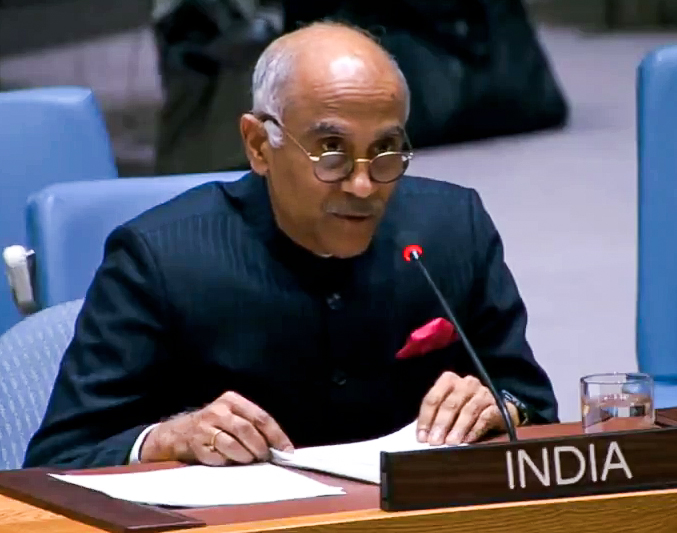
In a significant diplomatic intervention, India’s Permanent Representative to the United Nations, Ambassador Harish Parvathaneni, used a UN Security Council debate on Middle East security to highlight the increasing risks faced by merchant shipping and seafarers operating in the region.
India stated that it remains firmly opposed to attacks on merchant vessels and critical Sea Lanes of Communication (SLOCs), which serve as the lifelines of international trade and global energy transportation.
The Ambassador noted that many Indian nationals have either lost their lives or remain missing as a result of attacks on merchant vessels and maritime trade routes in recent years.
India’s intervention effectively elevated the issue beyond a single tanker incident, framing it as a broader challenge to maritime security, freedom of navigation and international commerce.
Sea Lanes Under Pressure
The attack comes amid mounting concerns over the security of vital maritime corridors connecting Asia, Europe and the Middle East.
Industry observers note that attacks on merchant shipping create risks far beyond the vessels directly involved.
Disruptions to major Sea Lanes of Communication can trigger:
- Higher marine insurance premiums
- Increased war-risk surcharges
- Rising freight rates
- Longer voyage diversions
- Supply chain disruptions
- Greater uncertainty in energy markets
For a trade-dependent economy such as India, the implications extend directly to shipping, ports, manufacturing and energy security.
India’s Stakes in the Gulf Region
India’s concerns are not merely diplomatic.
Ambassador Parvathaneni stressed that India is a proximate neighbour with significant economic and human interests across West Asia.
Nearly 10 million Indians live and work across the Gulf region, while Indian seafarers constitute one of the largest components of the global maritime workforce.
The Ambassador warned that the widening conflict, mounting destruction and disruption of normal economic activity across the region are creating serious concerns for countries dependent on stable trade and energy flows.
India’s energy security remains closely linked to the Gulf, while a substantial share of the country’s imports, exports and maritime trade passes through regional sea routes.
Seafarer Safety Back in Focus
The latest incident has once again highlighted the vulnerability of seafarers caught in geopolitical conflicts.
India’s Embassy in Muscat confirmed that it remains in close contact with Omani authorities and is actively monitoring rescue efforts involving the missing crew members.
The attack follows a series of maritime security incidents in Gulf waters over recent months, raising concerns among shipowners, crewing agencies and maritime unions regarding the safety of civilian seafarers operating in conflict-prone regions.
Industry stakeholders have repeatedly called for greater international efforts to protect commercial shipping and maritime personnel navigating high-risk waters.
Call for Diplomacy and Restoration of Free Navigation
India used both its diplomatic protest and its intervention at the United Nations to reiterate support for dialogue, diplomacy and restraint.
The government stressed that attacks on commercial shipping and civilian infrastructure must cease immediately and called for the restoration of free and unimpeded navigation through international waterways in accordance with international law.
Ambassador Parvathaneni also reaffirmed India’s support for all efforts aimed at achieving a peaceful resolution to the conflict.
“The people of West Asia deserve sustained peace and normalcy,” he told the Security Council, adding that India remains ready to contribute towards efforts that promote peace, stability and prosperity in the region.
For the global maritime industry, the incident serves as another reminder that the security of sea lanes, the safety of seafarers and the uninterrupted movement of commerce remain essential pillars of international trade and economic stability.