
India Moves to Repatriate Crew as Concerns Grow Over Rising Risks to Merchant Shipping in Conflict Zones
Maritime News, New Delhi / Muscat: Three Indian seafarers who were initially reported missing following a United States military strike on the Palau-flagged tanker MT Settebello off the coast of Oman have now been confirmed dead, marking one of the most serious recent tragedies involving Indian maritime professionals operating in the Gulf region.
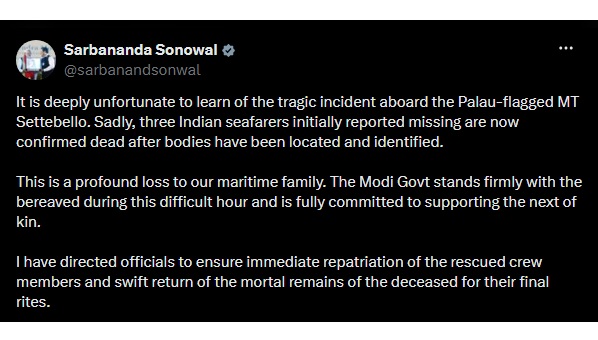
Union Minister for Ports, Shipping and Waterways Sarbananda Sonowal confirmed the deaths on Thursday, describing the incident as a profound loss for India’s maritime community.
The tanker, carrying 24 Indian crew members, came under attack earlier this week while transiting waters near the entrance of the strategically important Strait of Hormuz, triggering a major search-and-rescue operation involving Indian and Omani authorities.
“Sadly, three Indian seafarers initially reported missing are now confirmed dead after two bodies were recovered,” Sonowal said in a statement.
The Minister assured that the Government of India would extend all necessary assistance to the families of the deceased and facilitate the immediate repatriation of the 21 surviving crew members along with the mortal remains of the victims.
From Search Operation to Maritime Tragedy
Initial reports following the attack indicated that 21 crew members had been rescued while three Indian seafarers remained unaccounted for.
Maritime unions and shipping industry representatives closely monitored the situation as search efforts continued in coordination with Omani authorities.
Earlier reports suggested that two crew members had been confirmed dead while the vessel’s chief engineer remained missing as rescue teams continued their operations.
The subsequent confirmation of all three fatalities has transformed the incident from a rescue operation into one of the most significant seafarer casualty events involving Indian nationals in recent years.
India Registers Diplomatic Protest
The fatalities come a day after India formally lodged a diplomatic protest with the United States.
The Ministry of External Affairs summoned US Chargé d’Affaires Jason Meeks in New Delhi and conveyed India’s concerns regarding the attack and the safety of Indian nationals serving aboard merchant vessels operating in the region.
India strongly condemned the attack on the commercial tanker and reiterated that the targeting of merchant shipping and civilian maritime infrastructure remains unacceptable.
The government also renewed its call for de-escalation of tensions in West Asia and restoration of safe navigation through international waterways.
Merchant Shipping Caught in Geopolitical Conflict
The incident has once again highlighted the vulnerability of civilian seafarers operating through some of the world’s most strategically sensitive maritime corridors.
The Gulf region remains critical to global trade, energy transportation and international shipping, with the Strait of Hormuz handling nearly one-fifth of global oil movements.
Industry observers note that merchant vessels increasingly find themselves exposed to geopolitical tensions despite carrying civilian crews and commercial cargoes.
The attack on MT Settebello demonstrates how rapidly geopolitical confrontations can translate into direct risks for seafarers working aboard international vessels.
Growing Concerns for Indian Seafarers
India is among the world’s largest suppliers of merchant navy manpower, with thousands of Indian officers and ratings serving aboard foreign-flagged vessels across international trade routes.
Maritime organisations have repeatedly expressed concern over the increasing dangers faced by seafarers operating in conflict-prone waters.
The Forward Seamen’s Union of India (FSUI) had highlighted the importance of safeguarding Indian maritime personnel amid escalating tensions in the region and stressed the need for stronger protections for crews serving on international merchant ships.
The union also reported difficulties in obtaining timely information during the rescue phase, reflecting the challenges often faced by families when maritime emergencies occur far from home waters.
Industry Implications
Beyond the tragic loss of life, the incident is expected to intensify concerns across the global shipping industry regarding crew safety, voyage planning and risk management in Gulf waters.
Repeated attacks involving merchant vessels have already contributed to:
- Higher war-risk insurance premiums
- Increased operational security costs
- Additional voyage planning requirements
- Greater scrutiny of vessel routing decisions
- Rising concerns among seafarers and crewing agencies
Industry stakeholders warn that continued instability in the region could further affect shipping economics, freight rates and confidence among maritime professionals operating in high-risk zones.
A Reminder of the Human Cost of Maritime Conflict
While discussions surrounding Gulf tensions often focus on geopolitics, sanctions, energy security and international trade, the deaths of the three Indian seafarers serve as a reminder of the human cost borne by maritime workers.
For India’s maritime sector, the tragedy underscores the growing need for stronger international safeguards to protect merchant shipping, preserve freedom of navigation and ensure the safety of civilian seafarers who remain at the heart of global commerce.
As authorities work to repatriate the surviving crew and the mortal remains of the deceased, the incident is likely to reignite broader discussions on maritime security, crew welfare and the protection of merchant vessels operating in conflict-affected waters.