
Official trade data identifies declining imports, uneven export performance and strategic areas requiring closer policy attention
Key Takeaways
- Export growth remained strong, but performance varied significantly across sectors.
- Merchandise imports grew faster than exports, widening the trade deficit.
- Several import categories recorded notable declines during June 2026.
- Export growth remains concentrated in a limited number of major sectors.
- Balanced trade performance requires strengthening both competitiveness and diversification.
India’s latest trade statistics present a generally positive picture of export growth, but they also reveal several commodities, import segments and trade indicators that warrant closer attention. While engineering goods, electronics and chemicals recorded healthy growth, other sectors experienced declining imports or slower momentum, highlighting opportunities to improve India’s long-term trade competitiveness.
Rather than focusing only on headline export gains, a balanced assessment also examines areas where performance weakened, diversified growth remains limited or structural challenges persist.
The Ministry of Commerce’s latest trade data highlights strong export growth alongside several indicators requiring continued monitoring. Declining imports of project goods, silver, pearls and chemical materials, together with a widening merchandise trade deficit, point to areas that merit closer analysis by policymakers, exporters and industry.
Also Read: India Trade Deficit Widens Despite Strong Export Growth
Declining Import Categories Reflect Changing Trade Patterns
Official data shows that several import categories recorded negative growth during June 2026 compared with the corresponding month last year.
Project Goods
Project Goods imports recorded the sharpest decline, falling by 85.44%.
While the data confirms the decline, it does not by itself explain the underlying reasons. Possible factors may include project completion cycles, timing of large capital equipment imports or changes in investment schedules. Further sector-specific analysis would be required before drawing conclusions.
Silver
Silver imports declined by 73.62%.
The figures may reflect changing international prices, domestic demand or inventory adjustments. The trade statistics alone do not identify the primary cause.
Pearls, Precious and Semi-Precious Stones
Imports declined by 16.83%, indicating weaker demand or changing sourcing patterns within the gems and jewellery sector.
Chemical Materials and Products
Imports fell by 12.13%, potentially reflecting changes in industrial demand, domestic production or inventory management.
Vegetable Oil
Vegetable oil imports declined by 2.58%.
Although relatively modest, the decline may be relevant for sectors linked to food processing and edible oil supply chains.
Export Growth Remains Concentrated
The strongest export growth was recorded in sectors such as:
- Gems & Jewellery
- Engineering Goods
- Organic & Inorganic Chemicals
- Electronic Goods
- Rice
While these sectors continue to strengthen India’s export performance, the concentration of growth also highlights the importance of expanding competitiveness across a broader range of industries to improve long-term resilience.
Also Read: India’s Exports to Tanzania Surge 146.89%, Driven by Energy and Manufacturing
Trade Deficit Continues to Require Attention
Despite higher exports, merchandise imports continued to outpace merchandise exports during April–June FY2026-27.
The resulting merchandise trade deficit reinforces the importance of improving export competitiveness while reducing avoidable import dependence wherever economically viable.
Stakeholder Impact
Manufacturers
Export-oriented industries benefit from growing overseas demand but face continued competition in global markets.
Import-Dependent Industries
Businesses relying on imported raw materials and capital goods remain sensitive to changes in global prices and supply chains.
MSMEs
Diversifying export opportunities beyond a few high-performing sectors can create broader opportunities for small and medium enterprises.
Ports and Shipping
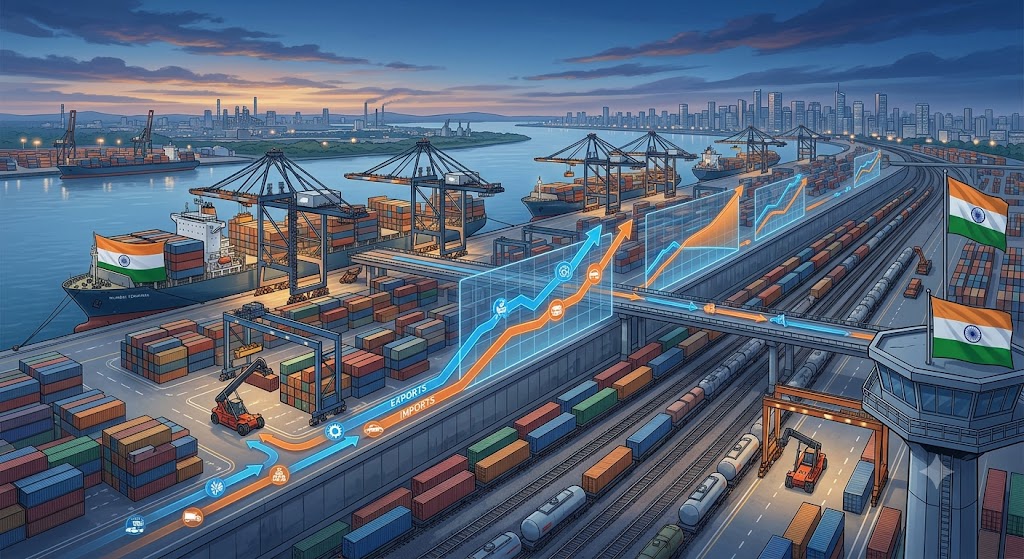
Changes in commodity composition influence cargo mix, terminal utilisation and shipping demand across Indian ports.
Policymakers
The data highlights the need to balance export promotion with continued efforts to strengthen domestic manufacturing, supply chains and trade diversification.
India’s Trade Performance Requires a Broader Assessment
Trade performance should not be measured solely by export growth. The latest official data also raises important questions about trade balance, sectoral concentration, import dependence and market diversification.
A comprehensive assessment suggests that while India’s export sector performed strongly during the quarter, several indicators warrant continued policy attention to sustain long-term competitiveness.
Five Areas Requiring Attention
Merchandise Imports Continue to Outpace Exports
Although merchandise exports recorded healthy double-digit growth, merchandise imports expanded at a faster pace during April–June FY2026-27. Consequently, the merchandise trade deficit widened from US$68.75 billion to US$86.86 billion, underscoring the need to strengthen India’s export competitiveness and improve the balance between exports and imports.
Export Growth Is Concentrated in Limited Sectors
Engineering goods, electronic goods, chemicals, gems and jewellery, and rice accounted for much of the export momentum.
While these sectors performed strongly, broader participation across manufacturing and value-added industries would improve resilience against changes in global demand.
Several Import Categories Recorded Sharp Declines
Official data recorded negative growth in:
- Project Goods
- Silver
- Pearls, Precious & Semi-Precious Stones
- Chemical Materials & Products
- Vegetable Oil
The statistics identify changing trade patterns but do not, by themselves, explain the underlying causes. Detailed sector-specific analysis will be necessary to determine whether these declines reflect weaker demand, improved domestic production or temporary market conditions.
Services Continue to Offset Merchandise Weakness
India’s services sector maintained a healthy trade surplus during the quarter, helping to offset part of the merchandise trade deficit.
This highlights the importance of maintaining competitiveness in both merchandise and services exports rather than viewing them as competing sectors. A balanced external trade profile requires sustained growth in both.
Export Diversification Remains an Ongoing Challenge
The latest data demonstrates strong performance in several established sectors. However, expanding exports across a wider range of products, industries and international markets would reduce concentration risks and strengthen India’s long-term export resilience.
Stakeholder Impact
Manufacturers
Continued export growth provides opportunities for industrial expansion, but wider participation across manufacturing sectors remains important.
Farmers and Agricultural Producers
Export-oriented agricultural commodities continue to support rural incomes, while diversification into processed and value-added products can strengthen long-term competitiveness.
MSMEs
Broader export diversification can create additional opportunities for small and medium enterprises supplying components, specialised products and manufacturing services.
Ports and Shipping
Higher trade volumes continue to generate cargo for Indian ports. Diversifying export commodities also supports a broader mix of container, bulk and specialised cargo operations.
Policymakers
The latest figures reinforce the importance of balancing export promotion with industrial development, supply chain resilience and strategic trade policy.
Performance Assessment
Strengths
- Strong merchandise export growth.
- Continued services trade surplus.
- Competitive performance in engineering goods, electronics and chemicals.
- Broad manufacturing contribution to export growth.
Areas Requiring Attention
- Merchandise trade deficit continues to widen.
- Imports remain higher than exports.
- Export growth is concentrated in relatively few sectors.
- Several import categories experienced significant declines requiring further analysis.
- Export diversification should remain a strategic priority.
Maritime Intelligence & Strategic Assessment (MISA)
India’s latest trade statistics present a picture of both progress and opportunity. Strong export growth confirms the competitiveness of several Indian industries, while rising imports and a widening merchandise trade deficit indicate that structural challenges remain.
For the maritime sector, expanding trade continues to generate higher cargo volumes and greater demand for ports, shipping and logistics services. Looking ahead, sustained improvements in export diversification, manufacturing competitiveness and maritime connectivity will be critical to strengthening India’s position in global trade and supporting the country’s long-term economic ambitions.
The Road Ahead
The first quarter of FY2026-27 has demonstrated India’s ability to sustain export growth despite a challenging global trading environment. The next phase will require maintaining this momentum while improving the quality and breadth of export growth.
Future trade policy may increasingly focus on expanding value-added manufacturing, strengthening new export markets, improving logistics efficiency and enhancing maritime infrastructure to support a more balanced and resilient external trade profile.
Frequently Asked Questions (FAQ)
Which trade indicator requires the most attention in the latest data?
The merchandise trade deficit widened because imports increased faster than exports during April–June FY2026-27.
Which import categories recorded negative growth?
Project Goods, Silver, Pearls, Chemical Materials & Products and Vegetable Oil recorded negative growth during June 2026.
Why is export diversification important?
A diversified export basket reduces dependence on a few sectors and improves resilience against changes in global demand.
Does a wider trade deficit automatically indicate poor economic performance?
No. A trade deficit can reflect higher imports of capital goods and industrial inputs. However, a sustained widening trend requires careful monitoring.
What does this trade data mean for India’s maritime sector?
Higher trade volumes support cargo movement through Indian ports, strengthen shipping demand and reinforce the importance of efficient maritime logistics.
Make us preferred source on Google
Reporting Basis: Official Government Release and MaritimeNews Analysis
Reporting by MaritimeNews Bureaus, Writing & Editing by Jaspal Singh Naol.