

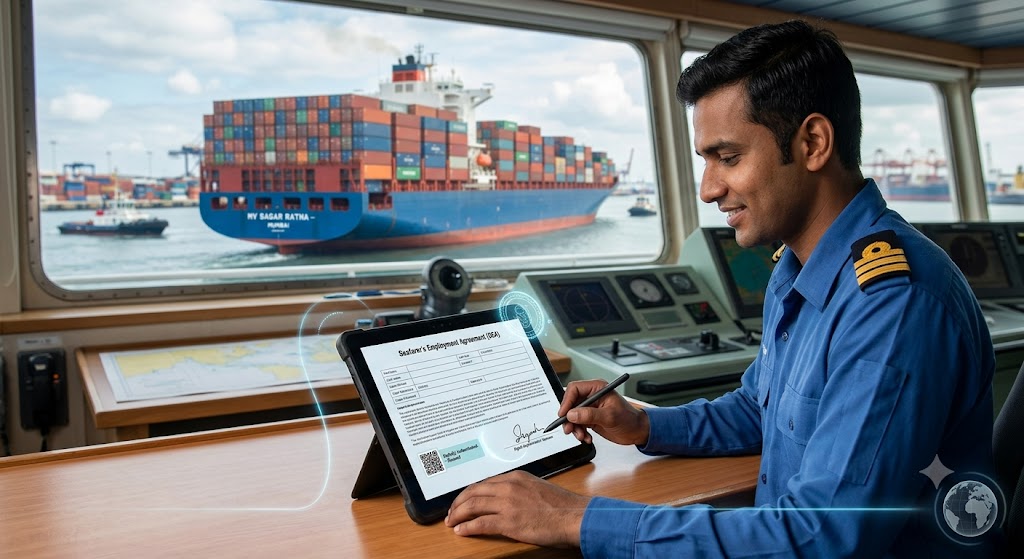
Draft circular introduces Digital and Smart Seafarers’ Employment Agreements using Aadhaar-based e-Sign and Digital Signature Certificates, marking a significant step towards paperless maritime employment and enhanced regulatory compliance
Make us preferred source on Google
Key Takeaways
- DG Shipping has issued a draft circular proposing digital execution of Seafarers’ Employment Agreements (SEAs).
- The proposal recognises Digital SEA and introduces the concept of a Smart SEA with compliance and audit features.
- Aadhaar-based e-Sign and Class III Digital Signature Certificates are proposed as standard authentication methods.
- Digital contracts would remain subject to the Merchant Shipping Act, maritime labour rules, the Information Technology Act, the Digital Personal Data Protection Act and other applicable laws.
- The Directorate has sought stakeholder comments before issuing the final circular.
Mumbai, Maharashtra, India, July 11 (Maritime News) – India’s maritime labour administration may be on the threshold of a significant digital transformation following the Directorate General of Shipping’s release of a draft circular proposing the implementation of Digitally Executed and Smart Seafarers’ Employment Agreements (SEAs). The proposal would permit Recruitment and Placement Service Licence (RPSL) holders, shipowners, ship managers and other authorised stakeholders to execute Seafarers’ Employment Agreements electronically using legally recognised digital signatures, including Aadhaar-based e-Sign authentication and Digital Signature Certificates (DSCs). Alongside enabling paperless contract execution, the draft introduces mandatory safeguards relating to consent, audit trails, data protection, multilingual accessibility and record retention, reflecting a broader shift towards technology-enabled maritime labour governance. The Directorate has invited comments from stakeholders before finalising the framework.
Also Read: MEA Steps Up Diplomatic Efforts for Indian Seafarers as Gulf Evacuation Enters Final Phase
India’s Maritime Labour Documentation Enters the Digital Era
For decades, Seafarers’ Employment Agreements have primarily been executed through physical documentation, requiring manual signatures, paper records and traditional contract management practices.
The Directorate General of Shipping’s draft circular proposes a significant departure from this model by formally permitting legally valid digital execution of employment agreements, subject to compliance with India’s existing legal and regulatory framework. According to the draft, the proposal responds to representations received from various stakeholders seeking permission to execute SEAs digitally using Aadhaar-based e-Sign and Digital Signature Certificates. The stated objectives include promoting digitisation, enhancing authenticity and traceability, preventing fraudulent employment contracts and facilitating a transition towards smart contracts in maritime labour governance.
Rather than replacing the legal obligations governing seafarer employment, the proposed framework seeks to modernise the method by which those obligations are documented and verified.
What the Draft Circular Proposes
Under the draft framework, the Directorate proposes to permit digital execution of Seafarers’ Employment Agreements, provided specified safeguards are met.
Among the principal conditions are:
- Compliance with the Information Technology Act, 2000.
- Compliance with the Digital Personal Data Protection Act, 2023, where applicable.
- Acceptance of digital execution by both contracting parties.
- No charges to be imposed on seafarers for digital signatures or e-Sign authentication.
- Maintenance of digital signature records for audit and inspection purposes.
The proposal applies broadly to:
- Recruitment and Placement Service Licence (RPSL) holders.
- Manning agencies.
- Shipowners.
- Ship managers.
- Digital service providers facilitating execution of SEAs.
Also Read: NHRC Directs MEA to Act on Safety Concerns of 2,000 Indian Seafarers Amid Gulf Tensions
Introducing Digital SEA and Smart SEA
One of the most notable features of the draft circular is the formal distinction between two concepts:
Digital Seafarers’ Employment Agreement (Digital SEA)
The draft defines a Digital SEA as a Seafarers’ Employment Agreement executed using legally valid digital signatures.
Smart Seafarers’ Employment Agreement (Smart SEA)
The proposal goes a step further by introducing the concept of a Smart SEA.
According to the draft, this would be a digitally executed agreement incorporating features such as:
- Automated compliance verification.
- Immutable audit logs.
- Condition-triggered obligations.
Importantly, the draft clarifies that Smart SEAs would initially function as digitised enforceable contracts rather than autonomous blockchain-based systems.
This distinction indicates that the Directorate is looking beyond simple digitisation towards a framework capable of supporting future technological developments while remaining grounded in existing legal requirements.
More Than Paperless Documentation
Although the immediate proposal concerns digital contract execution, its significance extends beyond replacing paper with electronic documents.
The draft outlines a framework that emphasises:
- Contract authenticity.
- Traceability.
- Auditability.
- Secure authentication.
- Transparent record keeping.
Together, these elements represent an evolution in maritime labour administration, where digital governance tools may increasingly support regulatory oversight while simplifying documentation processes for both seafarers and employers.
Also Read: Three Merchant Vessel Attacks, Three Indian Seafarers Dead, 3,537 Repatriated
MaritimeNews Insight
The draft circular should not be viewed merely as an administrative change in contract signing procedures.
Instead, it represents one of the first attempts to establish a structured legal framework for digital maritime employment documentation in India. By introducing concepts such as Digital SEA and Smart SEA, the Directorate General of Shipping is signalling a broader policy direction in which technology, regulatory compliance and maritime labour governance become increasingly integrated.
If adopted following stakeholder consultation, the framework could influence not only how employment agreements are signed but also how maritime labour records are authenticated, audited and managed across the Indian shipping sector.
Why Digital Seafarers’ Employment Agreements Matter
The Directorate General of Shipping’s proposal goes beyond replacing paper contracts with electronic documents. It seeks to modernise the way maritime employment relationships are created, verified and preserved by introducing a legally recognised digital framework for Seafarers’ Employment Agreements (SEAs).
If implemented, the proposal could reduce administrative delays, improve contract security, strengthen regulatory oversight and provide greater transparency for all stakeholders involved in the employment of Indian seafarers.
Also Read: Three Indian Seafarers Confirmed Dead After Tanker Strike Near Oman
Addressing Long-Standing Administrative Challenges
The execution of Seafarers’ Employment Agreements has traditionally relied on physical documentation, manual signatures and paper-based record management.
While this system has served the industry for many years, it also presents operational challenges, particularly in an increasingly digital and globally connected maritime environment.
Some of these challenges include:
- Delays in executing contracts when parties are located in different cities or countries.
- Dependence on physical document movement.
- Risks associated with misplaced or damaged records.
- Difficulties in verifying the authenticity of signatures.
- Administrative burdens during inspections and audits.
The draft circular seeks to address these issues by permitting legally valid digital execution of employment agreements while ensuring that regulatory safeguards remain intact.
Also Read: Indian Coast Guard, Oman Navy Rescue 24 Indian Seafarers After MT Marivex Incident Off Oman
A Balance Between Digital Convenience and Legal Protection
The proposal does not simply encourage digitalisation; it attempts to balance technological convenience with legal safeguards.
To ensure that digital execution remains both valid and trustworthy, the Directorate has proposed several mandatory conditions, including:
- Mutual acceptance of digital execution by both contracting parties.
- No financial burden on seafarers for using digital signatures or Aadhaar-based e-Sign.
- Maintenance of digital signature records for verification during audits and inspections.
- Compliance with applicable information technology and data protection laws.
These safeguards recognise that technology should enhance, rather than dilute, the rights and protections available to seafarers.
What Makes a Smart SEA Different?
Perhaps the most forward-looking element of the draft circular is the introduction of the Smart Seafarers’ Employment Agreement (Smart SEA).
Unlike a conventional electronic document, the proposed Smart SEA is envisioned as a digitally executed contract incorporating features such as:
- Automated compliance verification.
- Immutable audit logs.
- Condition-triggered contractual obligations.
The Directorate has clarified that the Smart SEA would initially operate as a digitised enforceable contract, rather than as an autonomous blockchain-based smart contract.
This distinction is important because it demonstrates a phased approach to digital innovation—leveraging technology to improve governance while remaining within India’s existing legal framework.
Also Read: US Forces Disable MT Marivex Near Oman; All 24 Indian Seafarers Rescued
Potential Benefits for Indian Seafarers
For seafarers, the proposed framework could offer several practical advantages.
Faster Contract Execution
Employment agreements could be executed remotely, reducing delays associated with physical documentation.
Improved Access to Contracts
The draft requires that seafarers receive a copy of their employment agreement before joining the vessel and retain the ability to download and preserve the document electronically.
Greater Transparency
The proposal also requires that contract terms be displayed transparently before signing and that employers ensure there is no coercion or automated acceptance of contractual conditions.
Better Protection Against Fraud
Digital authentication, timestamped records and secure audit trails may help reduce disputes relating to contract authenticity and document manipulation.
Operational Advantages for Manning Agencies and Shipowners
The proposed framework could also improve operational efficiency for Recruitment and Placement Service Licence (RPSL) holders, shipowners and ship managers.
Potential benefits include:
- Faster onboarding of seafarers.
- Reduced administrative paperwork.
- Easier contract retrieval.
- Improved compliance management.
- Enhanced audit preparedness.
- Better record preservation.
As maritime recruitment increasingly involves multiple locations and international operations, digital documentation may simplify coordination while improving regulatory compliance.
Also Read: India Steps Up Monitoring of Ships and Seafarers in Persian Gulf
Digital Governance Requires Digital Accountability
The draft circular also makes it clear that digitalisation carries corresponding responsibilities.
Entities adopting Digital or Smart SEAs would be expected to maintain comprehensive records capable of being produced during Directorate inspections and audits.
The proposed technical requirements include:
- Tamper-proof document storage.
- End-to-end encryption.
- Timestamped audit logs.
- Real-time verification capability.
- IP and device tracking, where legally permissible.
These requirements reflect a broader trend in digital governance where transparency and traceability become integral components of regulatory compliance.
International Context: Aligning with the Maritime Labour Convention
The draft circular explicitly states that digital execution of Seafarers’ Employment Agreements must not result in any deviation from the requirements of the Maritime Labour Convention, 2006 (MLC, 2006).
This is significant because the MLC establishes internationally recognised minimum standards for seafarers’ employment and welfare.
By maintaining compliance with these standards while modernising administrative processes, India appears to be pursuing digital transformation without altering the substantive rights guaranteed under international maritime labour law.
Also Read: DG Shipping Sets Up 24×7 Crisis Response Team for Seafarers
MaritimeNews Insight
The proposed framework represents more than a technological upgrade—it reflects a broader evolution in maritime labour governance.
Digital contracts are increasingly becoming standard practice across many sectors of the global economy. By introducing Digital and Smart Seafarers’ Employment Agreements within a structured legal framework, India has an opportunity to improve efficiency while strengthening transparency, accountability and regulatory oversight.
However, the long-term success of the initiative will depend not only on the technology itself but also on industry adoption, user awareness, cybersecurity, data protection and effective implementation across the maritime ecosystem.
Legal Framework, Compliance Requirements and Data Governance: Building Trust in Digital Maritime Employment
While the proposed introduction of Digital and Smart Seafarers’ Employment Agreements represents a technological advancement, the Directorate General of Shipping has emphasised that the initiative is fundamentally a legal and regulatory reform rather than simply an information technology project.
The draft circular makes it clear that digital execution of employment contracts cannot exist outside India’s existing legal framework. Instead, every Digital SEA must derive its validity from established legislation governing electronic records, digital signatures, maritime labour and data protection.
Also Read: 21 Indian Seafarers Unpaid Since December: MT Asphalt Star
Digital Contracts Must Remain Legally Enforceable
One of the central objectives of the draft circular is to ensure that digitally executed employment agreements enjoy the same legal standing as traditional paper-based contracts.
Accordingly, the proposed framework requires Digital and Smart SEAs to comply with multiple statutes and regulatory instruments, including:
- Merchant Shipping Act, 2025.
- Merchant Shipping (Maritime Labour) Rules.
- Merchant Shipping (Recruitment and Placement of Seafarers) Rules.
- Information Technology Act, 2000.
- Digital Personal Data Protection Act, 2023.
- Bharatiya Sakshya Adhiniyam, 2023 (regarding admissibility of electronic evidence).
- Aadhaar Act and associated e-Sign framework, where applicable.
This layered legal approach ensures that digitisation complements existing statutory protections rather than replacing them.
Recognised Modes of Digital Authentication
The draft circular identifies legally recognised methods through which employment agreements may be digitally executed.
These include:
Aadhaar-based e-Sign
A cloud-based electronic signature service enabling individuals to authenticate documents electronically using Aadhaar authentication.
Digital Signature Certificate (DSC)
Class III Digital Signature Certificates issued by licensed Certifying Authorities under the Information Technology Act.
The circular proposes that these authentication mechanisms should provide sufficient legal certainty regarding the identity of contracting parties while maintaining document integrity throughout the employment lifecycle.
Also Read: Storm Brews Over DGS Circular 31 of 2025: Indian Seafarers
Consent Remains Central to the Employment Relationship
An important feature of the draft framework is its emphasis on informed consent.
The Directorate proposes that:
- Both parties must voluntarily agree to digital execution.
- Contract terms should be presented clearly before signing.
- Digital execution should not occur through hidden or pre-selected acceptance mechanisms.
- Seafarers must be able to review the complete agreement before providing consent.
These provisions reinforce a fundamental principle of maritime labour law: technology should facilitate informed contractual relationships rather than automate them without meaningful participation.
Protecting Seafarers’ Rights in a Digital Environment
The draft circular also incorporates safeguards intended to ensure that digitalisation does not diminish the rights of Indian seafarers.
Among the proposed protections are:
- No fee may be charged to the seafarer for digital execution or authentication.
- Every seafarer must receive a copy of the digitally executed agreement.
- Contracts should remain accessible for future reference.
- Digital execution must not alter statutory employment protections available under Indian maritime law or the Maritime Labour Convention, 2006.
By explicitly preserving these rights, the proposal seeks to reassure stakeholders that the transition to digital documentation is administrative rather than substantive in nature.
Also Read: Seafarers’ Minimum Wage Raised After Breakthrough Geneva Talks
Cybersecurity and Data Protection Become Compliance Priorities
Unlike paper documents, digital employment agreements introduce new responsibilities relating to cybersecurity and information governance.
The draft therefore proposes technical safeguards including:
- Secure storage of electronic records.
- End-to-end encryption.
- Tamper-resistant documentation.
- Timestamped execution records.
- Comprehensive audit trails.
- Appropriate access controls.
- Protection of personal information in accordance with applicable law.
These measures recognise that confidence in digital contracts depends not only on legal validity but also on the security and integrity of the systems through which they are created and maintained.
Audit Trails: Strengthening Regulatory Oversight
One of the most significant governance features of the proposal is the requirement for robust auditability.
The draft envisages that digital systems should retain sufficient information to demonstrate:
- When a contract was executed.
- Who signed the agreement.
- Which authentication method was used.
- Whether the document has remained unaltered.
- Whether records can be produced during inspections or investigations.
Such audit capabilities may assist both regulators and employers in resolving disputes while improving confidence in digital maritime employment documentation.
Also Read: Seafarers Recognised as ‘Key Workers’ in Historic MLC Reform
Responsibilities of RPSL Holders and Employers
The proposed framework places significant compliance responsibilities on Recruitment and Placement Service Licence (RPSL) holders, shipowners and ship managers.
Their obligations would extend beyond obtaining digital signatures and include maintaining systems capable of:
- Preserving electronic records.
- Demonstrating legal compliance.
- Producing documentation during inspections.
- Protecting confidential personal data.
- Maintaining operational reliability and business continuity.
This represents a shift from document management towards broader digital governance responsibilities.
Implementation Challenges
While the proposed framework offers several operational advantages, successful implementation will require careful attention to practical issues.
Stakeholders may need to consider:
- Digital literacy among users.
- Availability of reliable authentication infrastructure.
- Cybersecurity preparedness.
- Interoperability between digital platforms.
- Long-term preservation of electronic records.
- Capacity building within RPSL organisations.
- Standard operating procedures for inspections and audits.
The public consultation process provides an opportunity for industry participants to identify operational challenges before the framework is finalised.
Also Read: Navigating the Seas of Maritime Employment: The Significance of RPSL
MaritimeNews Insight
The draft circular demonstrates that India’s maritime administration is increasingly viewing digital transformation as a governance reform rather than merely a technological upgrade.
By combining recognised electronic authentication, statutory safeguards, cybersecurity requirements and regulatory oversight within a single framework, the proposal attempts to modernise maritime employment documentation while preserving legal certainty and seafarer protections.
If implemented effectively, Digital and Smart Seafarers’ Employment Agreements could become an important component of India’s broader digital maritime ecosystem, supporting more transparent, efficient and accountable employment practices across the shipping industry.
From Paper Contracts to Smart Maritime Governance: What Comes Next?
The Directorate General of Shipping’s proposal on Digital and Smart Seafarers’ Employment Agreements represents more than a procedural update to contract execution. It reflects a broader shift in maritime governance, where digital technologies are increasingly being integrated into regulatory administration while maintaining statutory safeguards for seafarers and employers.
Although the draft circular focuses specifically on Seafarers’ Employment Agreements (SEAs), its successful implementation could establish a foundation for wider digital transformation across India’s maritime regulatory ecosystem.
Also Read: Seafarer Exploitation: A Chain of Exploitation Beyond RPSL
Potential Impact Across the Maritime Ecosystem
If implemented following stakeholder consultation, the proposed framework could influence a broad range of stakeholders.
Government & Regulators
For the Directorate General of Shipping and maritime regulators, digital documentation could improve:
- Regulatory oversight.
- Audit efficiency.
- Record verification.
- Inspection processes.
- Data-driven policy making.
- Transparency in maritime labour administration.
Digital records may also facilitate quicker retrieval of employment documentation during compliance inspections and investigations.
Indian Seafarers
For seafarers, the framework has the potential to deliver practical operational benefits while preserving statutory protections.
Potential advantages include:
- Faster execution of employment agreements.
- Reduced dependence on physical documentation.
- Easier access to employment records.
- Better protection against document loss.
- Improved verification of contractual authenticity.
- Greater transparency before contract execution.
Importantly, the draft also requires that digital execution should not impose additional financial costs on seafarers.
Also Read: India Strengthens Maritime Monitoring Amid Rising West Asia Tensions
Recruitment and Placement Service Licence (RPSL) Holders
For licensed recruitment agencies, the proposal may simplify several administrative processes, including:
- Remote contract execution.
- Electronic record management.
- Compliance documentation.
- Audit preparation.
- Contract retrieval.
- Long-term document preservation.
At the same time, RPSL holders will assume greater responsibility for maintaining secure digital systems capable of meeting regulatory requirements.
Shipowners and Ship Managers
For shipowners and ship managers operating across multiple jurisdictions, digital execution of employment agreements may reduce administrative delays associated with international crew mobilisation.
The proposal may support:
- Faster onboarding.
- Improved document standardisation.
- Better compliance management.
- Reduced paper handling.
- Enhanced contractual traceability.
Also Read: India Steps Up Monitoring of Ships and Seafarers in Persian Gulf
Maritime Technology Providers
The draft circular also creates opportunities for technology providers specialising in:
- Digital identity verification.
- Electronic signature platforms.
- Maritime HR management systems.
- Compliance software.
- Secure document management.
- Audit and governance solutions.
While the circular is technology-neutral, it establishes a regulatory environment in which trusted digital service providers could play an increasingly important role.
International Perspective
The maritime industry worldwide is progressively adopting digital solutions across vessel operations, port management, logistics and documentation.
Electronic Bills of Lading, digital port community systems and electronic certification have already become important components of maritime digitalisation in several jurisdictions.
Against this backdrop, the Directorate General of Shipping’s proposal reflects India’s efforts to modernise maritime employment documentation while ensuring continued compliance with the Maritime Labour Convention, 2006 and domestic legal requirements.
Rather than introducing entirely new employment rights or obligations, the draft focuses on improving the efficiency, authenticity and traceability of existing contractual processes.
Future Outlook
The publication of the draft circular marks the beginning—not the conclusion—of the policy process.
The Directorate has invited comments from stakeholders before finalising the framework. Depending on the outcome of the consultation process, future developments may include:
- Refinement of technical standards.
- Clarification of implementation procedures.
- Industry-specific operational guidance.
- Standard operating procedures for inspections.
- Capacity-building initiatives for RPSL holders.
- Integration with broader digital maritime platforms.
The effectiveness of the framework will ultimately depend not only on legal provisions but also on stakeholder awareness, technological readiness and consistent implementation across the maritime sector.
MaritimeNews Editorial Verdict
The Directorate General of Shipping’s draft circular should be viewed as a governance reform rather than simply an administrative circular.
Its significance lies not merely in allowing electronic signatures, but in establishing a structured legal and regulatory framework for digital maritime employment documentation.
By combining recognised digital authentication methods with statutory safeguards relating to consent, cybersecurity, auditability and seafarer rights, the proposal seeks to modernise maritime labour administration without compromising legal protections.
If implemented successfully, Digital and Smart Seafarers’ Employment Agreements could become an important milestone in India’s broader journey towards digital maritime governance—supporting transparency, operational efficiency and regulatory confidence across the shipping ecosystem.
The public consultation process will now determine how industry experience, operational realities and stakeholder feedback shape the final framework before implementation.
Also Read: NEED OF BALLAST WATER TREATMENT IN MARITIME SUSTAINABILITY
Frequently Asked Questions (FAQs)
What is a Digital Seafarers’ Employment Agreement?
It is a Seafarers’ Employment Agreement executed electronically using legally recognised digital authentication methods such as Aadhaar-based e-Sign or Digital Signature Certificates, in accordance with applicable Indian laws.
What is a Smart SEA?
The draft circular describes a Smart SEA as a digitally executed employment agreement incorporating features such as automated compliance verification, audit logs and condition-based contractual functions while remaining legally enforceable under existing law.
Will paper contracts disappear?
The draft circular proposes permitting digital execution. It does not state that paper-based agreements will be prohibited. The final position will depend on the circular issued after stakeholder consultation.
Will seafarers have to pay for digital signatures?
No. The draft specifically proposes that no charges should be imposed on seafarers for digital signature or e-Sign authentication required for executing employment agreements.
Which laws support Digital SEAs?
- The proposal references, among others:
- Merchant Shipping Act, 2025.
- Merchant Shipping (Maritime Labour) Rules.
- Merchant Shipping (Recruitment and Placement of Seafarers) Rules.
- Information Technology Act, 2000.
- Digital Personal Data Protection Act, 2023.
- Bharatiya Sakshya Adhiniyam, 2023.
Make us preferred source on Google
Source: DGMA formerly DG Shipping
Reporting Basis: Official Government Release and MaritimeNews Analysis
Reporting by MaritimeNews Bureaus, Writing by Harpal S Naol; Editing by Jaspal Singh Naol.