

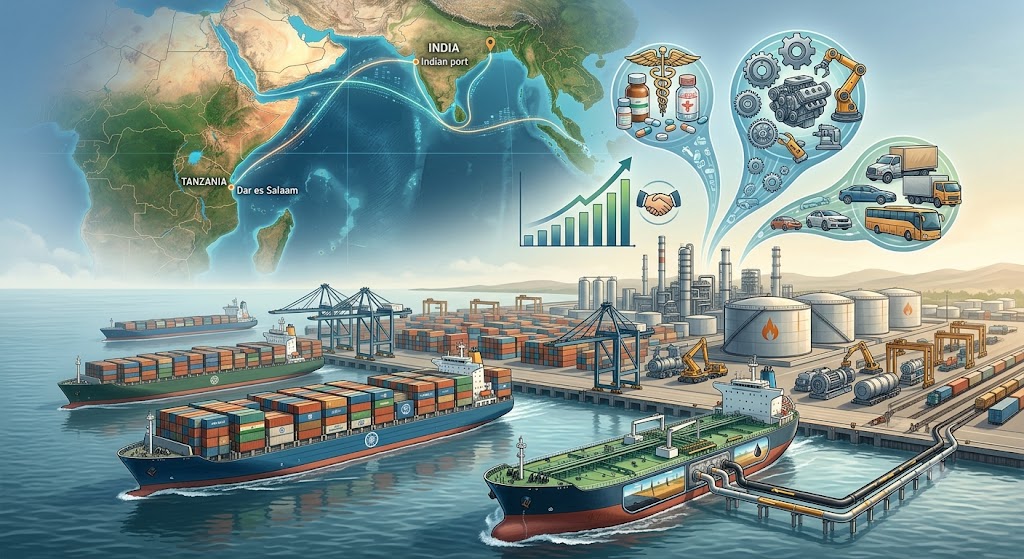
DGCI&S data indicates petroleum products, pharmaceuticals and engineering goods continue to anchor India’s expanding trade relationship with East Africa
Key Takeaways
- India’s exports to Tanzania grew by 146.89% during April–June FY2026-27, making it one of India’s fastest-growing export destinations.
- Petroleum products remain India’s largest export to Tanzania, significantly exceeding every other commodity in export value.
- Pharmaceuticals, industrial machinery, vehicles and engineering goods continue to strengthen the bilateral trade basket.
- The export growth reflects long-term strategic and economic cooperation, not merely short-term market fluctuations.
- Rising industrial exports are expected to support maritime cargo movement, shipping demand and port activity between India and East Africa.
Mumbai / Delhi, India, July 14 (Maritime News) – India’s exports to Tanzania recorded one of the strongest growth rates among India’s major export destinations during the first quarter of FY2026-27, rising 146.89% over the corresponding period of the previous year. While the headline figure reflects impressive trade momentum, a deeper examination of official trade statistics and bilateral cooperation reveals that the growth is rooted in long-term industrial, energy and infrastructure partnerships rather than a short-term spike in demand.
An analysis by MaritimeNews of Directorate General of Commercial Intelligence and Statistics (DGCI&S) principal commodity data, together with official India–Tanzania bilateral documents, indicates that petroleum products continue to dominate India’s exports, supported by pharmaceuticals, industrial machinery, vehicles, engineering products and construction equipment. The findings illustrate how diplomacy, industrial capability and maritime connectivity are collectively strengthening India’s commercial engagement with East Africa.
India’s exports to Tanzania increased by 146.89% during April–June FY2026-27, making Tanzania one of India’s fastest-growing export destinations during the quarter. While the Ministry of Commerce’s trade release highlights the growth, MaritimeNews’ examination of DGCI&S commodity data shows that the relationship is supported by a diversified manufacturing and industrial export base led by petroleum products. The trade profile reflects India’s expanding role as a supplier of energy, pharmaceuticals, machinery and engineering goods to Tanzania, underpinned by strategic bilateral cooperation and growing maritime connectivity across the Indian Ocean.
India’s Fastest-Growing Export Destination
The Ministry of Commerce and Industry’s latest trade statistics identified Tanzania as one of India’s best-performing export destinations during the first quarter of FY2026-27. Among all major trading partners, exports to Tanzania recorded a remarkable 146.89% year-on-year increase, signalling a significant expansion in bilateral trade.
For many publications, that percentage alone would have been the story.
For MaritimeNews, however, the more important question is:
What is driving this exceptional growth?
Answering that question requires looking beyond the monthly trade release and examining the composition of India’s exports, the evolution of bilateral relations and the wider maritime trade ecosystem linking India with East Africa.
Looking Beyond the Headline Numbers
Trade statistics often report how much exports have increased but rarely explain why they have increased.
To understand the drivers behind Tanzania’s exceptional growth, MaritimeNews analysed official DGCI&S principal commodity export data for April and May 2026 and compared it with earlier trade patterns and India’s official bilateral relations profile with Tanzania.
The analysis indicates that the export surge is not the result of a single new commodity or isolated transaction. Instead, it reflects sustained demand across several established industrial sectors where India has developed strong manufacturing capabilities and long-standing commercial relationships.
This distinction is important because broad-based industrial trade generally indicates greater resilience than export growth driven by a single commodity cycle.
Petroleum Products Continue to Lead India’s Export Basket
DGCI&S principal commodity data confirms that petroleum products remain by far the largest component of India’s exports to Tanzania.
During both April and May 2026, petroleum products accounted for export values substantially higher than any other commodity category, reinforcing India’s position as a major supplier of refined petroleum products to the Tanzanian market.
The dominance of petroleum products highlights the strategic importance of India’s refining sector in supporting exports to East Africa and demonstrates how energy trade continues to underpin the bilateral commercial relationship.
For India’s maritime sector, petroleum exports are particularly significant because they generate substantial liquid bulk cargo movements, supporting tanker operations, terminal infrastructure and specialised port services.
India Exports to Tanzania Are Driven by Manufacturing
While petroleum products dominate the export basket, the broader composition of India’s exports reveals a diversified manufacturing relationship.
DGCI&S principal commodity data identifies the following among India’s leading exports to Tanzania:
| Commodity Category | Trade Significance |
|---|---|
| Petroleum Products | Largest export category |
| Drug Formulations & Biologicals | Major pharmaceutical exports |
| Industrial Machinery | Supports industrial development |
| Sugar | Strong food processing exports |
| Products of Iron & Steel | Infrastructure and construction demand |
| Two & Three Wheelers | Automotive exports |
| Motor Vehicles | Expanding transport sector demand |
| Construction Machinery | Infrastructure development |
| Aluminium Products | Industrial applications |
| Electrical Machinery & Equipment | Manufacturing and utilities |
The composition demonstrates that India’s exports increasingly consist of value-added manufactured products rather than predominantly primary commodities. This reflects the growing competitiveness of Indian industry across multiple sectors while supporting Tanzania’s infrastructure, healthcare and industrial development requirements.
Why Tanzania Has Emerged as a Strategic Export Market
The exceptional growth in India’s exports cannot be viewed in isolation from the broader transformation in India–Tanzania relations over the past few years.
In October 2023, India and Tanzania elevated their bilateral relationship to a Strategic Partnership, expanding cooperation across trade, investment, maritime security, defence, healthcare, education and infrastructure development. Since then, both countries have pursued a more structured economic engagement aimed at strengthening commercial ties and enhancing connectivity across the Indian Ocean.
Today, India is among Tanzania’s most important economic partners. Official bilateral documents identify India as Tanzania’s second-largest trading partner and one of its leading sources of foreign investment, with Indian investments spanning pharmaceuticals, banking, engineering, manufacturing and infrastructure development. These long-term commercial relationships provide a stable foundation for sustained growth in merchandise exports.
Unlike short-term commodity booms, strategic partnerships tend to generate recurring demand for industrial goods, machinery, transport equipment and engineering products—precisely the sectors reflected in India’s export basket to Tanzania.
DGCI&S Data Shows a Stable and Diversified Export Basket
An examination of DGCI&S principal commodity data for 2024–2026 reveals another important trend.
Contrary to expectations, India’s export growth to Tanzania has not been driven by an entirely new product category. Instead, the country’s export basket has remained relatively consistent, with growth occurring within established sectors where India already possesses strong manufacturing capabilities.
Among the principal export commodities identified across successive reporting periods are:
- Petroleum Products
- Drug Formulations & Biologicals
- Industrial Machinery
- Sugar
- Products of Iron & Steel
- Two & Three Wheelers
- Motor Vehicles
- Construction Machinery
- Aluminium Products
- Electrical Machinery & Equipment
This consistency suggests that India is deepening an existing industrial trade relationship rather than relying on temporary market conditions or one-off export contracts.
For policymakers, this is an encouraging indicator because diversified export baskets are generally more resilient to fluctuations in global commodity prices and sector-specific demand.
Beyond Petroleum: Manufacturing Is Becoming the Real Story
Petroleum products continue to account for the largest share of India’s exports to Tanzania. However, focusing exclusively on petroleum would overlook a broader structural shift taking place in bilateral trade.
The growing contribution of pharmaceuticals, engineering products, industrial machinery, automobiles and construction equipment indicates that India’s manufacturing sector is steadily expanding its footprint in East Africa.
These sectors represent significantly higher levels of domestic value addition than many primary commodities and generate employment across manufacturing, logistics, warehousing, transportation and export services.
The trend therefore aligns closely with India’s broader objective of strengthening manufacturing competitiveness while increasing exports of value-added products.
Maritime Implications of India Exports to Tanzania: More Than a Trade Statistic
For the maritime sector, export statistics represent cargo movement rather than merely financial transactions.
Each major export category generates demand across different shipping segments.
| Export Commodity | Likely Maritime Cargo Segment |
|---|---|
| Petroleum Products | Liquid Bulk Tankers |
| Pharmaceuticals | Containerised Cargo |
| Industrial Machinery | Containers / Project Cargo |
| Motor Vehicles | Ro-Ro / Container Shipping |
| Iron & Steel Products | Breakbulk / Dry Cargo |
| Construction Equipment | Project Cargo |
| Electrical Machinery | Container Cargo |
As trade volumes expand, Indian ports handling petroleum, engineering products, automobiles and containerised cargo are likely to experience increased activity on trade routes connecting India with East Africa.
The growth also reinforces the strategic importance of India’s western coastline and its maritime connectivity with the eastern coast of Africa, a region expected to assume greater significance in India’s maritime and trade strategy over the coming decade.
Stakeholder Impact
Indian Refining Companies
Higher petroleum exports strengthen refinery utilisation and support India’s position as a major exporter of refined petroleum products to East Africa.
Pharmaceutical Manufacturers
Growing pharmaceutical exports create additional opportunities for Indian drug manufacturers while supporting India’s expanding healthcare partnerships across Africa.
Engineering and Manufacturing Industry
Demand for industrial machinery, vehicles and construction equipment benefits Indian manufacturers and strengthens export-led industrial growth.
Ports and Terminal Operators
Higher export volumes generate additional cargo handling opportunities for ports handling liquid bulk, containers and project cargo destined for East Africa.
Shipping and Logistics Companies
Expanding trade supports tanker operators, container shipping lines, freight forwarders and logistics providers serving India–East Africa trade routes.
MSMEs and Exporters
Small and medium-sized enterprises supplying engineering components, industrial products and value-added manufactured goods can benefit from expanding export demand.
Policymakers
The export growth demonstrates the importance of combining diplomacy, trade policy and industrial competitiveness to strengthen India’s commercial engagement with Africa.
Performance Assessment
What India Did Well
- Achieved one of the highest export growth rates among major destination countries during the quarter.
- Continued strengthening exports of higher value-added manufactured goods.
- Leveraged long-term diplomatic and economic partnerships to expand merchandise trade.
- Reinforced India’s position as a major supplier of petroleum products, pharmaceuticals and engineering goods to East Africa.
Areas Requiring Attention
Despite the impressive export performance, several issues warrant continued monitoring:
- Petroleum products continue to dominate the export basket, highlighting the need for greater diversification.
- Commodity-level data for June 2026 is not yet available, limiting a complete assessment of the quarterly surge.
- Sustaining triple-digit export growth over the medium term will require continued industrial competitiveness and market development.
- Indian shipping companies and ports should seek to capture a greater share of the logistics value generated by expanding India–Africa trade.
Also Read: MEA Steps Up Diplomatic Efforts for Indian Seafarers as Gulf Evacuation Enters Final Phase
Maritime Intelligence & Strategic Assessment (MISA)
The sharp increase in India’s exports to Tanzania should not be viewed merely as a quarterly trade statistic. It reflects the cumulative impact of strategic diplomacy, industrial capability and long-term commercial engagement.
The analysis of DGCI&S principal commodity data demonstrates that India’s export relationship with Tanzania is increasingly characterised by manufactured goods, engineering products and pharmaceuticals alongside petroleum exports. This diversification strengthens the resilience of bilateral trade and supports India’s ambition to expand its presence in African markets.
From a maritime perspective, continued growth in industrial exports is likely to translate into higher cargo volumes, stronger shipping demand and greater utilisation of Indian ports serving East African trade routes. As India’s economic engagement with Africa deepens, maritime connectivity will remain a critical enabler of bilateral commerce.
The Road Ahead
Tanzania’s emergence as one of India’s fastest-growing export destinations offers a useful illustration of how diplomacy, industrial development and maritime connectivity can reinforce one another.
The latest trade figures demonstrate strong momentum, but the longer-term significance lies in the quality of the export basket. A relationship increasingly driven by petroleum products, pharmaceuticals, machinery and engineering goods indicates a transition towards deeper industrial cooperation rather than dependence on a narrow range of commodities.
Once DGCI&S releases commodity-level data for June 2026, a more detailed assessment will be possible. That data will help determine which sectors contributed most significantly to the exceptional quarterly growth and whether the current momentum represents the beginning of a sustained expansion in India–Tanzania trade.
Frequently Asked Questions (FAQ)
What caused India exports to Tanzania to grow by 146.89%?
India exports to Tanzania grew due to higher shipments of petroleum products, pharmaceuticals, engineering goods and industrial machinery, supported by stronger bilateral trade and economic cooperation.
Which commodities dominate India exports to Tanzania?
Petroleum products are India’s largest exports to Tanzania, followed by pharmaceuticals, industrial machinery, sugar, iron and steel products, motor vehicles, construction machinery and electrical equipment.
Why is Tanzania important for India’s exports?
Tanzania is one of India’s key trading partners in East Africa. Strong diplomatic ties, growing investments and infrastructure cooperation have helped expand bilateral trade.
What does this export growth mean for India’s maritime sector?
Higher exports generate additional cargo for Indian ports and increase demand for tanker, container and project cargo shipping services connecting India with East Africa.
How does the India–Tanzania Strategic Partnership support trade?
The Strategic Partnership strengthens cooperation in trade, investment, infrastructure and maritime sectors, creating long-term opportunities for Indian exporters.
Which Indian industries benefit from exports to Tanzania?
The main beneficiaries include petroleum refining, pharmaceuticals, engineering, automobile manufacturing, construction equipment, steel and logistics industries.
Why did MaritimeNews analyse DGCI&S data?
The PIB release reported export growth but not the commodities behind it. DGCI&S data helped identify the sectors driving India’s exports to Tanzania.
Will India exports to Tanzania continue to grow?
Future growth will depend on market demand, industrial competitiveness, bilateral cooperation and the continued expansion of India–Africa trade.
Make us preferred source on Google
Reporting Basis: Official Government Release and MaritimeNews Analysis
Reporting by MaritimeNews Bureaus, Writing & Editing by Jaspal Singh Naol.