
Government, CII, FICCI and ACMA challenge proposed U.S. tariffs, arguing India’s legal safeguards and industry compliance frameworks do not justify additional duties as public hearings begin
Make us preferred source on Google
Key Takeaways
- The USTR has begun public hearings from 7–9 July 2026 on proposed Section 301 actions relating to imports of goods allegedly produced with forced labour.
- India faces a proposed 12.5% additional tariff, among the highest rates proposed under the current investigations.
- The Government of India has formally challenged the USTR’s findings, arguing that India’s legal and regulatory framework already addresses forced labour and that the proposed tariffs lack sufficient evidentiary basis.
- CII, FICCI and ACMA have each sought to testify before the USTR, presenting sector-specific arguments against the proposed measures.
- Beyond trade policy, the outcome could influence maritime exports, containerised cargo flows, ports, shipping lines and logistics networks serving India–U.S. trade.
India / USA, July 08 (Maritime News) – As the Office of the United States Trade Representative (USTR) commenced three days of public hearings on 7 July 2026 under its Section 301 investigations into alleged failures by 60 economies to prohibit imports of goods produced with forced labour, India has mounted a coordinated institutional and industry response against the proposed 12.5% additional tariff on Indian imports. Separate submissions by the Government of India, the Confederation of Indian Industry (CII), the Federation of Indian Chambers of Commerce and Industry (FICCI), and the Automotive Component Manufacturers Association (ACMA) argue that India’s constitutional safeguards, labour laws, international commitments and supply-chain compliance systems contradict the USTR’s findings and that additional tariffs would disrupt integrated global supply chains while increasing costs for U.S. manufacturers and consumers.
USTR Hearings Mark a Critical Phase in Section 301 Investigation
Public hearings began on Tuesday, 7 July, before the U.S. International Trade Commission in Washington, D.C., forming the latest stage of the USTR’s Section 301 investigations into whether 60 economies have failed to prohibit and effectively enforce restrictions on the importation of goods produced with forced labour.
The hearings follow the release of the USTR’s proposed findings in June 2026, which recommended additional tariffs on imports from multiple economies. India faces a proposed 12.5% additional tariff, while several other economies face lower proposed rates. The hearings provide governments, industry bodies and other stakeholders an opportunity to present testimony before the USTR finalises its recommendations later this month.
For Indian exporters and the maritime industry, the hearings represent more than a regulatory consultation—they could shape future cargo flows across one of India’s largest export markets.
India Presents a Coordinated Institutional Response
Unlike many trade disputes where governments and industry respond independently, India’s position has been presented through multiple coordinated submissions representing both public institutions and major industry associations.
The Government of India has formally requested an opportunity to appear before the USTR hearing and has rejected the preliminary findings that India lacks an effective legal regime prohibiting imports produced with forced labour. In its submission, the Ministry of Commerce & Industry argues that India has a structured domestic legal framework, that the proposed tariffs are not supported by specific evidence demonstrating harm to U.S. commerce, and that the USTR should reconsider the proposed measures.
The submission further contends that the USTR’s own report recognises the challenges in obtaining reliable forced labour data, making it difficult to draw definitive conclusions solely from the absence of an import prohibition.
CII Highlights India’s Legal and International Commitments
The Confederation of Indian Industry (CII) has based its submission on India’s constitutional protections and international labour commitments.
CII argues that Article 23 of the Constitution of India prohibits forced labour and is reinforced by the Bonded Labour System (Abolition) Act, Child Labour legislation and the country’s consolidated Labour Codes. It also points to mandatory ESG and Business Responsibility and Sustainability Reporting (BRSR) requirements, along with India’s ratification of key International Labour Organization conventions relating to forced labour and child labour.
CII further submits that many Indian exporters supplying U.S. manufacturers already operate under buyer-driven compliance regimes and voluntary certification systems, making the proposed tariff an inefficient mechanism for addressing the stated policy objective. It recommends that compliance-based cooperation through the India–U.S. Trade Policy Forum would be a more proportionate approach than additional tariffs.
FICCI Warns Against Disrupting Responsible Supply Chains
The Federation of Indian Chambers of Commerce and Industry (FICCI) has expressed support for eliminating forced labour from global supply chains while opposing the proposed tariff measures.
According to FICCI, Indian export supply chains serving the U.S. market already operate within established compliance frameworks emphasising traceability, supplier due diligence, independent audits and responsible sourcing. The organisation argues that imposing an additional 12.5% tariff on compliant trade could increase costs for U.S. businesses and consumers without advancing the objective of eliminating forced labour.
FICCI intends to present its assessment of how the proposed measures could affect legitimate trade, resilient supply chains and bilateral commercial relations.
Also Read: Mormugao Port Emerges as India’s Green Port Benchmark with ₹3,300-Crore Infrastructure Push
Automotive Industry Raises Supply Chain Concerns
The Automotive Component Manufacturers Association of India (ACMA) has focused its submission on the implications for integrated automotive supply chains.
ACMA argues that India’s automotive component sector is highly organised, technology-driven and operates within established labour compliance frameworks. It also questions why certain product exemptions proposed by the USTR apply only to civil aircraft applications and not to identical components used in the automotive sector.
According to ACMA, limiting these exemptions could expose U.S. automotive manufacturers to supply-chain disruptions, increased production costs and sourcing uncertainty because of the close integration of Indian suppliers with the U.S. automotive industry.
Why This Matters for Maritime Trade
While the immediate issue concerns trade policy, its implications extend across the maritime transport ecosystem.
The United States remains one of India’s largest export destinations for containerised cargo. Any additional tariffs affecting manufactured goods could influence export volumes across sectors such as automotive components, engineering goods, pharmaceuticals, textiles and industrial products.
Reduced export competitiveness may affect container throughput at Indian ports, vessel utilisation on India–U.S. trade lanes, freight forwarding activity, customs operations and logistics planning. Conversely, if the proposed measures are modified or withdrawn following the consultation process, existing cargo flows may continue with limited disruption.
For ports, shipping lines and logistics providers, trade policy decisions increasingly shape cargo movements as much as infrastructure investments or freight market dynamics.
Also Read: Goa Opens New Captain of Ports Terminal to Strengthen Maritime Governance and River Navigation
What Happens Next?
The public hearings are scheduled to continue until 9 July 2026, after which the USTR will review testimony, written submissions and stakeholder feedback before determining its final course of action.
The outcome may influence not only tariff policy but also future discussions between India and the United States on trade cooperation, supply-chain resilience and labour compliance standards.
Until a final decision is announced, the proposed tariffs remain under consideration rather than in force.
Maritime Perspective
The Section 301 hearings illustrate how international trade policy has become inseparable from maritime transport and global logistics. Decisions taken in Washington can reshape cargo volumes handled in Mumbai, Chennai or Mundra, influence container deployment by shipping lines and alter sourcing strategies for manufacturers across continents.
For the maritime industry, the issue is therefore not simply whether tariffs are imposed, but how regulatory changes affect the movement of goods through ports, shipping networks and integrated global supply chains.
Also Read: Goa Water Metro Receives Phase-I Priority as Centre Accelerates Sustainable Inland Water Transport
Editorial Verdict
The opening of the USTR hearings marks an important procedural milestone rather than the conclusion of the investigation. India’s response demonstrates a coordinated effort involving the Government and major industry associations, each presenting legal, regulatory and commercial arguments against the proposed tariffs. Whether those submissions alter the final USTR determination remains to be seen.
From a maritime perspective, however, the case reinforces a broader lesson: international trade enforcement measures increasingly influence shipping patterns, port activity and supply-chain resilience. For India’s maritime sector, the hearings are not merely a trade dispute but a development with potential implications for export logistics and global cargo flows.
Could the Proposed Tariffs Reshape India–U.S. Maritime Trade?
Although the USTR’s proposed action is framed as a trade enforcement measure, its consequences could extend well beyond customs duties and into the wider maritime logistics ecosystem.
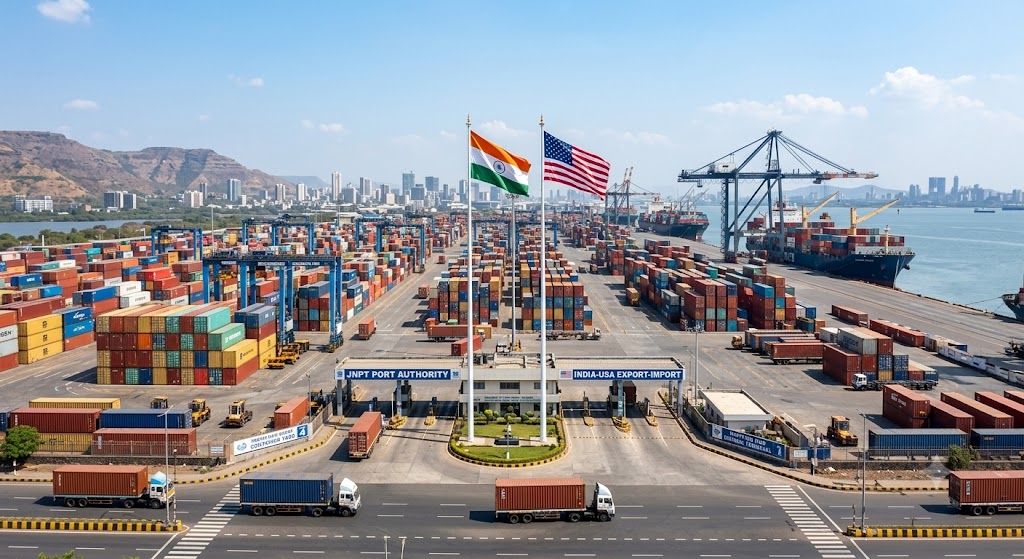
The United States is among India’s largest trading partners, with a substantial proportion of bilateral merchandise trade moving by sea through containerised shipping services. Indian exports such as engineering goods, automotive components, pharmaceuticals, textiles, chemicals, plastics, machinery and industrial products are routinely transported through major container gateways including Jawaharlal Nehru Port (JNPA), Mundra, Chennai, Visakhapatnam and Cochin before connecting to U.S. East Coast and West Coast ports.
Should additional tariffs eventually be imposed, exporters may face increased landed costs in the U.S. market, potentially affecting order volumes, shipping schedules and freight demand. While the precise commercial impact would depend on buyer behaviour, product categories and any subsequent negotiations, maritime stakeholders will closely monitor whether changes in trade policy translate into measurable shifts in cargo movement.
For ports and shipping companies, the issue is therefore not simply about tariffs but about maintaining stable cargo flows across one of India’s most significant international trade corridors.
Also Read: Port Authorities Are More Than Landlords: Kolkata Warehouse Collapse Raises New Questions
Container Shipping Could Feel the Effects
Container shipping has become the backbone of India–U.S. merchandise trade.
If exporters encounter higher import duties, supply chains may respond in several ways:
- Buyers could renegotiate contracts or adjust sourcing strategies.
- Exporters may absorb part of the additional cost to remain competitive.
- Some cargoes may be redirected to alternative markets depending on commercial viability.
- Shipping lines may review capacity deployment if sustained changes in cargo volumes emerge.
At this stage, these remain potential commercial responses rather than confirmed outcomes. The final impact will depend on the USTR’s decision, any subsequent bilateral engagement between India and the United States, and the response of global supply chains.
Ports, Logistics and Customs Stakeholders Watching Closely
Beyond exporters, the proposed measures are attracting attention across the logistics sector.
Customs brokers, freight forwarders, container freight stations, inland container depots, warehouse operators and multimodal logistics providers are all monitoring developments because any significant tariff change could influence customs documentation, trade compliance requirements and cargo planning.
Export-oriented manufacturing clusters that rely heavily on the U.S. market may also reassess inventory management, production schedules and logistics planning while awaiting clarity on the final USTR determination.
Although the hearings are taking place in Washington, their outcome could eventually influence operational decisions across India’s ports and logistics network.
Trade Policy Increasingly Shapes Maritime Transport
The Section 301 proceedings also reflect a broader trend in international commerce.
In recent years, maritime trade has increasingly been influenced by policy decisions rather than purely commercial factors. Geopolitical tensions, sanctions, environmental regulations, supply-chain resilience initiatives, carbon border measures and labour-related trade policies have all become important determinants of cargo movement.
For maritime businesses, understanding regulatory developments is becoming as important as monitoring freight rates or vessel deployment.
The current hearings therefore represent more than a dispute over tariffs—they illustrate how international trade policy can directly influence shipping demand, logistics planning and investment decisions across the maritime sector.
Maritime Perspective
For India’s maritime industry, the significance of the USTR hearings extends beyond the immediate debate over Section 301.
The proceedings demonstrate that trade compliance, labour standards and supply-chain governance are increasingly becoming components of maritime competitiveness. Export performance is no longer determined solely by manufacturing capability or shipping connectivity; it is also shaped by regulatory confidence, sustainability expectations and international market access.
As India pursues the objectives of Maritime India Vision 2030, PM Gati Shakti and the National Logistics Policy, maintaining predictable access to major export markets will remain critical for sustaining cargo growth through Indian ports.
MaritimeNews Editorial Verdict
The USTR hearings represent an important procedural stage rather than a final decision on the proposed tariffs. India has responded through a coordinated institutional effort involving the Government, industry associations and sectoral bodies, each presenting legal, commercial and supply-chain arguments before the U.S. authorities.
Regardless of the final outcome, the proceedings underscore an important reality for the maritime sector: international trade policy increasingly influences shipping, ports and logistics alongside traditional commercial considerations. For maritime professionals, the case is not only about whether tariffs are imposed, but about how evolving regulatory frameworks shape global cargo flows and the competitiveness of export-driven economies.
Frequently Asked Questions (FAQs)
What are the USTR Section 301 hearings?
Public hearings conducted by the Office of the United States Trade Representative to consider proposed actions under Section 301 of the Trade Act of 1974.
Why has India challenged the proposed tariffs?
India argues that its constitutional, legal and regulatory framework already prohibits forced labour and that the proposed tariffs are not supported by sufficient evidence.
Which Indian organisations participated?
Government of India, CII, FICCI & ACMA
How could the proposed tariffs affect maritime trade?
Changes in tariffs may influence export volumes, container shipping demand, port throughput and logistics planning.
Are the tariffs already effective?
No.
The hearings are part of the consultation process, and the USTR has not yet issued its final determination.
Which export sectors may be affected?
Potentially textiles, engineering goods, automotive components, pharmaceuticals, chemicals, plastics and other manufactured exports depending on the final scope of any measures.
Make us preferred source on Google
Source: United States Trade Representative (USTR)
Reporting by MaritimeNews Bureaus, Writing by Jaspal Singh Naol