

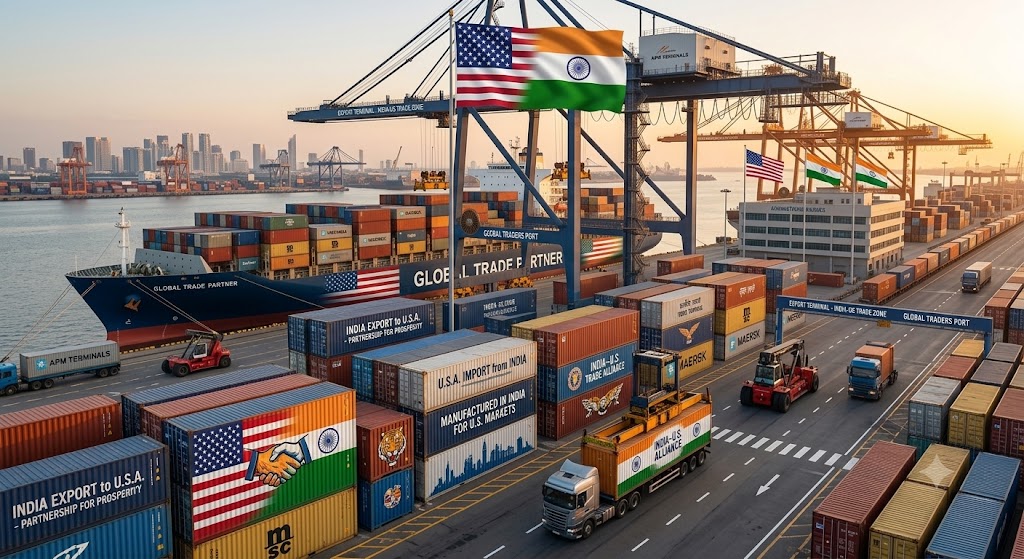
Government disputes legal basis of proposed 12.5% tariff as bilateral trade negotiations enter final phase, with maritime exporters, ports and logistics providers closely watching the outcome
Make us preferred source on Google
MaritimeNews Continuing Coverage
Previous Coverage
Global Maritime Trade Watch – Series 01
(Published by MaritimeNews)
Key Takeaways
- India has intensified its legal challenge to the proposed USTR tariffs, questioning both the factual and legal basis of the findings.
- The Section 301 proceedings are unfolding alongside negotiations on the India–U.S. Bilateral Trade Agreement.
- The temporary U.S. tariff regime is scheduled to expire on 24 July 2026, making the coming weeks critical for exporters.
- Bilateral goods trade exceeded US$149 billion in 2025, underlining the scale of commerce potentially affected by any policy changes.
- Maritime stakeholders are closely monitoring the potential impact on cargo flows, shipping services and logistics planning.
India / USA, July 09 (Maritime News) – As the USTR’s Section 301 public hearings continue in Washington, the debate has expanded beyond the proposed tariffs to encompass the broader future of India–U.S. trade relations. The Government of India has strengthened its legal challenge, arguing that the proposed 12.5% tariff lacks country-specific evidence and fails to satisfy the legal requirements under Section 301 of the U.S. Trade Act. At the same time, negotiations on the first phase of the India–U.S. Bilateral Trade Agreement continue, with both governments indicating that discussions are nearing completion even as uncertainty remains over the tariff framework expected after 24 July. For the maritime industry, the outcome carries implications not only for exporters but also for container shipping, ports, freight forwarding and integrated supply chains.
India’s Legal Challenge Becomes More Detailed
With the hearings now underway, India’s response has moved beyond a general objection to a detailed legal defence.
In its submission to the USTR, the Government argues that the proposed additional tariff is not supported by country-specific evidence demonstrating that India’s policies burden or restrict U.S. commerce. It further contends that the proposal does not establish a direct causal relationship between India’s import regime and any measurable injury to U.S. businesses, as required under Section 301 of the U.S. Trade Act.
The submission also emphasises that India already maintains a broad legal framework addressing forced labour and argues that effective enforcement should be assessed through domestic labour laws, regulatory oversight and due diligence mechanisms rather than solely through the existence of import prohibitions.
Trade Negotiations Now Form Part of the Bigger Picture
One of the most significant developments since MaritimeNews’ previous report is the growing overlap between the Section 301 proceedings and the negotiations for the proposed India–U.S. Bilateral Trade Agreement.
Officials from both countries have repeatedly indicated that discussions are in their final stages, although no definitive signing date has been announced. Commerce and Industry Minister Piyush Goyal has stated that negotiations have progressed substantially, while U.S. officials have similarly described the discussions as being close to completion.
For exporters, the uncertainty now extends beyond the Section 301 investigation itself. The structure of the eventual bilateral agreement and the tariff regime that follows could significantly influence India’s competitive position in the U.S. market.
Why the 24 July Timeline Matters
Industry attention has increasingly shifted towards 24 July 2026, when the temporary U.S. tariff arrangement is expected to expire.
The coming weeks may therefore determine not only the outcome of the Section 301 proceedings but also the tariff environment governing India–U.S. trade until a bilateral agreement is finalised.
For exporters, shipping companies and logistics providers, planning for the second half of the year will depend on whether a new tariff framework is introduced, modified or deferred following the ongoing consultations.
Trade Volumes Highlight the Stakes
The scale of bilateral trade demonstrates why the outcome is being watched closely across the maritime sector.
According to the latest trade summary, U.S. goods trade with India totalled approximately US$149.4 billion in 2025, comprising US$45.6 billion in U.S. exports and US$103.8 billion in imports from India. The resulting U.S. goods trade deficit with India stood at US$58.2 billion, reflecting continued growth in bilateral merchandise trade.
These figures underline that any changes to tariff policy could influence substantial cargo volumes moving between the two countries.
Competitive Pressures Could Shift Export Patterns
Independent trade analyses suggest that, if higher tariffs are eventually implemented, competing exporting nations with lower proposed tariff rates or preferential market access could strengthen their competitive position in selected product categories. Sectors identified as potentially sensitive include textiles, garments, automotive components, furniture, electronics and seafood.
Whether such shifts materialise will depend on the USTR’s final determination, buyer purchasing decisions and the outcome of bilateral negotiations. Nevertheless, exporters are closely monitoring the possibility of changes in relative competitiveness across key U.S. import markets.
Also Read: Mormugao Port Emerges as India’s Green Port Benchmark with ₹3,300-Crore Infrastructure Push
Why This Matters for Maritime Trade
The maritime implications extend beyond customs duties.
India–U.S. trade relies heavily on container shipping, integrated logistics networks and multimodal transport systems. Any sustained change in export competitiveness may influence container demand, shipping schedules, terminal throughput, warehousing activity and freight forwarding operations.
For ports handling significant U.S.-bound cargo, trade policy developments increasingly form part of operational planning alongside freight market conditions and infrastructure capacity.
Maritime Perspective
The ongoing USTR proceedings illustrate how trade policy, regulatory compliance and maritime logistics have become increasingly interconnected. Today’s competitiveness depends not only on manufacturing capability but also on market access, regulatory confidence and resilient supply chains.
For India’s maritime sector, maintaining stable access to major export markets remains essential to achieving the objectives of Maritime India Vision 2030 and strengthening the country’s position within global shipping networks.
Also Read: Goa Opens New Captain of Ports Terminal to Strengthen Maritime Governance and River Navigation
Editorial Verdict
The Section 301 hearings have evolved into more than a discussion on proposed tariffs. They now intersect with wider negotiations on the future of India–U.S. trade and the rules governing one of the world’s fastest-growing commercial relationships. While the final USTR decision remains pending, India’s legal submissions and the parallel trade negotiations suggest that the coming weeks could shape not only tariff policy but also cargo flows, logistics planning and maritime trade between the two countries.
Frequently Asked Questions (FAQs)
Why is India challenging the USTR proposal?
India argues that the proposal lacks country-specific evidence and that its legal framework already addresses forced labour concerns.
What is the July 24 deadline?
It is the date when the current temporary U.S. tariff arrangement is expected to expire, making it an important milestone for trade negotiations.
How large is India–U.S. merchandise trade?
According to the latest trade summary, U.S. goods trade with India reached approximately US$149.4 billion in 2025, including US$103.8 billion in imports from India.
How could the proposed tariffs affect maritime trade?
If implemented, the measures could influence export competitiveness, cargo volumes, container shipping demand, port throughput and logistics planning.
Are the tariffs already in force?
No. The USTR hearings form part of the consultation process, and the final determination is still pending.
Which industries are watching the outcome most closely?
Textiles, engineering goods, automotive components, pharmaceuticals, seafood, chemicals and logistics providers are among the sectors monitoring developments.
Make us preferred source on Google
Source: United States Trade Representative (USTR)
Reporting by MaritimeNews Bureaus, Writing by Jaspal Singh Naol