
World’s Largest Container Shipping Line to Acquire 49% Stake in India’s Fastest-Growing Deep-Water Transshipment Hub While Kerala Examines Concession Approval Requirements
Make us preferred source on Google
Key Takeaways
- MSC’s Terminal Investment Limited (TiL) will acquire a 49% stake in Vizhinjam International Seaport.
- The proposed transaction values the port at US$2.85 billion, with TiL’s investment estimated at US$1.397 billion.
- MSC, the world’s largest container shipping line, is investing in one of India’s fastest-growing transshipment ports.
- Kerala will examine the transaction under the existing concession agreement before regulatory approvals are finalised.
- The partnership combines global shipping expertise with India’s ambition to become a leading Indian Ocean transshipment hub.
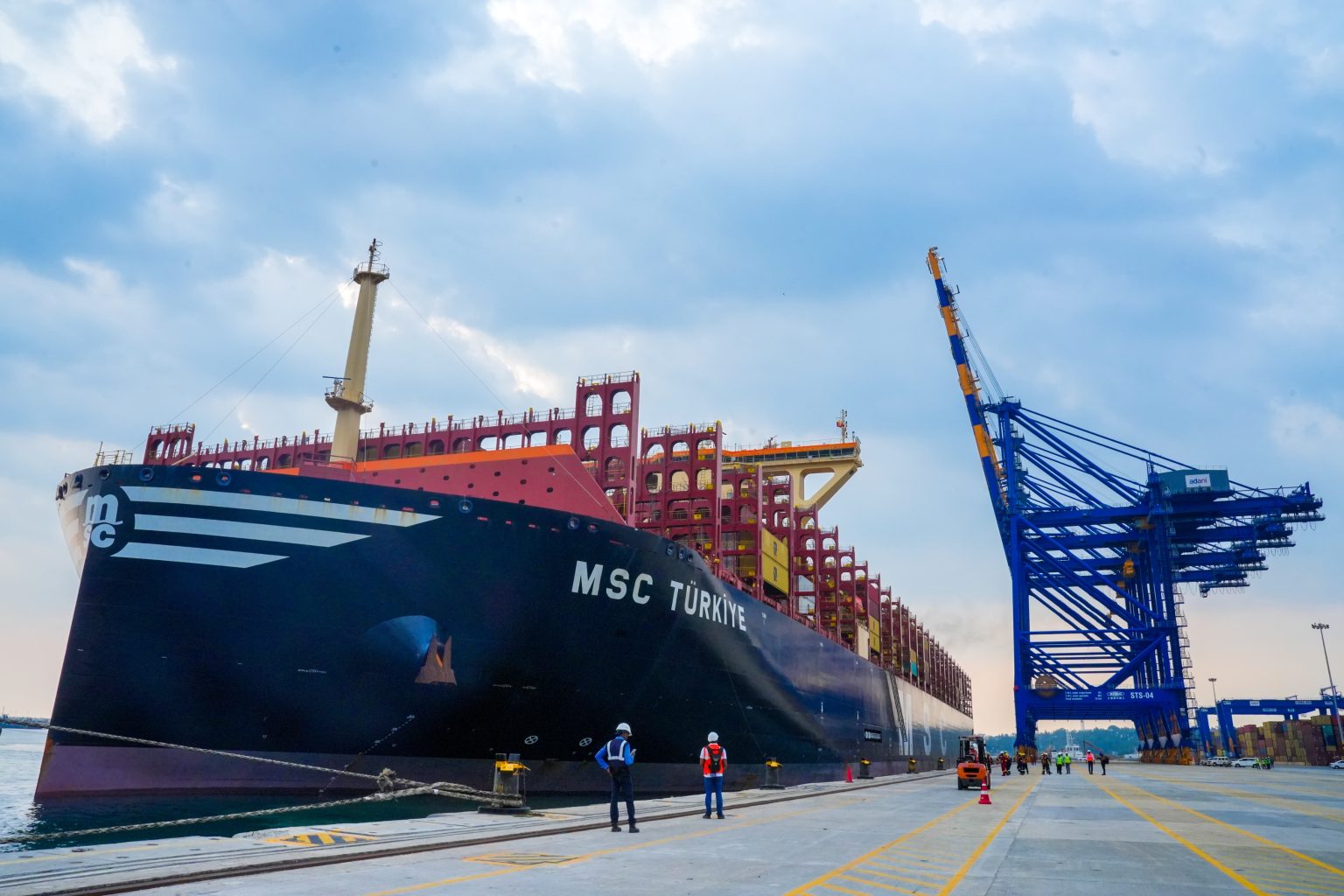
Vizhinjam, Thiruvananthapuram, Kerala, India, July 05 (Maritime News) – One of the largest foreign private investments in India’s maritime infrastructure is set to reshape the country’s transshipment ambitions after Terminal Investment Limited (TiL), the global port operating arm of Mediterranean Shipping Company (MSC)—the world’s largest container shipping line by fleet capacity—agreed to acquire a 49% stake in Vizhinjam International Seaport from Adani Ports and Special Economic Zone Ltd. (APSEZ).
The proposed transaction values Vizhinjam Port at an enterprise value of approximately US$2.85 billion, placing TiL’s investment at around US$1.397 billion. Beyond its financial scale, the deal reflects growing international confidence in India’s maritime infrastructure and positions Vizhinjam among the most strategically watched emerging container ports in the Indian Ocean.
The investment also comes during a period of renewed capital mobilisation across the Adani Group. In recent weeks, the conglomerate has announced major investments spanning ports, manufacturing and industrial infrastructure, signalling improving access to global capital following the resolution of its legal matters in the United States. Against this broader backdrop, the proposed TiL partnership represents not merely an equity transaction but a strategic collaboration between India’s largest private port operator and the world’s largest container shipping company.
However, the transaction has also introduced an important governance dimension. The Government of Kerala has indicated that the proposed transfer will be examined under the existing concession agreement governing Vizhinjam Port to determine whether prior government approval is required before the equity transaction proceeds. While the investment highlights growing confidence in India’s maritime sector, it also underscores the importance of transparent regulatory oversight in strategic infrastructure projects.
For India, the proposed partnership extends well beyond a corporate investment. It represents a significant step in the country’s long-term ambition to emerge as a globally competitive transshipment hub capable of retaining a larger share of container cargo that has historically been routed through foreign ports. At the same time, it reflects a broader shift in global shipping, where leading container carriers are increasingly investing directly in terminal infrastructure to strengthen their logistics networks and improve supply chain resilience.
Also Read: Mormugao Port Emerges as India’s Green Port Benchmark with ₹3,300-Crore Infrastructure Push
Why This Matters
The proposed TiL investment is significant not simply because of its size but because it brings together two influential players in global maritime trade. APSEZ contributes one of India’s fastest-growing deep-water ports, while MSC brings one of the world’s largest container shipping networks through its integrated shipping and terminal operations. If completed, the partnership could accelerate Vizhinjam’s emergence as a major regional transshipment gateway while strengthening India’s ability to retain container cargo that has traditionally been handled through overseas ports.
The Deal That Could Redefine India’s Transshipment Future
For decades, India’s container trade has relied heavily on overseas transshipment hubs despite the country’s strategic location along some of the world’s busiest maritime trade routes.
A substantial share of Indian export and import containers has traditionally been routed through regional ports such as Colombo, Singapore and Port Klang, resulting in additional handling costs, longer transit times and greater dependence on foreign logistics infrastructure. Much of the economic value generated from transshipment—including terminal revenues, logistics services and associated maritime activities—has therefore accrued outside India.
Vizhinjam International Seaport has been developed to reverse that trend.
Situated just a few nautical miles from the main East-West international shipping corridor, the deep-water port offers a rare combination of geographic advantage, natural depth and modern infrastructure capable of accommodating the world’s largest container vessels with minimal deviation from global trade routes.
It is this strategic advantage that has attracted Terminal Investment Limited, whose parent company MSC operates the world’s largest container fleet while managing an extensive international portfolio of container terminals across Europe, Asia, Africa and the Americas.
Unlike a purely financial investor, MSC’s interest reflects long-term confidence in Vizhinjam’s operational potential and its ability to become an integral part of the company’s global shipping network.
For APSEZ, the proposed partnership represents more than capital infusion. It aligns one of India’s most strategically located ports with a global shipping operator capable of generating sustained cargo volumes, strengthening commercial competitiveness and accelerating Vizhinjam’s integration into international container trade.
As global shipping continues to consolidate around fewer but larger transshipment hubs, the proposed APSEZ–TiL partnership may prove to be one of the most consequential developments in India’s port sector in recent years—provided the transaction successfully progresses through the required regulatory and contractual approval processes.
Also Read: Goa Opens New Captain of Ports Terminal to Strengthen Maritime Governance and River Navigation
The APSEZ–TiL Partnership Demonstrates Why Strategic Maritime Infrastructure Must Balance International Investment with Robust Regulatory Oversight
The proposed acquisition of a 49% stake in Vizhinjam International Seaport by Terminal Investment Limited (TiL) has been welcomed across the maritime industry as one of the most significant foreign private investments in India’s port sector. At the same time, the transaction has highlighted an equally important aspect of maritime infrastructure development—governance.
Soon after the announcement, the Government of Kerala stated that the proposed transaction would be examined under the terms of the existing concession agreement governing Vizhinjam International Seaport. According to the state government, any significant change in the ownership or equity structure of the concessionaire may require prior approval before the transaction can be completed.
While such regulatory scrutiny often attracts headlines, it is neither unusual nor unique.
Across the world, governments routinely review ownership changes involving strategic infrastructure such as ports, airports, energy facilities and telecommunications networks. These reviews are designed to ensure that investments remain consistent with concession agreements, regulatory obligations and long-term public interest.
Viewed in this context, the Kerala Government’s position represents an important governance process rather than a rejection of foreign investment.
Why Concession Agreements Matter
Modern ports developed under Public-Private Partnership (PPP) models operate through concession agreements that clearly define the rights and responsibilities of both governments and private operators.
These agreements typically address issues including:
- Ownership structure.
- Operational responsibilities.
- Investment obligations.
- Revenue-sharing mechanisms.
- Performance standards.
- Safety and environmental compliance.
- Procedures governing any significant transfer of ownership or control.
Such provisions provide certainty for investors while ensuring that governments retain appropriate oversight over nationally important infrastructure.
For large international investments, regulatory review therefore becomes an integral component of the transaction rather than an unexpected obstacle.
Also Read: Goa Water Metro Receives Phase-I Priority as Centre Accelerates Sustainable Inland Water Transport
Global Capital Requires Regulatory Confidence
International infrastructure investors seek more than commercial opportunity.
They also look for:
- Stable policy frameworks.
- Transparent approval processes.
- Predictable regulation.
- Strong contractual enforcement.
- Long-term legal certainty.
India has increasingly positioned itself as an attractive destination for infrastructure investment through initiatives such as Sagarmala, PM Gati Shakti, Maritime India Vision 2030 and continued improvements in the ease of doing business.
The proposed TiL investment reinforces that confidence.
Equally, the regulatory review process demonstrates that strategic infrastructure continues to operate within established legal and contractual frameworks.
These two factors—investment confidence and regulatory certainty—are complementary rather than contradictory.
More Than Capital: A Strategic Partnership
An important aspect sometimes overlooked is that Terminal Investment Limited is not a passive financial investor.
TiL represents the terminal operating arm of Mediterranean Shipping Company (MSC)—the world’s largest container shipping line.
Unlike institutional investors that primarily seek financial returns, TiL combines infrastructure ownership with operational expertise developed through managing container terminals across multiple continents.
For APSEZ, the proposed transaction therefore offers several strategic advantages beyond capital.
These include:
- Access to one of the world’s largest shipping networks.
- Greater international visibility.
- Potential long-term cargo commitments.
- Enhanced operational collaboration.
- Improved global competitiveness.
For MSC, the investment strengthens its ability to optimise shipping schedules, terminal utilisation and network planning across the Indian Ocean region.
The partnership therefore represents a convergence of infrastructure ownership and shipping operations rather than a conventional equity investment.
Also Read: Port Authorities Are More Than Landlords: Kolkata Warehouse Collapse Raises New Questions
What This Means for India’s Maritime Strategy
India has consistently sought to position itself as a leading maritime nation capable of serving both domestic trade and international logistics.
Achieving this objective requires three essential ingredients:
World-class infrastructure
↓
Global commercial partnerships
↓
Strong governance institutions
The proposed APSEZ–TiL partnership illustrates how these three elements increasingly intersect.
Infrastructure creates capacity.
Global shipping companies generate cargo.
Regulatory institutions provide stability and public confidence.
The long-term competitiveness of Indian ports will depend upon maintaining all three simultaneously.
MaritimeNews Strategic Perspective
Why This Transaction Is More Than an Investment
- One of India’s largest foreign private investments in port infrastructure.
- World’s largest container shipping line becomes both investor and commercial partner.
- Accelerates India’s ambition to become a global transshipment hub.
- Demonstrates increasing vertical integration in global container shipping.
- Reinforces investor confidence in India’s maritime infrastructure.
- Highlights the importance of transparent concession governance for strategic national assets.
MaritimeNews Editorial Verdict
The proposed US$1.397 billion investment by Terminal Investment Limited in Vizhinjam International Seaport represents far more than a major foreign investment in an Indian port.
It reflects a structural transformation taking place across the global maritime industry.
Leading container shipping companies are no longer limiting themselves to transporting cargo. Increasingly, they are investing directly in terminal infrastructure to integrate shipping operations, optimise logistics networks, strengthen supply-chain resilience and secure long-term access to strategically located ports.
For India, the proposed APSEZ–TiL partnership has the potential to accelerate Vizhinjam’s emergence as one of the Indian Ocean’s most important transshipment gateways while supporting the country’s ambition to retain a larger share of container cargo that has historically flowed through overseas ports.
Equally significant is the governance dimension.
The Kerala Government’s review of the transaction under the concession agreement demonstrates that strategic infrastructure investments must progress within transparent legal and regulatory frameworks. Far from discouraging investment, predictable governance enhances investor confidence by ensuring that commercial opportunities evolve within clearly defined institutional safeguards.
If the necessary approvals are secured, the APSEZ–TiL partnership could become one of the defining milestones in India’s modern maritime development—bringing together international capital, operational expertise, world-class infrastructure and regulatory oversight in support of a stronger, more globally competitive maritime economy.
Also Read: NEED OF BALLAST WATER TREATMENT IN MARITIME SUSTAINABILITY
Frequently Asked Questions (FAQs)
1. What is MSC’s proposed investment in Vizhinjam Port?
Terminal Investment Limited (TiL), the port operating arm of MSC, plans to acquire a 49% stake in Vizhinjam International Seaport for an estimated US$1.397 billion.
2. Why is Vizhinjam strategically important?
Vizhinjam is located close to the East-West international shipping corridor and has a natural deep-water harbour capable of accommodating Ultra Large Container Vessels with minimal route deviation.
3. Why is Kerala reviewing the transaction?
The Kerala Government has stated that it will examine whether the proposed equity transfer requires approval under the existing concession agreement governing Vizhinjam Port.
4. What is Terminal Investment Limited (TiL)?
TiL is the global terminal operating subsidiary of Mediterranean Shipping Company (MSC), managing container terminals across Europe, Asia, Africa, the Americas and the Middle East.
5. Why is MSC investing in a port it already uses?
The investment reflects a strategy of vertical integration, where shipping companies combine vessel operations with terminal ownership to improve efficiency, optimise schedules and strengthen supply-chain resilience.
6. How will this investment benefit India?
If approved, the partnership could strengthen India’s transshipment capacity, attract more international cargo, reduce dependence on overseas hubs and improve the country’s competitiveness in global container shipping.
Reporting Basis: APSEZ Press Release, National & International Newspapers and MaritimeNews Analysis
Reporting by MaritimeNews Bureaus, Writing by Jaspal Singh Naol