
ClassNK and Japan’s National Maritime Research Institute launch joint corrosion research that may influence future LCO₂ cargo tank design, maintenance planning and CCUS shipping confidence.
Make us preferred source on Google
Key Takeaways
- ClassNK and NMRI have launched joint research on corrosion rate evaluation for liquefied CO₂ cargo tanks.
- The research focuses on low-temperature and low-pressure LCO₂ transport conditions expected in large-scale carbon shipping.
- Impurities such as water and sulphur oxides are a key concern because they can increase corrosion risk.
- The project is expected to support future ClassNK rules, guidance, design data and maintenance approaches.
- Reliable corrosion data may help balance cargo purity, tank integrity, maintenance planning and overall CCUS transport costs.
Japan / India, July 07 (Maritime News) – The global shipping industry has transported the cargoes that shaped modern economic development, including coal, crude oil, liquefied natural gas, liquefied petroleum gas and containerised manufactured goods. A different type of cargo is now beginning to receive serious attention: captured carbon dioxide.
According to a ClassNK press release dated 29 June 2026, ClassNK and the National Maritime Research Institute (NMRI), National Institute of Maritime, Port and Aviation Technology, have launched a joint research project on corrosion rate evaluation for liquefied CO₂ cargo tanks under low-temperature and low-pressure conditions.
The announcement may appear narrow at first glance because it concerns corrosion testing. In reality, it addresses one of the technical questions that must be answered before large-scale carbon dioxide shipping can develop with confidence: how should ship designers, owners and operators manage corrosion risks when transported CO₂ contains small quantities of impurities?
Why This Research Matters
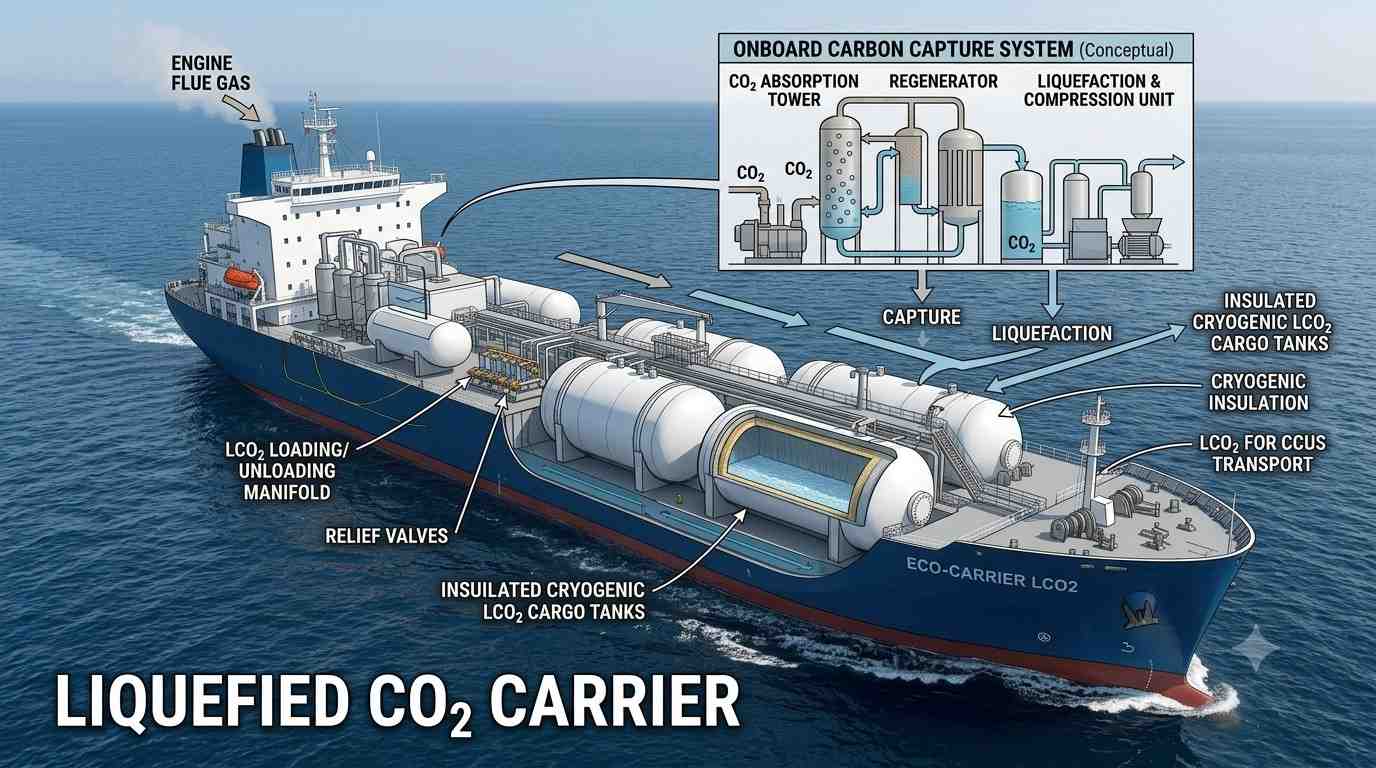
Carbon Capture, Utilization and Storage (CCUS) depends not only on capturing emissions at industrial facilities, but also on transporting the captured carbon dioxide to locations where it can be used or permanently stored. In many cases, storage sites may be offshore, located far from industrial emitters or situated across national boundaries.
Pipelines will play a role in some regions, but they may not always be practical or economical, particularly for cross-border transport, island economies and offshore storage projects. This is where specialised ships carrying liquefied CO₂ can become an important part of the CCUS value chain.
ClassNK’s announcement notes that cross-border CO₂ transportation has already commenced in Europe and that demand for LCO₂ transport is expected to expand in the Asia-Pacific region. For shipping, this creates both an opportunity and a technical responsibility.
The Corrosion Challenge Inside LCO₂ Cargo Tanks
Liquefied carbon dioxide is not a conventional bulk cargo. Under controlled cargo conditions, CO₂ may be transported safely, but impurities can change the risk profile. Trace amounts of water and sulphur oxides can contribute to corrosion, depending on impurity concentration, cargo conditions and the materials used in the cargo system.
This matters because corrosion is not only a maintenance issue. It can influence cargo tank design, material selection, corrosion allowance, inspection intervals, maintenance planning, survey expectations and lifecycle operating costs. If the industry does not understand the relationship between impurities and corrosion rate, it becomes harder to design safe and commercially efficient LCO₂ carriers.
A central question therefore emerges: how pure must the CO₂ be before it can be transported safely and economically? Removing more impurities can improve cargo quality, but it may increase processing and conditioning costs. Allowing higher impurity levels may reduce purification costs, but it may increase corrosion risk and maintenance burden. The industry needs scientific evidence to find a practical balance.
Also Read: Mormugao Port Emerges as India’s Green Port Benchmark with ₹3,300-Crore Infrastructure Push
What ClassNK and NMRI Will Study
Under the announced research programme, a CO₂ corrosion test facility will be installed at NMRI. The facility is intended to reproduce low-temperature and low-pressure environments suitable for large-scale LCO₂ transportation. Corrosion tests will be conducted under controlled conditions reflecting anticipated impurity types and concentrations.
The experimental data will then be analysed to establish fundamental information required for the design and maintenance of LCO₂ cargo tanks. ClassNK has stated that the findings are expected to be reflected in its rules and guidelines, supporting the development of rational and safe cargo tank designs.
The project is being carried out through collaboration between ClassNK and NMRI, with additional cooperation from the University of Tokyo’s social collaboration programme, “Materials for Future Energy Infrastructure Trust (MEIT).” This structure brings together expertise in material reliability evaluation and maritime technical rule development.
Why Classification Societies Are Involved Early
Classification societies have traditionally played an important role when new maritime technologies move from concept to commercial application. They help convert technical research into practical requirements for design, construction, survey and operation.
In the case of LCO₂ carriers, the industry will need confidence in containment systems, cargo handling arrangements, material behaviour and maintenance standards. ClassNK’s involvement at the research stage is therefore significant because the findings may eventually support future class rules, guidelines and wider technical discussions.
It is important, however, to distinguish between class rules and international regulation. The research may contribute to future rulemaking discussions, but it does not by itself create a new international standard. Its immediate value lies in building reliable technical data.
Also Read: Goa Opens New Captain of Ports Terminal to Strengthen Maritime Governance and River Navigation
Commercial Implications for the CCUS Value Chain
The commercial importance of the research lies in the relationship between cargo purity, corrosion risk and cost. If future data can show how specific impurities affect corrosion under defined cargo conditions, ship designers and cargo owners may be able to make better decisions about cargo preparation, tank design and maintenance strategy.
For the CCUS value chain, this could help reduce uncertainty. Shipowners need predictable maintenance requirements. Cargo interests need clarity on acceptable CO₂ quality. Ports and terminals need confidence in cargo handling systems. Investors need assurance that technical risks can be managed over the life of the asset.
Scientific data cannot remove every risk, but it can make those risks more measurable. In emerging maritime sectors, that measurement is often the first step toward commercial confidence.
Operational and Insurance Considerations
For ship managers, the practical value of corrosion research may appear in inspection planning, maintenance intervals, corrosion monitoring and cargo tank lifecycle management. If impurity-related corrosion can be more accurately assessed, operators may be able to plan maintenance more rationally and avoid unnecessary assumptions.
The insurance and claims dimension should also not be ignored. Future LCO₂ operations may raise questions involving cargo quality, tank condition, maintenance records, class requirements, delay, contamination or responsibility for cargo-system deterioration. Better technical data may assist owners, charterers, insurers and P&I Clubs in assessing risk and allocating responsibility more fairly.
Also Read: Goa Water Metro Receives Phase-I Priority as Centre Accelerates Sustainable Inland Water Transport
Implications for Shipbuilders, Ports and Equipment Makers
If commercial LCO₂ shipping expands, several parts of the maritime industry could be affected. Shipbuilders may see demand for purpose-built carriers with specialised cargo containment systems. Marine equipment manufacturers may develop materials, coatings, monitoring systems and cargo handling technologies suited to carbon transport.
Ports may eventually need CO₂ loading and receiving infrastructure, storage arrangements and emergency response procedures. Classification societies may develop more detailed inspection and certification approaches. Marine service companies may also find opportunities in corrosion monitoring, cargo system maintenance and technical consultancy.
These opportunities will depend on how quickly CCUS projects become commercially viable and how consistently future technical standards develop.
What Could This Mean for India?
For India and other emerging maritime economies, the immediate lesson is to monitor technical developments early. Commercial LCO₂ shipping remains at a developing stage, but the wider direction is important for countries investing in industrial decarbonisation, green hydrogen, shipbuilding, port-led development and energy transition infrastructure.
India may eventually need to consider port readiness, specialised training for seafarers and surveyors, shipbuilding capability for new cargo types, participation in technical standard-setting and national policy for maritime carbon transport. Preparing early would allow Indian industry to participate in future opportunities rather than responding after standards are already mature.
Also Read: Port Authorities Are More Than Landlords: Kolkata Warehouse Collapse Raises New Questions
Risks That Still Need Careful Management
The growth of LCO₂ shipping will depend on managing several uncertainties. Technical risk remains because corrosion behaviour under different impurity conditions is still being studied. Regulatory risk remains because future standards will need to develop across class, flag and international frameworks. Commercial risk remains because large investments in ships and port infrastructure depend on the speed and scale of CCUS deployment.
Safety risk must also remain central. Although captured CO₂ is associated with environmental objectives, it still requires careful cargo handling, containment integrity, emergency preparedness and crew competence.
MaritimeNews Editorial Verdict
The joint research by ClassNK and NMRI should not be viewed only as a laboratory study of corrosion. It represents an early technical step in building the confidence required for future liquefied CO₂ shipping.
Every major maritime cargo sector has depended on technical certainty before reaching commercial scale. LNG, LPG and other specialised cargoes developed through a combination of engineering research, classification standards, operational experience and regulatory confidence. LCO₂ shipping may now be entering a similar stage.
The future of carbon shipping will not be determined only by climate ambition. It will depend on whether ships, ports, cargo owners, insurers, regulators and classification societies can rely on sound technical evidence. In that sense, corrosion research may become one of the foundations of a new maritime transport segment.
MaritimeNews Editorial Note
This editorial is based on the announced joint research initiative by ClassNK and Japan’s National Maritime Research Institute concerning corrosion rate evaluation of low-temperature, low-pressure liquefied CO₂ cargo tanks. The analysis reflects Maritime News India’s independent assessment of the broader implications for maritime technology, ship classification, CCUS logistics and the possible future development of carbon shipping. The observations are intended to encourage informed professional discussion on an emerging maritime sector.
Also Read: NEED OF BALLAST WATER TREATMENT IN MARITIME SUSTAINABILITY
Frequently Asked Questions (FAQs)
What is liquefied CO₂ shipping?
Liquefied CO₂ shipping involves transporting captured carbon dioxide under controlled temperature and pressure for storage or industrial use as part of Carbon Capture, Utilisation and Storage (CCUS).
Why is ClassNK conducting corrosion research?
The research aims to understand how impurities affect corrosion inside liquefied CO₂ cargo tanks, helping improve future ship design, maintenance planning and classification guidance.
Why is corrosion important in CO₂ carriers?
Corrosion can influence cargo tank integrity, inspection intervals, maintenance costs, material selection and overall operational safety.
What role do classification societies play?
Classification societies develop technical standards and guidance that support safe ship design, construction, inspection and maintenance.
How could this research benefit the maritime industry?
Better technical data may reduce uncertainty in LCO₂ shipping, improve commercial confidence and support the development of safe carbon transport networks.
What does this mean for India?
India could benefit by preparing its ports, shipyards, classification expertise and maritime workforce for future participation in global carbon transport and CCUS logistics.
Reporting Basis: Official Release and MaritimeNews Analysis
Reporting by MaritimeNews Bureaus, Writing by Harpal S Naol; Editing by Jaspal Singh Naol Technical review and revisions by Priyatham Sanjeeva Reddy Ramidi