

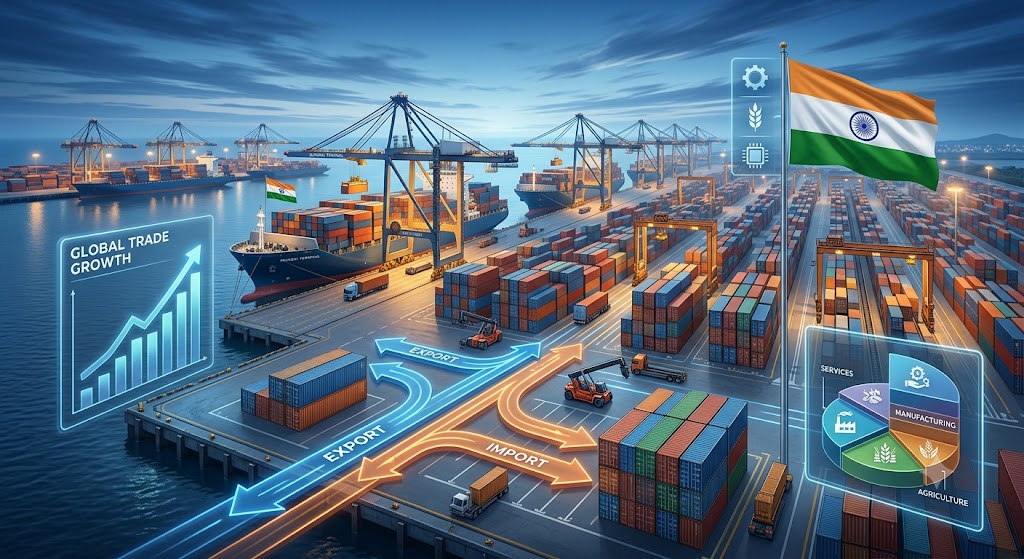
Imports continue to outpace exports even as merchandise shipments record double-digit growth during the first quarter of FY2026-27
Key Takeaways
- Merchandise exports grew 15.92% during April–June FY2026-27.
- Merchandise imports increased faster, widening the trade deficit.
- Services continued to generate a significant trade surplus.
- Engineering goods, electronics and chemicals remained major export drivers.
- The widening trade deficit highlights the importance of improving export competitiveness while managing import dependence.
Delhi, India, July 14 (Maritime News) – India’s external trade delivered encouraging export growth during the first quarter of FY2026-27, but a closer examination of official trade statistics reveals a more complex picture. While merchandise exports rose by 15.92%, imports increased at an even faster pace, resulting in a wider merchandise trade deficit and raising important questions about India’s overall trade performance.
The latest data released by the Ministry of Commerce and Industry indicates that India’s export momentum remains strong across several sectors, including engineering goods, electronic goods, chemicals and gems & jewellery. However, the rapid rise in imports highlights the continuing challenge of balancing export growth with import dependence.
MaritimeNews Summary
India’s total exports reached US$232.73 billion during April–June FY2026-27, registering an annual growth of 11.37%. Merchandise exports grew by 15.92% to US$129.32 billion, while merchandise imports increased to US$216.18 billion, widening the merchandise trade deficit to US$86.86 billion. Although services continued to generate a healthy trade surplus, the overall trade balance deteriorated compared with the corresponding period of the previous year.
Also Read: India’s Exports to Tanzania Surge 146.89%, Driven by Energy and Manufacturing
India Records Strong Export Growth, but Imports Grow Faster
Official trade data presents two contrasting trends.
On one hand, India’s merchandise exports increased from US$111.57 billion to US$129.32 billion during April–June FY2026-27, reflecting strong performance across several manufacturing sectors.
On the other hand, merchandise imports rose from US$180.31 billion to US$216.18 billion over the same period, expanding at a pace that exceeded export growth.
As a result, India’s merchandise trade deficit widened from US$68.75 billion to US$86.86 billion, indicating that import growth continues to outpace export earnings.
What the Trade Numbers Reveal
| Indicator | Apr–Jun FY2026-27 | Apr–Jun FY2025-26 | Growth |
|---|---|---|---|
| Merchandise Exports | US$129.32 Billion | US$111.57 Billion | +15.92% |
| Merchandise Imports | US$216.18 Billion | US$180.31 Billion | +19.89% |
| Merchandise Trade Deficit | US$86.86 Billion | US$68.75 Billion | Increased |
| Services Exports | US$103.41 Billion | US$97.41 Billion | +6.16% |
| Services Trade Surplus | US$49.43 Billion | US$47.90 Billion | Increased |
The figures indicate that while exports are expanding steadily, import growth remains sufficiently strong to offset much of the gain in merchandise trade.
Why the Trade Deficit Matters
A trade deficit does not automatically indicate economic weakness. Developing economies often import capital goods, machinery, technology and raw materials that support industrial growth.
However, a widening merchandise trade deficit deserves attention because sustained import growth that consistently exceeds export growth can increase dependence on external markets and place greater pressure on the trade balance.
The continuing surplus generated by India’s services sector helps offset part of the merchandise deficit, but merchandise exports remain critical for manufacturing, industrial production and cargo generation.
Merchandise Trade Remains Closely Linked to the Real Economy
Merchandise exports create economic activity across a broad production and logistics chain.
Growth in manufactured exports supports:
- Farmers producing agricultural commodities.
- Industrial workers in manufacturing facilities.
- MSMEs supplying components and intermediate goods.
- Trucking and logistics operators.
- Warehousing and cold chain businesses.
- Ports and terminal operators.
- Shipping companies engaged in international trade.
Services exports remain an important contributor to India’s foreign exchange earnings and global competitiveness. However, merchandise trade generally has wider linkages with manufacturing, agriculture, mining, logistics and maritime transport, making it particularly significant for employment-intensive sectors of the economy.
Maritime Implications
The trade figures have important implications for India’s maritime sector.
Higher merchandise exports generate additional outbound cargo through Indian ports, supporting container terminals, bulk cargo facilities and shipping services.
At the same time, increasing imports create higher inbound cargo volumes, strengthening demand for container shipping, dry bulk carriers and liquid bulk operations.
For Indian ports, both export and import growth contribute to cargo throughput. However, from a national trade perspective, improving export competitiveness remains important to achieving a more balanced merchandise trade profile.
Stakeholder Impact
Manufacturers
Growing exports provide additional market opportunities for Indian manufacturers, particularly in engineering, electronics and chemicals.
Farmers and Agricultural Producers
Higher merchandise exports support demand for agricultural and processed food products in international markets.
MSMEs
Small and medium-sized enterprises supplying export-oriented industries benefit from stronger manufacturing activity and expanding overseas demand.
Ports and Terminal Operators
Increasing trade volumes contribute to higher cargo handling across container, dry bulk and liquid bulk terminals.
Shipping and Logistics Companies
Growth in both exports and imports supports demand for international shipping, freight forwarding, customs brokerage and multimodal logistics services.
Policymakers
The widening merchandise trade deficit highlights the need to strengthen export competitiveness while managing strategic import dependence through continued industrial development and trade policy reforms.
Performance Assessment
What India Did Well
India recorded strong merchandise export growth during the first quarter of FY2026-27, with exports rising by 15.92% year-on-year. Engineering goods, electronic goods, organic and inorganic chemicals, gems & jewellery, rice and marine products emerged as key contributors, demonstrating the resilience of India’s manufacturing and export sectors. The continued growth in services exports further strengthened India’s external trade performance by generating a healthy trade surplus.
Areas Requiring Attention
Despite the encouraging export performance, merchandise imports expanded at a faster pace, widening the merchandise trade deficit to US$86.86 billion. The data highlights the importance of strengthening domestic manufacturing, increasing value-added exports and reducing strategic import dependence where economically feasible. Maintaining export growth while improving the balance between imports and exports will remain an important policy objective.
Maritime Intelligence & Strategic Assessment (MISA)
India’s latest trade figures present a mixed but strategically important picture. Strong export growth demonstrates the competitiveness of several Indian manufacturing sectors, yet the faster rise in imports indicates that export gains alone are not sufficient to narrow the merchandise trade deficit.
For the maritime sector, however, expanding trade volumes—both inbound and outbound—translate into higher cargo movement, greater port utilisation and increased demand for shipping and logistics services. The challenge for policymakers is therefore twofold: sustain export momentum while improving the quality and competitiveness of India’s merchandise trade so that exports contribute more effectively to long-term trade balance and industrial growth.
The Road Ahead
India has entered FY2026-27 with encouraging export momentum supported by manufacturing, engineering and services. The next phase will depend on sustaining this momentum while addressing the structural factors contributing to higher import growth.
Continued investment in manufacturing competitiveness, logistics efficiency, trade facilitation, port infrastructure and export diversification will be essential if India is to improve its merchandise trade balance and strengthen its position in global supply chains. Future monthly trade releases will indicate whether the current export momentum is sufficient to gradually reduce the widening trade deficit.
Frequently Asked Questions (FAQ)
What is India’s trade deficit?
India’s trade deficit is the difference between the value of imports and exports. It widens when imports exceed exports during a given period.
Why did India’s trade deficit increase in Q1 FY2026-27?
Merchandise imports grew faster than merchandise exports during April–June FY2026-27, resulting in a wider merchandise trade deficit despite strong export growth.
Which sectors contributed to India’s export growth?
Engineering goods, electronic goods, gems & jewellery, organic and inorganic chemicals, rice and marine products were among the major contributors to export growth during June 2026.
Why are merchandise exports important for India’s economy?
Merchandise exports support manufacturing, agriculture, logistics, ports, shipping and millions of jobs across India’s industrial value chain while earning valuable foreign exchange.
Does a higher trade deficit always indicate economic weakness?
Not necessarily. Imports of machinery, technology and industrial raw materials can support economic growth. However, a sustained widening trade deficit requires careful monitoring to ensure long-term trade sustainability.
How does trade growth benefit India’s maritime sector?
Higher trade volumes increase cargo movement through ports, creating demand for container shipping, bulk carriers, tankers, logistics services and port infrastructure.
Make us preferred source on Google
Reporting Basis: Official Government Release and MaritimeNews Analysis
Reporting by MaritimeNews Bureaus, Writing & Editing by Jaspal Singh Naol.



One thought on “India Trade Deficit Widens Despite Strong Export Growth”