
Why Ballast Water Management Has Become a Global Maritime Sustainability Priority
Key Takeaways
- Ballast water treatment is essential for protecting marine ecosystems from invasive aquatic species.
- IMO regulations have made ballast water management a mandatory part of modern shipping.
- Approved treatment systems help ships achieve environmental compliance and operational safety.
- Effective ballast water management strengthens maritime sustainability and marine biosecurity.
- India’s growing maritime sector must continue investing in sustainable shipping and environmental protection.
India, July 01 (Maritime News) –The global maritime industry, which carries most of the world’s trade by volume, is undergoing a major environmental transformation as governments, regulators and international agencies intensify pressure on shipping companies to adopt sustainable operating practices. Among the most important environmental concerns facing the sector is ballast water discharge – an operational necessity that can also become a serious marine ecological threat when it is not properly managed.
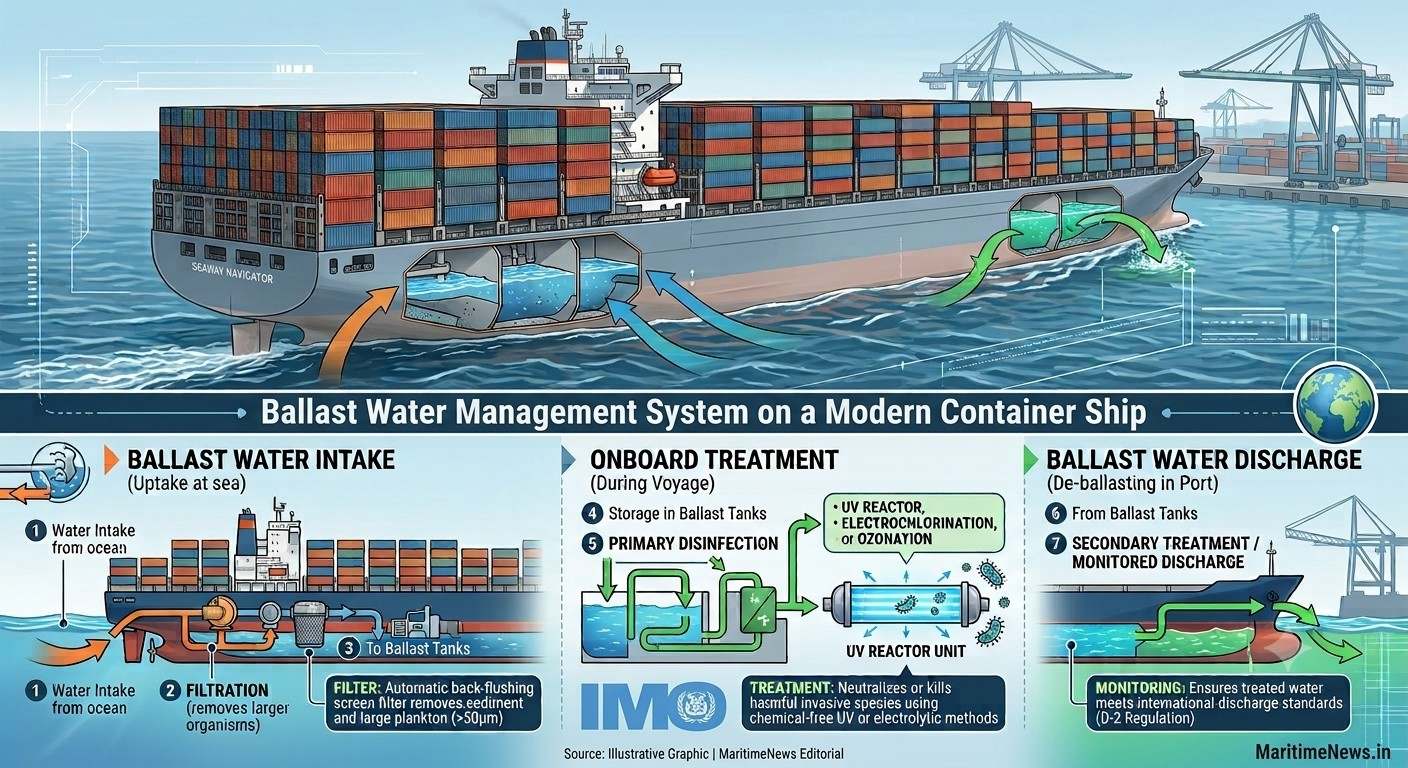
Ships take in and discharge ballast water to maintain safe operating conditions throughout a voyage. Ballast supports vessel stability, trim optimisation, hull stress distribution, propeller immersion and compensation for changes in cargo, fuel and freshwater loads. However, the same water may carry aquatic organisms, bacteria, microbes, sediments and pathogens from one ecosystem to another.
International Maritime Organization (IMO) material has long cited the movement of billions of tonnes of ballast water each year and the daily transfer of thousands of aquatic species through ships’ ballast tanks. When untreated ballast water is discharged at a destination port, non-native organisms may survive, reproduce and disrupt local marine ecosystems.
Ballast Water and the Global Ecological Threat
Environmental agencies and maritime researchers have repeatedly warned that untreated ballast water can damage marine biodiversity, fisheries, coastal economies and water infrastructure. One of the most widely cited examples is the spread of zebra mussels in North America, where invasive species introduced through shipping caused major ecological disruption and substantial industrial and environmental losses.
Similar concerns continue to arise across Asia, Europe and other coastal regions that depend on marine biodiversity and fisheries. As global trade expands and vessel traffic increases, ballast water management is becoming an important part of marine biosecurity for both developed and emerging maritime nations.
IMO Regulations Reshaping Global Shipping
The IMO adopted the International Convention for the Control and Management of Ships’ Ballast Water and Sediments, commonly known as the Ballast Water Management Convention. The Convention entered into force in 2017 and established a global framework to reduce the transfer of harmful aquatic organisms and pathogens.
The regulatory framework distinguishes between the D-1 and D-2 standards. The D-1 standard concerns ballast water exchange at sea, while the D-2 standard limits the number of viable organisms and specified indicator microbes that may be discharged. For ships within the Convention’s scope, the phase-in deadline for meeting the D-2 performance standard passed on 8 September 2024. In practice, compliance generally requires an approved onboard ballast water management system, supported by an approved plan, certification and accurate recordkeeping.
Shipowners have therefore invested in ultraviolet disinfection, electrochlorination, filtration, chemical treatment and automated monitoring technologies. The suitability of each system depends on the vessel type and trading profile. UV systems may be affected by high turbidity, while electrochlorination systems depend on water salinity, electrical demand and operating conditions. Technology selection must also consider treatment capacity, holding time, crew familiarity, maintenance support and the ports in which the vessel trades.
Industry estimates place ballast water treatment installation costs anywhere from several hundred thousand dollars to several million dollars per vessel, depending on vessel size, system type, retrofit complexity and associated dry-dock work. Market assessments also expect continued demand for ballast water treatment equipment and related services as compliance and green shipping initiatives expand.
Ballast Water and Maritime Sustainability – Key Numbers
- Most global trade by volume is carried by maritime transport.
- Billions of tonnes of ballast water are transferred internationally each year.
- IMO-related studies have cited the daily transport of thousands of aquatic species in ballast water.
- The Ballast Water Management Convention entered into force in 2017.
- The D-2 implementation deadline for ships within the Convention’s scope passed on 8 September 2024.
- India has 14 designated major ports, of which 12 are currently operational, as well as around 200 non-major ports.
- India’s coastline was officially reassessed in 2025 at approximately 11,098.81 kilometres.
- Indian major and non-major ports together handled more than 1.59 billion tonnes of cargo in FY 2024-25.
Why Ballast Water Treatment Matters
Ballast water treatment is no longer viewed only as a regulatory obligation. It has become an important part of maritime sustainability, marine conservation, responsible trade and environmental compliance. Proper ballast water management helps prevent the transfer of invasive species, protects biodiversity, safeguards fisheries and coastal livelihoods, and strengthens international marine governance.
It is equally important to recognise that ballast water management is integrated into everyday ship operations. The environmental objective must be achieved without compromising stability, seaworthiness or safe cargo operations. This is why an approved system must be suitable for the vessel’s design, pumping capacity, operating profile and crew capabilities.
Environmental compliance is also attracting greater attention from charterers, financiers, insurers and investors. Vessel environmental performance, regulatory history and the reliability of onboard treatment systems can influence commercial assessments, chartering decisions and broader ESG-linked evaluations.
India’s Maritime Sustainability Challenge
India’s expanding maritime sector must balance cargo growth, port development and coastal economic activity with the protection of marine ecosystems. The country currently has 14 designated major ports, including 12 operational major ports, and around 200 non-major ports. Its coastline was officially reassessed in 2025 at approximately 11,098.81 kilometres.
Official port statistics show that India’s operational major ports handled about 854.86 million tonnes of cargo in FY 2024-25, while non-major ports handled about 739.47 million tonnes. Combined cargo movement therefore exceeded 1.59 billion tonnes. Increased vessel traffic brings economic opportunity, but it also increases the importance of effective ballast water management, inspection capacity and marine biosecurity.
Murtaza Rajkotwala, Industrial Water Treatment Specialist at Nectar Purifiers, said the maritime industry can no longer treat water management as a secondary operational concern. “With global shipping volumes increasing continuously, sustainable water treatment technologies are becoming essential for operational compliance, environmental protection, and long-term maritime sustainability,” he said.
Operational and Financial Challenges at Sea
Despite greater awareness and regulatory pressure, ballast water treatment remains a significant operational and financial challenge for shipowners. Older vessels may have limited machinery space, restricted access routes and insufficient electrical capacity for a straightforward retrofit. Installation can require substantial piping modifications, electrical integration, automation work, class approval and coordination with a scheduled dry-docking.
Retrofit planning must also consider the vessel’s ballast pump capacity, ballast sequence, trading pattern and expected water quality. A system that performs well in one operating region may face limitations in another. Owners must therefore assess salinity, turbidity, temperature, power availability, treatment rate and shore-based service support before selecting equipment.
Small and medium operators in developing maritime economies may find the cost of environmental retrofitting especially difficult. Capital expenditure is only one part of the burden; downtime, commissioning, spare parts, consumables, crew training and long-term maintenance must also be considered.
Bittu Naol, Director of HAP Retrofit and Engineering Infrastructure Private Limited, observed that retrofit engineering and sustainability modernisation will become one of the maritime industry’s most important transition sectors in the coming decade. “Environmental retrofitting is becoming a major operational requirement globally. Shipping companies that delay sustainability upgrades may face increasing compliance pressure and competitive disadvantages in international markets,” he noted.
Crew Workload, Port State Control and Compliance
Ballast water compliance creates additional technical and administrative duties onboard. Crews must be familiar with system start-up and shutdown procedures, alarms, bypass arrangements, calibration requirements, sampling points and contingency measures. Accurate entries in the Ballast Water Record Book and compliance with the approved Ballast Water Management Plan are essential.
Port State Control inspections may examine certificates, records, system condition, alarm history and evidence that the treatment system is being operated correctly. Where required, authorities may also conduct indicative or detailed sampling. Deficiencies can lead to delays, operational restrictions, detention or instructions to manage ballast water by an approved alternative method.
Maritime Operations, Insurance and Liability Risks
Environmental compliance is increasingly connected with vessel operations, insurance and commercial performance. Non-compliance may expose operators to detention, penalties, reputational damage, additional operating costs and disruption to the vessel’s trading schedule.
It may also create Protection and Indemnity (P&I) exposure involving environmental claims, third-party liabilities, delay-related disputes and legal costs, depending on the circumstances and the applicable cover. Charter-party disagreements may arise where a vessel is delayed, detained or unable to conduct cargo operations because its ballast water system is defective or non-compliant.
Nikhil M, Ex-Mariner and Maritime Industry Commentator, emphasised that environmental accountability is becoming part of core vessel operations. “Modern shipping operations are no longer judged only on cargo movement and operational efficiency. Environmental responsibility, sustainability performance, and regulatory compliance are now central operational benchmarks across the global maritime sector,” he said.
Legal and Regulatory Perspective
Maritime environmental enforcement is expected to remain an important legal and regulatory issue as authorities strengthen marine pollution and biosecurity controls. Shipowners must consider the requirements of the IMO Convention, flag-state implementation, Port State Control practices and any additional national or regional rules that apply in the vessel’s trading area.
Rubina Parker, Advocate and Legal Expert, highlighted that environmental negligence in maritime operations can expose shipping companies to substantial legal and financial consequences. “Environmental compliance in maritime operations is increasingly becoming a legal liability issue. Regulatory violations linked to marine pollution, ballast discharge, or ecosystem damage can result in penalties, operational restrictions, reputational consequences, and long-term legal exposure,” she stated.
Sediment Management and Marine Biosecurity
Ballast water management also includes the control of sediments. Sediment accumulating in ballast tanks can harbour organisms, bacteria, cysts and pathogens even when the surrounding water has been treated. Regular inspection, tank cleaning where required and appropriate disposal of removed sediments are therefore important parts of the vessel’s ballast water management arrangements.
Port reception and disposal facilities, technical support and inspection capacity may vary between regions. These differences can create particular challenges for emerging maritime economies, where retrofit support, spare parts, trained technicians and port-side enforcement resources may not be equally available.
Sustainability, Policy and Industry Awareness
Ballast water management is now moving beyond specialist technical discussions into wider debates about sustainability, climate policy, coastal livelihoods and marine governance. Effective implementation requires coordination between regulators, shipowners, port authorities, classification societies, environmental agencies, technology providers and seafarers.
Gaurav Porwal, National Spokesperson of Global Seafarers Union of India (GSUI), stressed that India’s maritime growth ambitions require stronger coordination between regulators, shipping companies, environmental agencies and infrastructure stakeholders. “India’s maritime growth ambitions must move parallel with sustainability preparedness. Policy implementation, technological adaptation, and environmental awareness are essential to ensuring long-term maritime resilience,” he said.
Nagmani Pandey, Senior Journalist, noted that marine environmental issues are becoming increasingly relevant to public discourse. “Marine pollution and shipping sustainability are no longer isolated maritime-sector concerns. They are directly connected to climate discussions, fisheries, coastal economies, environmental governance, and sustainable development priorities globally,” he observed.
Economic Opportunities Emerging from Green Shipping
Although environmental regulations create costs and operational challenges, they also generate business opportunities. Demand is expected to continue for retrofit engineering, class-approved treatment systems, marine environmental technologies, monitoring equipment, green port infrastructure, compliance consulting and specialised maintenance services.
India’s shipbuilding, marine engineering and port modernisation sectors could benefit from this transition. Building domestic technical capability in system integration, commissioning, calibration, crew training, sampling and after-sales support would allow Indian companies to participate more effectively in the growing marine environmental technology market.
The Road Ahead
Ballast water treatment will remain one of the defining environmental responsibilities of modern shipping. Its success depends not only on installing treatment equipment, but on selecting suitable technology, integrating it correctly, training crews, maintaining accurate records and ensuring that regulators and ports have the capacity to verify compliance.
The future of maritime sustainability will depend on how effectively governments, regulators, shipowners, engineers, environmental specialists, legal professionals, insurers and policymakers work together to protect marine ecosystems while supporting global trade.
In the years ahead, ballast water management is likely to be judged not simply as a regulatory requirement, but as a practical measure of how responsibly the maritime industry manages its impact on the marine environment.
Reporting by MaritimeNews Bureaus, Writing by Jaspal Singh Naol Technical review and revisions by Priyatham Sanjeeva Reddy Ramidi