
A private cruise operator’s ambition to place India among the world’s top five cruise markets raises a bigger policy question: with the Cruise Bharat Mission already targeting millions of passengers by 2029, where is the government’s measurable progress report, and who will be held accountable if the targets are missed?
Key Takeaways
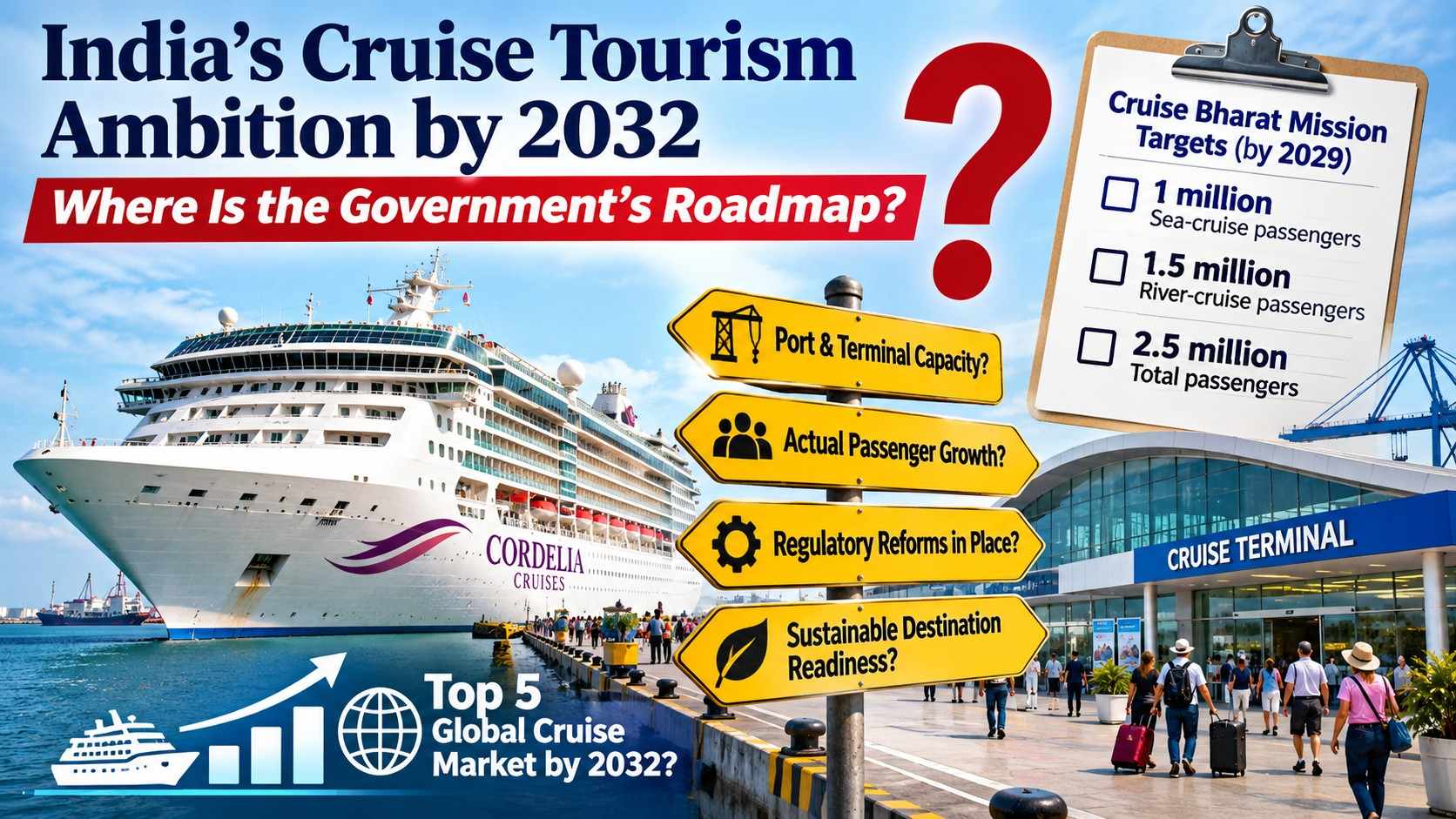
- Cordelia Cruises has expressed an ambition for India to become one of the world’s five largest cruise markets by 2032. It is a corporate aspiration, not a national policy target.
- The Government of India launched the Cruise Bharat Mission in September 2024, setting targets of one million sea-cruise passengers and 1.5 million river-cruise passengers by 2029.
- The Ministry of Ports, Shipping and Waterways reported 4.92 lakh cruise passengers and 272 cruise calls in FY2024–25, compared with 4.71 lakh passengers and 253 calls in FY2023–24.
- The government’s published figures demonstrate growth in that year, but do not establish whether India is on track to meet the mission’s phased targets.
- Port capacity, operating costs, regulatory coordination, trained personnel and destination readiness remain critical to sustainable growth.
- Previous Maritime News reporting on Costa Serena and cruise operations highlights why launching services and announcing targets are not sufficient evidence of long-term success.
- The government should publish a transparent performance dashboard showing actual passenger numbers, progress against each target, infrastructure delivery, expenditure and implementation responsibility.
New Delhi, India, November 2, 2026 (Maritime News): Who has the authority to declare that India should become one of the world’s five largest cruise markets by 2032? A private cruise operator can set a corporate expansion target. It can plan to add ships, develop itineraries, increase passenger numbers and invest in new services. But a national ambition involving port infrastructure, tourism policy, customs, immigration, coastal development and public investment must ultimately be owned and measured by the Government of India.
This distinction matters following reports that Cordelia Cruises wants India to enter the global top five cruise markets by 2032.
The company’s ambition may reflect confidence in India’s tourism potential. But it also raises a more fundamental question: what is the government’s own roadmap for achieving that position, and what evidence demonstrates that the country is progressing towards it?
India already has an official framework for cruise tourism. The Cruise Bharat Mission, launched on 30 September 2024, aims to double cruise passenger traffic within five years, with specific targets for sea and river cruising.
The policy ambition is therefore not new. The government has already announced targets, timelines, infrastructure objectives and administrative reforms.
The central issue is whether those commitments are being delivered—and whether the government is publicly accounting for the results.
1. A Private Company’s Ambition Is Not a National Performance Plan
Cordelia Cruises has expressed the ambition to help position India among the world’s five largest cruise markets by 2032.
According to reports published by PTI and other media outlets, the company’s chief executive, Jurgen Bailom, discussed this ambition alongside plans to expand the company’s fleet and itineraries.
The company currently operates Cordelia Empress and Cordelia Sky. It has indicated that a third vessel, Cordelia Sun, could join the fleet earlier than previously anticipated.
These developments are relevant to the company’s business strategy. More ships could increase capacity, provide greater scheduling flexibility and support additional domestic and international itineraries.
But they do not establish that India as a country is on course to enter the global top five.
A national cruise market includes more than the passengers carried by one operator. It involves the combined performance of domestic and international cruise services, passenger-origin markets, port infrastructure, tourism demand, regulatory arrangements and the commercial decisions of multiple operators.
The government also has responsibilities that a private operator does not: coordinating public infrastructure, managing regulatory systems, setting policy, measuring national performance and ensuring that public expenditure produces demonstrable results.
Cordelia is entitled to set its own growth ambitions. The question for policymakers is different.
Where is the government’s independently measurable plan for India’s position in the global cruise market by 2032?
The supplied reports do not establish that the government has adopted Cordelia’s top-five ambition as an official national target. It should therefore not be presented as government policy unless an official announcement confirms that status.
2. The Government Already Has a Cruise Mission. What Has It Delivered?
The Cruise Bharat Mission was launched by the Ministry of Ports, Shipping and Waterways on 30 September 2024.
The government described it as a whole-of-government initiative intended to double cruise passenger traffic within five years, by 2029.
The mission set out a phased development programme covering cruise terminals, marinas, destinations, passenger traffic and the integration of cruise circuits.
Its passenger targets were:
| Performance indicator | Phase I target by 30 September 2025 | Phase II target by 31 March 2027 | Phase III target by 31 March 2029 |
|---|---|---|---|
| Sea-cruise passengers | 0.5 million | 0.7 million | 1 million |
| River-cruise passengers | 0.5 million | 1 million | 1.5 million |
| Combined target | 1 million | 1.7 million | 2.5 million |
Source: Government of India’s Cruise Bharat Mission announcement, reported by Maritime News in February 2025 and set out in the official mission framework.
The targets are substantial. By the end of the mission, the government intends to reach one million sea-cruise passengers and 1.5 million river-cruise passengers annually.
However, targets are commitments, not evidence of achievement.
The first phase ended on 30 September 2025. The second phase is scheduled to run until 31 March 2027. India is therefore already in the implementation period in which the government should be able to report what the first phase delivered and how the second phase is progressing.
A meaningful assessment should establish:
- Whether the first-phase passenger targets were achieved.
- Whether the planned studies and master plans were completed.
- Which existing terminals were modernised and what improvements were delivered.
- Which new terminals, marinas and destinations have entered service.
- What expenditure has been incurred and what infrastructure remains incomplete.
- Whether the government’s regulatory reforms have reduced delays and operating costs.
- Who is responsible for correcting any shortfall against the mission’s milestones.
The official mission announcement establishes what the government intended to do. It does not, by itself, establish that each commitment has been fulfilled.
The Ministry should publish a consolidated progress report answering these questions.
3. The Latest Official Passenger Figures Show Growth—But Do They Show Mission Success?
The Ministry of Ports, Shipping and Waterways reported the following figures for FY2024–25:
| Indicator | FY2023–24 | FY2024–25 | Change |
|---|---|---|---|
| Cruise calls | 253 | 272 | +19 |
| Cruise passengers | 4.71 lakh | 4.92 lakh | +0.21 lakh |
| Passenger growth | — | — | Approximately 4.5% |
Source: Ministry of Ports, Shipping and Waterways, PIB release dated 25 July 2025.
The figures indicate an increase in cruise calls and passengers during FY2024–25. That is a positive development.
But growth in one year does not, on its own, establish that the government is on track to meet its 2029 targets.
There are three reasons to be cautious.
First, growth must be compared with the correct target
The government’s mission framework sets separate targets for sea-cruise and river-cruise passengers. A combined passenger figure cannot demonstrate whether each segment has met its respective target.
The Ministry should publish the actual figures for each segment, with consistent definitions and reporting periods.
Second, passenger numbers need to be accompanied by operational data
Passenger totals alone do not show whether terminals are functioning efficiently, whether vessels are operating regularly or whether additional capacity is commercially sustainable.
The government should report cruise calls, passenger volumes, terminal utilisation, operational disruptions and other relevant indicators.
Third, the figures are historical
The FY2024–25 figures do not establish India’s performance in FY2025–26 or the current position in November 2026.
The government’s July 2025 release is an official record of reported performance for that year. It cannot substitute for a current progress report.
The accountability question is straightforward: where are the latest verified passenger figures, and how do they compare with the Cruise Bharat Mission’s phased targets?
Until the government publishes the relevant data, the public cannot reliably judge whether the programme is ahead of schedule, on track or falling behind.
4. The Government Has Announced Reforms. Has Their Effect Been Measured?
The government has identified several measures intended to make cruise operations more attractive and efficient.
These include rationalised port tariffs, volume-based discounts, changes to cabotage rules, expanded visa facilities, digital passenger-clearance arrangements and a common standard operating procedure for stakeholders.
The Ministry has also reported the introduction of digital customs procedures and a cruise passenger clearance system.
These are relevant policy interventions. But announcing a reform is only the first step.
The government should also demonstrate whether the measures have achieved their intended purpose.
For example:
- Have port charges fallen in practice for operators using Indian cruise terminals?
- Have the revised arrangements reduced the time required for vessel and passenger clearance?
- Has the removal of specified charges improved India’s competitiveness against regional cruise hubs?
- Have visa and immigration changes increased international passenger arrivals?
- Have digital procedures reduced administrative burdens for operators and passengers?
- Are smaller ports and destinations able to implement the same procedures consistently?
The answers should be supported by before-and-after data, not just descriptions of the reforms.
The official policy framework identifies a whole-of-government approach involving central and state agencies, including customs, immigration, security bodies, state tourism departments, maritime agencies, district administrations and local police.
That breadth makes accountability particularly important.
When many agencies are involved, responsibility for a delay or an incomplete project can become difficult to identify. A national mission therefore needs clearly assigned responsibilities, delivery milestones and a mechanism for reporting unresolved problems.
The government should explain which agency is responsible for each major deliverable, what has been completed and what remains pending.
5. Infrastructure: Where Are the Terminals, Facilities and Delivery Timelines?
Cruise tourism depends on more than a vessel and a destination.
The Cruise Bharat Mission envisaged the development of ten international sea-cruise terminals, 100 river-cruise terminals and five marinas, alongside increased passenger traffic and employment.
These are significant infrastructure and development objectives.
However, the number of facilities announced or planned is not the same as the number completed, operational and being used effectively.
For every terminal or marina included in the programme, the government should publish:
- Project location and responsible implementing agency.
- Approved project cost and funding source.
- Original completion date and latest expected completion date.
- Physical progress and expenditure to date.
- Whether the facility is operational.
- Actual passenger or vessel activity after commissioning.
- Outstanding construction, access or service deficiencies.
The distinction between completion and operational readiness matters. A terminal may have been inaugurated but still require improvements in passenger processing, road access, utilities, security arrangements or supporting services.
Similarly, a berth may be physically available without being supported by all the services required for reliable cruise operations.
Maritime News has previously highlighted the operational complexity behind cruise services, including turnaround times, port congestion, technical management and coordination between ship and shore teams.
These are not minor administrative details. They affect whether a cruise ship can maintain its itinerary and whether passengers receive a dependable service.
The government should therefore report not only infrastructure construction but also whether the facilities are improving the actual performance of cruise operations.
6. The Costa Serena Experience: Why Announcements Are Not Enough
India’s cruise ambitions have a history that deserves attention.
In its report, New Eras Old Ambition of Indian Cruise Tourism: Costa Serena Sets Sail Again, Maritime News examined the return of Costa Serena to Indian operations in 2023.
The article also discussed the earlier suspension of its Indian operations and the challenges associated with weak demand, high costs and regulatory constraints.
The historical comparison should not be interpreted as proof that current operators will face the same outcome. Market conditions, business strategies and policy arrangements can change.
But it does establish an important lesson: the launch or relaunch of a cruise service is not evidence that the business will remain commercially viable.
Cruise operators must sustain passenger demand while meeting the cost of ships, fuel, crew, maintenance, port services and regulatory compliance.
If the economics do not work, additional capacity alone will not solve the problem.
For the government, the lesson is equally important. Public policy should be evaluated through durable outcomes, not just announcements, launch events or headline targets.
The Ministry should explain what lessons it has drawn from earlier cruise operations and whether the relevant regulatory and infrastructure issues have been addressed.
7. Who Is Responsible for Making the National Ambition Work?
A national cruise strategy requires clear institutional responsibility.
The Ministry of Ports, Shipping and Waterways has a central role in cruise policy, major-port coordination and the Cruise Bharat Mission. But the industry also depends on other ministries, state governments, port authorities, tourism departments and private operators.
A whole-of-government framework is useful only if it produces coordinated delivery.
The following responsibilities should be made transparent:
| Stakeholder | Key responsibility | Accountability question |
|---|---|---|
| Ministry of Ports, Shipping and Waterways | National cruise policy and mission oversight | Where is the consolidated progress report against the mission’s targets? |
| Major port authorities | Berths, terminals and port services | Which facilities are operational, and what performance improvements have been measured? |
| Ministry of Tourism and state tourism departments | Destination development and visitor services | How are passenger growth, local economic benefits and destination readiness being measured? |
| Customs, immigration and security agencies | Passenger and vessel clearance | Have clearance times and procedural burdens been reduced? |
| State governments and local authorities | Access roads, local transport, civic services and destination coordination | Are local infrastructure and service demands being addressed before traffic expands? |
| Private cruise operators | Fleet deployment, bookings, safety and commercial performance | Are services attracting sustainable passenger demand and operating reliably? |
The table identifies areas where accountability should be clear; it does not imply that each agency has failed to perform its role.
The government should publish a responsibility matrix with named implementing agencies, milestones and performance indicators. Where targets are missed, it should explain why and identify corrective measures.
A national strategy cannot depend on a private operator’s optimism to demonstrate that the public programme is succeeding.
8. The Economic Benefits Need Evidence, Not Just Projections
Cruise tourism can generate business for transport providers, restaurants, guides, hotels, retailers, excursion operators and other local services.
It can also create employment in vessel operations, port services, maintenance, hospitality and supporting industries.
The government has projected substantial employment opportunities through the Cruise Bharat Mission. Those projections are relevant, but they should not be reported as jobs already created.
To assess the actual economic contribution, the government should publish data on:
- Direct and indirect jobs created and the methodology used to calculate them.
- Passenger expenditure in port cities and coastal destinations.
- Local procurement and the participation of small businesses.
- The distribution of tourism revenue across destinations.
- Public investment and operating expenditure.
- The utilisation and commercial performance of publicly supported facilities.
These indicators would help establish whether cruise tourism is producing broad economic benefits or whether the gains are concentrated among a limited number of operators and locations.
The same principle applies to environmental and social costs. Increased cruise activity requires effective waste management, pollution prevention, freshwater planning and destination management.
The government should assess both the economic returns and the public-service demands associated with cruise growth.
9. Is India Measuring the Right Ambition?
The top-five target raises another question: what exactly does success mean?
A country can host more cruise calls without becoming one of the largest passenger-origin markets. It can expand its fleet without attracting enough customers to fill the ships. It can construct terminals without ensuring that the facilities are used efficiently.
These are different measures of development.
A credible national strategy should define the desired outcome and explain how progress will be measured.
If the ambition concerns India becoming a leading cruise source market, passenger-origin data and repeat travel demand are essential.
If the goal is to become a major cruise destination, the government should measure international cruise calls, passenger arrivals, destination expenditure and the competitiveness of port services.
If the goal is to become a regional cruise operating hub, the assessment should include homeporting, vessel deployment, port turnaround performance and the reliability of supporting services.
These objectives may reinforce one another, but they are not interchangeable.
The government should clarify the specific meaning of a top-five position by 2032 and identify the benchmark against which India will be ranked.
Without a defined metric, the target risks becoming a slogan that cannot be objectively assessed.
10. What the Government Should Publish Now
The Cruise Bharat Mission is already under way. The next step should be transparent implementation reporting.
Maritime News calls for the Ministry of Ports, Shipping and Waterways to publish a consolidated public dashboard containing the following information:
1. Passenger performance
- Latest annual and quarterly sea-cruise passenger numbers.
- Latest river-cruise passenger numbers.
- Comparison with each phased target.
- Definitions and data sources used.
2. Infrastructure delivery
- Terminal and marina projects planned, under construction and operational.
- Approved costs, expenditure and completion dates.
- Current utilisation and operational constraints.
3. Regulatory performance
- Passenger and vessel clearance times.
- Port charges and applicable discounts.
- Implementation status of announced reforms.
- Outstanding inter-agency bottlenecks.
4. Economic outcomes
- Verified employment created.
- Local economic activity and passenger spending.
- Private investment committed and delivered.
- Public expenditure and project outcomes.
5. Environmental and community safeguards
- Waste-management arrangements.
- Pollution-prevention measures.
- Destination capacity and visitor-management plans.
- Consultation with coastal communities and local businesses.
6. Responsibility and corrective action
- Implementing agency for each major milestone.
- Deadlines and current status.
- Reasons for delays or missed targets.
- Corrective measures and revised timelines.
Such a dashboard would allow Parliament, industry, coastal communities and the public to evaluate the mission against evidence rather than announcements.
Reality Check: What Is Established and What Is Not?
Established by the available sources:
- The government launched the Cruise Bharat Mission in September 2024.
- The mission set passenger and infrastructure targets for 2029.
- The Ministry reported 4.92 lakh cruise passengers and 272 cruise calls in FY2024–25.
- The government has announced regulatory and procedural measures intended to support cruise operations.
- Cordelia Cruises has expressed an ambition for India to enter the global top five cruise markets by 2032.
- Maritime News has previously documented operational challenges and the historical difficulties associated with sustaining some cruise services in India.
Not established by the available sources:
- Whether the first phase of the Cruise Bharat Mission met all its passenger and infrastructure targets.
- Whether India is currently on track to achieve the 2029 passenger targets.
- The current, verified passenger numbers for FY2025–26 and the latest reporting period.
- Whether the government has formally adopted Cordelia’s 2032 top-five ambition as a national target.
- The precise passenger volume India would need to reach fifth place in the relevant global ranking.
- Whether the announced infrastructure programme has delivered the planned capacity and operational improvements.
- The actual number of jobs created and the net economic benefit attributable to the mission.
These gaps do not prove that the government has failed. They show why a transparent and current performance assessment is necessary.
Frequently Asked Questions
1. Who has set the target for India to become a top-five cruise market by 2032?
The supplied media reports attribute the ambition to Cordelia Cruises. The available sources do not establish that the Government of India has formally adopted the same 2032 top-five target as an official national policy objective.
2. What is the government’s existing cruise tourism target?
The Cruise Bharat Mission targets one million sea-cruise passengers and 1.5 million river-cruise passengers by 2029, for a combined total of 2.5 million passengers.
3. How many cruise passengers did India handle in FY2024–25?
The Ministry of Ports, Shipping and Waterways reported 4.92 lakh cruise passengers and 272 cruise calls in FY2024–25, compared with 4.71 lakh passengers and 253 calls in FY2023–24.
4. Do these figures prove that the Cruise Bharat Mission is on track?
No. They demonstrate growth between the two financial years, but do not establish whether the mission’s phased targets were achieved. A comparison requires current sea-cruise and river-cruise passenger data, along with the relevant infrastructure and implementation indicators.
5. Why is Cordelia Cruises’ ambition relevant if the government is responsible for national policy?
A private operator’s ambition can signal commercial confidence and potential investment. However, the government remains responsible for national policy, public infrastructure, regulatory coordination and transparent measurement of government targets.
6. What were the main challenges identified in earlier Indian cruise operations?
Maritime News’ previous reporting discussed weak demand, high costs and regulatory constraints in the context of earlier operations. Its later operational analysis also highlighted technical management, crew coordination, port congestion and passenger turnaround requirements.
7. What should the government do next?
It should publish a consolidated performance report showing actual passenger numbers against the 2029 targets, infrastructure delivery, regulatory outcomes, public expenditure, employment results and responsibility for outstanding milestones.
India Needs a Government-Owned Roadmap, Not Just a Corporate Ambition
Cordelia Cruises is entitled to pursue growth and express confidence in India’s cruise tourism potential. But a private company’s ambition cannot substitute for a national implementation plan.
The Government of India has already launched the Cruise Bharat Mission, established passenger targets for 2029 and announced a range of infrastructure and regulatory measures. The public therefore has a legitimate basis for asking how much progress has been achieved and what remains to be delivered.
The reported increase in cruise passengers during FY2024–25 is encouraging. It is not, by itself, proof that the mission’s targets have been met or that India is on course to become a leading global cruise market.
The government should publish current, comparable passenger data, report the status of terminal and marina projects, quantify the effects of regulatory reforms and explain how responsibilities are divided among the agencies involved.
It should also define the proposed 2032 top-five benchmark, identify the investments required to reach it and establish a transparent system for measuring progress.
The wider objective must be to build a cruise sector that can sustain demand, operate commercially, provide reliable services and deliver measurable benefits to coastal communities.
The question is not whether Cordelia Cruises is ambitious enough. The question is whether the Government of India has a measurable, funded and accountable roadmap—and whether it is prepared to show the public what that roadmap has delivered.
Sources and References
Government sources
- Ministry of Ports, Shipping and Waterways — Cruise Bharat Mission, launched 30 September 2024. The announcement establishes the mission’s objectives, phases and passenger targets.
Read the official PIB release - Ministry of Ports, Shipping and Waterways — Cruise Bharat Mission performance figures, published 25 July 2025. The release reports 272 cruise calls and 4.92 lakh passengers in FY2024–25, compared with 253 calls and 4.7 lakh passengers in FY2023–24.
Read the official PIB release - Government of India — Steps Taken to Boost Cruise Tourism, covering policy measures and the Cruise Bharat Mission.
Read the official PIB note
Maritime News background reporting
- Doubling Indian Cruise Passenger Traffic by 2029 — Cruise Bharat Mission targets and the infrastructure, regulatory, commercial and environmental issues affecting implementation.
Read Maritime News - New Eras Old Ambition of Indian Cruise Tourism: Costa Serena Sets Sail Again — historical context on the return of Costa Serena and the challenges associated with sustaining cruise operations in India.
Read Maritime News - Behind the Cruise Operations: Challenges, and the People in Charge behind the Scenes — technical management, crew coordination, port congestion, turnaround times and operational readiness.
Read Maritime News
Reports on Cordelia Cruises’ 2032 ambition
- PTI News — Cordelia aims to bring India among top five global cruise markets by 2032
- The Telegraph — Cordelia Cruises targets India’s entry into world’s top five cruise markets by 2032
- NewsBytes — Cordelia Cruises eyes India top 5 cruise market by 2032
- Urban Acres — India Cruise Tourism Faces a Capacity Test Before 2032