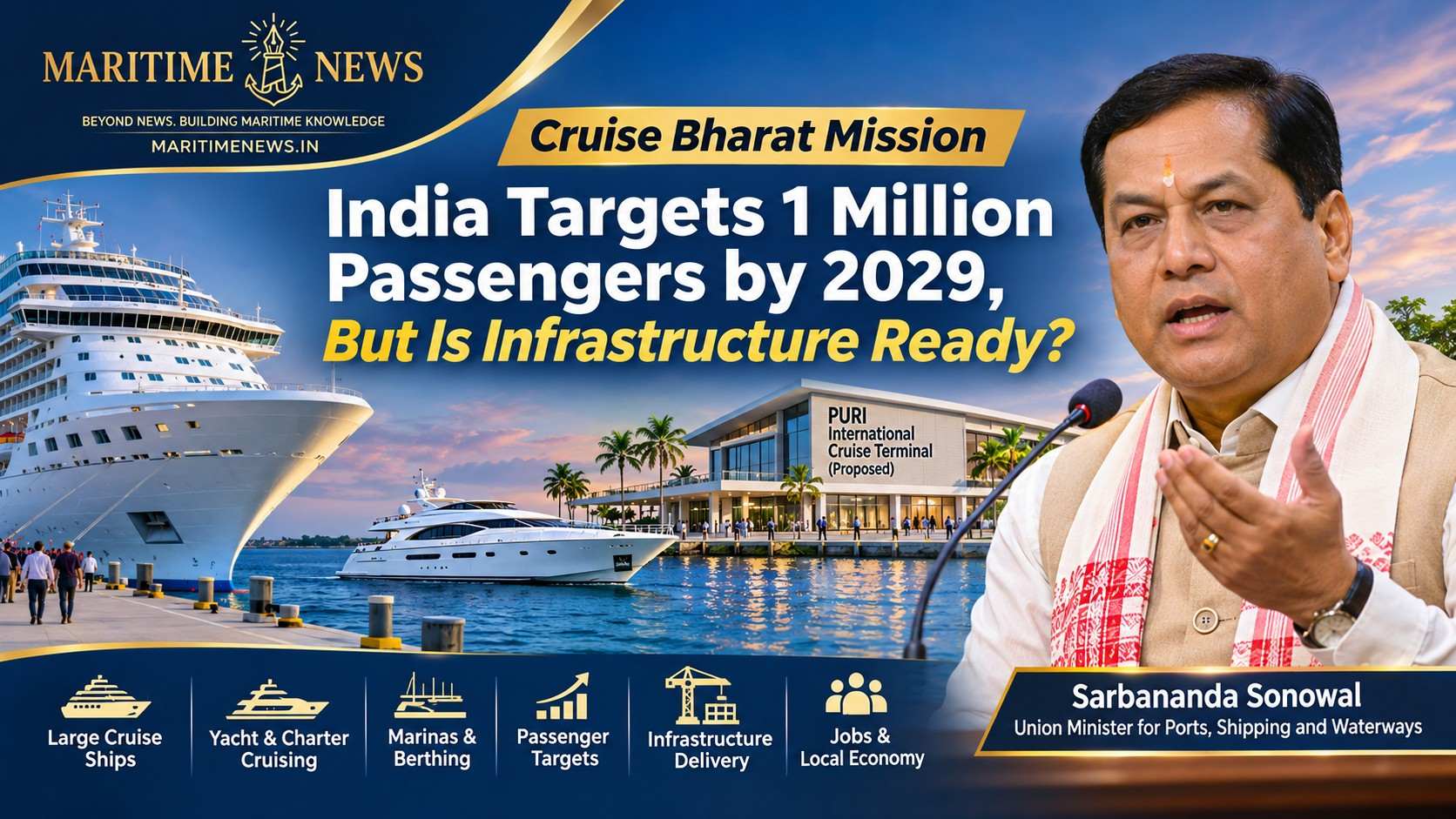
India’s cruise ambitions extend beyond large passenger ships. Yacht cruising, charter vessels, day cruises, marinas and coastal destinations must also be part of the country’s maritime tourism strategy.
Key Takeaways
- The Cruise Bharat Mission targets one million sea-cruise passengers and 1.5 million river-cruise passengers by March 2029.
- The latest government figures show 462,661 ocean-cruise passengers and 212 vessel calls in FY2025–26, down from 492,362 passengers and 272 calls in FY2024–25.
- The proposed ₹1,500-crore Puri International Cruise Terminal adds a new infrastructure commitment, but its project approvals, funding structure, timeline and operational plan need to be disclosed.
- India’s cruise tourism potential is not limited to large ocean-going cruise ships. Yacht charters, private yachts, day-cruise vessels, leisure boats and marina-based tourism represent another important segment.
- India needs a broader maritime tourism strategy covering different vessel categories, infrastructure requirements, safety standards, coastal destinations and local operators.
- The government should publish a transparent implementation dashboard showing passenger numbers, infrastructure delivery, expenditure and measurable economic outcomes.
New Delhi, India, November 4, 2026 | Maritime News: India’s cruise tourism ambitions are receiving renewed attention following the latest announcements by Union Minister for Ports, Shipping and Waterways Sarbananda Sonowal at a Consultative Committee meeting in Puri, Odisha, on November 3, 2026.
The Ministry of Ports, Shipping and Waterways has reiterated its ambition to attract one million sea-cruise passengers by 2029 under the Cruise Bharat Mission. The Minister also announced a proposed International Cruise Terminal at Puri, to be developed by Paradip Port Authority (PPA) in partnership with the Government of Odisha, at an estimated cost of ₹1,500 crore.
These announcements add to a policy programme that began in September 2024. However, India’s cruise tourism strategy now needs to be assessed against a more fundamental question: is the country building a complete maritime tourism ecosystem, or is it primarily focusing on large cruise ships and their terminal infrastructure?
The distinction matters.
Cruise tourism includes several operating models. Large ocean-going passenger ships, domestic cruise vessels, river cruise boats, private yachts, charter yachts and day-cruise vessels do not operate in the same way. They have different passenger capacities, infrastructure needs, safety requirements, regulatory arrangements and commercial models.
A strategy that focuses only on large cruise ships risks overlooking the wider opportunities offered by coastal and yacht tourism.
The Cruise Bharat Mission: What Did the Government Promise?
The Cruise Bharat Mission was launched on September 30, 2024, as a coordinated programme to develop India’s sea and river cruise sectors.
As reported by Maritime News in its earlier article, Doubling Indian Cruise Passenger Traffic by 2029, the mission established three implementation phases.
| Performance indicator | Phase I: By 30 September 2025 | Phase II: By 31 March 2027 | Phase III: By 31 March 2029 |
|---|---|---|---|
| Sea-cruise passengers | 0.5 million | 0.7 million | 1 million |
| River-cruise passengers | 0.5 million | 1 million | 1.5 million |
| Combined target | 1 million | 1.7 million | 2.5 million |
The mission also envisaged infrastructure development, including ten international sea-cruise terminals, 100 river-cruise terminals and five marinas.
The Ministry subsequently reported that the mission aims to generate approximately 400,000 jobs.
These targets are significant. But Phase I ended in September 2025, and India is now in Phase II. The government should therefore provide a consolidated report explaining what was achieved during the first phase and what remains outstanding.
The public needs more than the original targets. It needs actual passenger numbers, project-level progress, expenditure, operational status and the agencies responsible for delivery.
The Latest Passenger Numbers Raise an Important Question
The latest figures announced by the Minister provide a more recent basis for evaluating the programme.
According to the Ministry’s PIB release dated November 3, 2026, India recorded 462,661 ocean-cruise passengers and 212 vessel calls in FY2025–26.
The Ministry’s earlier PIB release dated July 25, 2025, reported 492,362 passengers and 272 cruise calls in FY2024–25.
| Indicator | FY2024–25 | FY2025–26 | Year-on-year change |
|---|---|---|---|
| Ocean-cruise passengers | 492,362 | 462,661 | Approximately -6.0% |
| Vessel calls | 272 | 212 | Approximately -22.1% |
Sources: PIB, 25 July 2025 and PIB, 3 November 2026.
The figures deserve attention.
The Minister has highlighted the long-term growth in ocean-cruise passengers and vessel calls since 2013–14. That historical growth is relevant, but the latest annual comparison shows a decline in both passenger numbers and calls.
This does not establish that the Cruise Bharat Mission has failed. Nor does it explain why the numbers declined. It does, however, raise questions about market demand, vessel deployment, itinerary frequency, port economics and the commercial sustainability of cruise services.
A national mission targeting one million sea-cruise passengers by March 2029 needs to demonstrate how it will reverse this latest annual trend.
The Ministry should publish the reasons behind the decline, the latest available passenger data and a clear comparison with the mission’s phased targets.
River Cruise Figures Need Greater Clarity
The river-cruise segment presents another data question.
A Lok Sabha reply dated February 13, 2026, provided the following figures:
| Passenger category | FY2024–25 | FY2025–26 up to December 2025 |
|---|---|---|
| Sea-cruise passengers | 492,362 | 342,631 |
| River-cruise passengers | 435,163 | 2,926,440 |
Source: Lok Sabha Unstarred Question No. 2311, answered 13 February 2026.
The reported river-cruise figure of 2.93 million passengers up to December 2025 is substantially higher than the 435,163 recorded for the previous financial year.
This difference should not be ignored or treated as self-explanatory evidence of rapid market expansion.
The Ministry should clarify:
- Whether the two reporting periods use the same definition of a river-cruise passenger.
- Whether local sightseeing, ferry-like services, short excursions or other passenger movements are included.
- Whether the data represents unique passengers, passenger trips or total embarkations.
- Whether the reporting coverage or counting methodology changed.
- How the figure relates to the Cruise Bharat Mission’s target of 1.5 million river-cruise passengers by March 2029.
Without consistent definitions, comparisons can produce misleading conclusions.
A passenger taking a short local river excursion and a passenger undertaking a multi-day river cruise may represent very different tourism products. The government should explain how these activities are classified in its national statistics.
Beyond Large Cruise Ships: India Must Recognise Yacht Cruising
One important dimension is often missing from discussions about India’s cruise tourism potential: yacht cruising.
The public conversation frequently revolves around large international cruise liners, passenger terminals and the number of ocean-cruise calls. These are important, but they represent only one part of the maritime tourism economy.
Yacht cruising includes several distinct activities:
- Private yacht cruising: Privately owned vessels used for leisure and coastal travel.
- Charter yacht operations: Yachts hired by individuals, families or groups for private experiences.
- Day-cruise yachts: Vessels offering short coastal trips, sightseeing, celebrations and recreational experiences.
- Leisure boats and small passenger vessels: Smaller craft operating local tourism routes and coastal excursions.
- Marina-based tourism: Services built around yacht berthing, provisioning, maintenance, hospitality and visitor facilities.
These vessels are not equivalent to large ocean-going cruise ships. Their passenger capacity, voyage duration, operating costs and port requirements are different.
However, they form part of the wider cruise and marine tourism ecosystem.
At a destination level, the number of yachts, charter vessels and smaller leisure boats may be considerably larger than the number of large cruise ships. But India does not appear to have a single, comparable national dataset establishing the total number of active vessels and operators across these categories. The scale of this segment should therefore be measured rather than assumed.
The policy question is whether the Cruise Bharat Mission and related maritime tourism programmes adequately recognise these smaller-vessel activities.
A large international cruise terminal cannot automatically serve as a marina or a yacht-charter facility. Yacht tourism requires suitable berths, mooring arrangements, passenger access, fuelling and provisioning services, maintenance facilities, waste reception, navigation support and appropriate safety oversight.
India’s coastal and island destinations could benefit from a more integrated approach that connects large cruise tourism with yacht and small-vessel experiences.
For a closer look at the yacht-booking and charter segment, Cruise Yacht Tourism provides a relevant example of the private-yacht and charter-booking ecosystem. Such platforms are part of the wider market, not substitutes for public infrastructure, regulation or official tourism data.
The Marina Question: Five Facilities Are Not Enough to Define a National Network
The Cruise Bharat Mission’s stated infrastructure ambitions include five marinas.
That is an important starting point, but the government should explain what it means by a marina in the context of the national programme.
A marina is not simply a place where a yacht can temporarily anchor. A functioning marina ecosystem may require:
- Secure berthing and mooring facilities.
- Shore power and freshwater connections.
- Fuel supply and waste-reception services.
- Maintenance, repair and technical support.
- Passenger access, parking and local transport.
- Customs and immigration arrangements where international movements are permitted.
- Emergency response, navigation assistance and safety services.
- Commercial facilities supporting charter operators and local tourism businesses.
The government should publish the locations, planned capacity, funding, development agency and expected commissioning dates for the five proposed marinas.
It should also explain whether these facilities will be designed primarily for private yachts, charter operations, larger leisure vessels or a combination of uses.
Without this information, the marina target remains a numerical commitment rather than a measurable infrastructure programme.
India also needs to examine whether coastal destinations with existing yacht and leisure-boat activity require smaller facilities, upgraded landing points or improved regulatory arrangements rather than large capital-intensive marina projects.
Infrastructure planning should reflect the vessel categories and local markets it is intended to serve.
Puri’s ₹1,500-Crore Cruise Terminal: Announcement or Project Delivery?
The November 3 announcement of the proposed Puri International Cruise Terminal is one of the most significant developments in the latest government statement.
According to PIB, Paradip Port Authority will develop the project in partnership with the Government of Odisha, at a likely cost of ₹1,500 crore.
The proposal could strengthen Odisha’s position in coastal tourism and provide an additional destination for cruise itineraries.
However, a project announcement is not the same as an approved and executable project.
The available PIB announcement does not provide a detailed project report, financing structure, land requirements, environmental clearances, construction schedule, passenger capacity or operational model.
Before the project is treated as a confirmed infrastructure delivery, the following information should be made public:
- Has the detailed project report been prepared and approved?
- What is the proposed location and land requirement?
- What is the division of financial responsibility between PPA and the Odisha Government?
- Has the project received the necessary statutory and environmental clearances?
- What vessel size and draft will the facility accommodate?
- Will it serve only large cruise ships, or will it also provide facilities for smaller passenger and leisure vessels?
- What are the proposed passenger-handling capacity and annual operating targets?
- What are the road, transport, hospitality and last-mile connectivity arrangements?
- What is the expected construction and commissioning timeline?
- How will the project affect coastal communities, fishing activity and the surrounding environment?
Puri’s tourism profile may provide opportunities for cruise-linked visitor experiences, but the project must be assessed in terms of navigational feasibility, access, environmental conditions and commercial demand.
The proposed terminal should also be considered alongside existing and planned facilities at other ports, rather than as an isolated announcement.
Goa’s Experience: Cruise Ships, River Circuits and Yacht Tourism
Goa illustrates why a wider maritime tourism approach is necessary.
The Ministry’s July 2025 PIB release identifies Mormugao among India’s cruise ports. The Lok Sabha reply of February 2026 also states that a sea international and domestic cruise terminal was under construction at Mormugao Port.
The same parliamentary reply lists river-cruise circuits in Goa, including:
- Chapora River: Chapora–Alorna Fort.
- Sal River: Cavelossim–Betul Fort–Betul Lighthouse.
These examples show that cruise tourism is not limited to international ocean-going ships. Inland and coastal waterways can support different forms of passenger experiences.
Goa also has a visible leisure and yacht-tourism market, involving private charters, day cruises and smaller passenger vessels.
These activities require a different infrastructure and regulatory approach from that of a large cruise liner. Their development depends on safe boarding points, suitable berthing, vessel permissions, passenger safety, local transport, destination management and responsible coastal operations.
The state therefore provides a useful case for examining how large cruise calls, river tourism and yacht-based experiences can coexist within a broader tourism strategy.
The government should consider publishing state-level data covering not only large cruise ships but also registered passenger vessels, charter operations, leisure boats and marina facilities.
Without this information, a substantial part of the maritime tourism economy may remain outside the national policy discussion.
Operational Readiness: A Cruise Terminal Is Only One Part of the System
Cruise operations require extensive coordination between vessel operators, port authorities, customs, immigration, security agencies, tourism departments and local service providers.
Maritime News examined these operational realities in its earlier report, Behind Luxury Cruise Operations: Technical Challenges and People Powering the Industry.
The report highlighted the importance of technical management, crew coordination, vessel maintenance, port congestion, passenger turnaround and the work of shipboard personnel.
These considerations are relevant to India’s cruise expansion.
A terminal may be built, but the quality of the passenger experience also depends on timely vessel clearance, reliable port services, shore excursions, transport, security, waste management and the ability to handle passengers efficiently.
Smaller yacht and charter operations have their own requirements. Safety equipment, crew competency, passenger limits, vessel registration, weather restrictions, navigation rules and emergency-response arrangements must be appropriate to the type of vessel and activity.
A national maritime tourism strategy should therefore distinguish between the regulatory and operational requirements of:
- International ocean-cruise ships.
- Domestic coastal cruise vessels.
- River-cruise vessels.
- Private yachts and charter yachts.
- Day-cruise and leisure passenger boats.
A uniform approach that ignores these differences may create unnecessary burdens for smaller operators or leave gaps in safety oversight.
The Costa Serena Experience: Why Long-Term Viability Matters
India’s cruise ambitions have been discussed for years.
Maritime News’ earlier report, New Eras Old Ambition of Indian Cruise Tourism: Costa Serena Sets Sail Again, examined the return of Costa Serena to Indian operations in November 2023 and recalled the earlier suspension of its Indian service.
The report discussed the challenges surrounding the earlier operation and the policy measures intended to make cruise services more attractive.
The experience is relevant because launching a cruise service does not guarantee its long-term commercial viability.
Operators must manage vessel costs, fuel, maintenance, crew, port charges, passenger demand and itinerary economics. A service that attracts attention at launch may still struggle to sustain regular operations.
The same principle applies to yacht tourism. A growing number of charter listings or new vessels does not necessarily demonstrate a sustainable market. Operators need safe facilities, reliable demand, suitable regulations and commercially viable services.
Government policy should therefore focus on sustainable operations and measurable market development, not only infrastructure announcements and passenger targets.
Employment and Environmental Claims Need Separate Measurement
The November 3 PIB release states that the Cruise Bharat Mission targets 400,000 jobs by March 2029.
It also says that the Coastal Cargo Promotion Scheme and Cruise Bharat Mission together are expected to generate more than 560,000 jobs and save 16 million tonnes of carbon dioxide emissions.
These are projected outcomes for the two initiatives together. They should not be presented as jobs already created or environmental savings already achieved by cruise tourism alone.
The government should disclose the methodology behind these projections and distinguish between direct, indirect and induced employment.
For cruise and yacht tourism, relevant employment categories include:
- Seafarers, vessel officers and technical crew.
- Hospitality and passenger-service personnel.
- Port and terminal workers.
- Yacht operators, charter managers and booking staff.
- Marine engineers and maintenance technicians.
- Local guides, transport providers and excursion operators.
- Marina, provisioning and support-service personnel.
- Small businesses serving coastal and island destinations.
Environmental performance also needs to be measured. Cruise ships, yachts and smaller passenger vessels all require responsible fuel management, waste handling, sewage management and pollution prevention.
The expansion of marine tourism should not compromise coastal ecosystems, fishing livelihoods or the carrying capacity of destinations.
A credible programme should report both economic benefits and environmental safeguards.
What Maritime News Wants the Government to Clarify
The Cruise Bharat Mission has established national targets. The latest Puri announcement adds a major proposed infrastructure project. But the next stage must be transparent implementation.
Maritime News believes the Ministry of Ports, Shipping and Waterways should publish a consolidated maritime tourism progress dashboard covering:
Passenger and vessel data
- Annual sea-cruise and river-cruise passengers.
- Cruise calls and vessel deployment.
- Consistent definitions and reporting methodology.
- Separate data for large cruise ships, river cruises and smaller passenger vessels where available.
Infrastructure
- Status of the ten international sea-cruise terminals.
- Status and locations of the 100 river-cruise terminals.
- Locations, capacity and progress of the five proposed marinas.
- Project costs, expenditure, approvals and commissioning timelines.
- Operational utilisation after completion.
Yacht and small-vessel tourism
- A national inventory of registered yacht, charter and leisure passenger vessels.
- State-wise information on operators and destinations.
- Marina and berthing capacity.
- Applicable registration, safety and operating requirements.
- Support for local operators and coastal tourism businesses.
Regulatory performance
- Passenger and vessel clearance times.
- Port charges and tariff incentives.
- Implementation of digital clearance systems.
- Safety and emergency-response arrangements.
- Coordination between central and state authorities.
Economic and environmental outcomes
- Verified employment created.
- Local business participation and visitor expenditure.
- Private investment committed and delivered.
- Waste-management and pollution-control performance.
- Impacts on coastal communities and sensitive destinations.
The dashboard should identify the responsible agency for each milestone and explain delays or changes in project timelines.
Reality Check: What Is Established and What Still Needs Evidence?
Established by official sources
- The Cruise Bharat Mission was launched in September 2024.
- Its 2029 targets include one million sea-cruise passengers and 1.5 million river-cruise passengers.
- The government has identified infrastructure targets covering sea-cruise terminals, river-cruise terminals and marinas.
- FY2025–26 recorded 462,661 ocean-cruise passengers and 212 vessel calls, according to the November 2026 PIB release.
- The Ministry reported 492,362 passengers and 272 calls in FY2024–25.
- A sea international and domestic cruise terminal was reported under construction at Mormugao Port in the February 2026 Lok Sabha reply.
- The government announced a proposed ₹1,500-crore Puri International Cruise Terminal involving PPA and the Odisha Government.
Not established by the available announcements and data
- Whether all Phase I Cruise Bharat Mission targets were achieved.
- Whether India is currently on track to reach one million sea-cruise passengers by March 2029.
- The reasons for the decline in ocean-cruise passengers and vessel calls in FY2025–26.
- The methodology behind the sharp increase in reported river-cruise passenger numbers.
- The approved project cost, financing, clearances and construction schedule for the Puri terminal.
- The current operational status and utilisation of every planned cruise terminal and marina.
- The national number of active private yachts, charter vessels and day-cruise boats.
- The actual number of jobs created and environmental savings attributable to the individual programmes.
These gaps do not establish that the government has failed. They identify the information required to evaluate the programme fairly.
Frequently Asked Questions (FAQs)
1. What is the Cruise Bharat Mission’s passenger target?
The mission targets one million sea-cruise passengers and 1.5 million river-cruise passengers by March 2029.
2. How many ocean-cruise passengers did India record in FY2025–26?
The Ministry reported 462,661 ocean-cruise passengers and 212 vessel calls in FY2025–26.
3. Did ocean-cruise passenger numbers increase in FY2025–26?
No. The reported figure declined from 492,362 in FY2024–25 to 462,661 in FY2025–26, a fall of approximately 6%.
4. Does cruise tourism include yacht cruising?
Yes. Yacht cruising, charter yachts, day-cruise vessels and leisure boats are distinct segments of the wider maritime tourism economy. They should not be confused with large ocean-going cruise ships, but they deserve consideration in national coastal and marine tourism planning.
5. Why are marinas important?
Marinas provide berthing and support facilities for yachts and leisure vessels. Depending on their design, they may include shore power, water, fuel, maintenance, waste reception, passenger access and other services needed for safe and commercially viable yacht operations.
6. What is the proposed Puri International Cruise Terminal project?
The November 3, 2026 PIB announcement states that Paradip Port Authority and the Odisha Government will develop the proposed terminal at a likely cost of ₹1,500 crore. The announcement does not itself provide a detailed project schedule, financing structure or operational specifications.
7. What is the significance of Goa in India’s cruise tourism strategy?
Goa is identified as a cruise-port destination in government records. The Ministry has also listed river-cruise circuits on the Chapora and Sal rivers. Goa’s yacht and leisure-vessel activity illustrates why maritime tourism planning should cover more than large cruise ships.
8. What should the government publish next?
A consolidated dashboard showing passenger numbers, vessel calls, infrastructure status, marina development, regulatory performance, employment, investment and environmental safeguards.
India’s Cruise Future Must Be Bigger Than Cruise Ships
The Cruise Bharat Mission provides India with a framework for developing sea and river cruise tourism. The proposed Puri International Cruise Terminal adds another major infrastructure ambition to that programme.
But India’s maritime tourism potential cannot be measured only through large cruise ships, passenger terminals and international vessel calls.
Yacht cruising, charter operations, day-cruise vessels, river excursions, marinas and smaller coastal passenger services are also part of the wider maritime tourism economy. They create opportunities for local operators, hospitality businesses, technical services, coastal destinations and skilled maritime personnel.
The government should recognise these segments in its policy framework while maintaining clear distinctions in vessel classification, safety regulation, infrastructure planning and passenger statistics.
The latest ocean-cruise figures also make the need for transparent reporting more urgent. Passenger numbers and vessel calls declined in FY2025–26 compared with the previous year, even as the country pursues a target of one million sea-cruise passengers by 2029.
India needs more than ambitious targets and new terminal announcements. It needs reliable data, viable projects, commercially sustainable operations, appropriate facilities for different vessel categories and measurable benefits for coastal communities.
The question is no longer simply how many cruise ships India can attract.
It is whether India can build a safe, connected and commercially sustainable maritime tourism ecosystem—one that includes cruise liners, yachts, river vessels, local operators and the coastal destinations that bring visitors to the water.
Maritime News will continue to track the Cruise Bharat Mission against its announced targets, infrastructure commitments and the wider development of India’s maritime tourism economy.
Sources and References
Government and Official Sources
- Press Information Bureau, Government of India – 3 November 2026
Sarbananda Sonowal Outlines Plan to Double Coastal & Waterway Freight Share to 12% by 2047.
Includes the latest ocean-cruise passenger figures, vessel calls, proposed Puri International Cruise Terminal, employment projections and Cruise Bharat Mission announcements.
https://www.pib.gov.in/PressReleseDetailm.aspx?PRID=2332260®=48&lang=2 - Press Information Bureau, Government of India – 25 July 2025
Cruise Bharat Mission.
Reference for the mission’s objectives, phased passenger targets, infrastructure commitments and FY2024–25 cruise passenger and vessel-call figures.
https://www.pib.gov.in/PressReleasePage.aspx?PRID=2148283&lang=2®=48 - Lok Sabha – Unstarred Question No. 2311, Answered 13 February 2026
Parliamentary reply containing sea-cruise and river-cruise passenger figures, cruise infrastructure information and details concerning port facilities.
https://sansad.in/getFile/loksabhaquestions/annex/187/AU2311_JVcKBG.pdf?source=pqals
Previous Maritime News Reporting
- Maritime News – India’s Cruise Tourism Ambition by 2032: Where Is the Government’s Roadmap?
Earlier investigation into the government’s cruise tourism roadmap, policy commitments, infrastructure targets and implementation questions.
https://maritimenews.in/india-cruise-tourism-policy-government-accountability/ - Maritime News – Doubling Indian Cruise Passenger Traffic by 2029
Background on the Cruise Bharat Mission and its passenger growth ambitions.
https://maritimenews.in/doubling-indian-cruise-passenger-traffic-by-2029/ - Maritime News – Behind the Cruise Operations: Challenges and the People in Charge Behind the Scenes
Background on operational requirements, technical management and the people involved in cruise operations.
https://maritimenews.in/behind-the-cruise-operations-challenges-and-the-people-in-charge-behind-the-scenes/ - Maritime News – New Era’s Old Ambition of Indian Cruise Tourism: Costa Serena Sets Sail Again
Historical context on Costa Serena’s Indian operations and the commercial challenges surrounding cruise services.
https://maritimenews.in/new-eras-old-ambition-of-indian-cruise-tourism-costa-serena-sets-sail-again/
Related Maritime Tourism Reference
- Cruise Yacht Tourism – Yacht Bookings, Goa, India
Reference for the yacht-charter and private-yacht segment of the wider maritime tourism ecosystem. This is an industry-platform reference, not a government policy or statistical source.
https://cruiseyachttourism.in/