
Maharashtra has tested the Swedish-built Candela P-12 electric hydrofoil off the Gateway of India and plans to acquire 12 vessels for Mumbai’s proposed water transport network. But with an indicative vessel acquisition outlay of ₹264 crore, the initiative raises questions about public investment, private operation, commercial returns and what taxpayers and passengers will receive in return.
Key Takeaways
- The Maharashtra Maritime Board (MMB) conducted sea trials of the Candela P-12 off the Gateway of India on 20 November 2026.
- Ports Minister Nitesh Rane described the vessel as India’s first 100% electric hydrofoil vessel in his public announcement.
- The initiative involves the Government of Maharashtra, Rural Enhancers Group and Saadhav Shipyards Limited, according to the Minister’s statement.
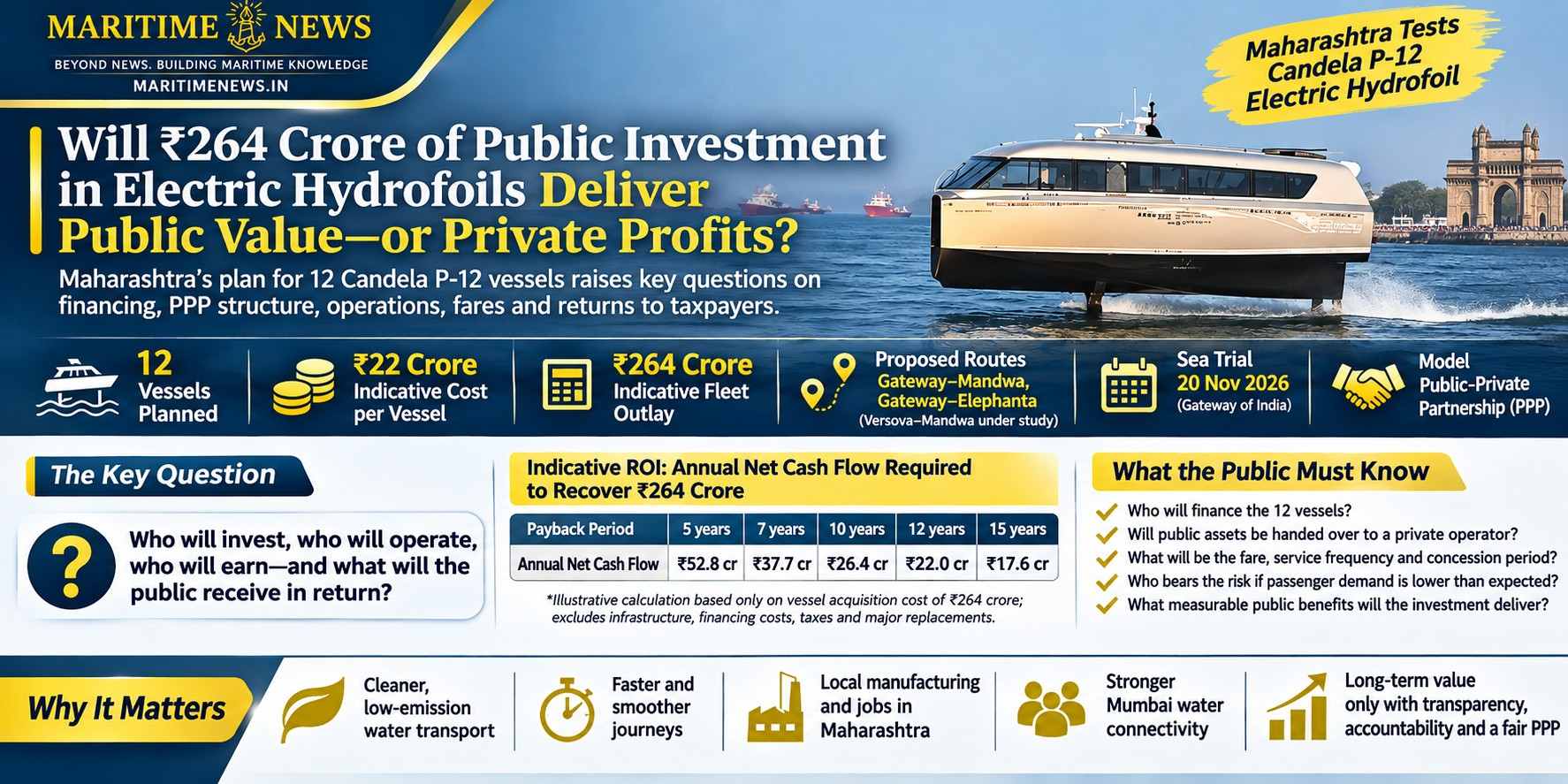
- Maharashtra plans to acquire 12 vessels at an indicative cost of approximately ₹22 crore each, implying a potential vessel acquisition outlay of ₹264 crore.
- Proposed routes include Gateway of India–Mandwa and Gateway of India–Elephanta Caves, with Versova–Mandwa also under consideration.
- The proposed services are expected to operate under a public-private partnership (PPP) model.
- Maharashtra has announced an MoU with Candela for manufacturing hydrofoil boats in the state.
- The funding structure, asset ownership, operating concessions, revenue-sharing arrangements and allocation of commercial risks remain important unanswered questions.
Maharashtra’s plans to introduce electric hydrofoil passenger vessels in Mumbai have moved a step forward with the successful trials of the Candela P-12, a fully electric passenger vessel imported from Sweden.
On 20 November 2026, Ports Minister Nitesh Rane announced the trials through his official X account, describing the Candela P-12 as India’s first 100% electric hydrofoil vessel. His statement identified the initiative as a joint effort involving the Government of Maharashtra, Rural Enhancers Group and Saadhav Shipyards Limited, and highlighted the Maharashtra Maritime Board’s role in introducing the technology.
Read the Ports Minister’s announcement on X.
The project is being presented as an important step towards sustainable maritime transportation and the adoption of advanced marine technology. The proposed manufacturing arrangement with Candela could also create opportunities for Maharashtra’s maritime manufacturing ecosystem.
However, the proposal raises a question that extends beyond technology and environmental sustainability.
At an indicative cost of ₹22 crore per vessel, the proposed fleet represents a potential vessel acquisition outlay of ₹264 crore. With the services expected to operate under a PPP model, the critical issue is how the investment will be financed, who will own the vessels, which entities will operate them and whether the public will receive an adequate return from the expenditure.
For Maritime News, the significance of this initiative must therefore be examined through three dimensions: maritime technology, commercial viability and public accountability.
What Is the Candela P-12 and How Does Its Hydrofoil Technology Work?
The Candela P-12 is an electric passenger vessel developed by Swedish manufacturer Candela.
Unlike conventional ferries, which move through the water with most of their hull in contact with it, the P-12 uses underwater wings known as hydrofoils.
As the vessel accelerates, these foils generate lift and raise most of the hull above the water’s surface. This reduces the wetted surface area and water resistance, allowing the vessel to travel at higher speeds with lower energy requirements.
The technology is also designed to reduce the wake produced by the vessel. This could be relevant for Mumbai’s busy waterways, where passenger ferries, fishing vessels, commercial craft and other marine traffic operate in close proximity.
The P-12 uses an automated flight-control system that continuously adjusts the hydrofoils to maintain stability. Candela says the system is designed to provide a smoother ride, including in challenging water conditions.
The manufacturer claims that its technology can reduce energy consumption by up to 80% compared with conventional vessels operating at similar speeds. This is a manufacturer claim; actual savings would depend on operating speed, passenger load, route conditions and other operational factors.
What Are the Technical Specifications of the Candela P-12?
Candela’s standard P-12 Shuttle has a length of 11.99 metres and a width of 4.5 metres. Its propulsion system uses two C-Pod electric motors supported by a nominal 378 kWh battery pack.
| Parameter | Standard P-12 Shuttle |
|---|---|
| Length | 11.99 metres |
| Width | 4.5 metres |
| Standard passenger capacity | 30 passengers |
| Propulsion | Two C-Pod electric motors |
| Battery capacity | 378 kWh nominal |
| Continuous motor output | 110 kW per motor |
| Peak motor output | 160 kW per motor |
| Service speed | 25 knots |
| Maximum speed | 30 knots |
| Claimed range | Up to 40 nautical miles |
| DC charging | Up to 300 kW |
These are the manufacturer’s standard vessel specifications and should not automatically be treated as the final configuration of the vessels intended for Maharashtra.
Why Does the Passenger Capacity Need Clarification?
There is a distinction between the standard P-12 Shuttle specification and the vessel tested in Maharashtra.
Sadhav Shipping’s November 2026 investor-call transcript describes the Indian technology demonstrator as a 16-seater vessel. Candela’s standard P-12 Shuttle, meanwhile, is specified for 30 passengers plus one crew member.
The final passenger capacity of the vessels proposed for Mumbai’s passenger services therefore needs confirmation.
This distinction matters because passenger capacity directly affects potential ticket revenue, vessel utilisation, route economics and the number of services required to meet passenger demand.
Why Is Maharashtra Planning to Acquire 12 Electric Hydrofoil Vessels?
Maharashtra plans to acquire 12 hydrofoil vessels to expand water-based passenger transport in the Mumbai region.
Ports Minister Nitesh Rane has indicated an estimated cost of approximately ₹22 crore per vessel.
If all 12 vessels are acquired at that indicative price, the implied vessel acquisition outlay would be approximately ₹264 crore.
| Particulars | Indicative amount |
|---|---|
| Proposed number of vessels | 12 |
| Indicative cost per vessel | ₹22 crore |
| Implied vessel acquisition outlay | ₹264 crore |
This is an indicative calculation, not a confirmed final procurement value or an established government expenditure commitment.
The complete project cost could also include charging infrastructure, terminal development, berthing facilities, maintenance arrangements, technical support and other operational requirements.
The proposed services are expected to operate under a public-private partnership model. Charging infrastructure is planned near Ferry Wharf.
The Gateway of India–Mandwa route is expected to receive priority, with connections to Elephanta Caves also proposed. A Versova–Mandwa service is being considered as another potential connection.
Regular passenger services are targeted by the end of 2026, subject to the necessary operational arrangements.
Will ₹264 Crore of Public Investment Deliver Public Value—or Private Profits?
The proposed acquisition of 12 electric hydrofoil vessels raises a question that extends beyond maritime technology: who will finance the vessels, who will operate them and who will ultimately benefit from the investment?
At an indicative cost of approximately ₹22 crore per vessel, the proposed fleet represents a potential vessel acquisition outlay of ₹264 crore. However, the actual funding structure, procurement arrangements and allocation of financial risks have not been established in the available reporting.
Ports Minister Nitesh Rane has indicated that the proposed services will operate under a PPP model. But the reference to a PPP does not, by itself, clarify whether the vessels will be purchased by the government, financed by private investors or acquired through a shared investment arrangement.
This distinction is fundamental to evaluating the project.
Who Will Finance the Vessels?
There are several possible arrangements:
| Possible arrangement | Investment responsibility | Operation | Key public-interest question |
|---|---|---|---|
| Government-owned, privately operated | Government | Private operator | What financial and service obligations will the operator have? |
| Privately financed PPP | Private partner | Private partner | What concession rights and government support will be provided? |
| Joint investment | Government and private partner | Private operator | How will investment, ownership and risks be divided? |
| Government-funded concession | Government | Private concessionaire | What concession fees, revenue-sharing and asset-transfer conditions will apply? |
These are possible models for assessing the proposed arrangement, not confirmed descriptions of the Maharashtra project.
The government and MMB should clarify which structure is actually proposed before the financial implications can be evaluated.
Will Publicly Funded Vessels Be Operated by Private Entities?
Private participation in public transport is not inherently problematic. Private operators can bring technical expertise, operational efficiency, customer service capabilities and investment.
The public-interest concern arises when public funds finance expensive assets while private entities receive operating rights and commercial revenue without clearly defined obligations or proportionate returns to the public.
If the government or MMB purchases the vessels and subsequently appoints private operators, the concession agreement should establish:
- Ownership of the vessels and associated infrastructure.
- Duration and conditions of the operating concession.
- Concession fees or revenue-sharing arrangements.
- Passenger fare-setting mechanisms.
- Minimum service frequency and passenger-service obligations.
- Maintenance, insurance and asset-replacement responsibilities.
- Penalties for service failures and operational non-compliance.
- Ownership and transfer arrangements at the end of the concession period.
If private entities finance the vessels, the public should also be able to understand the nature of government support, the allocation of commercial risk and the obligations attached to the concession.
Who Bears the Risk if the Project Fails to Attract Passengers?
This is one of the most important questions for public finance.
If passenger demand is lower than projected, will the private operator absorb the losses? Or could the government be required to provide operating subsidies, viability-gap funding or minimum-revenue guarantees?
If the vessels are publicly funded and remain underutilised, taxpayers could bear the cost of assets that fail to generate the expected transport benefits.
The financial arrangement must therefore clearly identify who bears the risks associated with passenger demand, operating expenses, maintenance, charging infrastructure and vessel downtime.
What Will the Public Receive in Return?
The success of a public transport project cannot be measured only by the commercial earnings of its operator.
The public benefits should be assessed through:
- Affordable and transparent passenger fares.
- Improved connectivity between Mumbai and adjoining coastal destinations.
- Reliable and regular passenger services.
- Reduced journey times where demonstrated under actual operating conditions.
- Measurable environmental benefits.
- Transparent use of public assets and expenditure.
- Employment, skill development and local manufacturing opportunities.
The green technology proposition should not become a substitute for financial accountability. Electric propulsion may offer environmental and operational advantages, but the benefits must be assessed against the complete project cost and the lifetime economics of operating the fleet.
The real question is not whether private companies should participate in electric water transport. It is whether public investment, if involved, will generate measurable public benefits alongside legitimate commercial returns for private operators.
Can the Electric Hydrofoil Fleet Generate Viable Financial Returns?
The indicative vessel acquisition outlay of ₹264 crore provides a starting point for evaluating the project’s financial viability.
A simple payback calculation illustrates the annual net operating cash flow that would be required to recover this amount over different periods.
| Illustrative payback period | Annual net cash flow required |
|---|---|
| 5 years | ₹52.8 crore |
| 7 years | ₹37.7 crore |
| 10 years | ₹26.4 crore |
| 12 years | ₹22 crore |
| 15 years | ₹17.6 crore |
These figures are illustrative calculations based only on the ₹264 crore vessel acquisition estimate. They exclude charging infrastructure, terminal investment, financing costs, taxes, major replacements and residual asset value.
They are not forecasts of actual project profitability.
What Will Determine Revenue?
The financial performance of the fleet will depend on several variables:
- Passenger capacity of each vessel.
- Average passenger occupancy.
- Number of trips per day.
- Average ticket price.
- Operating days per year.
- Route-wise passenger demand.
- Seasonal variation in tourism and commuter traffic.
- Availability and utilisation of vessels.
The distinction between the 16-seater demonstrator and the standard 30-passenger P-12 Shuttle specification is particularly important when calculating potential revenue.
What Will Determine Operating Costs?
The operating model must account for:
- Electricity and charging expenses.
- Crew salaries and training.
- Maintenance of electric propulsion systems.
- Hydrofoil inspection and servicing.
- Insurance and safety compliance.
- Terminal, berthing and passenger-handling expenses.
- Vessel downtime and repairs.
- Battery replacement and other lifecycle costs.
Without route-wise passenger projections, fare structures, operating schedules and cost estimates, it would be premature to declare the proposed fleet commercially viable or unviable.
A proper assessment should include operating cash flow, net present value (NPV), internal rate of return (IRR) and discounted payback, rather than relying only on a simple recovery calculation.
Could Local Manufacturing Create a New Opportunity for Maharashtra’s Maritime Industry?
The project is not limited to importing finished electric vessels.
Maharashtra has announced an MoU with Candela for manufacturing hydrofoil boats in the state. If implemented, the proposal could create opportunities for local maritime manufacturing, technology transfer and the development of electric marine mobility.
For Maharashtra’s maritime industry, the potential significance extends beyond passenger transport.
Local manufacturing could create demand for skilled workers, marine electrical systems, specialised components, battery-related systems, maintenance services and supporting supply-chain capabilities.
This proposal also needs to be viewed in the context of India’s wider shipbuilding ambitions. Maritime News has previously examined India’s five greenfield shipbuilding clusters and the proposed $10 billion investment opportunity.
The development of local manufacturing capabilities will also depend on the availability of trained personnel, domestic suppliers and a supporting repair and maintenance ecosystem. The Naukosh portal initiative connecting India’s shipbuilding and ship repair ecosystem is relevant to this wider industry context.
The extent of the opportunities arising from the Candela arrangement will depend on the manufacturing structure, level of technology transfer, role of domestic suppliers and actual production commitments under the MoU.
The government should clarify whether the proposed manufacturing arrangement involves assembly, component sourcing, technology transfer, full-scale production or a phased approach.
The economic benefits of domestic manufacturing should also be evaluated independently from the commercial returns of operating passenger services.
Which Mumbai Routes Could Benefit from Electric Hydrofoil Services?
The proposed deployment is intended to strengthen passenger connectivity between Mumbai and destinations across the harbour and adjoining coastal areas.
The routes identified in the current plan include:
Gateway of India–Mandwa: A proposed priority connection linking South Mumbai with the Alibaug-side passenger and tourism destination.
Gateway of India–Elephanta Caves: A proposed service connecting Mumbai with one of the region’s major visitor destinations.
Versova–Mandwa: A route under consideration that could provide another north-western Mumbai connection to the Raigad coast.
Candela has also indicated that the Gateway–Mandwa service could be an initial operating route, with a possible extension towards Navi Mumbai International Airport.
However, the final route structure, frequency, fares, passenger-handling arrangements and operating schedules will need to be established before the services begin.
How Does the Project Fit into Mumbai’s Wider Water Metro Plans?
The Candela P-12 initiative is part of a broader effort to develop water-based passenger connectivity across the Mumbai Metropolitan Region.
Separately, the Maharashtra Maritime Board has selected a joint venture between TYPSA India Pvt Ltd and RINA Consulting SpA as the project management consultant for Phase 1 of the Mumbai Water Metro.
The consultancy appointment is associated with a proposed fee of ₹31.98 crore, for which the MMB has approved submitting a proposal to the state government for administrative approval.
The proposed Phase 1 network covers eight routes:
- Vasai–Mira Bhayander
- Vashi–Navi Mumbai Airport
- Belapur–Navi Mumbai Airport
- Gateway of India–Navi Mumbai Airport
- Gateway of India–Vashi
- Kalyan–Dombivli–Kalher–Kolshet
- Bandra–Worli–Nariman Point
- Jessel Park–Fountain–Gaimukh–Nagla Bunder–Kalher
The MMB has also cleared a proposal to construct a roll-on/roll-off (Ro-Ro) jetty at Revdanda.
The electric hydrofoil initiative and the wider Water Metro planning are related to the broader objective of expanding water transport, but they should not be treated as the same project. Their eventual integration will depend on route planning, vessel suitability, infrastructure and operating arrangements.
What Does the Introduction of Electric Hydrofoils Mean for Mumbai’s Maritime Ecosystem?
The proposed introduction of electric hydrofoil vessels could create a new segment within Maharashtra’s passenger marine transport market.
For passengers, the technology promises faster journeys and a potentially smoother ride. For operators, lower energy consumption could offer an opportunity to reduce operating costs, although actual savings will need to be assessed under local operating conditions.
For the maritime industry, the proposal creates potential opportunities across several parts of the ecosystem:
- Vessel manufacturing: Local production could support domestic shipbuilding and specialised marine engineering.
- Marine electrical systems: Battery technology, electric propulsion, charging systems and associated equipment could create new supplier opportunities.
- Maintenance and repair: Hydrofoil systems and electric propulsion will require specialised servicing capabilities.
- Port and terminal infrastructure: Passenger terminals, charging facilities and vessel berthing arrangements will need to be developed.
- Marine workforce: The technology could increase demand for personnel trained in electric propulsion, marine electronics and advanced vessel systems.
- Passenger transport operators: The PPP model could create opportunities for private operators, subject to the final concession and operating structure.
These opportunities remain potential outcomes. Their realisation will depend on the final procurement, manufacturing and operating arrangements.
What Must the Government Clarify Before Committing Public Funds?
For a proposal involving a potential ₹264 crore vessel acquisition outlay, transparency over the financial and operational structure is essential.
The following questions deserve clear answers:
- Who will finance the acquisition of the 12 vessels?
- Will the Maharashtra Government or MMB own the vessels?
- What is the final procurement cost, including associated infrastructure?
- Which entity or entities will be selected to operate the services?
- Will private operators pay concession fees or share revenue with the government?
- Who will determine passenger fares?
- Will the government provide subsidies, viability-gap funding or minimum-revenue guarantees?
- Who will bear losses if passenger demand falls below projections?
- Who will be responsible for maintenance, insurance and battery replacement?
- What will happen to the vessels after the concession period?
- What manufacturing commitments, investment and technology-transfer provisions are included in the MoU with Candela?
- Will the procurement, PPP agreement, concession terms and financial projections be made publicly available?
These are not merely contractual details. They determine whether the project represents a sound public investment, a commercially sustainable private operation or a combination that delivers fair returns to both.
Conclusion: Will Maharashtra’s Green Maritime Investment Benefit the Public?
The successful sea trials of the Candela P-12 mark an important step in Maharashtra’s effort to introduce electric hydrofoil technology into passenger water transport.
The proposed acquisition of 12 vessels, the indicative investment of approximately ₹22 crore per vessel, the identification of initial routes and the MoU for local manufacturing indicate that the initiative is intended to extend beyond a single technology demonstration.
However, the success of the project cannot be judged solely by the introduction of advanced vessels or the environmental promise of electric propulsion.
The financing structure, ownership of assets, operating concessions, passenger fares, allocation of commercial risks and public benefits must all be examined.
If public money is used to finance the vessels, the public must receive measurable value through improved connectivity, affordable services, transparent operating arrangements and accountable use of public assets. If private capital is invested, the commercial returns must be assessed alongside the obligations and risks accepted by private partners.
For Maharashtra’s maritime sector, the larger opportunity is to develop an electric marine transport ecosystem supported by domestic manufacturing, skilled employment and sustainable operations.
Green technology deserves investment. But the green label cannot exempt public expenditure from scrutiny. The ultimate measure of success must be whether the investment creates lasting public value, rather than simply a new commercial opportunity for private operators.
Sources and References
External Sources
- Nitesh Rane’s official X announcement on the Candela P-12 trials.
- Times of India Auto, “Maharashtra Tests India’s First Electric Hydrofoil Ferry; 12 Candela P-12 Boats Planned For Mumbai”, Mohammad Rameez Anas, 22 November 2026. The supplied report records the sea trial, proposed fleet, routes, indicative vessel cost and manufacturing MoU. The public article URL should be added after verification.
- Sadhav Shipping’s November 2026 investor-call transcript, for the description of the Indian technology demonstrator as a 16-seater vessel. The original transcript URL should be added after verification.
- Candela’s official P-12 technical specifications and product information. The precise manufacturer page should be linked after verification.