
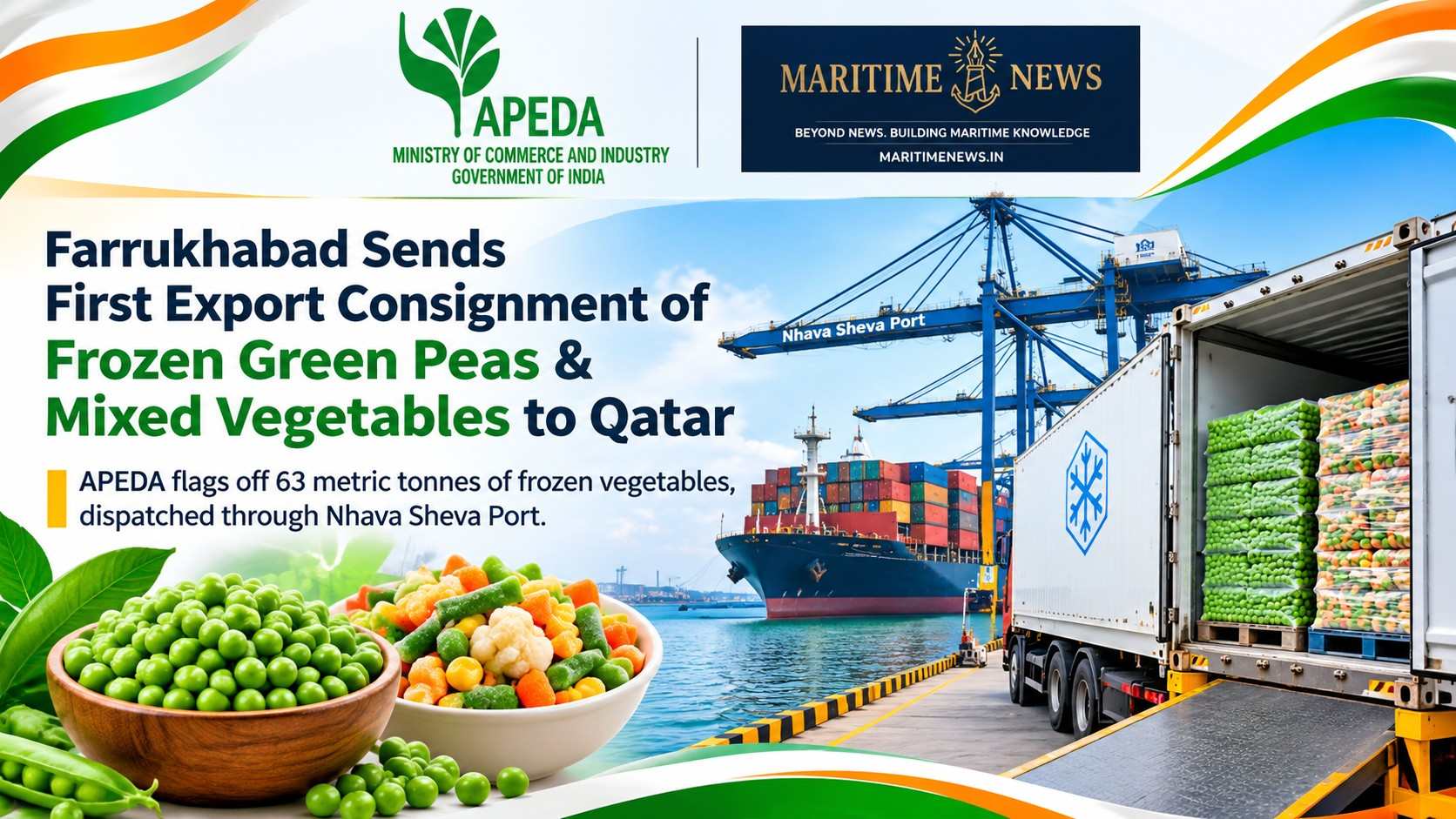
APEDA’s 63-metric-tonne consignment of frozen green peas and mixed vegetables from Farrukhabad, Uttar Pradesh, has been dispatched through Nhava Sheva for Doha, highlighting the growing connection between regional food processing, export logistics and international markets.
Key Takeaways
- The Agricultural and Processed Food Products Export Development Authority (APEDA) organised a stakeholder interaction programme in Varanasi on 20 November 2026.
- The programme included the virtual flag-off of the first-ever export consignment of frozen green peas and mixed vegetables from Farrukhabad, Uttar Pradesh, to Qatar.
- The consignment comprises 63 metric tonnes and was exported by M/s Shree Laxmi Frozen Foods.
- The shipment originated from Farrukhabad and was dispatched through Nhava Sheva Port for onward transportation to Doha, Qatar.
- APEDA Chairman Abhishek Dev highlighted the Bharat Krishi Niryat Yojana (BKNY) and APEDA’s BHARATI initiative.
- The development could create opportunities for farmers, Farmer Producer Organisations (FPOs), food processors and exporters in Uttar Pradesh.
- The shipment demonstrates the importance of connecting inland agricultural production and processing with port-based export logistics.
Farrukhabad, Uttar Pradesh, 24 November 2026 (Maritime News): An agricultural export consignment from Farrukhabad in Uttar Pradesh has brought together regional food processing, export facilitation and maritime logistics, with 63 metric tonnes of frozen green peas and mixed vegetables dispatched through Nhava Sheva Port for Doha, Qatar.
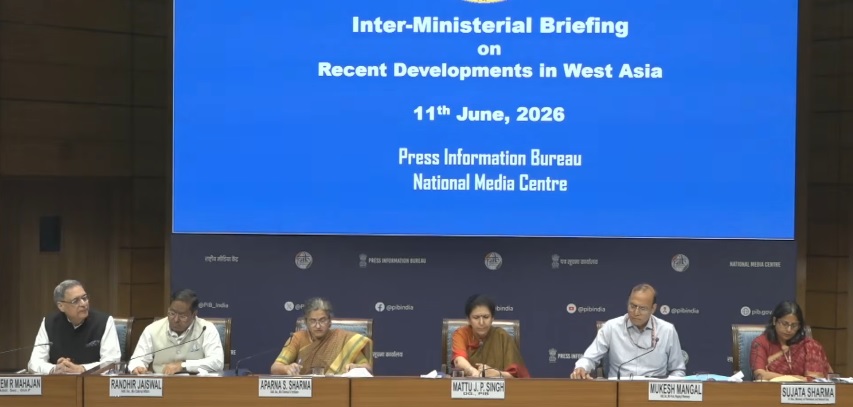
The first-ever export consignment of these frozen vegetable products from Farrukhabad was virtually flagged off during an interaction programme organised by the Agricultural and Processed Food Products Export Development Authority (APEDA) in Varanasi on 20 November 2026.
Exported by M/s Shree Laxmi Frozen Foods, the consignment represents a new development in Uttar Pradesh’s agricultural export basket, particularly in the value-added and frozen food segment.
The development is significant not only for the district’s agricultural and food-processing sector but also for the logistics network connecting inland production centres with international markets. The shipment’s movement through Nhava Sheva illustrates the role of India’s maritime gateways in enabling regional producers to access overseas buyers.
The larger question is whether this first consignment can become the foundation for a more organised agricultural export ecosystem connecting farmers, processors, exporters, logistics providers and international markets.
APEDA’s Varanasi Stakeholder Programme Connects Exporters with Government Agencies
The Agricultural and Processed Food Products Export Development Authority, functioning under the Department of Commerce, Ministry of Commerce and Industry, organised the Interaction with Stakeholders programme in Varanasi on 20 November 2026.
The programme brought together exporters and government agencies to discuss challenges and opportunities relating to agricultural and processed food exports.
The discussions covered:
- Export facilitation.
- Packaging requirements.
- Logistics and transportation.
- International market access.
- Regulatory requirements.
- Institutional support for exporters.
APEDA officials addressed concerns raised by participants and assured them of assistance in resolving export-related challenges and facilitating greater participation by regional exporters in international markets.
The programme was chaired by APEDA Chairman Abhishek Dev, under whose chairmanship the virtual flag-off of the Farrukhabad consignment took place.
The interaction also provided an opportunity for exporters, FPOs and government representatives to discuss practical requirements for connecting regional agricultural production with international supply chains.
Farrukhabad’s First Frozen Vegetable Export: What Was Shipped?
The principal development announced during the programme was the first-ever export consignment of frozen green peas and mixed vegetables from Farrukhabad to Qatar.
The shipment details are as follows:
| Particular | Details |
|---|---|
| Origin | Farrukhabad, Uttar Pradesh, India |
| Export destination | Doha, Qatar |
| Products | Frozen green peas and mixed vegetables |
| Quantity | 63 metric tonnes |
| Exporter | M/s Shree Laxmi Frozen Foods |
| Port of dispatch | Nhava Sheva Port, India |
| Flag-off | Virtual flag-off during APEDA’s Varanasi programme |
| Programme date | 20 November 2026 |
The shipment is important because it demonstrates the potential to move beyond conventional agricultural exports towards processed and value-added food products.
Frozen vegetables require an organised processing and logistics chain that can connect production, processing, packaging, storage, transportation and international distribution.
The successful movement of this consignment could encourage other regional processors and exporters to explore similar opportunities, subject to market demand, regulatory compliance and commercially viable logistics arrangements.
The PIB announcement does not disclose the overseas buyer, shipment value, container configuration, vessel name, shipping line or transit time. These details should not be assumed when assessing the commercial scale of the shipment.
Primary source: Press Information Bureau – APEDA Organises Stakeholder Interaction Programme in Varanasi, 24 November 2026.
Why Is the Nhava Sheva Connection Important?
The consignment originated in Farrukhabad and was dispatched through Nhava Sheva Port for onward transportation to Doha.
This connects an inland agricultural production and processing location in Uttar Pradesh with one of India’s major maritime export gateways.
The movement illustrates a central requirement of export competitiveness: international market access depends not only on the ability to produce goods but also on the efficiency of the logistics network connecting the place of production with the overseas buyer.
The export chain for this consignment involves several stages:
Agricultural Production → Processing and Freezing → Packaging → Export Documentation → Customs Clearance → Inland Transportation → Nhava Sheva Port → Port and Terminal Operations → Shipping Line → Doha → Overseas Buyer
Each stage has a role in ensuring that the product reaches its destination in the required condition and within commercially acceptable timelines.
For frozen food exports, temperature management and coordination across the logistics chain are particularly important. However, the PIB announcement does not specify the cold-chain arrangements, temperature requirements or inland transport mode used for this particular shipment.
Maritime News has previously examined how inland logistics infrastructure can connect agricultural and industrial production centres with Nhava Sheva through its report on DP World’s EXIM Rail Link Connecting Madhya Pradesh with Nhava Sheva.
The broader role of Nhava Sheva’s port-linked warehousing and logistics infrastructure is also relevant to understanding the infrastructure supporting India’s export supply chains.
Frozen Food Exports Require Integrated Cold-Chain Logistics
The export of frozen green peas and mixed vegetables highlights the importance of temperature-controlled logistics in agricultural trade.
Unlike many conventional dry cargoes, frozen food products require appropriate handling and storage conditions throughout the supply chain. Any disruption in temperature management can affect product quality and commercial acceptance.
The broader infrastructure requirements can include:
- Processing facilities capable of meeting export specifications.
- Suitable packaging and labelling.
- Temperature-controlled storage.
- Refrigerated inland transportation where required.
- Appropriate cargo handling at logistics facilities and terminals.
- Coordination between exporters, customs brokers, freight forwarders and shipping lines.
- Compliance with the destination market’s applicable food safety and import requirements.
The PIB announcement confirms the export of the 63-metric-tonne consignment but does not provide details of the specific cold-chain facilities or shipping arrangements used.
India’s expanding cold-chain infrastructure is therefore an important part of the wider discussion on agricultural export competitiveness. Maritime News previously examined this infrastructure dimension in its report on DP World’s Cold Chain Facility in Taloja, which discussed temperature-controlled warehousing and its relevance to agri-exports.
The commercial significance of future shipments from Farrukhabad will depend on whether exporters can establish reliable processing, storage and transportation arrangements that meet overseas buyer requirements.
Can Farmers and Farmer Producer Organisations Benefit?
The export development has implications beyond the exporting company.
Farrukhabad and its adjoining areas have considerable potential for vegetable production and processing. APEDA has identified the opportunity to connect regional agricultural production with food-processing facilities and international supply chains.
This could create opportunities for:
- Farmers supplying vegetables to processing facilities.
- Farmer Producer Organisations aggregating produce from multiple growers.
- Food-processing companies investing in value addition.
- Exporters developing overseas markets.
- Logistics providers handling temperature-sensitive cargo.
- Packaging and storage businesses supporting export operations.
For farmers, access to export-oriented processing markets could potentially create additional avenues for selling agricultural produce. FPOs may also play a role in aggregation, quality management and coordination with processors.
However, the first consignment alone does not establish the scale of farmer participation or the financial benefits reaching growers. The PIB announcement does not disclose the number of farmers involved, procurement prices, quantities sourced from individual producers or the share of the export value retained by farmers.
These are important indicators that will need to be examined as the export activity develops.
Bharat Krishi Niryat Yojana and APEDA’s BHARATI Initiative
During the programme, APEDA Chairman Abhishek Dev highlighted two initiatives intended to strengthen India’s agricultural export ecosystem.
Bharat Krishi Niryat Yojana
The recently launched Bharat Krishi Niryat Yojana (BKNY) was highlighted as an initiative aimed at encouraging agricultural exports and strengthening export-related infrastructure and activities.
The programme’s broader relevance lies in supporting the development of export-oriented agricultural activities and addressing infrastructure and market-access requirements.
APEDA’s BHARATI Initiative
The Chairman also highlighted APEDA’s BHARATI initiative, which seeks to empower Farmer Producer Organisations and facilitate their integration into export value chains.
FPO participation can be important in regions where agricultural production is distributed among multiple growers. Aggregation and organised market linkages can help connect individual producers with processing and export businesses.
The two initiatives were presented in the context of strengthening agricultural exports and increasing the participation of regional producers in international markets.
The PIB announcement does not provide specific funding allocations, individual project approvals or quantified export targets for either initiative during the Varanasi programme.
Government Agencies and Exporters Discuss Practical Challenges
The stakeholder programme included participation from senior officials representing APEDA, the Department of Agriculture, Government of Uttar Pradesh, ECGC, DPPQS, AICLASS and other concerned institutions.
Exporters, FPOs and representatives from the agricultural and food-processing sectors also participated.
Their involvement is relevant because agricultural exports require coordination across several areas of regulation and institutional support.
Exporters must address product quality, documentation, packaging, applicable food safety requirements, phytosanitary requirements where relevant, insurance and payment risks, customs procedures and overseas market conditions.
Institutions such as ECGC, DPPQS and other relevant agencies have roles within the broader export ecosystem, depending on the nature of the product and the transaction.
The programme provided a platform for exporters to raise practical challenges and discuss possible measures to improve export facilitation.
The effectiveness of such interactions will ultimately depend on whether the issues raised translate into faster resolution of procedural bottlenecks, improved infrastructure access and greater predictability for exporters.
What Does This Mean for India’s Agricultural Export Supply Chain?
The Farrukhabad shipment highlights how regional production centres can become part of international trade when agricultural output is connected with processing capacity, export facilitation and maritime logistics.
The supply chain extends beyond the farmer and the exporter. It includes processors, packaging companies, customs brokers, freight forwarders, inland transport operators, port terminals, shipping lines and overseas buyers.
India’s export chain:
Farmer / Producer → FPO / Aggregator → Food Processor → Exporter → Export Documentation → Customs Broker → Customs → Freight Forwarder / NVOCC → Inland Logistics → CFS / ICD → Port / Terminal → Shipping Line → Overseas Buyer
For frozen food products, the chain also requires appropriate temperature-controlled handling and storage at relevant stages.
The first export consignment from Farrukhabad demonstrates the possibility of linking an inland production and processing cluster with an international destination through India’s maritime gateways.
It also reinforces the importance of coordination among government agencies, exporters and logistics providers. A production region may have agricultural potential, but its ability to participate in global trade depends on the availability of reliable processing, packaging, transport, compliance and port connectivity.
The broader challenge is to make such export movements repeatable and commercially sustainable rather than treating them as isolated consignments.
From a Maiden Shipment to a Sustainable Export Cluster
The first export consignment of frozen green peas and mixed vegetables from Farrukhabad to Qatar marks a new development in Uttar Pradesh’s value-added agricultural export activity.
The 63-metric-tonne shipment by M/s Shree Laxmi Frozen Foods demonstrates the potential to connect regional vegetable production and processing with overseas markets through Nhava Sheva.
APEDA’s stakeholder programme in Varanasi also highlights the importance of institutional support, exporter engagement, FPO participation and export-oriented infrastructure.
The next stage will require attention to several measurable outcomes:
- Whether additional frozen vegetable consignments follow the maiden shipment.
- Whether more processors and exporters from Farrukhabad and neighbouring areas enter international markets.
- Whether farmers and FPOs become part of organised procurement and processing arrangements.
- Whether cold-chain and inland logistics infrastructure can support regular export volumes.
- Whether exporters secure repeat orders from Qatar and other international markets.
- Whether APEDA’s support initiatives translate into greater participation by regional exporters.
A single consignment cannot establish a long-term export trend. But it can demonstrate the feasibility of connecting an inland agricultural cluster with international markets.
For the maritime and logistics industry, the development is another reminder that export growth begins far beyond the seaport. Ports become gateways to global markets when the production, processing and inland transport networks behind them function effectively.
The real test for Farrukhabad will be whether its first frozen vegetable export becomes the beginning of a consistent export programme that delivers commercial opportunities across farmers, processors, exporters and the logistics chain.
Sources and References
External Sources
- Press Information Bureau, Government of India, APEDA Organises Stakeholder Interaction Programme in Varanasi – First-ever Export Consignment of Frozen Green Peas and Mixed Vegetables from Farrukhabad to Qatar, published 24 November 2026.
Internal Sources – Maritime News Archive
- DP World Connects Madhya Pradesh with Nhava Sheva through New EXIM Rail Link
- DP World’s Nhava Sheva Business Park Attains IGBC Platinum Certification
- DP World’s New Cold Chain Facility in Taloja
- Cashew Exports from Jaigad Port – Will Farmers Benefit?
- Sindi Railway Multi-Modal Logistics Park to Connect Vidarbha Exporters with JNPA