
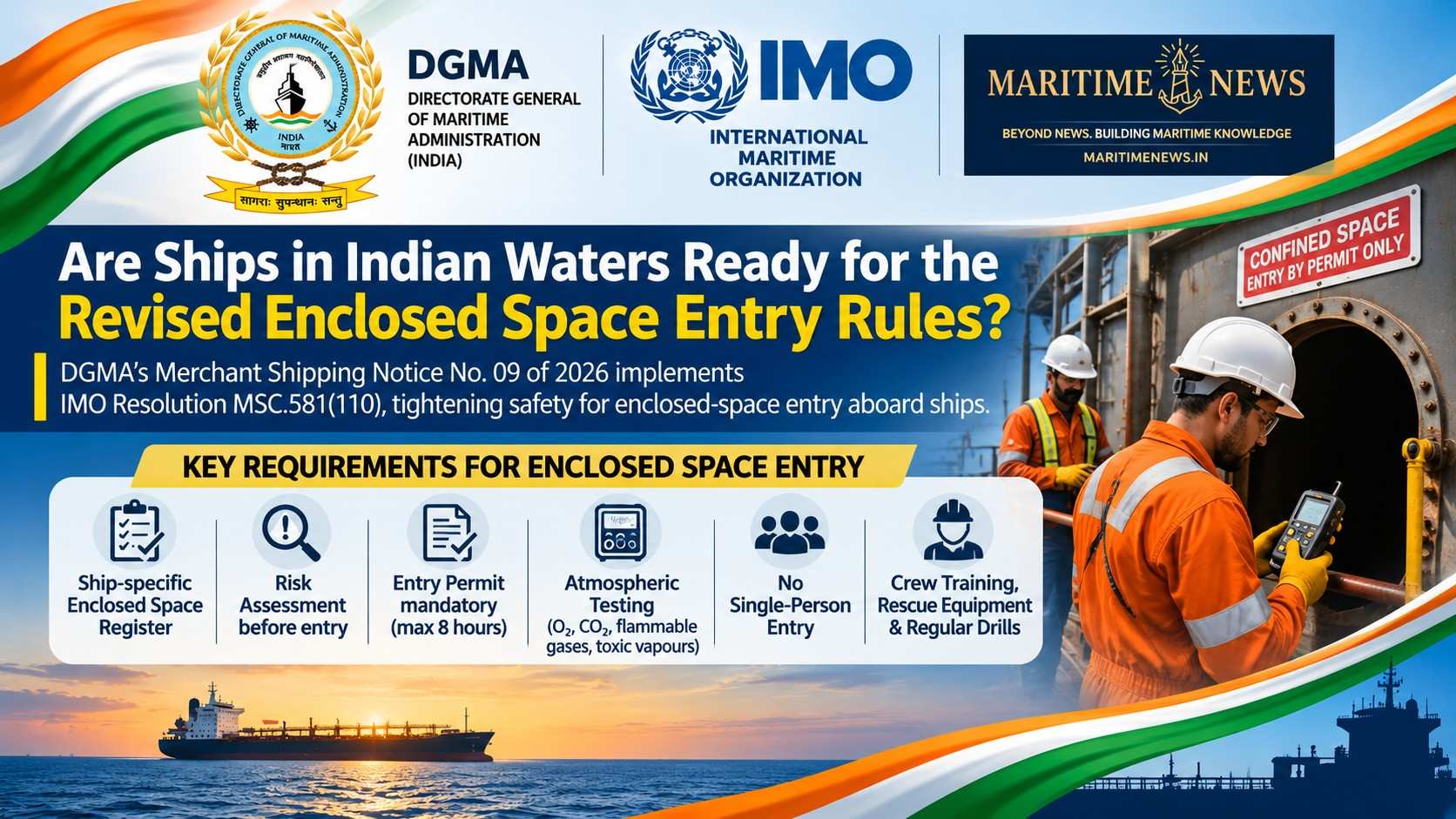
DGMA’s Merchant Shipping Notice No. 09 of 2026 brings revised IMO recommendations into the Indian maritime framework, placing renewed responsibility on shipowners and ship managers to strengthen risk assessment, atmospheric testing, crew training and emergency preparedness.
Key Takeaways
- The Directorate General of Maritime Administration (DGMA) issued Merchant Shipping Notice No. 09 of 2026 on 23 November 2026 concerning revised recommendations for entering enclosed spaces aboard ships.
- The notice refers to IMO Resolution MSC.581(110), adopted on 27 June 2025.
- The revised recommendations call for ship-specific Enclosed Space Registers, systematic risk assessments, trained personnel, appropriate equipment and planned rescue arrangements.
- An enclosed-space entry permit must be used where the risk assessment identifies a risk to health or life. Its validity must be based on the assessment and cannot exceed eight hours.
- Single-person entry into an enclosed space is not permitted under the IMO recommendations.
- Atmospheric testing must address oxygen, carbon dioxide, flammable gases and toxic substances identified through the risk assessment.
- Particular attention is given to organic solid bulk cargoes that can deplete oxygen and generate carbon dioxide.
- Effective implementation will depend on company-level safety management and the ability of crews to follow procedures without commercial or operational pressure.
Mumbai, Maharashtra, 24 November 2026 (Maritime News): Enclosed-space accidents remain one of the most serious occupational safety risks aboard ships. Cargo holds, ballast tanks, pump rooms, cofferdams, chain lockers, void spaces and other restricted compartments can contain atmospheres incapable of supporting human life. The danger may not be visible, and a compartment previously considered safe can become hazardous as cargo conditions, ventilation or the surrounding atmosphere changes.
The International Maritime Organization (IMO), through Resolution MSC.581(110), adopted on 27 June 2025, revised its recommendations for entering enclosed spaces aboard ships. The resolution addresses the continuing loss of life associated with oxygen depletion, oxygen enrichment, toxic gases and flammable atmospheres.
India has now brought these revised recommendations into focus through the Directorate General of Maritime Administration’s Merchant Shipping Notice No. 09 of 2026, dated 23 November 2026. The notice directs the stakeholders within its stated scope to ensure effective implementation of the revised recommendations.
The issue is not simply whether a ship carries gas-testing equipment or maintains an entry permit. It is whether the company and vessel have an effective system to identify hazardous spaces, assess changing conditions, control access, train personnel and conduct a rescue without creating further casualties.
What Does DGMA’s Merchant Shipping Notice No. 09 of 2026 Require?
The Directorate General of Maritime Administration (DGMA), Mumbai, issued Merchant Shipping Notice No. 09 of 2026 concerning the implementation of revised recommendations for entering enclosed spaces aboard ships in accordance with IMO Resolution MSC.581(110).
The notice applies to Indian-flagged vessels and foreign-flagged vessels operating in Indian waters, and addresses shipowners and ship management companies. It directs relevant stakeholders to ensure effective implementation to prevent enclosed-space accidents and safeguard seafarers’ lives.
DGMA is the present name of the authority formerly known as the Directorate General of Shipping (DG Shipping). Maritime News has previously reported on the authority’s wider responsibilities in seafarer protection, including its 24×7 crisis response arrangements for seafarers.
The significance of the new notice lies in the responsibilities it places on both the ship and the shore-based management organisation. Enclosed-space safety cannot be achieved through shipboard instructions alone. Companies must provide the necessary systems, equipment, training and operational support, while vessels must ensure that established procedures are followed during actual operations.
Official notice: DGMA Merchant Shipping Notice No. 09 of 2026 – Recommendations on Enclosed Space Entry, 23 November 2026.
What Changed Under IMO Resolution MSC.581(110)?
IMO Resolution MSC.581(110) was adopted by the Maritime Safety Committee at its 110th session on 27 June 2025. It contains the revised recommendations for entering enclosed spaces aboard ships and invites the IMO Assembly to revoke the earlier Resolution A.1050(27).
The resolution responds to continuing fatalities involving personnel entering spaces where the atmosphere cannot support life. It identifies failures to systematically recognise hazards, assess risks and implement appropriate entry procedures as significant factors in many accidents.
The recommendations are intended to improve the safety of personnel entering or working in spaces where oxygen deficiency, oxygen enrichment, flammable gases or toxic substances may be present. They also provide guidance for an appropriate, planned response to an emergency within an enclosed space.
The IMO recommendations apply to all types of ships and provide guidance to ship operators, seafarers and shore personnel. They are intended to complement national laws, regulations and accepted industry standards.
An important distinction is that MSC.581(110) is a set of IMO recommendations. Its implementation within the Indian regulatory framework is addressed through DGMA’s Merchant Shipping Notice. The two documents therefore serve different but connected purposes: the IMO resolution provides the revised technical and operational framework, while the DGMA notice communicates its implementation in the Indian context.
Primary international source: IMO Resolution MSC.581(110), adopted 27 June 2025.
Which Spaces Can Become Dangerous?
An enclosed space is not limited to a cargo hold or tank. Under the IMO definition, it is a space that may contain a hazardous atmosphere or lack oxygen and has one or more of the following characteristics:
- Limited openings for entry and exit.
- Inadequate ventilation.
- A design that does not allow continuous human occupancy.
Examples include cargo holds, bilge spaces, ballast and other tanks, pump rooms, chain lockers and engine crankcases.
The revised recommendations also distinguish between enclosed, connected and adjacent spaces.
A connected space is linked by permanent or temporary means, such as a door, to a source space that may contain a hazardous atmosphere. The IMO recommends treating it as hazardous until testing proves otherwise. Even a manually operated watertight door does not automatically establish that the connected space is safe.
An adjacent space shares a common boundary with a compartment that may contain a hazardous atmosphere but has no opening into that compartment. A failure of the separating barrier can nevertheless expose the adjacent space to danger.
A trapped hazardous atmosphere may remain in a connected space or clear at a different rate from the source compartment. It may therefore persist even after cargo has been discharged from the original space.
The implications extend to accommodation areas, engine rooms, forecastle spaces, stores, pipe tunnels and other working areas connected to or adjacent to hazardous cargo spaces. A space that is regularly visited by crew members cannot be presumed safe merely because it is not normally classified as a cargo tank or hold.
Why Is a Ship-Specific Enclosed Space Register Important?
The revised recommendations call for companies to establish a comprehensive safety strategy in consultation with each vessel. A central component is a ship-specific Enclosed Space Register.
The register must identify enclosed spaces, their connected and adjacent spaces, associated hazards, risk mitigation measures and the ways in which atmospheric conditions may change depending on cargo or the contents of a compartment.
The register should contain information relevant to the actual vessel, including:
- Physical layout, access and escape points.
- Connected and adjacent spaces.
- Physical hazards such as vertical ladders, unguarded openings, poor lighting, slippery surfaces and excessive heat.
- Specific atmospheric hazards, including those arising from cargo, fumigants, fuel oils or other stored contents.
- Fixed and portable ventilation arrangements.
- Estimated time required to achieve the necessary air changes.
- Lighting and temporary lighting arrangements, including intrinsically safe lighting where appropriate.
- Atmospheric testing arrangements.
- Locking arrangements and “Safe to enter” or “Unsafe to enter” signage.
- Equipment necessary to facilitate emergency rescue.
The register and risk assessment should be maintained aboard the vessel and ashore. They must be reviewed and updated when circumstances change, particularly after loading and when the contents of a space are altered.
The register is not intended to be a static inventory. It must support the assessment of actual conditions and form the basis for the ship-specific enclosed-space emergency response plan.
Risk Assessment Must Precede Opening and Entry
The revised recommendations require a competent person to assess potential hazards before a space is opened or entered.
The assessment should consider the characteristics of previous and current cargoes, Safety Data Sheets, ventilation, coatings, the physical structure of the space and other relevant factors. It should identify the potential for oxygen-deficient, oxygen-enriched, flammable or toxic atmospheres, including carbon monoxide and carbon dioxide.
The assessment must also consider whether hazards can move into connected or adjacent spaces. Ventilation procedures suitable for one compartment may not be adequate for another.
The IMO recommendations establish a precautionary principle: the space to be entered should be considered hazardous until it has been positively proved safe for entry.
This is particularly important when cargoes can absorb oxygen or release gases, when fumigation has taken place, or when atmospheric conditions may change after an initial inspection.
The company must also ensure that cargo hazard information provided by shippers is made available to the crew in a format they can understand. This is essential when the hazards are not immediately apparent from the physical condition of the cargo or the compartment.
Entry Authorisation and the Eight-Hour Permit Limit
The IMO recommendations state that no person should open or enter an enclosed space unless authorised by the master or a responsible person nominated by the master, and the ship’s prescribed safety procedures have been followed.
An enclosed-space entry permit system, which may include a checklist, must always be used where the risk assessment identifies a risk to health or life.
The permit must be issued by the master or the nominated responsible person. Its validity must be determined through the risk assessment and must never exceed eight hours.
The eight-hour period is a maximum limit, not an automatic entitlement to work for eight hours. The actual validity must reflect the assessed conditions and the nature of the work.
Additional permits may be required under the vessel’s Safety Management System, depending on the activity. These may include energy isolation, electrical isolation, hot work and working-at-height permits, as well as a Job Hazard Analysis.
The recommendations also address access by shore personnel. Companies and vessels must ensure that people coming aboard for cargo operations, maintenance or other work receive relevant information about enclosed-space hazards.
Atmospheric Testing: What Must Be Checked?
Atmospheric testing is central to determining whether a space is safe for entry. Section 7.4 of IMO Resolution MSC.581(110) specifies steady readings to be obtained after a suitable risk assessment targeted to the space.
| Parameter | Reading specified by IMO |
|---|---|
| Oxygen | 20.9% by volume |
| Carbon dioxide | Less than 0.5% by volume (5,000 ppm) |
| Flammable gases or vapours | Less than 1% of the Lower Flammable Limit (LFL), where relevant to the risk assessment |
| Toxic gases or vapours | Less than 50% of the relevant Occupational Exposure Limit (OEL) |
The resolution notes that national requirements may differ when determining safe atmospheric ranges. If the required conditions are not achieved, appropriate ventilation and retesting are necessary before entry.
Testing must not be treated as a one-time exercise. The atmosphere should be tested frequently while the space is occupied, and personnel must be instructed to leave if conditions show signs of deterioration.
The recommendations also call for calibrated and tested personal gas-detection instruments capable of monitoring oxygen, carbon dioxide, flammable gases or vapours, toxic gases including carbon monoxide, and other gases identified in the risk assessment.
The practical implication is that a satisfactory pre-entry reading does not remove the need for continued monitoring where conditions may change during the work.
Why Is Single-Person Entry Prohibited?
Section 3.11 of the IMO recommendations states that companies should ensure single-person entry into an enclosed space is not permitted.
An attendant must maintain watch over personnel entering the space, maintain communication with those inside and initiate emergency procedures if an incident occurs.
The entry arrangements should include a suitable communication system, agreed emergency and evacuation signals, and rescue equipment positioned and ready for use.
This requirement addresses a recurring danger in enclosed-space incidents: a person attempting to rescue a colleague may enter the same hazardous atmosphere without suitable protection and become another casualty.
The attendant’s role is therefore not merely to remain near the entrance. It is part of a planned safety arrangement that supports communication, monitoring and the initiation of rescue procedures.
Crew Training, Equipment and Rescue Drills
The revised framework places responsibility on companies to ensure that relevant crew members receive adequate training in enclosed-space safety management.
Training should cover hazard recognition, evaluation, measurement, control and elimination. Personnel responsible for maintaining, calibrating and using atmospheric testing equipment must receive comprehensive training, and records of competency should be maintained.
The competent person, responsible person and attendant each have distinct responsibilities under the recommendations. The competent person assesses the likelihood of a dangerous atmosphere. The responsible person, who must be at management level aboard the vessel and authorised by the company, permits entry. The attendant maintains watch and communication with those inside.
Companies must also provide equipment suitable for the vessel’s operational profile. The recommendations identify ventilation devices, atmospheric testing equipment, breathing apparatus and personnel recovery apparatus among the equipment needed to facilitate safe entry and rescue.
Regular rescue drills are required under the IMO recommendations, with reference to SOLAS regulation III/19.3.6. The drills should cover:
- Personal protective equipment required for entry.
- Communication equipment and procedures.
- Instruments used to measure the atmosphere.
- Rescue equipment and procedures.
- First aid and resuscitation techniques.
Internal company audits and external audits by the Administration should verify that established procedures are followed and remain consistent with the company’s safety strategy.
The recommendations also require companies to establish criteria for managing simultaneous operations (SIMOPS) where one activity involves enclosed-space entry. The availability of personnel and resources for an emergency must be considered.
Organic Solid Bulk Cargoes: The Carbon Dioxide Risk
The IMO resolution gives particular attention to the dangers associated with solid bulk cargoes and materials that can deplete oxygen or generate hazardous gases.
Depending on their characteristics and condition, solid bulk cargoes can create atmospheres involving flammability, toxicity, oxygen depletion, carbon dioxide or carbon monoxide generation, and self-heating. The resolution identifies coal, wood products, wood chips, wood pellets, metal sulphide concentrates, ferrous materials, seed cake cargoes and scrap metal among examples requiring attention.
Organic cargoes can absorb oxygen and release carbon dioxide through oxidation and microbiological degradation. Carbon dioxide may accumulate in concentrated pockets in cargo holds and connected spaces.
The IMO resolution warns that exposure to carbon dioxide at concentrations around 4% can cause serious oxygen deprivation, permanent brain damage, coma or death. It also highlights that death caused by carbon dioxide can precede death resulting from oxygen deficiency.
This means that relying on oxygen readings alone may be inadequate when organic cargoes are being transported. The recommendations state that ships carrying organic solid cargoes in bulk should continue testing for carbon dioxide before entry and frequently thereafter because the cargoes can continue to emit the gas.
The resolution also warns that a carbon-dioxide-laden atmosphere may look normal. There may be no sensory indication to alert personnel to the danger.
These provisions make cargo information, atmospheric testing and the assessment of connected spaces particularly important during loading, carriage, discharge and maintenance activities.
Emergency Response: Why Unplanned Rescue Attempts Must Be Avoided
The IMO recommendations make a clear distinction between a planned rescue and an improvised attempt to save someone inside an enclosed space.
In an emergency, the crew and shore personnel should follow the ship-specific enclosed-space emergency response plan. The recommendations expressly warn against independently entering the space to perform a rescue.
The Enclosed Space Register and risk assessment should form the basis of the emergency response plan. Rescue drills should test whether the plan is effective, and it should be reviewed after drills so that improvements can be made where necessary.
This is an important operational safeguard. An immediate but unprotected attempt to rescue a colleague can expose additional people to the same atmosphere and turn one casualty into several.
The responsibility of the company is therefore not limited to providing rescue equipment. It must ensure that the crew knows where the equipment is, how to use it and how to follow the agreed rescue plan.
What Must Shipowners and Ship Managers Review?
The implementation of the revised recommendations requires more than circulating a safety notice to vessels. Companies need to assess whether their existing systems meet the recommendations and whether personnel can apply them in actual working conditions.
Key areas requiring attention include:
- Reviewing each vessel’s Enclosed Space Register and identifying enclosed, connected and adjacent spaces.
- Updating risk assessments to reflect current and previous cargoes, contents, ventilation and structural conditions.
- Reviewing entry authorisation and permit procedures, including the eight-hour maximum validity.
- Ensuring atmospheric testing equipment is suitable, calibrated and maintained.
- Providing appropriate personal gas detectors, ventilation and rescue equipment.
- Ensuring single-person entry is prohibited and attendants are properly trained.
- Conducting regular enclosed-space rescue drills.
- Reviewing procedures for cargo operations and shore personnel access.
- Establishing controls for simultaneous operations involving enclosed-space entry.
- Maintaining training, competency, inspection and audit records.
The IMO recommendations also call for companies to allow adequate time for planned enclosed-space activities and avoid undue time pressure, whether explicit or implied. The resolution identifies such pressure as a causal factor in many enclosed-space accidents.
This is a management responsibility. Commercial schedules and operational demands must not undermine the time required for ventilation, testing, authorisation and safe execution.
The Wider Maritime Safety and Seafarer Protection Context
The revised recommendations raise a broader question about how maritime safety is managed in practice. A ship may carry the prescribed equipment and maintain documented procedures, but these measures provide protection only when they are understood, resourced and consistently implemented.
Maritime News has examined concerns relating to maintenance culture, working conditions and accountability through its The Cost of Silence dossier series. The discussion in Maritime Maintenance Culture – The Cost of Silence, Part I and Living Below Deck – The Cost of Silence, Part VI provides wider context for examining how organisational practices and working conditions can affect safety at sea.
The accountability dimension also extends to the relationship between shipboard operations and shore-based management. The concluding discussion in The Cost of Silence examines the need to move beyond individual incidents and consider the systems and practices that shape maritime safety.
The protection of seafarers also becomes visible during maritime emergencies. Maritime News has reported on Indian seafarers affected by incidents in the Gulf region, including the MT Tara Gas attack, the attack on MT El Gaia off Oman and the family’s account concerning Goan seafarer Dilesh Teli.
These incidents are not enclosed-space accidents and should not be treated as evidence of failures under the revised enclosed-space recommendations. They are relevant to the wider discussion of seafarer protection, emergency preparedness, communication and the responsibility to safeguard personnel at sea.
Implementation Will Determine Whether the Recommendations Save Lives
DGMA’s Merchant Shipping Notice No. 09 of 2026 brings the revised IMO recommendations into the Indian maritime context. The technical framework addresses the full sequence of enclosed-space safety: identifying spaces, assessing hazards, controlling access, testing the atmosphere, authorising entry, monitoring conditions and preparing for rescue.
The challenge for the maritime industry is to translate these recommendations into everyday shipboard practice. The Enclosed Space Register must reflect the actual vessel. Risk assessments must account for changing cargo and atmospheric conditions. Permits must be meaningful, equipment must be operational, and rescue drills must prepare crews for realistic emergencies.
For seafarers, the effectiveness of the notice will ultimately be measured not by the number of procedures issued, but by whether they can refuse unsafe entry, obtain the necessary support and return safely from the work they are assigned to perform.
The question for shipowners, ship managers and the maritime administration is therefore straightforward: are the revised recommendations being implemented as a working safety system, or will they remain another set of instructions on paper?
Sources and References
External Sources
- Directorate General of Maritime Administration, Merchant Shipping Notice No. 09 of 2026 – Recommendations on Enclosed Space Entry, 23 November 2026.
- International Maritime Organization, Resolution MSC.581(110) – Revised Recommendations for Entering Enclosed Spaces Aboard Ships, adopted 27 June 2025.
Internal Sources – Maritime News Archive
- DG Shipping Sets Up 24×7 Crisis Response Team for Seafarers
- Maritime Maintenance Culture – The Cost of Silence, Part I
- Living Below Deck – The Cost of Silence, Part VI
- The Cost of Silence – Conclusion
- MT Tara Gas Attack – Indian Seafarer Missing in Hormuz
- One Indian Seafarer Missing After Attack on MT El Gaia Off Oman
- Goan Seafarer Dilesh Teli – Family Account and Repatriation Appeal