
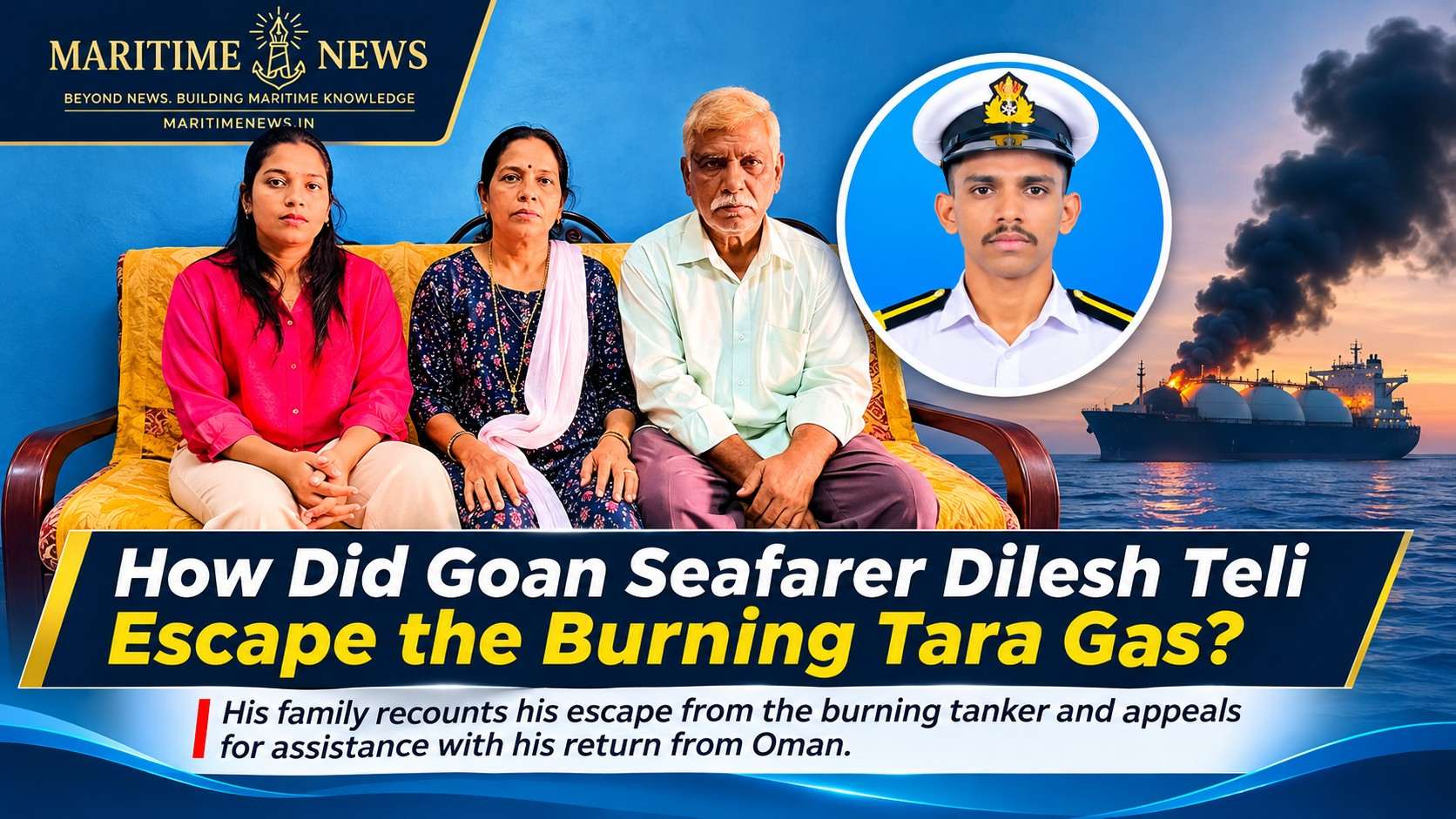
His family recounts his escape through smoke and flames, his rescue in Oman and the urgent appeal to bring him home after losing his passport and personal belongings.
Key Takeaways
- Goan seafarer Dilesh Chandrakant Teli reportedly survived the emergency aboard the LPG tanker Tara Gas after escaping from the burning vessel.
- According to his family, Dilesh was inside his cabin when the incident occurred and found the ship engulfed in flames and smoke after stepping outside.
- The crew reportedly found an accessible exit, put on life jackets and jumped into the sea.
- Dilesh subsequently contacted his family from Oman using another person’s phone after losing his mobile phone, passport and belongings.
- His family is seeking Goa Government assistance to arrange the necessary travel documents and facilitate his early return.
MORMUGAO, Goa, 24 November 2026 (Maritime News): The family of Goan seafarer Dilesh Chandrakant Teli learnt that he had survived the emergency aboard the LPG tanker Tara Gas through an unexpected WhatsApp call on Tuesday evening.
In a recorded video interview with Maritime News, family members said the call came from an unknown number. Communication was initially difficult, but when the call connected again, they recognised Dilesh.
He reportedly told them that the vessel had been attacked, that the crew had jumped into the sea and that he had reached safety in Oman.
The family said it had not known about the incident before receiving the call. Dilesh had last contacted them on Saturday evening. His sister described the shock of hearing his voice and learning that he had escaped a life-threatening situation at sea.
The incident forms part of the wider series of security concerns affecting Indian seafarers operating in the Strait of Hormuz, where commercial vessels and their crews have faced serious risks.
Inside the burning vessel: how did the crew find an exit?
According to the account Dilesh subsequently shared with his family, he was inside his cabin when the incident occurred. He was not in the engine room at that time.
When he stepped outside, he found that the vessel was on fire. Smoke had spread through the ship, making visibility extremely poor. People were moving through the vessel in search of a way out.
The family said Dilesh described the chief officer as an experienced person who guided the crew as they tried to find an accessible exit. Several doors were reportedly tried before they reached an open one, described in the interview as the seventh door.
After reaching the deck, the crew put on life jackets and jumped into the sea. Some crew members were reportedly hesitant to jump, and others encouraged them to enter the water.
Dilesh described the sea as deep and the situation as frightening. His family said he remembered praying before making the jump.
The account offers a glimpse into the difficulties faced by crew members trying to evacuate a vessel during a fire. However, the precise sequence of the escape has not been independently verified by Maritime News.
Rescue in Oman and concern over a missing crew member
Dilesh’s sister said she contacted the shipping company after communication with him was interrupted. A senior company representative reportedly informed her that the crew had been rescued and that the survivors were safe, but one crew member was still missing and search-and-rescue operations were continuing.
The family said it understood that 25 crew members had been aboard the vessel, including 24 Indians. Dilesh was reportedly the only Goan among them.
The family also referred to crew members who sustained injuries. It said two people were seriously injured and admitted to hospital, while others had also suffered injuries.
The interview records what the family was told at the time. It does not establish the final outcome of the missing crew member or provide an independently confirmed injury list.
The Tara Gas incident is not the first recent case involving Indian crew members aboard foreign-flagged vessels in the region. Maritime News had earlier reported on three foreign-flagged ships carrying 42 Indian crew members that were hit in the West Asia conflict, while 173 seafarers remained in the Gulf.
Reaching safety without a passport or personal belongings
The family said Dilesh reached land in Oman on Tuesday and contacted them using another person’s phone. His own mobile phone, passport, documents and personal belongings had reportedly been lost during the incident.
According to the family, the shipping company arranged hotel accommodation for the rescued crew and facilitated further communication.
Family members said Dilesh had been discharged from hospital and was staying at a hotel. They also said the company had arranged clothes and meals for him.
Although his survival brought relief, the loss of his travel documents has created a separate problem. The family is now concerned about the formalities required for him to return to India without his original passport and other documents.
Family appeals to Goa Government for early repatriation
The family’s immediate request is for the Goa Government to coordinate with the relevant authorities and the shipping company to facilitate Dilesh’s return.
During the interview, family members described approaching local representatives and seeking assistance through officials associated with Goa’s NRI-related department. They said a letter had been prepared and that they had been guided on the procedures to follow.
Their principal concern remains the absence of Dilesh’s passport and other documents. The family wants the necessary travel documentation and formalities completed so that he can return to Goa at the earliest.
The interview establishes that the family has sought assistance. It does not establish that a replacement passport has already been issued, that all travel formalities have been completed or that a confirmed repatriation date has been communicated.
A first overseas assignment interrupted by a maritime emergency
The family said Dilesh joined the vessel in April 2026 after travelling from Mumbai for his assignment. His contract was expected to run until early January 2027, and the family had been looking forward to his return after the completion of his service.
The family described this as his first overseas assignment aboard a ship. They had been concerned about security incidents in the region but had expected him to complete the remaining period of his contract and return home.
His sister also referred to a family wedding scheduled for February. The family had expected Dilesh to be back in Goa before then.
The incident has therefore disrupted not only his professional assignment but also the family’s plans for his return.
The risks faced by seafarers in the region have also been highlighted in Maritime News reporting on the attack on MT El Gaia off Oman, in which one Indian seafarer was reported missing. Such incidents underline the continuing exposure of Indian crew members serving aboard foreign-flagged commercial vessels during periods of regional instability.
The challenge does not end with rescue
Dilesh’s reported escape from the burning vessel and his subsequent arrival in Oman mark the immediate survival phase of the emergency. His family’s account, however, highlights the practical difficulties that can follow a maritime incident: loss of identity and travel documents, medical recovery, temporary accommodation and the arrangements required to bring a seafarer home.
For a rescued seafarer who has lost essential documents, repatriation requires coordination between the employer, relevant authorities and the country’s consular machinery. The family is now seeking that coordination.
The incident also raises a wider question for the maritime sector: how effectively are the post-rescue needs of seafarers addressed after a vessel emergency, particularly when their identity and travel documents are lost?
For Dilesh’s family, the priority is immediate and personal: to see him safely back home in Goa.
Maritime News will continue to follow the family’s appeal and report confirmed developments concerning Dilesh Teli’s repatriation.
Sources and Reporting Basis
Primary External Source – Recorded Video Interview
Recorded video interview with the family of Dilesh Chandrakant Teli, supplied directly to Maritime News.
- Recording duration: 11 minutes 52 seconds.
- Language: Konkani, with Marathi and English expressions.
- Recording format: Original video interview.
- Transcription: Automatic transcription followed by editorial translation from Konkani.
Internal Sources – Maritime News Archive
- What Does the Attack on MT Tara Gas Reveal About the Growing Risks for Indian Seafarers in the Strait of Hormuz? – earlier incident reporting and the initial crew-safety situation.
- Three Foreign-Flagged Ships With 42 Indian Crew Hit in West Asia Conflict; 173 Seafarers Remain in Gulf – wider regional exposure of Indian seafarers.
- One Indian Seafarer Missing After Attack on MT El Gaia Off Oman – an earlier incident involving Indian crew aboard a foreign-flagged vessel.