
India’s shipbuilding order book exceeds $1.7 billion across more than 150 vessels, with exports accounting for over 80% of order value, as Sarbananda Sonowal invites global shipbuilders to invest in five proposed coastal clusters.
Key Takeaways
- India is pitching an estimated $10 billion investment opportunity across five proposed greenfield shipbuilding clusters.
- The five locations are Dugarajapatnam in Andhra Pradesh, Kuchhadi in Gujarat, Dighi in Maharashtra, Kendrapada in Odisha and Thoothukudi in Tamil Nadu.
- The Government cited domestic demand for more than 400 vessels, representing a potential investment opportunity of nearly $24 billion.
- India’s active shipbuilding order pipeline exceeds 150 vessels valued at more than $1.7 billion, with exports accounting for over 80% of the value, according to the Minister.
- Thirty foreign shipyards participated in discussions, including South Korea’s three largest shipbuilders.
- Ten international delegations are scheduled to visit the proposed cluster locations on 17 November.
- Damen Shipyards and Cochin Shipyard signed an MoU to collaborate on future shipbuilding projects.
- The Government aims to place India among the world’s top 10 shipbuilding nations by 2030 and the top five by 2047.
New Delhi, India, November 17, 2026 | Maritime News: India has presented a proposed $10 billion shipbuilding investment opportunity to international maritime industry leaders, placing five greenfield coastal clusters at the centre of its strategy to expand domestic shipbuilding capacity and attract global participation.
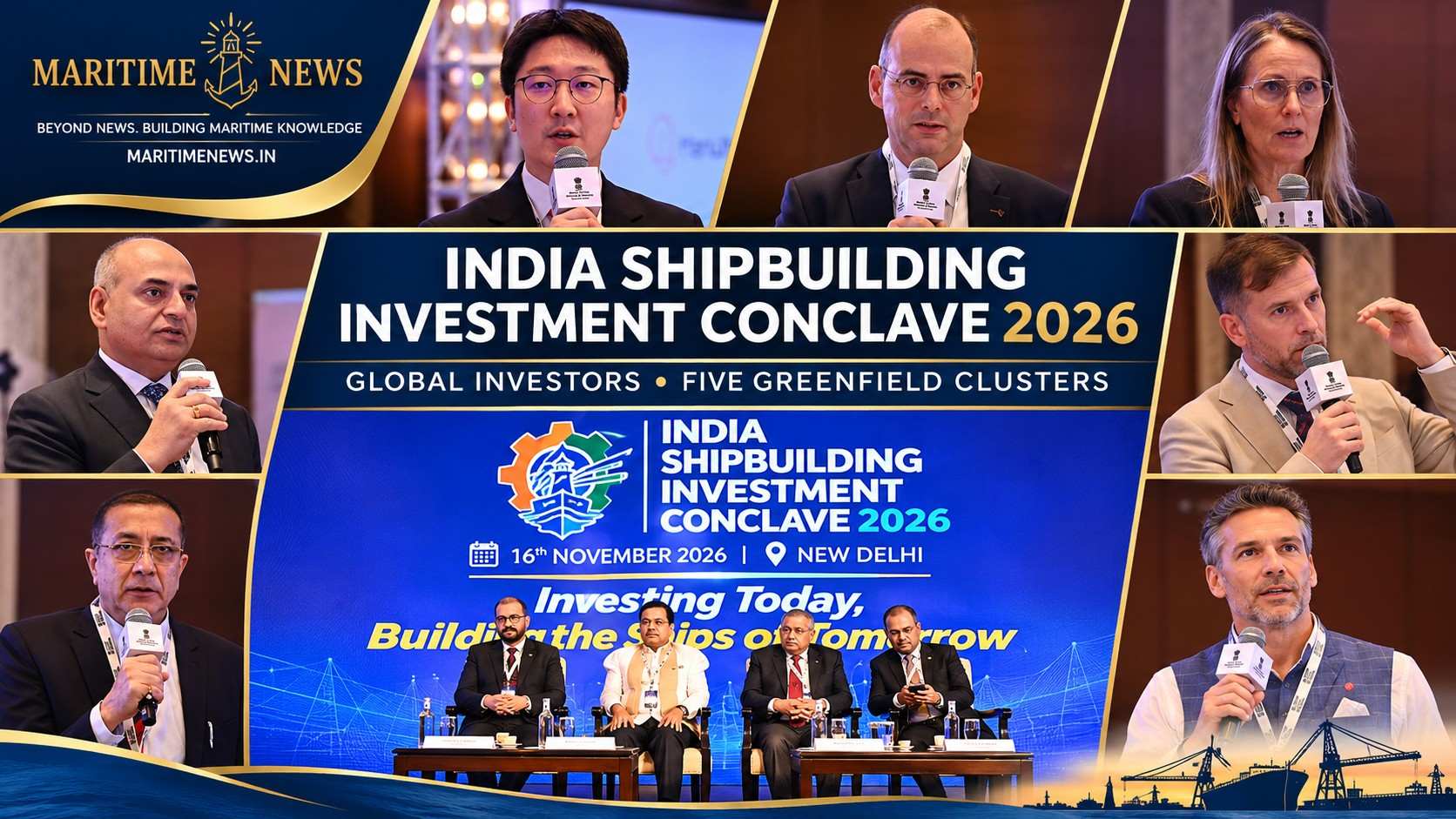
Addressing the India Shipbuilding Investment Conclave 2026 in New Delhi on 16 November, Union Minister for Ports, Shipping and Waterways Sarbananda Sonowal invited international shipbuilders, shipping lines, equipment manufacturers and financiers to invest in India. The Minister said the country aims to become one of the world’s top 10 shipbuilding nations by 2030 and enter the top five by 2047.
The conclave, organised by the Ministry of Ports, Shipping and Waterways (MoPSW), also saw the launch of Naukosh, a digital portal for the shipbuilding and ship repair industry. Another significant development was the signing of a memorandum of understanding between Cochin Shipyard and Damen Shipyards to collaborate on future shipbuilding projects.
The Government’s pitch combines a claimed domestic vessel demand pipeline, export orders, dedicated financial support and proposed industrial clusters. The immediate question, however, is whether the investment interest generated at the conclave can be converted into committed capital, operational shipyards, manufacturing capacity and sustained vessel orders.
Five Greenfield Clusters Form the Centre of the Investment Pitch
The proposed investment opportunity is spread across five coastal locations:
| State | Proposed shipbuilding cluster |
|---|---|
| Andhra Pradesh | Dugarajapatnam |
| Gujarat | Kuchhadi |
| Maharashtra | Dighi |
| Odisha | Kendrapada |
| Tamil Nadu | Thoothukudi |
The Minister described the clusters as ready to build and said Central and state government teams had presented investors with information on available land, supporting policies and joint government backing.
The proposed locations are intended to accommodate shipyards, component manufacturers and allied marine businesses. The wider objective is to develop integrated industrial ecosystems rather than isolated shipbuilding facilities.
The proposed Dugarajapatnam shipbuilding cluster has already featured in the Government’s maritime investment outreach in Andhra Pradesh. Its development is part of the broader effort to position coastal states as partners in India’s shipbuilding expansion.
However, the PIB announcement does not provide a project-wise breakdown of the projected $10 billion investment, individual cluster capacities, identified anchor investors or construction schedules for all five locations. Those details will be important in assessing the commercial readiness of each proposed cluster.
Domestic Demand and Export Orders: The Market Case
The Government is using domestic vessel demand and the existing order pipeline to demonstrate the potential market for shipbuilders investing in India.
According to Sonowal, identified domestic demand covers more than 400 vessels, representing a potential investment opportunity of nearly $24 billion. The active order pipeline comprises more than 150 vessels valued at over $1.7 billion. Export orders account for more than 80% of that order value.
These figures provide two different indicators of market opportunity.
The demand estimate of more than 400 vessels represents a potential market for future acquisition and construction. It should not be treated as an order book of already contracted vessels.
The order pipeline of more than 150 vessels, valued at over $1.7 billion, provides a more immediate indication of activity. The reported export share is also significant because it suggests that Indian shipyards are participating in demand beyond the domestic market.
The commercial challenge will be to convert identified demand into firm contracts, secure financing, allocate construction capacity and deliver vessels at competitive prices and timelines.
For international shipbuilders, the combination of domestic demand and export opportunities could support long-term investment decisions. But the reliability, funding and timing of the vessel pipeline will matter as much as its headline value.
Thirty Foreign Shipyards Join the Investment Discussions
The conclave brought together executives from 30 international shipyards, along with shipping companies, equipment manufacturers, banks, investors, diplomatic missions and Indian industry representatives.
The participating organisations named in the PIB release included:
- South Korea: HD KSOE, Samsung Heavy Industries and Hanwha Ocean.
- Europe: Fincantieri, Meyer Werft, Damen and Royal IHC.
- Marine technology and equipment: Everllence, Mitsui Engines, Wärtsilä and Kongsberg.
- Ship repair and offshore services: Drydocks World Dubai.
- Global shipping and logistics: Maersk, MSC, CMA CGM, MOL and DP World.
The participation of South Korea’s three largest shipbuilders is particularly relevant to India’s effort to secure international technology and industrial partnerships.
The Korean Ambassador to India led a delegation following Sonowal’s recent visit to South Korea. HMM also participated in the discussions.
The outreach builds on the VOYAGES partnership framework—Vision for Operation of Yard Assisted Growth with Efficiency and Scale—signed by Prime Minister Narendra Modi and South Korean President Lee Jae Myung in April 2026. The partnership seeks to connect Korean shipbuilding expertise with India’s ambitions under Maritime Amrit Kaal Vision 2047.
Participation in a conclave, however, is not the same as a commitment to invest. The next stage will require commercial negotiations, technical assessments, project selection and formal agreements.
Damen and Cochin Shipyard Sign Shipbuilding MoU
A notable industry development at the conclave was the signing of a memorandum of understanding between Damen Shipyards and Cochin Shipyard.
The two companies agreed to collaborate on future shipbuilding projects. The announcement adds an international partnership dimension to India’s investment outreach, connecting a major European shipbuilding group with one of India’s established public-sector shipyards.
The PIB release does not specify the vessel types, project value, construction locations, technology-transfer arrangements or implementation schedule under the MoU. It should therefore be treated as a framework for future collaboration rather than a confirmed shipbuilding investment or a finalised construction contract.
The agreement nevertheless reflects the Government’s objective of using international partnerships to strengthen domestic shipbuilding capabilities.
The next indicators to watch will be the identification of specific projects, the nature of technical cooperation, the allocation of construction responsibilities and the conversion of the MoU into executable contracts.
Naukosh Portal Launched to Connect the Shipbuilding Ecosystem
Sonowal also launched Naukosh, a digital portal developed by the Directorate General of Maritime Administration (DGMA) for India’s shipbuilding and ship repair industry.
The portal is intended to bring policies, approvals and investment-related information onto a common digital platform, with the objective of improving transparency and ease of doing business.
Its intended users include shipyards, ship repair facilities, equipment manufacturers, design agencies, classification societies, research and training institutions, financiers, insurers and regulatory authorities.
Naukosh has eight principal modules:
- Industry Directory
- Capability Insights
- Collaboration Hub
- Finance and Insurance
- Technical Library
- Innovation Centre
- Training and Certifications
- Regulatory and Compliance
The portal’s public homepage is also intended to provide industry indicators, including shipyard and capacity information, vessels delivered, vessels on order and sector updates.
For prospective investors, a reliable national directory and capability database could make it easier to identify potential Indian partners and assess the domestic industrial base. For ancillary manufacturers, it could provide a route to greater visibility among shipyards, shipowners and international companies.
Its effectiveness will depend on the accuracy of registered information, verification of company capabilities, regular updates and actual participation by industry stakeholders.
Ten International Delegations to Visit Cluster Locations
The conclave included a Global Maritime Leaders’ Open House, where executives shared feedback directly with government officials on policy and long-term investment plans.
One-to-one meetings were also organised between international participants, state cluster teams, Central Government ministries and financial institutions to discuss potential opportunities.
The next stage of the programme is scheduled for Tuesday, 17 November 2026, when ten international delegations are expected to visit the proposed cluster locations.
The visits are intended to give potential investors an opportunity to examine the proposed sites and engage with state governments on land availability, supporting infrastructure and policy arrangements.
These site visits will be an important step in moving discussions beyond presentations. Investors will need to assess whether the locations can support the scale, infrastructure requirements and operating economics of modern shipbuilding facilities.
The PIB announcement does not identify the ten delegations individually or specify which clusters each delegation will visit.
The $8 Billion Financial Package and the Investment Challenge
The conclave builds on the approximately $8 billion shipbuilding financial package approved by the Government in 2025, according to the PIB release.
The financial package is intended to support the expansion of India’s shipbuilding sector. The five proposed clusters add a location-based industrial development strategy to this wider financial-support framework.
Together, the policy direction seeks to address several requirements of a competitive shipbuilding industry: access to finance, land and infrastructure, international technology, domestic manufacturing, skilled labour and a dependable order book.
Yet the projected $10 billion investment opportunity should not be confused with committed investment. The PIB release does not provide a confirmed investor-wise allocation or evidence that the entire projected amount has been secured.
The Government’s immediate task will be to establish the project-level conditions that allow international and domestic investors to take binding decisions.
These include:
- Confirmed land availability and site-development schedules.
- Port connectivity, utilities and supporting infrastructure.
- Clearances and predictable approval processes.
- Cluster-level investment and financing structures.
- Anchor shipyard operators and technology partners.
- Marine equipment and ancillary manufacturing capacity.
- Availability of trained technical and production personnel.
- Firm vessel orders and commercially viable demand.
The development of the five clusters will also require coordination between the Central Government, state governments, maritime authorities, port administrations, financial institutions and private-sector participants.
Maritime News Analysis
India’s latest shipbuilding investment pitch brings together three elements that have often been discussed separately: domestic vessel demand, international industrial partnerships and dedicated coastal manufacturing clusters.
The reported demand for more than 400 vessels provides a potential market signal. The order pipeline of over 150 vessels offers an indication of existing activity, while the reported export share of more than 80% demonstrates the importance of overseas customers to the value of current orders.
The proposed five clusters could provide the physical industrial base required to expand production. The participation of international shipbuilders could help bring technology, engineering expertise and access to global supply chains. The Damen–Cochin Shipyard MoU is one example of the partnership approach being pursued.
But the figures must be read carefully. The nearly $24 billion domestic demand estimate is not equivalent to contracted orders. The $10 billion investment projection for the clusters is not evidence of secured capital. Participation by 30 foreign shipyards does not establish that all participants intend to invest.
The distinction between interest, negotiation, agreement, financial closure and operational construction will be central to evaluating progress.
There is also a wider industrial question. Shipbuilding competitiveness is not determined by the number of shipyards alone. It depends on the strength of the supporting supply chain, the availability of propulsion and electrical systems, marine equipment, design capabilities, skilled workers, classification and certification services, financing and timely delivery.
The launch of Naukosh could help address the information and coordination gap between these stakeholders. But a digital directory must evolve into a trusted industry resource, with verified capabilities and commercially useful information.
The five clusters will need to demonstrate that they can offer more than land and policy incentives. They must become locations where shipyards and ancillary industries can operate competitively, attract orders and deliver vessels for domestic and international customers.
Strategic Outlook: From Investment Pitch to Shipbuilding Capacity
The Government’s stated ambition is to place India among the top 10 shipbuilding nations by 2030 and among the top five by 2047.
That is a substantial industrial objective. Achieving it will require measurable progress across the five clusters, expansion of existing shipyards, stronger domestic equipment manufacturing, technology partnerships and a sustained supply of skilled maritime and engineering personnel.
The next milestones should be assessed through identifiable outcomes:
- Project-wise investment commitments and financial closure.
- Land transfer, infrastructure development and statutory approvals.
- Identification of anchor shipyard operators and technology partners.
- Conversion of international discussions into binding agreements.
- Firm domestic and export shipbuilding contracts.
- Growth in domestic marine-equipment manufacturing.
- Vessel construction, delivery and production-capacity data.
- Employment and technical skill-development outcomes.
The scheduled site visits by ten delegations on 17 November will provide an early indication of investor engagement. The more significant test will be whether those visits lead to formal project proposals and commercially binding commitments.
Maritime Perspective
India’s $10 billion shipbuilding investment pitch is an attempt to position the country as a serious destination for global shipbuilding capital and technology. The five proposed coastal clusters, the existing vessel pipeline, the Damen–Cochin Shipyard partnership and the launch of Naukosh provide different components of that strategy.
The opportunity is significant, but its delivery cannot be measured by investment estimates or conclave participation alone.
India will need to demonstrate that the proposed clusters can secure investors, establish infrastructure, attract anchor shipyards, develop domestic supply chains and deliver vessels at internationally competitive standards.
The transition from investment interest to operational shipbuilding capacity will determine whether the 2030 and 2047 ambitions become measurable industrial outcomes.
Frequently Asked Questions (FAQs)
What is the estimated investment opportunity in India’s five greenfield shipbuilding clusters?
The Government has presented an estimated investment opportunity of nearly $10 billion across five proposed coastal shipbuilding clusters. The PIB announcement does not provide a project-wise allocation or confirm that the full amount has been committed.
Which five locations have been identified for greenfield shipbuilding clusters?
The five proposed locations are Dugarajapatnam in Andhra Pradesh, Kuchhadi in Gujarat, Dighi in Maharashtra, Kendrapada in Odisha and Thoothukudi in Tamil Nadu.
What is India’s current shipbuilding order pipeline?
According to Sarbananda Sonowal, the active order pipeline comprises more than 150 vessels valued at over $1.7 billion, with exports accounting for more than 80% of the value.
What is the estimated domestic demand for vessels?
The Minister cited identified domestic demand for more than 400 vessels, representing a potential investment opportunity of nearly $24 billion. This is a demand estimate and should not be treated as a fully contracted order book.
Which international shipbuilders participated in the conclave?
The participating companies named in the PIB release included HD KSOE, Samsung Heavy Industries, Hanwha Ocean, Fincantieri, Meyer Werft, Damen and Royal IHC, among others.
What agreement did Damen and Cochin Shipyard sign?
Damen Shipyards and Cochin Shipyard signed an MoU to collaborate on future shipbuilding projects. The PIB release does not disclose specific vessel orders, project values or implementation schedules.
What is Naukosh?
Naukosh is a digital portal developed by DGMA for India’s shipbuilding and ship repair industry. It is designed to connect shipyards, suppliers, service providers, financiers, training institutions and other maritime stakeholders.
When will international delegations visit the proposed clusters?
The PIB announcement scheduled site visits by ten international delegations for 17 November 2026.
What is India’s shipbuilding ambition for 2030 and 2047?
The Government aims to place India among the world’s top 10 shipbuilding nations by 2030 and among the top five by 2047.
Sources and References
External Sources
- Press Information Bureau, Ministry of Ports, Shipping and Waterways – Sarbananda Sonowal Pitches $10 Billion Shipbuilding Opportunity to Global Maritime Leaders, 16 November 2026, 6:54 PM.
- Naukosh – Comprehensive Shipbuilding and Ship Repair Portal
Internal Sources – Maritime News Archive
- Andhra Pradesh’s Eastern Maritime Gateway Ambition: ₹30,000-Crore Dugarajapatnam Shipbuilding Cluster Takes Centre Stage
- Sonowal Woos Korean Firms for Indian Shipyards, Calls for Maritime Rules All Countries Can Implement
- Cochin Shipyard-Drydocks World JV to Build India’s Ship Repair Hub
- MoPSW Secretary Meets Drydocks World CEO
- India’s Shipbuilding Modernisation Gets New Project Management Unit Under SbDS