
India pitches a $7.8 billion shipbuilding support package and a potential 400-vessel government order book to Korean industry as Sonowal calls for universal maritime standards backed by practical implementation support
Make us preferred source on Google
Key Takeaways
- Korean industry outreach: Union Minister Sarbananda Sonowal met the Korea Marine Equipment Association (KOMEA) in Busan, inviting its members to participate in India’s shipbuilding and marine-equipment manufacturing growth.
- Mumbai office planned: KOMEA is scheduled to open its first Indian office on 30 October 2026, creating a local platform for engagement with Indian industry.
- Shipbuilding support: India approved a shipbuilding package worth approximately US$7.8 billion in September 2025, according to the Ministry of Ports, Shipping and Waterways.
- Vessel pipeline: The ministry reported a pipeline of more than 120 vessels worth over US$1.27 billion under direct government assistance, with export orders accounting for more than 80% of the value.
- Long-term demand: Government entities have aggregated demand for more than 400 vessels, representing approximately US$23 billion in potential order-book visibility over the next decade.
- Local manufacturing opportunity: Sonowal identified engines, propulsion, deck machinery, electrical systems and navigation equipment as areas where Korean suppliers could support Indian shipyards.
- IMO implementation debate: At the World Maritime Day Parallel Event in Busan, Sonowal advocated universal maritime standards alongside practical assistance that reflects differences in national capabilities and resources.
- Capacity-building proposal: His approach includes joint working groups, training for surveyors and inspectors, legislative assistance and time-bound implementation plans.
- Key question: The opportunity will depend on whether announced demand and investment interest translate into actual contracts, manufacturing capacity, technology transfer, skilled employment and competitive Indian shipbuilding.
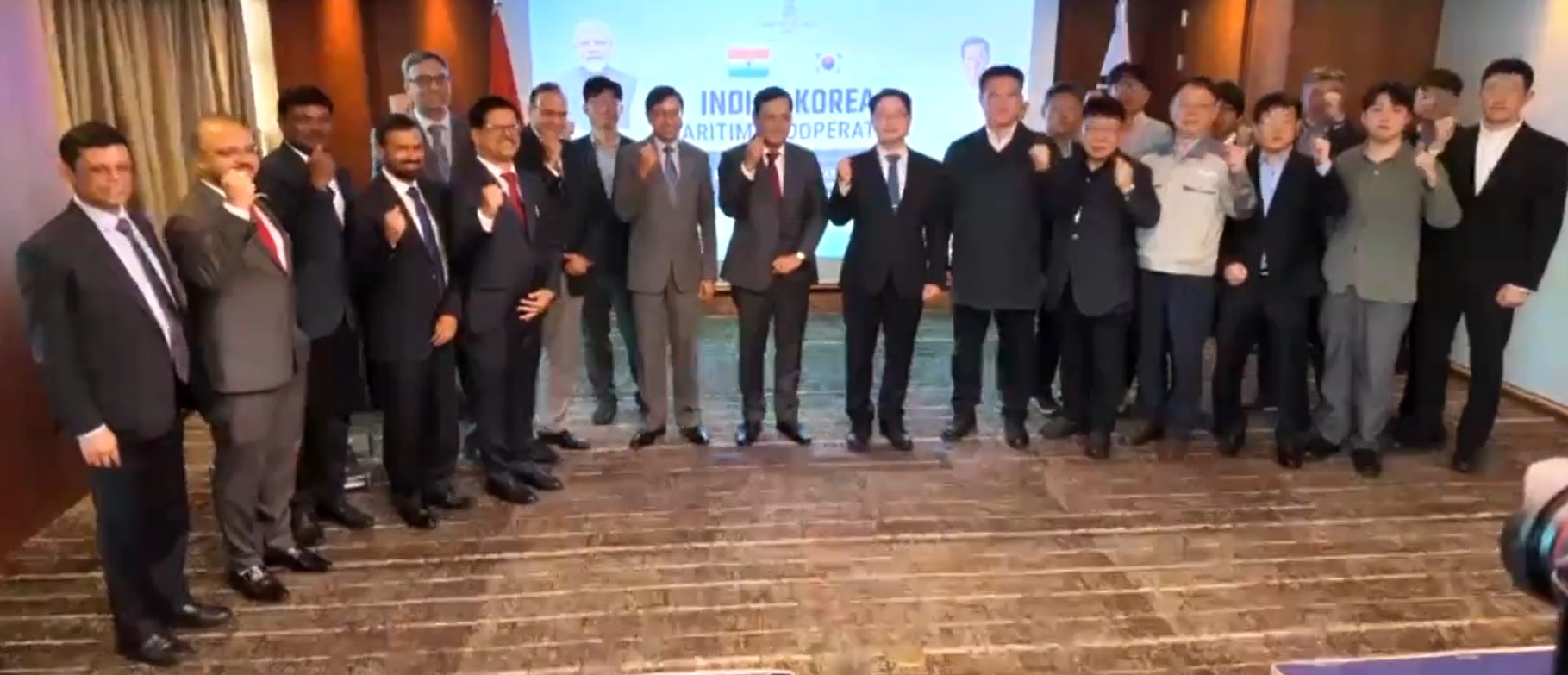
Busan, South Korea, October 27, 2026 (Maritime News): India is seeking a larger role in global shipbuilding by combining domestic industrial support with international technology partnerships. During a four-day visit to South Korea, Union Minister for Ports, Shipping and Waterways Sarbananda Sonowal invited Korean marine-equipment manufacturers to invest in India, collaborate with Indian shipyards and help build a stronger domestic supply chain for shipbuilding.
The outreach coincided with the World Maritime Day Parallel Event in Busan, where Sonowal also called for international maritime rules that maintain common standards while helping countries with different levels of development and technical capacity implement them effectively.
The two discussions address different but connected challenges facing the maritime industry. Shipbuilding requires capital, technology, specialised components, skilled workers and a dependable order book. International maritime regulation, meanwhile, requires countries to translate agreed conventions into domestic legislation, effective administration, inspection and enforcement.
India’s pitch is that cooperation with South Korea can help strengthen its shipbuilding capabilities, while international technical cooperation can help countries close gaps in implementing maritime rules.
The commercial test will be whether the proposed partnerships result in measurable industrial capacity, domestic manufacturing, technology development and completed shipbuilding contracts.
Source: Press Information Bureau (PIB), Ministry of Ports, Shipping and Waterways, 26 October 2026.
1. Sonowal Calls for Universal Maritime Standards with Practical Implementation Support
At the ministerial roundtable during the World Maritime Day Parallel Event, Sonowal joined International Maritime Organization (IMO) Secretary-General Arsenio Dominguez, South Korea’s Vice Minister of Oceans and Fisheries Nam Jaeheon, Norway’s Minister of Fisheries and Ocean Policy Marianne Sivertsen Næss, and Cyprus Shipping Deputy Minister Marina Hadjimanolis. Former South Korean oceans and fisheries minister Moon Seong-hyeok chaired the session.
Sonowal argued that international maritime standards should remain ambitious and universal, but their implementation should account for differences in national circumstances, development, technology and access to finance.
He invoked the principle of common but differentiated responsibilities and respective capabilities, arguing that countries should work towards common standards and outcomes while receiving appropriate support to implement them.
“The objective should therefore be common standards and outcomes, supported by cooperation that enables every Member State to implement them effectively.”
The statement places implementation capacity at the centre of the discussion. International conventions can establish common obligations, but effective implementation also depends on national legislation, trained personnel, administrative systems, inspection capability and enforcement.
The broader policy question is how international maritime cooperation can maintain common safety, security and environmental objectives without allowing capacity gaps to undermine implementation.
From conventions to operational capability
Sonowal described IMO conventions as an “operational lighthouse” for shipping amid geopolitical instability, piracy and disruption in the Red Sea. He said the conventions help protect seafarers, trade and supply chains.
He proposed practical cooperation between countries that have already implemented particular conventions and those still developing the capacity to do so. The measures he outlined included:
- Joint working groups between countries at different stages of implementation.
- Training for surveyors and inspectors.
- Assistance with drafting national legislation.
- Time-bound implementation plans.
- Cooperation designed to leave countries with lasting domestic expertise.
Sonowal said the aim should be to create “permanent national capability rather than creating continuing dependence.”
If technical expertise or administrative resources are insufficient, countries may struggle to implement requirements consistently. Training and institutional cooperation can help address these gaps, although their effectiveness depends on funding, continuity, domestic ownership and measurable improvements in implementation.
The IMO’s 2026–2027 World Maritime Day theme, From Policy to Practice: Powering Maritime Excellence, similarly emphasises translating international policy into practical results through implementation, training and technical cooperation.
Sources: PIB ministerial roundtable announcement; IMO’s World Maritime Day 2026–2027 theme.
2. India Highlights Maritime Reforms and Port Digitalisation
Sonowal cited several domestic measures to demonstrate India’s work on maritime governance and regulatory implementation.
According to the ministry’s announcement:
- Five maritime laws enacted in 2025 took effect in March 2026.
- India’s Maritime Single Window covers 69 ports and terminals.
- The Alang-Sosiya ship-recycling cluster has 115 facilities reported as compliant with the Hong Kong International Convention for the Safe and Environmentally Sound Recycling of Ships.
These measures cover different parts of the maritime system.
The legislative changes concern the domestic legal framework. The Maritime Single Window is associated with digital facilitation and information submission. The Alang-Sosiya figures relate to ship recycling and environmental compliance.
Taken together, they form part of India’s argument that its maritime industry is developing the institutional and operational systems required to support a larger role in global shipping.
However, the individual claims need to be assessed according to their respective scope. The number of ports and terminals covered by a digital system does not, by itself, establish the extent of its use or the reduction in clearance times. Similarly, a reported count of compliant recycling facilities does not independently establish the performance of every facility across all environmental and operational indicators.
For maritime businesses, the practical measures of reform include predictable regulation, efficient documentation, effective inspections, environmental compliance and the ability to coordinate activity across ports, terminals, shipyards and service providers.
The PIB release provides the government’s stated position; it does not supply a detailed independent evaluation of these indicators.
3. KOMEA’s India Entry Could Open a Route to Marine-Equipment Manufacturing
The industrial component of Sonowal’s visit centred on the Korea Marine Equipment Association, or KOMEA.
Founded in 1980, KOMEA represents 304 equipment manufacturers, design firms, shipbuilders and repair companies, according to the PIB announcement. Its members include major South Korean maritime industry groups such as HD Hyundai, Hanwha Ocean and Samsung Heavy Industries.
KOMEA is scheduled to open its first Indian office in Mumbai on 30 October 2026. The two governments had welcomed the planned office in April under VOYAGES, their framework for cooperation in shipbuilding, shipping and maritime logistics.
The association had also offered in February 2025 to work with Indian shipyards in areas including:
- Ship design and modernisation.
- Technology transfer.
- Joint education programmes.
- Local manufacturing of marine equipment and spare parts.
Sonowal positioned the Indian market as an opportunity for Korean companies to supply equipment and establish a longer-term industrial presence.
“Every ship built in India needs engines, propulsion, deck machinery, and electrical and navigation systems.”
He said much of this high-value equipment is currently imported, creating an opportunity for Korean suppliers.
The minister’s argument identifies a major industrial challenge: increasing the number of ships built in India is only one part of developing a competitive shipbuilding ecosystem.
Shipyards also require a broad supplier base capable of delivering reliable components, technical services and after-sales support. Depending on vessel type, this can include propulsion systems, power-generation equipment, control systems, navigation technology, pumps, valves, deck machinery and other specialised equipment.
If more components are manufactured domestically, Indian shipyards could potentially reduce their dependence on imported supplies in selected categories, strengthen local supplier networks and improve access to maintenance and spare parts.
However, domestic production is not automatically commercially viable. Suppliers must meet technical specifications, certification requirements, delivery schedules, quality expectations and competitive pricing. Some highly specialised components may continue to be sourced internationally.
The policy challenge is therefore not simply import substitution. It is building a supplier ecosystem that can compete on cost, reliability, technology and quality.
Korean companies may contribute through joint ventures, licensing arrangements, technology partnerships or their own manufacturing facilities. The form of participation will determine how much production, expertise and value addition remains in India.
4. KOMEA Members Signal Interest, but Investment Decisions Remain to Be Seen
KOMEA Chairman Ho-il Kang said members had begun preparing to enter the Indian market within the next two years.
The PIB announcement identified SB Sunbo, Daeyang, KASEMEC and JO Engineering among companies whose representatives discussed plans for possible investment in India’s maritime sector.
Sonowal described KOMEA’s Mumbai office as a long-term platform for Korean firms considering joint ventures, licensing or factories in India. He also said the ministry was ready to help companies establish themselves.
These discussions indicate interest in exploring the Indian market. They do not, on their own, establish that the named companies have approved specific projects, committed investment amounts or finalised locations and production plans.
The distinction matters because an association office and an industrial investment serve different purposes. A representative office can help members understand the market, develop contacts and coordinate business discussions. A manufacturing investment requires additional decisions about capital, technology, land or facilities, suppliers, staffing, regulatory approvals and customers.
Korean marine-equipment companies evaluating India are likely to consider several commercial factors:
- Demand visibility: Whether Indian shipyards have sufficiently reliable orders to justify investment.
- Supplier readiness: Whether local suppliers can meet technical and quality requirements.
- Production economics: Whether domestic manufacturing can compete with imported equipment.
- Technology and licensing: Which technologies can be transferred and under what commercial conditions.
- Workforce capability: Whether India can provide trained engineers, technicians and production personnel.
- Regulatory and certification requirements: Whether equipment meets the standards required by shipyards, shipowners and relevant classification bodies.
- Export potential: Whether facilities in India can serve overseas customers as well as the domestic market.
These are analytical considerations, not a list of commitments confirmed by the companies in the PIB release.
Maritime News analysis: KOMEA’s planned office could improve access to the Indian market, but the more significant milestones will be actual investment decisions, signed manufacturing or technology agreements, operational facilities and measurable domestic production.
5. India Cites Shipbuilding Growth and a Large Potential Order Book
Sonowal used the government’s shipbuilding support measures and projected demand to make the case for investment.
The ministry said India approved a shipbuilding package worth approximately US$7.8 billion in September 2025. It also reported that shipbuilding output rose by 40% year on year in 2025 following the scheme’s approval, with output increasing by more than 80% in 2026.
The release does not specify the complete calculation methodology, the precise output measure or the comparison period underlying the reported 2026 increase. The percentages should therefore be understood as figures reported by the ministry, rather than as independently verified measures of long-term productivity growth.
Sonowal also cited a pipeline of more than 120 vessels worth over US$1.27 billion under direct government assistance. According to the ministry, export orders account for more than 80% of the value of that pipeline.
“We are already building for the world.”
The export-order share is an important part of the government’s argument because it points to demand beyond the domestic market. Nevertheless, the value of a vessel pipeline should not be treated as equivalent to revenue already earned or ships already delivered.
The ministry further said demand from government entities had been aggregated to provide Indian shipyards with order-book visibility for more than 400 vessels worth approximately US$23 billion over the next 10 years.
That projection could be significant for shipyards and component suppliers if the demand translates into funded procurement and executable contracts.
Shipbuilding investment decisions depend on confidence in future demand. Yet different stages of the order process carry different levels of certainty:
- Projected demand indicates an anticipated requirement.
- Aggregated demand brings requirements from multiple entities into a wider planning view.
- A tender or procurement process establishes a route towards potential contracts.
- A signed contract creates a more concrete commercial commitment, subject to its terms.
- Construction and delivery demonstrate that the order has progressed into physical output.
The PIB announcement describes the government’s demand aggregation as providing order-book visibility. It does not establish that all 400-plus vessels have been contracted, funded or scheduled for delivery.
For Korean equipment manufacturers, the distinction is crucial. A large potential order book may justify market exploration, but long-term factory investment usually requires greater clarity on procurement timing, vessel specifications, likely component volumes and contractual arrangements.
Maritime News analysis: The opportunity for India is to convert demand visibility into a dependable production pipeline. For suppliers, the key question is whether the order book provides enough predictable volume to support investment, technology localisation and competitive manufacturing.
6. Why Korean Technology Could Matter to India’s Shipbuilding Ambitions
South Korea is an established shipbuilding and marine-equipment centre. Cooperation with its industry could give Indian shipyards access to technical expertise, established manufacturing practices and specialised components.
The areas discussed by Sonowal and KOMEA are potentially complementary. Indian yards seeking to increase output need equipment suppliers, design capabilities and skilled workers. Korean companies looking to enter India need market access, reliable demand and viable production arrangements.
The potential benefits extend beyond the shipyard itself.
A wider maritime industrial chain
A shipbuilding project can support activity across a broader network:
Shipowner or Government Buyer → Shipyard → Naval Architect and Design Team → Marine-Equipment Manufacturers → Component Suppliers → Fabrication and Assembly → Testing and Certification → Vessel Delivery → Maintenance and Repair
This chain is simplified; actual responsibilities and sequencing vary by vessel type and contract.
Each stage creates dependencies. Shipyards need components delivered on time, manufacturers need clear specifications and dependable orders, and shipowners need vessels that meet contractual and regulatory requirements.
If a key component is unavailable, delayed or unsuitable, the shipyard may face production disruption. A stronger domestic supplier base could improve coordination and spare-parts availability, provided suppliers can meet required technical standards.
The potential economic benefits include manufacturing employment, engineering development, training, supplier expansion and opportunities for maintenance and repair services.
However, the extent of those benefits will depend on the structure of individual agreements. A facility that mainly assembles imported equipment may generate a different level of domestic value addition from one that develops local engineering, production and supplier capabilities.
What would demonstrate meaningful localisation?
Useful indicators would include:
- The number and value of confirmed Korean investment projects.
- The amount of marine equipment manufactured in India.
- The share of locally produced components in relevant vessel categories.
- Technology-transfer and licensing agreements that become operational.
- Training completed and technical roles created.
- Delivery reliability and production quality.
- Indian-made equipment supplied to export-oriented shipbuilding projects.
- The growth of Indian suppliers able to meet international standards.
These indicators would provide a more robust assessment than counting meetings or expressions of interest alone.
7. VOYAGES and the India–South Korea Maritime Relationship
The planned KOMEA office forms part of a wider effort to deepen maritime cooperation between India and South Korea under the VOYAGES framework, which the PIB release describes as covering shipbuilding, shipping and maritime logistics.
The framework provides a policy context for cooperation between the two countries’ maritime industries. The KOMEA engagement is intended to connect that broader relationship with commercial opportunities for manufacturers and shipyards.
For India, cooperation with Korean industry could support its ambition to build more ships and develop a wider domestic manufacturing base. For Korean companies, India offers a market in which they can explore sales, licensing, joint ventures and manufacturing partnerships.
The practical outcome will depend on how effectively the two sides move from government-level engagement to business-level agreements.
For example, a technology-transfer arrangement would need clarity on the equipment involved, intellectual property, training, quality assurance, production responsibility and the commercial conditions governing the partnership. A joint venture would also need to establish ownership, capital contributions, management arrangements and the customers it intends to serve.
The policy framework may facilitate discussions, but companies will still need commercially sustainable projects.
8. Universal Rules, Differentiated Implementation: The Global Shipping Debate
The shipbuilding initiative is an industrial and investment story. Sonowal’s intervention at the World Maritime Day Parallel Event raises a separate issue: how to make international maritime rules effective across countries with different institutional and financial capacities.
The IMO develops international conventions and standards covering areas such as ship safety, security, pollution prevention and maritime facilitation. Their implementation requires national administrations and industry participants to translate these obligations into practical procedures.
Sonowal’s position was that common standards should be maintained while cooperation helps countries build the capacity to implement them.
This does not mean that the underlying objectives of international rules should automatically be lowered. Rather, his proposal emphasises assistance with the practical steps needed to meet shared objectives.
Why implementation capacity matters
A country’s ability to implement maritime requirements may depend on:
- Trained maritime administrators, surveyors and inspectors.
- Adequate funding and institutional resources.
- Domestic legislation aligned with international obligations.
- Reliable systems for ship registration, certification and oversight.
- Effective inspection and enforcement.
- Technical expertise and access to relevant technology.
Capacity-building partnerships can help countries address these requirements. But their success depends on whether the training and technical support lead to lasting improvements in domestic institutions.
Sonowal’s emphasis on joint working groups and time-bound plans is intended to make such cooperation practical rather than open-ended.
Implications for shipping and trade
Consistent implementation of international maritime standards supports confidence in the global shipping system. Differences in implementation can create operational, regulatory and enforcement challenges for administrations and industry participants.
The broader challenge is to maintain a credible international framework while helping countries develop the means to comply with it.
The IMO’s 2026–2027 theme, From Policy to Practice: Powering Maritime Excellence, reflects this implementation focus. Its official messaging highlights technical assistance, training and the need to translate regulatory decisions into safer, more resilient and environmentally sustainable shipping.
Sonowal’s remarks align with that broad implementation objective while emphasising differences in national circumstances and capabilities.
The detailed implications will depend on the conventions concerned, the obligations of individual member states and the practical cooperation arrangements established.
Also Read: Edible Oil Import Duty Cut: Who Gets the Benefit — Importers, Refiners, Farmers or Consumers?
9. What Happens Next?
Sonowal’s four-day visit was scheduled to continue with additional meetings and visits after the 26 October announcement.
The immediate milestone identified in the PIB release is KOMEA’s planned opening of its Mumbai office on 30 October 2026. The next stage will be to determine whether the engagement produces specific projects.
For India’s shipbuilding industry, the main issues to watch are:
- Whether Korean companies announce firm investment plans.
- Whether shipyards and suppliers sign technology-transfer or manufacturing agreements.
- Whether local production of marine equipment increases.
- Whether vessel demand translates into contracts and construction schedules.
- Whether the reported growth in shipbuilding output can be assessed against clearly defined measures.
- Whether the two countries establish practical training and workforce-development initiatives.
- Whether international capacity-building proposals lead to concrete cooperation between IMO member states.
These developments will determine whether the visit becomes a turning point in industrial cooperation or remains primarily a platform for market exploration and policy dialogue.
Frequently Asked Questions (FAQs)
1. Why is Sarbananda Sonowal visiting South Korea?
The Union Minister for Ports, Shipping and Waterways is engaging with Korean maritime industry stakeholders to strengthen cooperation in shipbuilding, marine-equipment manufacturing, shipping and maritime logistics. He also participated in the World Maritime Day Parallel Event in Busan.
2. What is KOMEA?
The Korea Marine Equipment Association is an industry association representing marine-equipment manufacturers, design firms, shipbuilders and repair companies. The PIB announcement says it was founded in 1980 and represents 304 organisations.
3. When will KOMEA open its first Indian office?
According to the PIB announcement dated 26 October 2026, KOMEA is scheduled to open its first Indian office in Mumbai on 30 October 2026.
4. Which Korean companies were mentioned in the announcement?
The release named HD Hyundai, Hanwha Ocean and Samsung Heavy Industries among KOMEA’s members. It also identified SB Sunbo, Daeyang, KASEMEC and JO Engineering among members that discussed possible investment plans in India’s maritime sector. The announcement does not confirm that all these companies have committed to Indian manufacturing investments.
5. How much is India’s shipbuilding support package worth?
The ministry described the package approved in September 2025 as worth approximately US$7.8 billion.
6. What does the reported 400-vessel demand figure mean?
The ministry said government entities had aggregated demand for more than 400 vessels worth approximately US$23 billion over the next 10 years. This provides order-book visibility, but the announcement does not establish that every vessel has already been contracted or funded.
7. How many vessels are in the direct-assistance pipeline?
The ministry reported a pipeline of more than 120 vessels worth over US$1.27 billion under direct government assistance. It said export orders accounted for more than 80% of the value.
8. What marine equipment does India want to manufacture locally?
Sonowal highlighted engines, propulsion systems, deck machinery, electrical equipment and navigation systems. The broader opportunity includes developing suppliers and manufacturing capabilities that can meet shipyard specifications and international requirements.
9. What is the VOYAGES framework?
The PIB announcement identifies VOYAGES as the India–South Korea framework for cooperation in shipbuilding, shipping and maritime logistics.
10. What did Sonowal propose on international maritime regulations?
He advocated universal standards and common outcomes, supported by cooperation that enables every IMO member state to implement the relevant requirements effectively. His proposed measures included joint working groups, training, legislative assistance and time-bound plans.
11. Does differentiated implementation mean weaker maritime standards?
Sonowal’s stated position was that common standards and outcomes should be maintained while implementation support accounts for differences in national capabilities and circumstances. His proposal emphasised capacity-building rather than simply lowering the common objectives.
12. What should be monitored to assess the success of the India–South Korea initiative?
Key indicators include confirmed investment, operational manufacturing facilities, technology-transfer agreements, local equipment production, skilled employment, signed shipbuilding contracts and actual vessel deliveries. These would show whether policy engagement is translating into measurable industrial outcomes.
Also Read: India’s Shipbuilding Modernisation Gets New Project Management Unit Under SbDS
India’s maritime outreach to South Korea combines an industrial ambition with a wider argument about international maritime governance. Sonowal is seeking Korean participation in India’s shipbuilding ecosystem while calling for a global regulatory framework that countries can implement effectively with appropriate technical and institutional support.
The commercial opportunity is significant, particularly if India can convert vessel demand into a dependable production pipeline and attract marine-equipment manufacturers that build lasting capabilities within the country.
But announced demand is not the same as contracted orders, and expressions of investment interest are not the same as operational factories. The progress of KOMEA’s Mumbai office, the investment decisions of its members and the development of local manufacturing will be important indicators of what the visit delivers.
On the regulatory side, the test will be whether proposed cooperation helps countries implement international maritime obligations more consistently while maintaining common standards.
For India, the strategic objective is not simply to build more vessels. It is to develop a competitive shipbuilding ecosystem supported by technology, suppliers, skilled workers, effective maritime administration and credible access to global markets.
Sources
- Primary source: Press Information Bureau, Ministry of Ports, Shipping and Waterways — “Sarbananda Sonowal Woos Korean Firms for India’s Shipyards, Seeks Global Shipping Rules All Can Follow,” 26 October 2026.
- Visit context: Press Information Bureau — “Sarbananda Sonowal to pitch India’s Shipbuilding Opportunity to Korean Industry during Korea Visit,” 25 October 2026.
- International regulatory context: International Maritime Organization — World Maritime Day theme 2026–2027.
- Implementation context: International Maritime Organization — “IMO launches global campaign to put maritime policy into practice,” 11 February 2026.
Make us preferred source on Google
Reporting by MaritimeNews Bureaus, Writing by Harpal S Naol; Editing by Jaspal Singh Naol.