
Scheduled for 1–2 December 2026 in New Delhi, NAMEXPO 2026 will bring together naval and commercial shipbuilding stakeholders, policymakers, shipyards, technology providers and investors. The organisers aim to accelerate industry collaboration, strengthen domestic manufacturing and support India’s ambition to develop a US$300 billion shipbuilding industry by 2047.
Make us preferred source on Google
Key Takeaways
- Event dates: NAMEXPO 2026 will take place on 1–2 December 2026 at the Manekshaw Centre, New Delhi.
- Organisers: The Confederation of Indian Industry (CII), Society for Aerospace, Maritime and Defence Studies (SAMDeS), and Research and Information System for Developing Countries (RIS).
- Long-term ambition: The initiative aligns with the stated ambition to develop a US$300 billion shipbuilding industry by 2047.
- Naval–commercial integration: The conclave will promote collaboration across ship design, advanced manufacturing, propulsion systems, digital technologies, certification and supply chains.
- Investment and business development: Organisers expect the event to connect shipyards, original equipment manufacturers, marine equipment suppliers, MSMEs, financial institutions, investors and international partners.
- Industry challenge: India’s shipbuilding ambitions will require sustained demand, competitive financing, domestic component manufacturing, workforce development and reliable access to technology.
- Important distinction: NAMEXPO is a planned industry conclave. Its announcement does not, by itself, establish that investments, orders or international partnerships have already been secured.
New Delhi, India October 09, 2026 (Maritime News): India’s ambition to become a leading global shipbuilding nation is gaining another industry platform with the announcement of Naval & Maritime Shipbuilding Fusion 2026 (NAMEXPO 2026), an international conclave designed to connect naval and commercial maritime stakeholders. Scheduled for 1–2 December at the Manekshaw Centre in New Delhi, the event is intended to facilitate dialogue, investment discussions, technology collaboration and business engagements across the shipbuilding value chain.
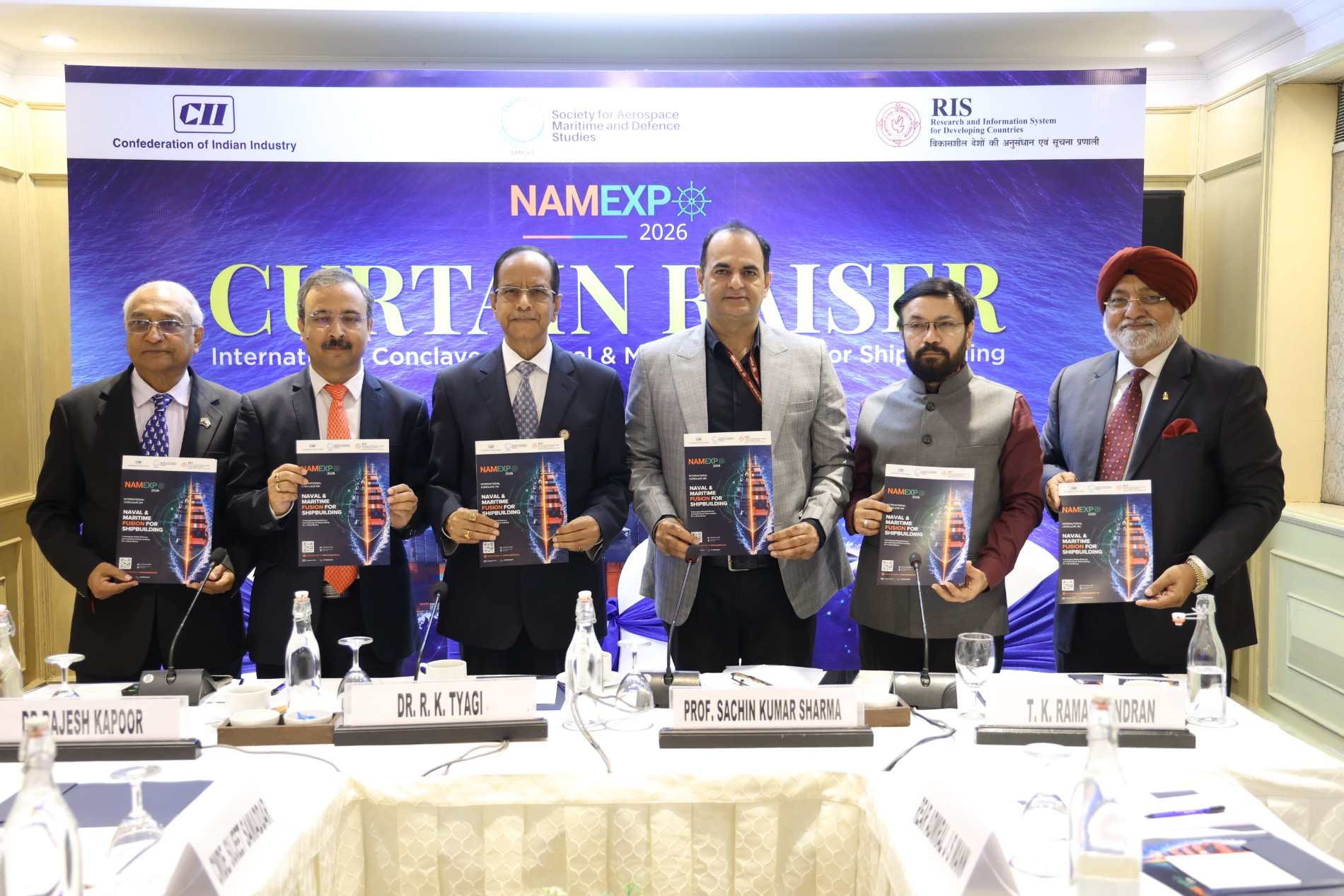
The curtain-raiser ceremony brought together industry leaders, policymakers, defence stakeholders, technology providers and maritime experts. According to the organisers, the initiative is intended to help address fragmentation between naval and commercial shipbuilding and strengthen links among government, industry, academia, financial institutions and international partners.
The announcement comes as India seeks to expand domestic shipbuilding capacity and increase its participation in global maritime manufacturing. The central question is not simply whether India can attract investment, but whether it can build the order pipeline, supplier network, financing framework and production capabilities required to compete consistently in international markets.
NAMEXPO 2026 is being organised jointly by CII, SAMDeS and RIS. Its proposed scope extends beyond defence shipbuilding to include commercial vessels, maritime technologies, marine equipment manufacturing, supply chains, financing institutions and international business partnerships.
A defining feature of the conclave will be its emphasis on the convergence of naval and commercial shipbuilding capabilities. The organisers intend to encourage collaboration in ship design, advanced manufacturing, propulsion systems, digital technologies, certification standards and supply-chain development.
The two segments have different procurement systems, technical requirements and operating environments. Naval programmes are generally shaped by defence requirements, security considerations and government procurement, while commercial shipbuilding is heavily influenced by vessel demand, construction costs, financing, delivery schedules and competition among international yards.
Nevertheless, the segments can share selected capabilities, including engineering expertise, manufacturing processes, digital systems, workforce skills and parts of the marine equipment supply chain. Cooperation will require appropriate technical standards, security safeguards and commercially viable arrangements rather than an assumption that capabilities can be transferred automatically between sectors.
NAMEXPO aims to create a platform where these possibilities can be explored by industry participants and government stakeholders.
A US $300 billion shipbuilding ambition by 2047
The organisers have positioned NAMEXPO within India’s long-term ambition to develop a US$300 billion shipbuilding industry by 2047.
The target signals the scale of industrial transformation being sought. Achieving it would require more than expanding the number of shipyards. India would need a sustained pipeline of orders, competitive construction costs, access to long-term finance, stronger domestic marine equipment manufacturing, reliable delivery performance and a larger skilled workforce.
It would also require greater integration between shipbuilders and the wider maritime economy, including shipping companies, ports, logistics operators, marine engineering firms, classification and certification bodies, research institutions and financial institutions.
The curtain-raiser announcement does not provide a baseline against which progress towards the US$300 billion target can be measured. It also does not specify a detailed investment trajectory, annual production targets or the respective contributions expected from naval and commercial shipbuilding.
NAMEXPO should therefore be understood as an industry-engagement initiative intended to support the broader ambition, rather than as evidence that the target is already within reach.
At the curtain-raiser ceremony, T. K. Ramachandran, Co-Chair of the CII Task Force on Maritime Ecosystem, Professor of Practice at RIS and former Secretary of the Ministry of Ports, Shipping and Waterways, said India had the talent, capabilities and ambition to become a global shipbuilding powerhouse.
Ramachandran emphasised the need to overcome institutional and industrial silos, accelerate indigenisation and bring government, industry, academia and the defence sector together to develop a self-reliant maritime ecosystem.
He also described the current period as an opportunity for international companies to establish shipbuilding facilities, invest in domestic capabilities and build long-term partnerships with Indian industry.
His remarks place international engagement alongside domestic capability development. For India, the objective will be to attract global participation while strengthening local manufacturing, engineering expertise and the ability of Indian companies to supply a larger share of the value embedded in vessels.
Dr R. K. Tyagi, founding member of SAMDeS, former Chairman and Managing Director of Hindustan Aeronautics Limited and Pawan Hans Limited, and Chairman of the Aeronautical Society of India, highlighted the importance of cooperation across countries, institutions, industries and technology disciplines.
Tyagi said the oceans connect nations, economies and societies, and argued that their future cannot be secured through isolated national efforts. He described NAMEXPO as an opportunity to initiate sustained collaboration, partnerships and the development of Indian industry and technologies in naval and commercial shipbuilding.
Professor Sachin Kumar Sharma, Director General of RIS, emphasised the relationship between government policy and industry requirements. He said naval and commercial shipbuilding and shipping require another critical form of integration: cooperation between government and industry. Aligning policy with industrial realities, he argued, is essential to translating ideas into practical outcomes and building a self-reliant maritime sector.
The three interventions converge on a central issue: India’s shipbuilding ambitions will depend on the effectiveness of coordination among public institutions, shipyards, suppliers, technology providers, financiers and international partners.
Shipbuilding is an interconnected industrial activity. A vessel depends on engineering design, steel and other materials, propulsion equipment, electrical systems, navigation technology, safety equipment, specialist components, skilled labour, testing and certification.
A stronger domestic shipbuilding ecosystem could create opportunities for marine equipment manufacturers, engineering companies, electronics suppliers, fabrication businesses, technology firms and micro, small and medium enterprises (MSMEs).
The organisers expect NAMEXPO to bring these participants into contact with shipyards, original equipment manufacturers (OEMs), investors and financial institutions. The intended outcomes include commercial partnerships, investment, technology collaboration and new orders.
However, an event’s ability to convene stakeholders is different from its ability to generate sustained industrial demand. The value of the conclave will ultimately depend on whether discussions result in identifiable projects, supplier agreements, financing commitments, technology partnerships or vessel orders.
India’s shipbuilding capacity: The demand and financing challenge
The curtain-raiser material identifies a cycle of limited demand and constrained capacity as a challenge facing the industry. It also points to shipyard clusters, infrastructure status for the shipping sector and legislative reforms as factors that could support expansion.
The relationship between demand and capacity is important. Shipyards may be reluctant to invest in production facilities, equipment and skilled personnel without visibility over future orders. Buyers, meanwhile, may hesitate to place orders if construction costs, delivery timelines, financing or technical capabilities are less competitive than alternatives available internationally.
Breaking this cycle requires progress on both sides.
On the demand side, the industry needs a stronger pipeline of commercially viable vessel orders and clear procurement visibility. On the supply side, shipyards need access to finance, modern production equipment, engineering capabilities, trained workers and reliable suppliers.
Infrastructure status and legislative reforms may improve the environment for investment, but they do not automatically resolve every commercial constraint. The practical effect depends on the detailed policy framework, availability of finance, project economics and the willingness of buyers to place orders with Indian yards.
The supplied curtain-raiser announcement does not quantify the current demand gap, shipyard utilisation, domestic component dependence or financing requirements. These indicators would be needed to assess how quickly the industry can expand.
A globally competitive shipbuilding industry cannot rely solely on assembling vessels at domestic yards. Competitiveness also depends on the availability, cost, quality and delivery reliability of the equipment and components installed on board.
The NAMEXPO agenda explicitly includes marine equipment manufacturing, OEMs, technology providers and MSMEs. This is significant because suppliers can influence construction schedules, maintenance requirements, lifecycle costs and the ability of shipyards to meet international specifications.
A stronger supplier base could also allow Indian companies to participate in export markets beyond the sale of complete vessels. Marine equipment, engineering services, software, repair services and specialist components can all contribute to the wider maritime manufacturing economy.
Yet indigenisation must be assessed by capability and commercial performance, not by the existence of local production alone. Domestic suppliers need to meet required technical standards, provide dependable after-sales support, maintain competitive pricing and deliver at the scale required by shipyards.
NAMEXPO could help identify gaps and encourage partnerships. Whether it leads to a more resilient supplier base will depend on the agreements and investments that follow.
Global partnerships: Investment opportunity or implementation test?
The organisers have invited shipyards, maritime companies, OEMs, technology providers, financial institutions, investors, start-ups and international maritime stakeholders to participate.
The invitation is directed both at established industry participants and businesses considering entering or diversifying into shipbuilding and maritime manufacturing.
For international companies, potential opportunities include investment in production facilities, joint ventures, technology partnerships, supplier agreements and collaboration with Indian shipyards. For Indian companies, international engagement could provide access to technical expertise, new markets, specialised equipment and global supply chains.
Partnerships will nevertheless require commercially sound arrangements. Investors will assess order visibility, policy stability, access to infrastructure, workforce availability, technology requirements and the expected return on capital. Indian businesses will need to assess the terms of technology transfer, the role of domestic suppliers, intellectual property considerations and the long-term distribution of value.
The curtain-raiser material identifies these areas as opportunities but does not announce specific investment commitments, signed joint ventures or confirmed vessel orders. Any assessment of NAMEXPO’s commercial impact will need to distinguish future possibilities from documented transactions.
Stakeholder-chain analysis: Where shipbuilding value is created
The shipbuilding ecosystem extends well beyond the shipyard gate. Its main stages include:
Vessel owner or government buyer → Financing and project contracting → Ship design and engineering → Materials and marine equipment suppliers → Shipyard fabrication and assembly → Integration, testing and certification → Delivery and commissioning → Operations, maintenance and repair
Each stage affects the competitiveness of the final vessel.
| Stakeholder | Role in the value chain | Key issue for India |
|---|---|---|
| Vessel owners and government buyers | Generate demand through orders and procurement | Long-term order visibility and commercially viable contracts |
| Banks, investors and financing institutions | Finance vessels, shipyards and production expansion | Access to affordable, suitable long-term finance |
| Ship designers and engineering firms | Develop vessel designs and technical specifications | Design capability, innovation and technology access |
| Marine equipment manufacturers and OEMs | Supply propulsion, electrical, navigation and other systems | Domestic availability, quality, cost and delivery reliability |
| Shipyards | Fabricate, assemble, integrate and deliver vessels | Productivity, capacity, skilled labour and schedule performance |
| Classification and certification organisations | Verify compliance with applicable technical and safety requirements | Timely certification and adherence to relevant standards |
| Government and policy institutions | Set regulatory conditions and support industrial development | Clear policies, predictable implementation and effective coordination |
| International partners | Provide markets, technology, investment and supply-chain connections | Mutually beneficial partnerships and sustainable domestic capability |
NAMEXPO’s potential value lies in connecting these stakeholders. Its impact will be greater if engagement results in specific commercial and technical outcomes rather than remaining limited to general policy discussion.
What should be measured after NAMEXPO 2026?
To assess whether the conclave advances India’s shipbuilding ambitions, subsequent reporting should look for measurable outcomes.
These include confirmed investment commitments, new vessel orders, joint ventures, technology agreements, domestic supplier contracts, shipyard expansion plans and workforce-development initiatives.
It would also be useful to monitor whether the event produces a follow-up mechanism that assigns responsibilities and timelines to participating institutions. Without such a mechanism, it may be difficult to determine whether discussions have progressed into implementation.
The organisers have positioned NAMEXPO as a platform for dialogue, collaboration, investment and business engagement. The event’s contribution to the US$300 billion ambition will be clearer when its outcomes can be connected to specific projects, orders and industrial capabilities.
Frequently Asked Questions (FAQs)
1. What is NAMEXPO 2026?
NAMEXPO 2026 is an international conclave focused on naval and commercial shipbuilding. It is designed to bring together industry, government, defence stakeholders, technology providers, investors and international partners to explore collaboration and business opportunities across the shipbuilding value chain.
2. When and where will NAMEXPO 2026 take place?
The conclave is scheduled for 1–2 December 2026 at the Manekshaw Centre in New Delhi.
3. Who is organising NAMEXPO 2026?
The event is being organised jointly by the Confederation of Indian Industry (CII), Society for Aerospace, Maritime and Defence Studies (SAMDeS), and Research and Information System for Developing Countries (RIS).
4. What is India’s stated shipbuilding ambition for 2047?
The organisers say the initiative aligns with India’s ambition to develop a US$300 billion shipbuilding industry by 2047. The supplied announcement does not provide a detailed financial roadmap or annual milestones for achieving the target.
5. Why does NAMEXPO focus on naval and commercial shipbuilding together?
The two segments have different procurement and operating requirements but may share selected engineering, manufacturing, digital and supplier capabilities. The conclave aims to encourage collaboration while supporting the development of a stronger domestic maritime industrial base.
6. Which areas of the shipbuilding industry will the event cover?
The planned scope includes defence and commercial shipbuilding, commercial vessels, ship design, propulsion systems, advanced manufacturing, digital technologies, marine equipment, certification, supply chains, financing and international partnerships.
7. How could NAMEXPO benefit Indian MSMEs?
MSMEs involved in fabrication, engineering, electronics, marine equipment, digital technology and specialist manufacturing could use the platform to connect with shipyards, OEMs, investors and potential international partners. Actual benefits will depend on whether these interactions lead to contracts, investments or supplier agreements.
8. Has NAMEXPO announced confirmed investments or shipbuilding orders?
The supplied curtain-raiser announcement describes expected business outcomes and opportunities but does not identify specific confirmed investments, joint ventures or vessel orders resulting from the event.
9. What are the main challenges facing India’s shipbuilding ambitions?
Key challenges include building a sustained order pipeline, improving access to finance, expanding domestic marine equipment manufacturing, strengthening design and engineering capabilities, developing a skilled workforce and ensuring reliable delivery schedules at competitive costs.
10. How can the impact of NAMEXPO 2026 be evaluated?
Useful indicators include confirmed vessel orders, investment commitments, supplier agreements, technology partnerships, shipyard expansion projects, workforce-development programmes and evidence of follow-up implementation after the conclave.
Also Read: Edible Oil Import Duty Cut: Who Gets the Benefit — Importers, Refiners, Farmers or Consumers?
NAMEXPO 2026 is being positioned as a platform to bring together the institutions and companies needed to strengthen India’s shipbuilding ecosystem. Its focus on naval–commercial cooperation, marine equipment manufacturing, financing and international partnerships reflects the interconnected nature of shipbuilding as an industrial activity.
India’s ambition to develop a US$300 billion shipbuilding industry by 2047 is substantial. Achieving it will require more than policy announcements or industry gatherings: it will depend on sustained demand, competitive finance, capable shipyards, reliable domestic suppliers, skilled workers and effective cooperation between government and industry.
The key question after 1–2 December will be what the conclave delivers in measurable terms. New orders, investment commitments, technology partnerships and supplier contracts will provide stronger evidence of progress than participation figures or declarations of intent alone.
Sources
Primary source: NAMEXPO 2026 curtain-raiser announcement supplied for this report, dated 23 October 2026. The source identifies the organisers, event schedule, stated industrial ambition and remarks by T. K. Ramachandran, Dr R. K. Tyagi and Professor Sachin Kumar Sharma.
Organisations named in the announcement:
- Confederation of Indian Industry (CII)
- Society for Aerospace, Maritime and Defence Studies (SAMDeS)
- Research and Information System for Developing Countries (RIS)
Make us preferred source on Google
Reporting by MaritimeNews Bureaus, Writing by Harpal S Naol; Editing by Jaspal Singh Naol.