

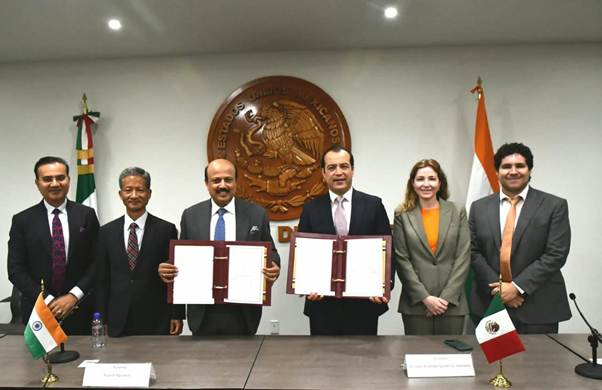
India and Mexico have launched negotiations for a Preferential Trade Agreement as official Indian data shows bilateral trade declined to US$7.83 billion in FY 2025–26. The proposed agreement could improve market access and trade facilitation, but its significance will depend on whether negotiations translate into sustained trade growth and measurable benefits for supply chains and maritime logistics.
Make us preferred source on Google
Key Takeaways
- Bilateral trade contracted: India–Mexico merchandise trade fell 9.11%, from US$8.62 billion in FY 2024–25 to US$7.83 billion in FY 2025–26, according to the figures supplied from the Department of Commerce’s TradeStat portal.
- Imports recorded the sharper decline: Indian imports from Mexico fell 26.59% to US$2.11 billion, while exports to Mexico edged down 0.38% to US$5.73 billion.
- India’s trade surplus widened: The surplus rose from US$2.88 billion to US$3.62 billion, even as total bilateral trade declined.
- Negotiations have formally begun: On 28 October 2026, India and Mexico signed the Terms of Reference for negotiations on a Preferential Trade Agreement (PTA).
- August figures show a contrasting picture: OEC data supplied for August 2026 records year-on-year increases in both exports and imports. This monthly performance does not, by itself, establish that the annual decline has been reversed.
- The maritime question: Will a new trade framework generate sustained additional cargo, stronger logistics links and greater predictability for businesses, or will its benefits remain limited by other commercial and operational constraints?
The Government of India’s Department of Commerce recorded total India–Mexico trade of US$7.83 billion in FY 2025–26, down from US$8.62 billion in the preceding financial year. The 9.11% decline raises questions about the performance of an important commercial relationship and the potential for a new trade framework to expand market access and business opportunities.
The signing of the Terms of Reference on 28 October establishes the framework, scope, modalities and roadmap for negotiations. The agreement is not yet concluded, and the announcement does not establish that the decline in trade was the reason negotiations were initiated.
Nevertheless, the timing makes the trade figures an important part of the policy context. The central question is whether the proposed PTA can help both countries expand commercial engagement and generate sustained growth across the businesses, logistics networks and supply chains that support bilateral trade.
Official announcement: Government of India, Press Information Bureau, Ministry of Commerce and Industry, 28 October 2026.
1. Official Trade Data Shows a 9.11% Contraction
India’s official financial-year statistics reveal that bilateral trade declined substantially in FY 2025–26.
According to the figures in the Department of Commerce’s TradeStat country-wise trade report, total trade between India and Mexico fell from US$8,618.03 million in FY 2024–25 to US$7,833.27 million in FY 2025–26.
The contraction was driven primarily by a decline in India’s imports from Mexico. Indian exports to Mexico also decreased, but only marginally.
India–Mexico Bilateral Trade
Values in US$ million; financial years as reported in the supplied TradeStat data.
| Indicator | FY 2024–25 | FY 2025–26 | Year-on-year change |
|---|---|---|---|
| India’s exports to Mexico | 5,749.01 | 5,727.12 | −0.38% |
| India’s imports from Mexico | 2,869.02 | 2,106.15 | −26.59% |
| Total bilateral trade | 8,618.03 | 7,833.27 | −9.11% |
| India’s trade surplus | 2,879.99 | 3,620.97 | Increased |
Source: Department of Commerce, Government of India, TradeStat country-wise total trade data. The figures are reproduced from the supplied report.
The data reveals three important developments.
First, India’s exports to Mexico were broadly flat, falling by just US$21.89 million. This suggests that the overall decline cannot be explained by a significant fall in Indian exports alone.
Second, imports from Mexico declined by US$762.87 million, making them the main contributor to the reduction in bilateral trade value.
Third, India’s trade surplus increased by approximately US$741 million. This is not evidence of stronger bilateral trade overall: the surplus widened principally because imports fell more sharply than exports.
The figures establish the scale and direction of the contraction, but they do not identify its causes. Product-level data, tariff information and business evidence would be needed to determine whether the decline resulted from commodity prices, demand, sourcing decisions, regulatory barriers or other factors.
Official data source: Department of Commerce, Government of India — TradeStat, country-wise trade report.
Against this economic backdrop, India and Mexico signed the Terms of Reference for negotiations on a Preferential Trade Agreement on 28 October 2026.
The Government of India’s Press Information Bureau said the Terms of Reference establish the framework, scope, modalities and roadmap for the negotiations. The proposed agreement is intended to create economic opportunities, expand bilateral trade, support investment flows and contribute to resilient and diversified supply chains.
The Indian delegation was led by Commerce Secretary Rajesh Agrawal. Mexico’s Undersecretary of Foreign Trade, Luis Rosendo Gutiérrez Romano, participated on behalf of Secretary of Economy Marcelo Ebrard Casaubon.
The initiative follows an understanding reached between Prime Minister Narendra Modi and Mexican President Claudia Sheinbaum during their meeting on the sidelines of the G7 Summit in Canada in June 2025. According to the Indian government, the two leaders agreed to strengthen and deepen the India–Mexico partnership.
The negotiations therefore form part of a broader effort to develop bilateral economic relations. The available announcement, however, does not explicitly state that the fall in annual trade prompted the negotiations.
That distinction matters. The trade decline provides a measurable reason to examine the proposed agreement’s potential impact, but the effectiveness of the PTA will ultimately depend on its negotiated provisions and their implementation.
Primary source: PIB announcement, India and Mexico launch Negotiations for Preferential Trade Agreement, Sign Terms of Reference, 28 October 2026.
3. What Will the PTA Negotiations Cover?
The Terms of Reference identify several areas that could influence the cost, predictability and ease of trading between the two countries.
Market access for goods
Negotiations on market access could determine the preferential treatment available to selected goods. The commercial impact would depend on the products covered, the concessions agreed by each country and the conditions attached to those concessions.
For Indian exporters, improved access could create opportunities in sectors identified by the government, including automotive products, chemicals, electronics, pharmaceuticals, agri-food, medical devices and advanced manufacturing.
The agreement’s actual benefits cannot be quantified until the negotiated tariff commitments and product coverage are known.
Rules of origin
Rules of origin determine whether a product qualifies for preferential treatment under a trade agreement. They can be particularly important where manufacturing involves components or intermediate goods sourced from multiple countries.
Clear and commercially workable rules could help eligible businesses understand how to qualify for preferences. Complex or restrictive requirements, by contrast, could limit their practical value.
Customs procedures and trade facilitation
Customs procedures and trade facilitation are directly relevant to cross-border logistics. Documentation requirements, processing arrangements and administrative predictability can influence the time and cost involved in moving goods through international supply chains.
For importers, exporters, freight forwarders, customs brokers and other logistics providers, the practical value of these provisions would depend on the final commitments and their implementation.
Technical barriers and sanitary requirements
The negotiations also cover technical barriers to trade and sanitary and phytosanitary measures.
These areas can affect products that must comply with technical standards, testing, certification or health-related requirements. Their significance will vary across sectors, and the negotiations’ eventual provisions will determine whether businesses face fewer procedural obstacles.
Dispute settlement and trade remedies
The Terms of Reference also include dispute settlement and trade remedies. These mechanisms can shape how disagreements and trade-related concerns are handled under the eventual agreement.
Taken together, the negotiating areas extend beyond tariffs. They could influence the broader conditions under which businesses trade, document shipments and organise their supply chains.
Important qualification: The signing of the Terms of Reference launches negotiations; it does not mean that tariff reductions, simplified customs procedures or other preferential measures have already entered into force.
The annual decline is not the only available indicator of India–Mexico trade performance.
Monthly product-level figures supplied from the Observatory of Economic Complexity (OEC) show that India’s trade with Mexico increased year on year in August 2026.
According to those figures, India exported US$615 million to Mexico in August 2026, compared with US$471 million in August 2025. Imports from Mexico rose to US$435 million from US$278 million.
August Trade Comparison
Values in US$ million.
| Indicator | August 2025 | August 2026 | Change |
|---|---|---|---|
| India’s exports to Mexico | 471 | 615 | +30.6% |
| India’s imports from Mexico | 278 | 435 | +56.6% |
| Total bilateral trade | 749 | 1,050 | +40.2% |
| India’s trade balance | +193 | +180 | Lower surplus |
Source: OEC bilateral trade data supplied for this article. Figures are monthly trade values.
The monthly figures indicate that bilateral trade was substantially higher in August 2026 than in the same month a year earlier. Exports increased by US$144 million, while imports rose by US$157 million.
India nevertheless retained a positive trade balance in the month, although the surplus narrowed from US$193 million to US$180 million.
Why the annual and monthly figures must be read together
The August increase does not contradict the decline recorded for FY 2025–26 because the figures refer to different reporting periods.
The annual data covers the financial year ending in March 2026. The August 2026 figures concern a single month in the subsequent financial year.
The two datasets therefore show different aspects of the trade relationship: a contraction over the completed financial year and a substantial year-on-year increase in one later month.
The monthly figures are encouraging, but they are not enough to establish a durable recovery. Further monthly data would be required to determine whether the August increase continued.
Differences in data sources, classifications and reporting methodologies should also be considered when comparing the datasets.
5. Which Products Are Driving the Monthly Trade?
The supplied OEC figures identify several major product categories in August 2026.
India’s leading exports to Mexico
| Product category | August 2026 value |
|---|---|
| Motor vehicles/cars | US$120 million |
| Telecommunications instruments | US$83 million |
| Automotive components and parts | US$49.8 million |
The figures identify automotive products and telecommunications equipment as important components of India’s exports to Mexico in the reported month.
The supplied data also indicates notable year-on-year increases in selected export categories:
- Telecommunications instruments increased by US$72.5 million, or 692%.
- Automotive components and parts increased by US$22.3 million, or 80.9%.
- Other construction machinery increased by US$10.3 million, or 156%.
These figures suggest that some product categories experienced substantial growth even while the longer financial-year trade total declined.
However, a sharp increase in one month’s value does not establish a long-term export trend. Nor does the value of a product category reveal how much physical cargo was transported.
India’s leading imports from Mexico
| Product category | August 2026 value |
|---|---|
| Computer hardware and peripherals | US$188 million |
| Crude petroleum | US$88.3 million |
| Manufactured fertilisers | US$49.8 million |
The supplied figures also identify increases in selected import categories:
- Computer hardware and peripherals increased by US$175 million, approximately 1,410%.
- Crude petroleum increased by US$33.1 million, or 60.1%.
- Telecommunications instruments increased by US$18 million, or 69.2%.
The computer hardware figure is particularly prominent in the monthly comparison. Yet the data alone does not establish whether this increase represents a sustained sourcing shift, an unusually low comparison base, the timing of shipments or another factor.
The annual decline in imports and the strong August increase therefore need further product-level and multi-month examination before firm conclusions can be drawn about structural changes in India’s sourcing from Mexico.
Source for monthly product figures and changes: OEC data supplied for this article. Values are not physical shipment volumes.
For MaritimeNews, the significance of the proposed PTA extends beyond the headline value of bilateral merchandise trade.
A trade agreement can influence the conditions under which goods are exchanged, but its effect on maritime transport depends on whether it generates additional physical cargo, changes sourcing patterns or alters logistics requirements.
The products identified in the August data illustrate why the relationship deserves examination across different parts of the supply chain.
Automotive exports and components
Motor vehicles and automotive components can involve multiple movements between manufacturers, suppliers, distributors and buyers.
If the PTA eventually improves market access and contributes to sustained growth in automotive trade, it could create additional logistics requirements for eligible goods. The effect on maritime transport would depend on shipment volumes, the transport mode selected and the resulting movement through ports and inland logistics networks.
The current data does not establish that vehicle or component cargo volumes have increased.
Electronics and computer hardware
Telecommunications instruments and computer hardware feature prominently in the supplied monthly figures.
These products can form part of complex international manufacturing and distribution networks. Their trade performance may therefore be relevant to businesses involved in freight forwarding, cargo handling and supply-chain planning.
However, the value of electronics trade cannot be directly translated into container volumes, shipping demand or port throughput. Such conclusions require physical cargo and transport data.
Crude petroleum and fertilisers
Crude petroleum and manufactured fertilisers appear among India’s leading imports from Mexico in the August data.
These categories have different handling, storage and transport requirements. Crude petroleum movements may involve specialised liquid-bulk logistics, while fertilisers can move through different cargo-handling arrangements depending on the product and shipment.
The supplied figures do not identify the transport mode, the ports used or the quantities shipped. They therefore cannot establish a corresponding increase or decrease in tanker movements, bulk cargo or port activity.
Customs and trade facilitation
The PTA’s proposed focus on customs procedures and trade facilitation is particularly relevant to the wider logistics chain.
The practical outcome will depend on whether the final agreement and its implementation make documentation, regulatory compliance and cross-border processing more predictable for businesses.
For the maritime sector, the relevant question is not simply whether trade values rise. It is whether firms can move goods more reliably and competitively across the entire supply chain.
Any improvement in India–Mexico trade would need to pass through a network of commercial and logistics participants.
The following is an analytical framework for assessing possible effects, not a claim that the agreement has already improved these operations.
| Stakeholder | Potential relevance of the PTA | What needs to be measured |
|---|---|---|
| Manufacturer or trader | Greater commercial access and potential new orders | Export orders, product coverage and sales |
| Export documentation provider | Compliance with origin and trade-document requirements | Documentation costs, processing time and errors |
| Customs broker | Application of customs rules and preferential treatment | Clearance times and compliance costs |
| Customs authorities | Implementation of agreed procedures | Processing predictability and release times |
| Freight forwarder or NVOCC | Coordination of international cargo movements | Freight costs, booking patterns and shipment frequency |
| CFS or ICD operator | Handling and consolidation of relevant cargo | Actual cargo volumes and utilisation |
| Inland logistics provider | Movement between production centres and ports | Transit times, reliability and costs |
| Port or terminal | Handling of cargo moving through the port | Recorded throughput by cargo type |
| Shipping line | Capacity planning for relevant trade lanes | Cargo bookings, load factors and service demand |
| Overseas buyer | Procurement, delivery and supply-chain planning | Landed cost, delivery reliability and order growth |
The agreement’s ultimate value will depend on the extent to which any benefits at the market-access level translate into commercially viable shipments and more efficient logistics operations.
For example, a tariff concession may improve a product’s competitiveness, but the benefit could be reduced by expensive freight, regulatory requirements, weak demand or unreliable delivery schedules.
Conversely, clearer customs procedures could reduce administrative friction without necessarily generating a large increase in trade volumes.
The policy test is therefore measurable performance across the supply chain, not simply the signing of an agreement.
8. Mexico’s Proposed Business Mission to India in Q1 2027
The Indian government said the two delegations also discussed the possibility of organising a Mexican business mission to India during the first quarter of 2027.
The proposed mission would facilitate business-to-business meetings, help identify commercial opportunities and strengthen ties between businesses in both countries.
If organised, the mission could provide a channel for companies to explore partnerships, assess demand and identify products with commercial potential. It could also help businesses understand regulatory requirements and possible supply-chain arrangements.
For the maritime and logistics sectors, the practical value would depend on whether discussions lead to concrete commercial commitments, repeat orders and additional shipments.
The mission remains a possibility discussed by the delegations, rather than a confirmed event with a published programme in the announcement.
The launch of negotiations creates an opportunity to improve the trade framework, but several questions remain unanswered.
First, the causes of the annual decline have not been established. The supplied TradeStat figures show that imports fell much more sharply than exports. They do not explain why. Product-level annual data and evidence from businesses would be needed to identify the main drivers.
Second, the agreement’s commercial terms are not yet known. The Terms of Reference identify negotiating areas, but the final tariff commitments, product coverage and implementation arrangements have not been established by the announcement.
Third, the monthly increase requires follow-up. August 2026 trade values were significantly higher than a year earlier, but one month cannot demonstrate that the annual contraction has been reversed.
Fourth, trade value is not the same as cargo volume. Changes in the value of petroleum, electronics, vehicles or fertilisers may reflect changes in prices, quantities or product composition. The supplied datasets do not identify the transport mode or establish changes in port throughput.
Finally, a trade agreement cannot guarantee commercial growth. Businesses must still find competitive products, buyers, reliable suppliers and workable logistics arrangements. Regulatory compliance, freight costs, demand and other commercial factors will influence whether preferential access translates into actual trade.
The PTA should therefore be evaluated through its final terms and subsequent performance—not solely through the announcement of negotiations.
10. What Maritime Stakeholders Should Watch Next
Several developments will help establish whether the proposed agreement produces meaningful results.
- Negotiating progress: The scope of product coverage, tariff commitments and the treatment of sensitive sectors.
- Rules of origin: Whether businesses can understand and meet the requirements to qualify for preferential treatment.
- Customs implementation: Whether the final arrangements reduce procedural uncertainty or administrative costs.
- Product-level trade: Whether the categories that experienced strong monthly growth maintain their performance over subsequent months.
- Import recovery: Whether India’s imports from Mexico stabilise after the substantial decline recorded in FY 2025–26.
- Business participation: Whether the proposed Mexican business mission and related commercial engagement lead to identifiable transactions.
- Physical cargo evidence: Whether later data shows changes in shipment frequency, quantities, cargo composition or port throughput.
These indicators would allow a more rigorous assessment of whether the PTA is strengthening the trade relationship and generating tangible benefits for maritime logistics.
Frequently Asked Questions (FAQs)
1. Why is India negotiating a Preferential Trade Agreement with Mexico?
The Government of India says the proposed PTA aims to expand bilateral trade, create business opportunities, enhance investment flows and contribute to resilient and diversified supply chains. The official announcement does not explicitly identify the decline in trade as the reason negotiations were initiated.
2. How much did India–Mexico trade decline in FY 2025–26?
According to the supplied Department of Commerce TradeStat figures, total bilateral trade fell from US$8.62 billion in FY 2024–25 to US$7.83 billion in FY 2025–26, a decline of 9.11%.
3. What caused the decline in bilateral trade?
The available figures show that India’s imports from Mexico fell by 26.59%, while exports declined by 0.38%. The data establishes the direction and scale of the changes but does not identify their underlying causes.
4. Did India–Mexico trade increase in August 2026?
Yes. The supplied OEC data records total bilateral trade of US$1.05 billion in August 2026, compared with US$749 million in August 2025. This is a year-on-year monthly comparison and does not establish that the full-year decline has been reversed.
5. Which products feature prominently in the trade data?
The supplied August figures identify motor vehicles, telecommunications instruments and automotive components among India’s leading exports to Mexico. Computer hardware and peripherals, crude petroleum and manufactured fertilisers feature among India’s leading imports from Mexico.
6. Will the PTA increase shipping and port activity?
It could create opportunities if the agreement leads to sustained additional trade. However, the current data does not establish an increase in physical cargo volumes, port throughput or vessel movements. Those outcomes would need to be measured separately.
7. When will the PTA come into force?
The 28 October 2026 announcement confirms that negotiations have been launched through the signing of the Terms of Reference. It does not establish a final agreement or an implementation date.
8. Is a Mexican business mission to India confirmed for early 2027?
No. The official announcement says the two sides discussed the possibility of organising such a mission during the first quarter of 2027. It does not confirm a final date or programme.
Also Read: Edible Oil Import Duty Cut: Who Gets the Benefit — Importers, Refiners, Farmers or Consumers?
The Measure of Success Will Be Trade Recovery
India and Mexico have taken a formal step towards a new trade framework, but the agreement’s significance must be assessed against the performance of their existing commercial relationship.
The Department of Commerce figures show that bilateral trade declined 9.11% in FY 2025–26, with the sharper fall in India’s imports from Mexico contributing to a larger Indian trade surplus. The supplied August 2026 data offers a more positive monthly picture, but it is too early to conclude that the annual contraction has been reversed.
The PTA negotiations create an opportunity to address market-access issues, establish rules of origin and improve the framework for customs procedures and trade facilitation. Whether those measures lead to higher trade will depend on the final terms, business uptake and wider commercial conditions.
For MaritimeNews, the decisive question is whether the negotiations eventually translate into sustained trade growth and measurable improvements across the supply chain—from manufacturers and exporters to freight forwarders, ports, terminals and shipping lines.
The agreement has entered the negotiating stage. Its real test will be whether India and Mexico can turn that process into durable commercial growth.
Sources and Reporting Basis
- Primary announcement: Press Information Bureau — India and Mexico launch Negotiations for Preferential Trade Agreement, Sign Terms of Reference.
- India’s Department of Commerce: TradeStat — Country-wise Total Trade Report
- Country trade profiles: India — OEC and Mexico — OEC.
Make us preferred source on Google
Reporting by MaritimeNews Bureaus, Writing by Harpal S Naol; Editing by Jaspal Singh Naol.


