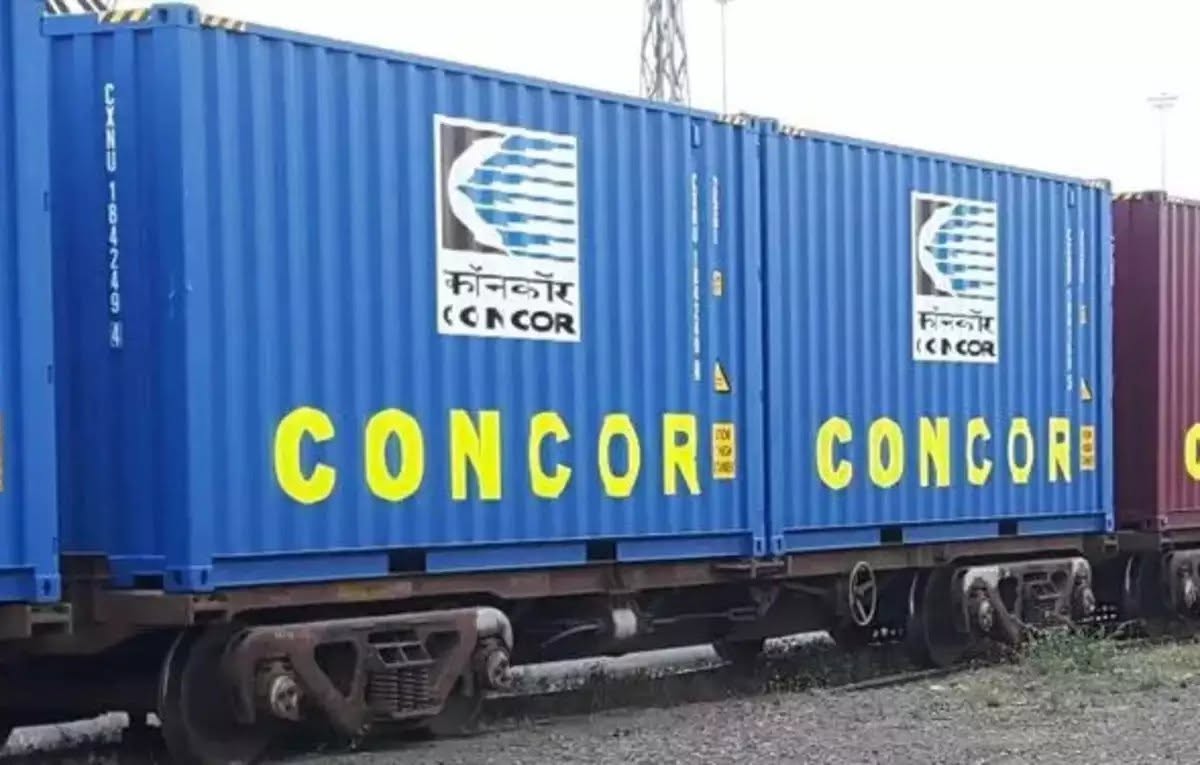

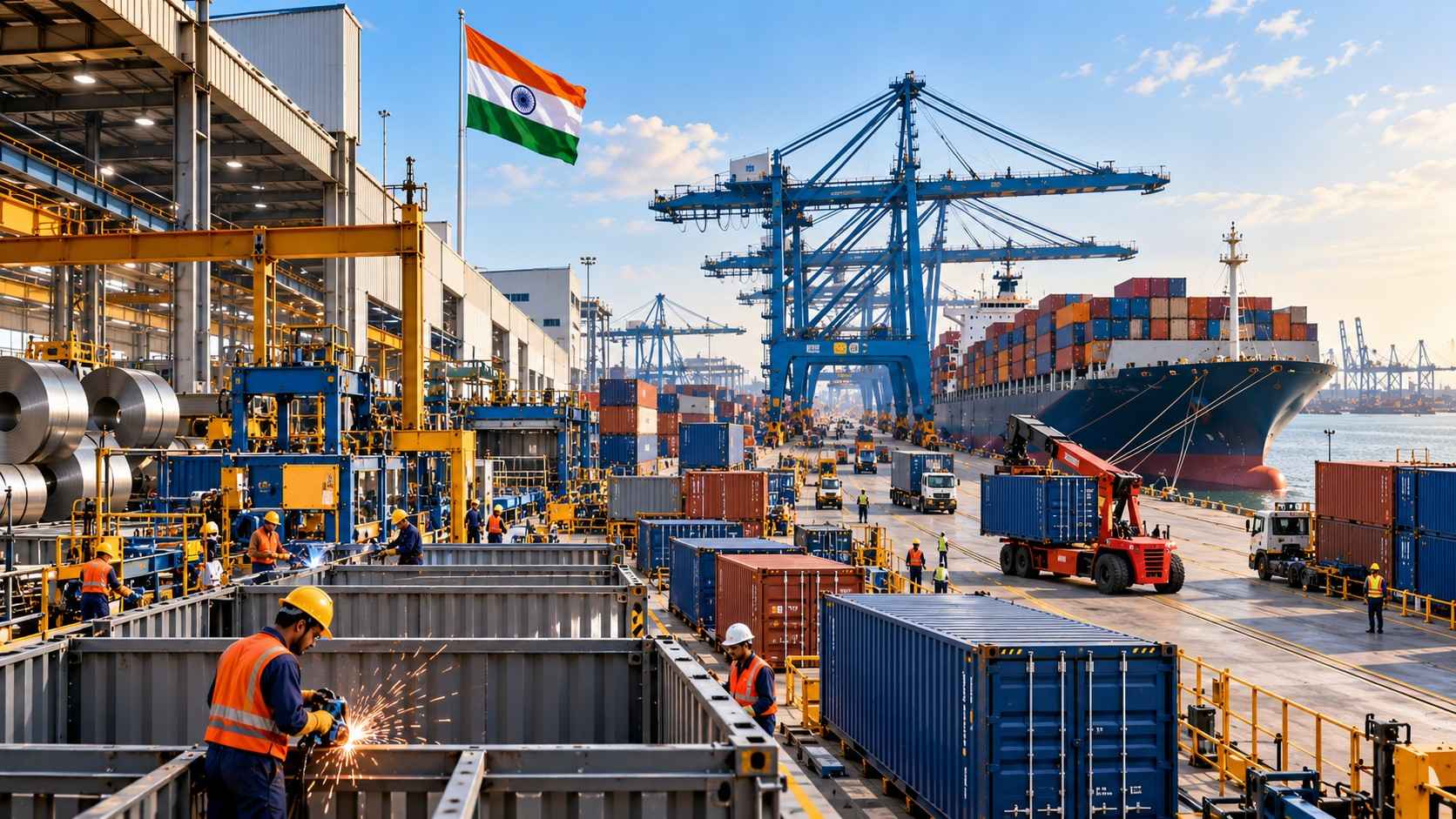
The Union Cabinet has approved a ₹10,000-crore Container Manufacturing Promotion Scheme to increase India’s annual container manufacturing capacity nearly ten-fold to 7.5 lakh TEUs. The programme aims to develop a globally competitive industry, strengthen domestic supply chains and reduce dependence on imported shipping containers, but its success will depend on cost competitiveness, manufacturing quality, domestic component availability and sustained demand.
Key Takeaways
- ₹10,000 crore approved: The Union Cabinet approved the Container Manufacturing Promotion Scheme (CMPS) on 28 October 2026.
- Capacity target: Annual domestic manufacturing capacity is projected to rise from approximately 70,000 TEUs to 7.5 lakh TEUs.
- Import dependence: The government says almost all containers used by India are manufactured abroad, creating a strategic case for developing domestic production.
- Largest allocation: Operational Expenditure Assistance accounts for ₹8,891 crore of the total outlay, intended to improve the price competitiveness of Indian-made containers.
- Domestic content: Minimum local-content requirements are scheduled to rise from 70% through FY 2031–32 to 90% from FY 2032–33.
- Port-linked manufacturing: Eligible manufacturers may receive land-leasing support at 25% of the notified rate at major ports.
- Employment and output projections: The government estimates approximately 3,000 direct jobs, more than 50,000 indirect jobs and ₹75,000 crore in economic output by FY 2039–40.
- The implementation challenge: Achieving the production target will require investment, internationally competitive quality, reliable component supply chains and sufficient commercial demand.
The Union Cabinet, chaired by Prime Minister Narendra Modi, approved the Container Manufacturing Promotion Scheme (CMPS) on 28 October 2026. Announced in the Union Budget 2026–27, the scheme will operate from FY 2027–28 to FY 2039–40, with three years allocated for establishing manufacturing facilities and ten years of production support.
The programme aims to raise India’s annual container manufacturing capacity from approximately 70,000 TEUs to 7.5 lakh TEUs—an increase of around ten-fold. It will support both new factories and the expansion of existing manufacturing units.
Union Minister for Ports, Shipping and Waterways Sarbananda Sonowal welcomed the approval, crediting Prime Minister Narendra Modi’s leadership and describing the scheme as a step towards reducing import dependence and securing India’s logistics chain.
The government’s stated objective extends beyond manufacturing more containers. It is to establish a domestic industrial ecosystem capable of supplying the containers required by exporters, importers, shipping lines and logistics operators, while creating opportunities for steel, component manufacturing and other ancillary industries.
Primary source: Government of India, Press Information Bureau, Ministry of Ports, Shipping and Waterways, Cabinet approves Rs 10,000 Crore Scheme to Make India a Global Container Manufacturing Hub.
1. Why Container Manufacturing Matters to India’s Maritime Economy
Shipping containers are central to modern cargo transportation. Standardised containers allow goods to move between ships, trucks and trains without requiring the cargo to be unloaded and repacked at every transfer point.
This intermodal system supports international trade by enabling more predictable cargo handling, consolidation and distribution. Containers are used to transport a wide range of manufactured products, consumer goods, machinery, components and other merchandise.
India’s dependence on imported containers therefore has implications beyond the manufacturing sector. It connects the country’s trade requirements with industrial production, access to materials, container availability and the wider logistics network.
According to the government announcement, almost all containers used by India are manufactured abroad. The proposed scheme seeks to change this position by creating a domestic production base capable of meeting a greater share of India’s requirements and potentially serving overseas markets.
The government’s Maritime Amrit Kaal Vision projects Indian container traffic rising from approximately 24 million TEUs in 2024 to 175 million TEUs by 2047.
These figures refer to container traffic, not the number of containers India needs to manufacture each year. Traffic represents the movement of containerised cargo through the logistics system, whereas manufacturing capacity measures the industry’s ability to produce containers. The two are related, but they are not interchangeable.
As container traffic grows, demand may arise not only for additional containers but also for replacements as existing equipment ages or becomes unsuitable for particular operations.
The government’s manufacturing strategy is designed to prepare domestic industry for these anticipated requirements.
The CMPS combines interest support for capital investment, assistance towards operating costs, testing and certification support, and scheme administration.
Financial allocation
| Scheme component | Financial allocation | Main purpose |
|---|---|---|
| Interest Subvention Assistance | ₹859 crore | Reduce eligible borrowing costs for new facilities and capacity expansion |
| Operational Expenditure Assistance | ₹8,891 crore | Improve the competitiveness of domestically manufactured containers |
| Testing and Certification Assistance | ₹150 crore | Support common testing and certification facilities |
| Scheme management | ₹100 crore | Administration, monitoring and capacity building |
| Total | ₹10,000 crore | Develop a globally competitive container manufacturing ecosystem |
Source: Government of India, Ministry of Ports, Shipping and Waterways, PIB announcements dated 28 October 2026.
The allocation structure is significant. Most of the support is directed towards operational expenditure rather than capital investment alone.
This suggests that the policy challenge is not simply to build factories. Domestic manufacturers must also be able to produce containers at prices and quality levels that make them commercially competitive.
The final outcome will depend on how the scheme is implemented, which manufacturers qualify, how assistance is calculated and whether production can achieve sustainable cost efficiencies.
3. Interest Subvention: Incentivising New Factories and Expansion
The scheme allocates ₹859 crore for Interest Subvention Assistance (ISA).
Eligible manufacturers will receive interest subvention of 3% per year on qualifying term loans used for capital investment in container manufacturing facilities.
The scheme identifies two broad categories:
- Greenfield facilities: New manufacturing plants must have an annual production capacity of at least 1,00,000 TEUs.
- Brownfield expansion: Existing facilities must add at least 25,000 TEUs of annual capacity.
The support is intended to reduce financing costs for businesses investing in new production facilities or expanding existing operations.
Container manufacturing requires investment in industrial premises, production equipment, material handling, quality control and testing. Access to financing at a lower effective interest cost could improve the viability of projects that might otherwise struggle to compete with established overseas producers.
However, interest subvention does not eliminate the commercial risks associated with a manufacturing investment. Companies must still secure suitable land, obtain the necessary approvals, arrange materials, develop technical expertise and establish a dependable customer base.
The minimum capacity thresholds also indicate that the scheme is designed to encourage manufacturing at a meaningful industrial scale rather than support only small production operations.
The largest component of CMPS is Operational Expenditure Assistance (OEA), with an allocation of ₹8,891 crore.
The government says the assistance will support containers manufactured to global shipping standards and sold by eligible manufacturers. Its stated purpose is to bridge the cost gap with imported containers and improve the competitiveness of domestic production.
According to the detailed PIB backgrounder, the indicative assistance per container is:
| Container category | Indicative assistance |
|---|---|
| Standard 20-foot container | ₹49,500 |
| Standard 40-foot container | ₹86,625 |
| 20-foot specialised container | ₹37,125–₹74,250 |
Source: Government of India, PIB, Container Manufacturing Promotion Scheme backgrounder, 28 October 2026. The applicable assistance will depend on the notified scheme rules and eligibility conditions.
This support is intended to address a fundamental industrial challenge: a new domestic manufacturer must compete with suppliers that already operate established production facilities and supply chains.
The cost of a container depends on several factors, including steel prices, component availability, production efficiency, labour, financing, quality assurance and factory utilisation.
A subsidy can narrow a cost disadvantage, but it cannot permanently replace efficient manufacturing. If domestic production remains structurally expensive after assistance, the industry could continue to depend on government support to compete.
The scheme’s longer-term test will therefore be whether manufacturers use the support period to improve productivity, develop local suppliers, achieve consistent quality and build commercial relationships with shipping and logistics companies.
A central feature of CMPS is the requirement to increase domestic content in manufactured containers.
The detailed PIB backgrounder specifies the following schedule:
- Through FY 2031–32: Minimum domestic content of 70%.
- From FY 2032–33: Minimum domestic content of 90%.
The higher threshold is intended to deepen domestic sourcing and strengthen the industrial ecosystem around container manufacturing.
The requirement could create opportunities for Indian suppliers of specialised steel, corner castings, wooden flooring or frames, paints and other container components.
It also creates a challenge: domestic suppliers must be able to provide materials and components that meet the technical and quality requirements of container manufacturers.
If a manufacturer cannot obtain a required component domestically at a competitive price or to the necessary specification, meeting the local-content threshold could become difficult.
The policy’s success will consequently depend on coordination between container manufacturers, steel producers, component suppliers, testing facilities and other industrial participants.
The local-content schedule also matters for investment planning. Manufacturers and suppliers will need to anticipate the transition from the initial requirement to the higher threshold, rather than treat the change as a last-minute compliance exercise.
The strategic objective is not merely to assemble containers in India, but to establish a deeper domestic supply chain capable of producing them competitively.
The scheme provides ₹150 crore for testing and certification assistance.
The government intends to support common facilities, including dynamic longitudinal impact testing, to reduce dependence on overseas testing infrastructure.
Testing is essential to demonstrate that containers can withstand the stresses associated with handling and transportation. Containers used in international shipping must meet applicable technical and safety requirements and be accepted by the relevant operators and authorities.
Domestic testing facilities could help manufacturers assess products during development and production, potentially reducing the time and expense involved in accessing overseas facilities.
However, establishing a testing facility is not, by itself, proof that Indian-made containers will be accepted globally. The facilities must meet applicable technical requirements, and the testing and certification processes must provide the credibility needed by manufacturers, buyers and shipping operators.
For the industry to become internationally competitive, product quality, durability and consistency will matter alongside price.
7. Port-Linked Manufacturing: An Opportunity for the Maritime Industrial Ecosystem
The scheme offers land-leasing support at major ports at 25% of the notified rate.
This provision creates the possibility of locating eligible manufacturing facilities within or near port-linked industrial areas, subject to the scheme’s conditions and land availability.
Such locations could offer advantages where container manufacturing can be integrated with industrial suppliers, transport networks and customers in the maritime sector.
Potential benefits could include:
- Easier access to port-related industrial infrastructure.
- Better coordination between manufacturers and logistics operators.
- Opportunities to develop supplier clusters around container factories.
- Reduced inland movement for some inputs or finished products, depending on sourcing and delivery arrangements.
- Scope for combining manufacturing with other industrial and logistics activities.
These are potential advantages, not guaranteed results. The commercial case for each facility will depend on land availability, connectivity, utilities, labour, environmental and other approvals, supplier access and proximity to customers.
The government announcement identifies major ports as a source of potential demand and industrial opportunity. It does not identify final manufacturing locations or establish that every new facility will be located at a port.
The effectiveness of port-linked manufacturing will therefore depend on how the scheme is translated into actual investment decisions.
The government estimates that CMPS will generate approximately 3,000 direct jobs and more than 50,000 indirect jobs.
Direct employment would arise within manufacturing facilities, while indirect employment could be supported by the broader industrial and logistics ecosystem.
The government identifies several ancillary industries expected to benefit, including:
- Specialised steel.
- Corner castings.
- Wooden frames and related materials.
- Paints.
- Components and associated logistics services.
The potential impact extends across procurement, manufacturing, testing, warehousing, transportation and distribution.
However, the employment numbers remain government projections. Actual job creation will depend on the number of factories established, the pace of capacity expansion, production volumes, automation, supplier participation and the commercial viability of the industry.
The distribution of employment will also matter. A manufacturing plant may create direct jobs at one location while generating indirect opportunities across several supplier regions.
For policymakers, the challenge is to ensure that the scheme supports durable industrial capabilities and skilled employment rather than only temporary activity during the construction and establishment of factories.
9. The Government’s ₹75,000-Crore Economic Output Projection
The government estimates that the scheme will generate approximately ₹75,000 crore in economic output by FY 2039–40—more than seven times the ₹10,000-crore support provided.
This is an expected economic outcome, not a realised return.
The projection should be assessed against the assumptions underlying production capacity, factory utilisation, local sourcing, domestic demand, exports and the industry’s ability to compete without indefinite financial assistance.
Economic output is also not the same as government revenue, profit or net economic benefit. It represents a different measure and should not be interpreted as a guaranteed fiscal return of ₹75,000 crore.
To assess the scheme’s performance over time, relevant indicators would include:
- Actual manufacturing capacity commissioned.
- Annual container production and factory utilisation.
- Domestic-content achievement.
- Container quality and compliance with applicable standards.
- The price competitiveness of Indian-made containers.
- Sales to Indian shipping and logistics companies.
- Exports to overseas buyers.
- Direct and indirect employment created.
- Dependence on imported components and production inputs.
- The level of assistance required as the industry matures.
These indicators would help determine whether public support is creating a self-sustaining manufacturing base.
10. Where Will Demand Come From?
The government identifies several possible sources of demand for Indian-made containers.
These include replacement requirements across the global container fleet, the proposed Bharat Container Shipping Line and new mega-port developments such as Vadhavan and Galathea Bay.
Each could contribute to the wider demand outlook, but the scale and timing of the resulting demand will need to be established.
Replacement of the global fleet
Shipping containers are durable industrial assets, but they do not remain in service indefinitely. Replacement requirements can create recurring demand for new equipment.
For Indian manufacturers, the opportunity will depend on their ability to meet buyer specifications, deliver reliably and compete with established international suppliers.
Global replacement demand does not automatically translate into orders for Indian factories. Manufacturers must secure contracts and demonstrate the quality and commercial performance required by buyers.
Bharat Container Shipping Line
The government identifies the Bharat Container Shipping Line as a potential source of demand.
A domestic container shipping initiative could create opportunities for Indian container manufacturers if procurement arrangements favour or competitively source suitable domestically manufactured equipment.
The precise scale of demand will depend on the shipping line’s fleet and equipment requirements, procurement strategy and operational plans.
Vadhavan and Galathea Bay
The government also identifies the development of mega ports, including Vadhavan and Galathea Bay, as part of the anticipated demand environment.
Port development can expand cargo-handling capacity and create opportunities for associated industrial and logistics services. However, port capacity and container manufacturing demand are different measures.
The development of a new port does not, on its own, establish how many containers will be purchased from domestic manufacturers. Demand will depend on actual cargo flows, shipping services, equipment utilisation and procurement decisions.
11. Stakeholder-Chain Analysis: How Domestic Containers Could Strengthen the Maritime Supply Chain
The scheme’s impact will be felt across a chain of manufacturers, suppliers, transport operators, ports and shipping companies.
The following analysis identifies where benefits could arise and what would need to happen for them to materialise.
| Stakeholder | Potential impact | Key dependency or risk |
|---|---|---|
| Steel producers | Additional demand for steel suitable for container manufacturing | Price competitiveness, specifications and supply reliability |
| Component manufacturers | Opportunities to supply corner castings, flooring materials, paints and other components | Quality standards, scale and timely delivery |
| Container manufacturers | Financial support for investment and production | Factory utilisation, production costs and market demand |
| Testing and certification facilities | Greater domestic access to technical testing | Technical capability, standards compliance and acceptance |
| Exporters and importers | Potentially more resilient access to container equipment | Availability, leasing terms and commercial pricing |
| Freight forwarders and NVOCCs | Potential changes in container sourcing and equipment availability | Equipment positioning, booking arrangements and service coverage |
| Inland transport operators | Potential demand for movement of inputs and finished containers | Factory location, connectivity and transport costs |
| CFS and ICD operators | Potential changes in the wider container logistics ecosystem | Actual cargo flows and the availability of suitable equipment |
| Ports and terminals | Opportunities linked to port-connected manufacturing and logistics | Land, infrastructure, demand and operational integration |
| Shipping lines | Potential access to domestically manufactured equipment | Global quality acceptance, lifecycle cost and reliable supply |
| Overseas buyers | Potential access to another source of container supply | Product standards, delivery schedules and total cost |
The scheme could strengthen the domestic supply chain if investment in container production is accompanied by reliable local sourcing, testing capacity and commercial uptake.
However, domestic manufacturing alone does not resolve every equipment-related problem in maritime logistics. Container availability at a particular location also depends on trade imbalances, equipment repositioning, leasing arrangements, shipping schedules and operational demand.
A container produced in India will only improve logistics performance if it is available where and when a customer needs it, at a competitive cost and with the required technical specifications.
The scheme’s impact should therefore be assessed not only through factory output but also through equipment availability, utilisation, reliability and commercial acceptance.
12. Reality Check: Five Challenges That Could Determine Success
The government has announced an ambitious capacity target and a substantial financial support programme. Turning these commitments into a globally competitive industry will require overcoming several challenges.
Challenge 1: Competing with established overseas manufacturers
Financial assistance can reduce the immediate cost disadvantage faced by domestic producers. Long-term competitiveness, however, depends on manufacturing efficiency, scale, materials procurement and quality.
The critical question is whether Indian manufacturers can remain competitive as production volumes increase and support arrangements evolve.
Challenge 2: Building a dependable domestic component base
The 90% domestic-content target creates an incentive to develop Indian suppliers, but it also raises the importance of component quality, availability and pricing.
If domestic suppliers cannot meet specifications or delivery requirements, manufacturers may face higher costs or difficulty meeting eligibility conditions.
Challenge 3: Converting announced capacity into actual production
The target of 7.5 lakh TEUs refers to annual manufacturing capacity. It should not be reported as the number of containers already being produced or sold.
Actual output will depend on factories being established or expanded, equipment being commissioned, workers being trained and orders being secured.
Capacity that remains unused will not deliver the intended industrial or employment benefits.
Challenge 4: Establishing global quality acceptance
The scheme’s international ambitions depend on containers meeting applicable shipping standards and being accepted by buyers and operators.
Testing facilities, consistent manufacturing processes and effective quality assurance will be necessary to build confidence in Indian-made containers.
Challenge 5: Maintaining demand beyond the support period
Production incentives can help an emerging industry reach scale. Yet long-term sustainability requires recurring commercial demand.
Manufacturers will need customers in India and potentially overseas, while maintaining competitive pricing and product quality.
The government has identified several potential demand sources, but the actual scale of procurement and export orders will need to be demonstrated.
Also Read: Edible Oil Import Duty Cut: Who Gets the Benefit — Importers, Refiners, Farmers or Consumers?
13. What Maritime Stakeholders Should Monitor
The scheme will run over an extended period, making implementation milestones important indicators of progress.
Maritime News identifies the following measures as useful for assessing its performance:
Investment and capacity
- Number of eligible projects approved.
- Manufacturing facilities established or expanded.
- Annual capacity commissioned against the 7.5-lakh-TEU target.
Production and competitiveness
- Actual containers manufactured and sold.
- Factory utilisation and production costs.
- Price competitiveness against imports.
- Quality performance and buyer acceptance.
Domestic supply chains
- Achievement of the 70% and 90% domestic-content thresholds.
- Growth in local component suppliers.
- Availability of specialised materials and components.
- Testing and certification capacity developed in India.
Commercial outcomes
- Orders from domestic shipping and logistics companies.
- Procurement by the Bharat Container Shipping Line, if applicable.
- Exports of Indian-made containers.
- Repeat orders and sustained customer demand.
Employment and economic impact
- Actual direct and indirect jobs created.
- Participation by ancillary industries.
- Progress towards the projected ₹75,000 crore in economic output.
These indicators would provide a stronger basis for evaluating the scheme than announcements of investment or capacity alone.
Frequently Asked Questions
1. What is the Container Manufacturing Promotion Scheme?
The Container Manufacturing Promotion Scheme (CMPS) is a ₹10,000-crore programme approved by the Union Cabinet on 28 October 2026 to develop a globally competitive container manufacturing ecosystem in India, reduce import dependence and strengthen maritime supply-chain resilience.
2. How much will India’s container manufacturing capacity increase?
The government aims to increase annual domestic manufacturing capacity from approximately 70,000 TEUs to 7.5 lakh TEUs, or around ten-fold. This is a capacity target, not a statement of current production.
3. How long will the scheme run?
The scheme will operate from FY 2027–28 to FY 2039–40. The announced structure provides three years for setting up facilities and ten years of production support.
4. How will container manufacturers receive financial assistance?
The scheme includes 3% annual interest subvention on eligible term loans, operational expenditure assistance for qualifying containers manufactured to global shipping standards and sold by eligible manufacturers, and support for testing and certification facilities.
5. What is the domestic-content requirement?
The detailed government backgrounder specifies a minimum domestic-content requirement of 70% through FY 2031–32, rising to 90% from FY 2032–33.
6. How many jobs could the scheme create?
The government estimates approximately 3,000 direct jobs and more than 50,000 indirect jobs. These are projections, and actual employment will depend on investment, production and supplier participation.
7. Will the scheme reduce India’s dependence on imported containers?
That is one of its principal objectives. The extent of import substitution will depend on actual domestic production, product quality, pricing, availability and the share of demand met by Indian manufacturers.
8. Can India become a global container manufacturing hub?
The scheme is designed to help India develop that capability. Success will depend on competitive production costs, reliable component supply chains, quality compliance, manufacturing scale and sustained orders from domestic and international customers.
9. How could the scheme benefit ports and shipping lines?
Domestic production could provide another source of container equipment and create opportunities for port-linked manufacturing. However, benefits to shipping lines and ports will depend on actual procurement, equipment availability, commercial competitiveness and operational requirements.
10. Does the ₹75,000-crore output estimate represent a guaranteed return?
No. It is the government’s estimate of economic output by FY 2039–40. It should not be interpreted as guaranteed profit, government revenue or a realised fiscal return.
Also Read: India’s Shipbuilding Modernisation Gets New Project Management Unit Under SbDS
The Real Test Is Competitive Production, Not Announced Capacity
The approval of the ₹10,000-crore Container Manufacturing Promotion Scheme marks a significant policy push to build domestic capacity in an industry closely connected to international trade and maritime logistics.
The programme combines investment support, production assistance, testing infrastructure and rising domestic-content requirements. Together, these measures are intended to encourage new factories, expand existing facilities and develop a wider network of Indian suppliers.
The potential benefits extend beyond container manufacturers. Steel producers, component suppliers, logistics operators, ports and shipping companies could all gain if the scheme results in reliable, competitively priced equipment and a stronger domestic industrial base.
But the targets remain ahead. The increase to 7.5 lakh TEUs in annual capacity, the projected employment figures and the estimated ₹75,000 crore in economic output must be evaluated against actual investment, production, sales, domestic sourcing and export performance.
For India’s maritime sector, the decisive question is whether the scheme can transform public financial support into an industry that produces containers at globally competitive prices and quality, supplies domestic users reliably and wins customers overseas.
India has approved the framework and committed the funding. The next test is execution: building factories, developing suppliers and proving that Indian-made containers can compete in the global market.
Sources and Reporting Basis
- Government of India, Press Information Bureau: Cabinet approves Rs 10,000 Crore Scheme to Make India a Global Container Manufacturing Hub, 28 October 2026. Primary source for the Cabinet approval, scheme duration, capacity target, allocation, port land-leasing support, employment projections and economic-output estimate.
- Government of India, Press Information Bureau: Cabinet approves Container Manufacturing Promotion Scheme, 28 October 2026. Details the scheme’s main financial components and intended outcomes.
- Government of India, Press Information Bureau: Container Manufacturing Promotion Scheme backgrounder, 28 October 2026. Provides detailed information on eligibility thresholds, indicative per-container assistance, domestic-content milestones and the wider maritime context.
Make us preferred source on Google
Reporting by MaritimeNews Bureaus, Writing by Harpal S Naol; Editing by Jaspal Singh Naol.