
Terminal mechanisation, public waterfront access and environmental upgrades are central to the latest programme. But the financial figures, employment commitments and operational outcomes require closer scrutiny.
Key Takeaways
- Union Minister Sarbananda Sonowal dedicated a 710-metre waterfront promenade at Visakhapatnam Port, developed at a reported cost of ₹19 crore.
- Three terminal operation and maintenance contract groups covering WQ-1/WQ-1RE, WQ-2/WQ-3 and EQ-3 are valued at approximately ₹580 crore.
- The Ministry expects the terminal contracts to generate around 500 local jobs, but has not disclosed the employment structure, wages, duration or local recruitment criteria.
- A sewage treatment capacity upgrade from 10 MLD to 15 MLD is estimated to cost ₹11 crore.
- The PIB headline describes the development package as worth approximately ₹560 crore, while the same release values the three terminal contracts at approximately ₹580 crore. The figures need an official project-wise explanation.
- Cargo growth is positive, but it does not by itself establish improved berth productivity, reduced vessel waiting time or lower logistics costs.
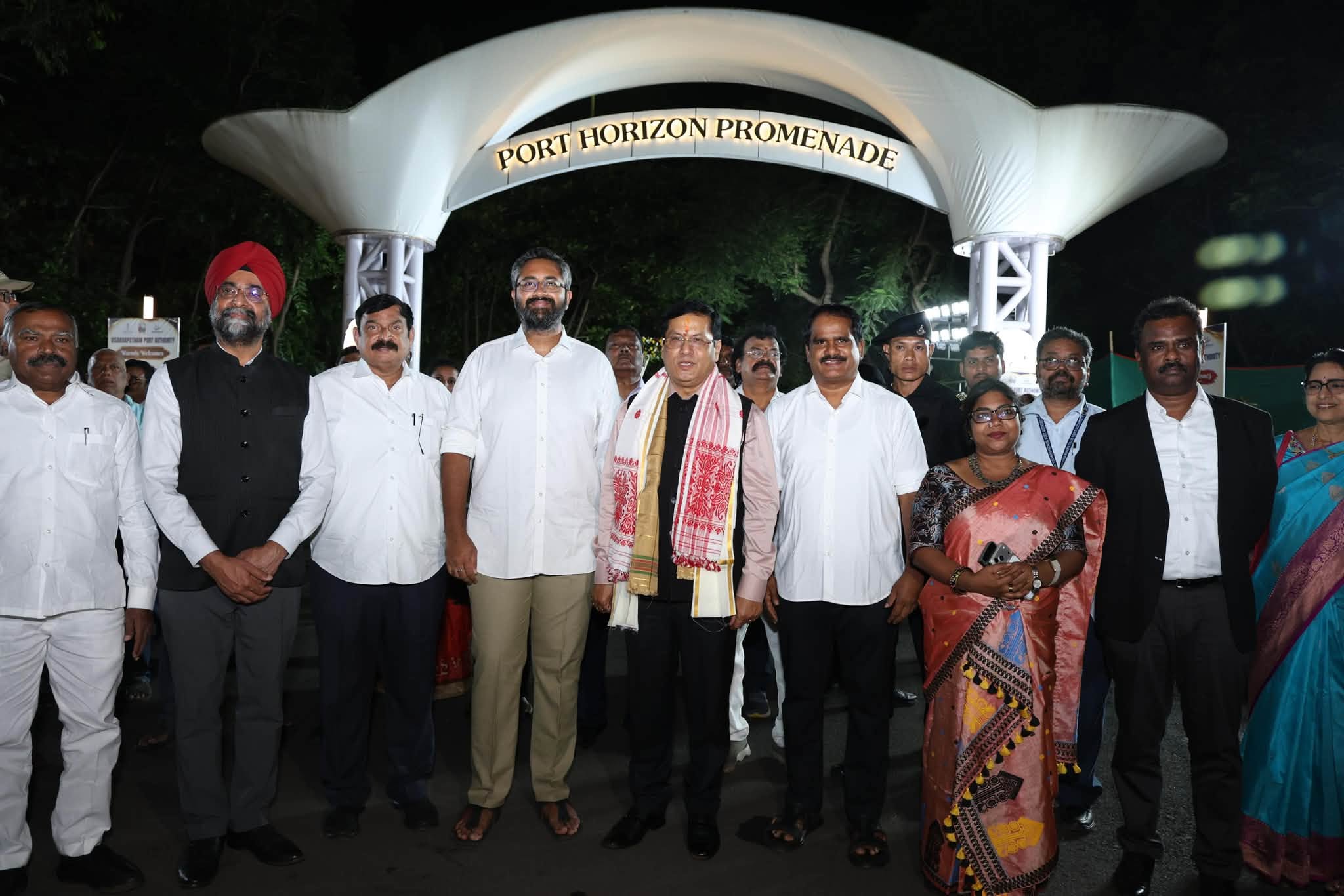
Visakhapatnam / Vizag, Andhra Pradesh, India, November 10, 2026 | Maritime News: Visakhapatnam Port is pursuing a development programme that combines terminal mechanisation, public waterfront infrastructure, environmental improvements and a greater role for private terminal operators. During his visit, Union Minister for Ports, Shipping and Waterways Sarbananda Sonowal dedicated a waterfront promenade to the nation and laid foundation stones for additional projects.
The Ministry of Ports, Shipping and Waterways has presented the initiatives as part of India’s wider port-modernisation agenda. The announcement links the projects to improved cargo handling, capacity utilisation, local employment and a more accessible relationship between the port and the city. External source: PIB, 11 November 2026
However, the announcement needs to be examined beyond its headline investment figure. The promenade is a public-facing amenity; terminal operation and maintenance contracts are commercial and operational arrangements; and the sewage treatment upgrade is an environmental infrastructure intervention. These are different projects with different objectives and performance measures.
The financial presentation also raises an unresolved question. The PIB headline describes projects worth approximately ₹560 crore, while the same release places the value of three terminal contract groups at approximately ₹580 crore. The available announcement does not explain how these figures relate to each other. External source: PIB, 11 November 2026
Waterfront Promenade: Opening the Port to the City
The newly dedicated waterfront promenade extends approximately 710 metres across 5.5 acres, from Venkateswara Temple to the International Cruise Terminal. The Ministry reports its cost at ₹19 crore. The facility includes a waterfront walkway, two view decks, a park, public plaza, children’s play area, food court and visitor parking. One of the view decks has been described as Titanic-style. External source: PIB, 11 November 2026
Sonowal described the project as opening the port to the city, stating: “It opens up the port to the city.” He also said the project was dedicated to the people of Visakhapatnam. According to the Ministry, the promenade has been developed on existing port land without affecting cargo operations. That operational claim is important, but the long-term public value will depend on access arrangements, safety, maintenance, visitor management and the sustainability of the facility. External source: PIB, 11 November 2026
The promenade’s proximity to the International Cruise Terminal creates an opportunity to connect cruise passengers with the city. But proximity alone does not establish a functioning cruise-tourism ecosystem. Passenger movement, transport links, shore excursions, visitor information and local tourism participation will determine whether the facilities complement each other. Maritime News has also examined the wider potential and implementation questions surrounding India’s cruise tourism ambitions. External source: PIB, Visakhapatnam International Cruise Terminal, September 2023
A further financial question concerns the promenade itself. A July 2025 PIB announcement had placed the proposed cost at ₹15.90 crore, whereas the November 2026 release reports the completed facility cost at ₹19 crore. The available announcements do not explain the difference. The port authority should clarify whether the change reflects revised scope, additional facilities, execution-related changes or a final expenditure adjustment. External sources: PIB, July 2025 and PIB, November 2026
Terminal Mechanisation: The Operational Core
The more consequential operational component involves three terminal operation and maintenance contract groups:
- WQ-1 and WQ-1RE;
- WQ-2 and WQ-3; and
- EQ-3.
The Ministry places the combined value of these contracts at approximately ₹580 crore. The operators are expected to mechanise the berths through equipment such as cranes and conveyors, along with environmental controls. External source: PIB, 11 November 2026
Mechanisation can improve cargo-handling consistency, reduce dependence on certain manual processes and support more predictable berth operations. But equipment installation alone does not guarantee higher productivity. The outcome will depend on equipment availability, maintenance arrangements, operator capability, cargo compatibility, labour deployment and the efficiency of supporting port systems.
A mechanised berth can still experience delays if cargo evacuation is inadequate, vessels arrive outside planned windows, equipment remains unavailable or supporting road and rail infrastructure becomes congested. The Ministry’s stated objective of improving capacity utilisation therefore needs to be tested through operational data rather than inferred from the value of the contracts.
Sonowal said the projects would help Visakhapatnam Port Authority secure assured cargo throughput and achieve optimum capacity utilisation at the berths. The announcement, however, does not provide the baseline productivity figures or contract-specific performance benchmarks needed to assess whether this objective is achieved. External source: PIB, 11 November 2026
The port should publish berth-wise performance indicators, including cargo handled per operating hour, vessel waiting time, vessel turnaround time, equipment downtime, terminal utilisation and cargo evacuation time. These are the types of measurable indicators that make a port performance framework meaningful. Internal source: Maritime News, 29 May 2026
The 500-Job Projection: Employment Needs Definition
The Ministry estimates that the new terminal contracts will generate employment for approximately 500 local people. The figure is significant, but the release does not clarify whether these positions represent direct employment by terminal operators, contractual workers, outsourced manpower, indirect employment or a combination of these categories. It also does not specify wages, duration, skill requirements or recruitment procedures. External source: PIB, 11 November 2026
Mechanisation can increase demand for equipment operators, technicians, maintenance personnel, safety specialists and workers with digital or operational skills. At the same time, some existing manual tasks may be reduced or reorganised. The transition therefore requires training, reskilling, occupational safety measures and clear employment arrangements.
The port authority and terminal operators should disclose the direct, contractual and outsourced employment breakdown; local recruitment targets; training and certification requirements; wage and working-condition standards; and employment continuity over the contract period. Until these details are published, 500 jobs should be treated as a projected outcome, not as 500 confirmed appointments.
Sewage Treatment Upgrade: Environmental Performance Must Be Measured
The Ministry says the port’s sewage treatment capacity will increase from 10 million litres per day (MLD) to 15 MLD through an additional 5 MLD plant, at an estimated cost of ₹11 crore. Treated water is intended for uses including dust suppression, road wetting and sprinkling in stockpile yards. The Ministry links the intervention to the Harit Sagar green port initiative. External source: PIB, 11 November 2026
Reusing treated wastewater can reduce freshwater demand and support dust-management measures in port areas. But installed treatment capacity does not establish actual environmental performance. The relevant measures include plant uptime, actual treatment volumes, reuse volumes, treated-water quality, sludge handling and monitoring of dust in the areas where the water is applied.
The port should publish periodic environmental performance data, including water-quality test results and the volume of treated water actually reused. Without such information, the environmental benefits remain an intended outcome rather than a demonstrated result.
Cargo Growth: Throughput Is Not the Same as Efficiency
The Ministry reports that Visakhapatnam Port handled 91.17 million metric tonnes of cargo during FY2025–26, representing approximately 10 per cent year-on-year growth and the fourth consecutive year of growth. It also reports an increase of 4.44 million metric tonnes, or 8.88 per cent, between 1 April and 31 October 2026 compared with the corresponding period in the previous year. External source: PIB, 11 November 2026
These figures indicate a positive cargo trajectory. But cargo growth and operational efficiency are not the same measure. A port can handle more cargo while still experiencing vessel waiting time, uneven berth utilisation, equipment downtime, gate congestion or higher inland transport costs.
A meaningful assessment should consider cargo throughput by commodity and terminal, berth productivity, equipment availability, average vessel waiting and turnaround time, cargo evacuation, storage and handling costs, and service reliability for exporters and importers. The Ministry’s announcement does not provide this complete operational picture.
The Ministry also says Visakhapatnam has one of the deepest container terminals among Indian major ports, with a permissible draft of 16 metres. This is an infrastructure advantage, but draft capacity must be considered alongside vessel calls, terminal productivity, hinterland connectivity and the commercial requirements of shipping lines. External source: PIB, 11 November 2026
Landlord-Port Model: Private Operation Requires Public Oversight
The Ministry says Visakhapatnam Port is moving towards a landlord-port model, with the objective of reducing vessel turnaround time and logistics costs. Under this model, the port authority generally retains responsibility for core infrastructure and governance while private operators undertake terminal operations under contractual arrangements.
The model can bring investment, operational expertise and equipment modernisation. Its success, however, depends on the quality of contracts, the strength of oversight and whether operators meet their investment and performance obligations. The PIB announcement does not provide the contract periods, detailed investment obligations, cargo commitments, performance benchmarks or penalty provisions. External source: PIB, 11 November 2026
The regional role of Visakhapatnam Port Authority also deserves attention. Maritime News previously reported on the authority’s proposed 49 per cent stake in Mulapeta Port, reflecting its wider regional ambitions. The authority’s expanding footprint makes transparent investment priorities, governance and performance reporting increasingly important. Internal source: Maritime News, 16 August 2024
The Ministry separately refers to four PPP projects worth approximately ₹800 crore that are under construction and expected to be commissioned by 2027. The announcement does not identify these projects individually. They should not be combined with the three terminal contract groups unless the Ministry provides a clear project-wise relationship. External source: PIB, 11 November 2026
The ₹560-Crore versus ₹580-Crore Question
The financial presentation in the official release needs clarification. Its headline describes projects worth approximately ₹560 crore. Within the same announcement, however, the three terminal operation and maintenance contract groups are valued at approximately ₹580 crore. The sewage treatment upgrade is separately estimated at ₹11 crore, while the completed promenade is reported to have cost ₹19 crore. External source: PIB, 11 November 2026
These figures cannot responsibly be combined into a revised package total without knowing which projects are included in the headline amount, whether the contract values are calculated on the same financial basis and whether some figures refer to separate phases or categories.
The difference between the promenade’s earlier proposed cost of ₹15.90 crore and its reported completed cost of ₹19 crore also needs a project-level explanation. A clear statement should identify the original approved cost, revised approval if any, final expenditure and the reasons for any variation. External sources: PIB, July 2025 and PIB, November 2026
For a public-sector infrastructure programme, the basic requirement is a project-wise financial statement showing approved cost, contract value, revised cost where applicable, expenditure to date and funding arrangement. This would prevent confusion between completed works, new contracts and projects still under construction.
Connectivity: Faster Berth Operations Need Faster Cargo Evacuation
In August 2026, the Ministry announced an internal flyover project valued at ₹334.89 crore. The proposed 3.584-kilometre flyover is intended to connect Convent Junction with the Dock Area and address road-rail traffic bottlenecks at nine level crossings. Its stated completion period is 30 months from commencement. External source: PIB, August 2026
The flyover is relevant to terminal mechanisation because faster cargo handling at the berth will not necessarily translate into faster cargo movement beyond the terminal gate. If road and rail evacuation remain constrained, operational gains at the berth may be absorbed by congestion elsewhere in the logistics chain.
The wider Andhra Pradesh port development pipeline has been examined by Maritime News in the context of execution pace and the need to convert infrastructure announcements into operational capacity. Visakhapatnam’s development must be coordinated with road and rail links, storage, cargo evacuation and hinterland connectivity. Internal source: Maritime News, 13 February 2026
The Minister’s visit also coincided with the 31st CII Partnership Summit 2026, hosted by the Andhra Pradesh Government on 12–13 November under the theme “Navigating New World Order: Trade, Technology, Trust.” The broader investment context makes the port’s implementation record important: infrastructure must support reliable supply chains and attract sustainable cargo flows, not merely generate announcements. External source: PIB, 11 November 2026
Stakeholder Impact: Who Benefits, and What Must Be Monitored?
Port workers: Mechanisation may create demand for new technical and equipment-related skills, but it can also alter existing job roles. Training, reskilling, occupational safety and employment continuity should be monitored.
Terminal operators: The contracts create opportunities to modernise facilities and improve operations. Their performance should be assessed against disclosed investment commitments, equipment availability, throughput and service benchmarks.
Shipping lines and vessel operators: Better berth productivity could reduce waiting and turnaround times. The port should publish comparable performance data to establish whether these improvements actually occur.
Exporters, importers and cargo owners: More efficient handling may improve cargo reliability. The benefit will be limited if inland evacuation delays, storage costs or other logistics charges remain high.
Local residents and businesses: The promenade may create recreational and commercial opportunities. Its public value will depend on access, maintenance, safety, parking and transparent management.
Cruise passengers and tourism operators: The promenade’s proximity to the cruise terminal creates an opportunity for better visitor experiences. Transport links, shore excursions and local tourism participation will determine whether this opportunity produces economic value.
Fishing and coastal communities: The announcement does not establish a direct impact of the current projects on fishing communities. Their concerns should not be assumed or dismissed without project-specific evidence and consultation. Maritime News has previously reported on the vulnerability of the local fishing harbour in Visakhapatnam’s Fishing Harbor Engulfed by a Sea of Flames, 40 Boats in Ruins. That earlier incident is historical context for resilience and safety, not evidence of a current impact from these projects. Internal source: Maritime News, 21 November 2023
Environment and surrounding areas: The sewage treatment upgrade and terminal environmental controls should be judged through water-quality results, treated-water reuse, dust monitoring, emissions and waste-management performance.
Maritime News Analysis: Announcements Must Become Measurable Outcomes
Visakhapatnam Port’s programme has three distinct public-interest dimensions. The promenade concerns public access and the relationship between the port and the city. The terminal contracts concern operational capacity, private participation and cargo performance. The sewage treatment upgrade concerns environmental infrastructure and resource reuse.
Each requires a separate performance framework. For the promenade, the relevant measures include public access, visitor safety, maintenance and utilisation. For the terminal contracts, they include berth productivity, equipment uptime, vessel turnaround, cargo throughput and employment. For the sewage treatment plant, they include actual treatment volumes, water quality, reuse and environmental monitoring.
The wider national policy context also matters. Sarbananda Sonowal and the Ministry have been associated with several maritime modernisation initiatives, while Narendra Modi has articulated the wider national development ambition. But national policy objectives must ultimately be evaluated through project delivery and measurable port-level outcomes. Internal sources: Maritime News, 27 October 2026 and 11 September 2026
The port authority should publish a consolidated project dashboard with project status, costs, milestones, operational results and accountability arrangements. Such disclosure would help residents, workers, investors, cargo owners and policymakers understand whether the programme is delivering the outcomes promised.
Editorial Verdict
Visakhapatnam Port’s development programme has the potential to strengthen cargo operations while improving public access and environmental infrastructure. The proposed mechanisation of berths and the move towards a landlord-port model could support operational improvements if backed by capable operators, enforceable contracts and transparent oversight.
But the announcement is not proof of delivery.
The estimated 500 local jobs need to be translated into verifiable employment outcomes. The terminal contracts need measurable productivity benchmarks. The sewage treatment upgrade needs published environmental performance data. The promenade needs a long-term public-access and maintenance plan.
Most importantly, the financial figures need clarification. An announcement describing projects worth approximately ₹560 crore while reporting terminal contracts worth approximately ₹580 crore should provide a clear project-wise explanation.
The real measure of success will not be the number of foundation stones laid or the scale of announced investment. It will be whether Visakhapatnam becomes a more productive, reliable, environmentally accountable and publicly accessible port.
Frequently Asked Questions (FAQs)
What projects were announced at Visakhapatnam Port?
The Ministry announced three terminal operation and maintenance contract groups, a sewage treatment capacity upgrade and the dedication of a waterfront promenade. It also referred to four separate PPP projects under construction. Source: PIB, 11 November 2026
What is the reported cost of the waterfront promenade?
The November 2026 PIB release reports a cost of ₹19 crore. A July 2025 PIB announcement had reported a proposed cost of ₹15.90 crore. The reason for the difference has not been explained in the available announcements. Sources: PIB, July 2025 and PIB, November 2026
How many jobs are expected from the terminal contracts?
The Ministry estimates approximately 500 local jobs. It has not specified the breakdown between direct, contractual, outsourced or indirect employment. Source: PIB, 11 November 2026
What is the value of the three terminal contract groups?
The PIB release places their combined value at approximately ₹580 crore. Source: PIB, 11 November 2026
Why does the ₹560-crore headline require clarification?
The release headline describes projects worth approximately ₹560 crore, while the same release reports terminal contracts worth approximately ₹580 crore. The project-wise accounting basis is not explained. Source: PIB, 11 November 2026
What is the sewage treatment upgrade?
The port’s treatment capacity is expected to increase from 10 MLD to 15 MLD through an additional 5 MLD plant, estimated to cost ₹11 crore. Treated water is intended for uses including dust suppression and road wetting. Source: PIB, 11 November 2026
Does cargo growth prove that port efficiency has improved?
No. Cargo growth measures the volume handled. Operational efficiency also requires data on berth productivity, vessel waiting time, turnaround time, equipment downtime, cargo evacuation and logistics costs.
Sources and References
A. External Sources
- Press Information Bureau, Ministry of Ports, Shipping and Waterways — “Sarbananda Sonowal Lays Foundation Stones for Projects Worth Rs 560 Crore at Visakhapatnam Port”, 11 November 2026.
https://www.pib.gov.in/PressReleaseDetail.aspx?PRID=2335212®=48&lang=1 - Press Information Bureau — “Union Minister Sarbananda Sonowal Launches Capacity-Building Initiatives Worth ₹276 Crore at Visakhapatnam Port”, July 2025.
https://www.pib.gov.in/PressReleaseIframePage.aspx?PRID=2144691&lang=2®=48 - Press Information Bureau — Visakhapatnam Port internal flyover project announcement, August 2026.
https://www.pib.gov.in/PressReleasePage.aspx?PRID=2297902&lang=1®=48 - Press Information Bureau — Visakhapatnam International Cruise Terminal announcement, September 2023.
https://www.pib.gov.in/PressReleasePage.aspx?PRID=1954750&lang=2®=48
B. Internal Sources – Maritime News Archive
- Sonowal Woos Korean Firms for Indian Shipyards, Calls for Maritime Rules All Countries Can Implement, 27 October 2026.
https://maritimenews.in/india-south-korea-shipbuilding-cooperation-sonowal/ - India Launches Port Performance Index and Major Maritime Digital Reforms, 29 May 2026.
https://maritimenews.in/india-launches-port-performance-index-and-major-maritime-digital-reforms/ - Cruise Bharat Mission Targets 1 Million Passengers by 2029, But Is India Ready for the Wider Cruise Tourism Economy?, 4 November 2026.
https://maritimenews.in/cruise-bharat-mission-cruise-yacht-tourism/ - Mumbai Port Showcases Cruise Infrastructure, Marina Plans to Seychelles Parliamentary Delegation, 8 September 2026.
https://maritimenews.in/mumbai-port-showcases-cruise-infrastructure-marina-plans-to-seychelles-parliamentary-delegation/ - Modi-Putin Talks Put Maritime Trade and Seafarer Safety at the Heart of a Wider BRICS Economic Realignment, 11 September 2026.
https://maritimenews.in/modi-putin-talks-put-maritime-trade-and-seafarer-safety-at-the-heart-of-a-wider-brics-economic-realignment/ - Andhra Pradesh Expands Port Pipeline, But Execution Pace?, 13 February 2026.
https://maritimenews.in/andhra-pradesh-expands-port-pipeline-but-execution-pace/ - Visakhapatnam Port Authority Eyes 49% Stake in Mulapeta Port, 16 August 2024.
https://maritimenews.in/visakhapatnam-port-authority-eyes-49-stake-in-mulapeta-port/ - Visakhapatnam’s Fishing Harbor Engulfed by a Sea of Flames, 40 Boats in Ruins, 21 November 2023.
https://maritimenews.in/visakhapatnams-fishing-harbor-engulfed-by-a-sea-of-flames-40-boats-in-ruins/