
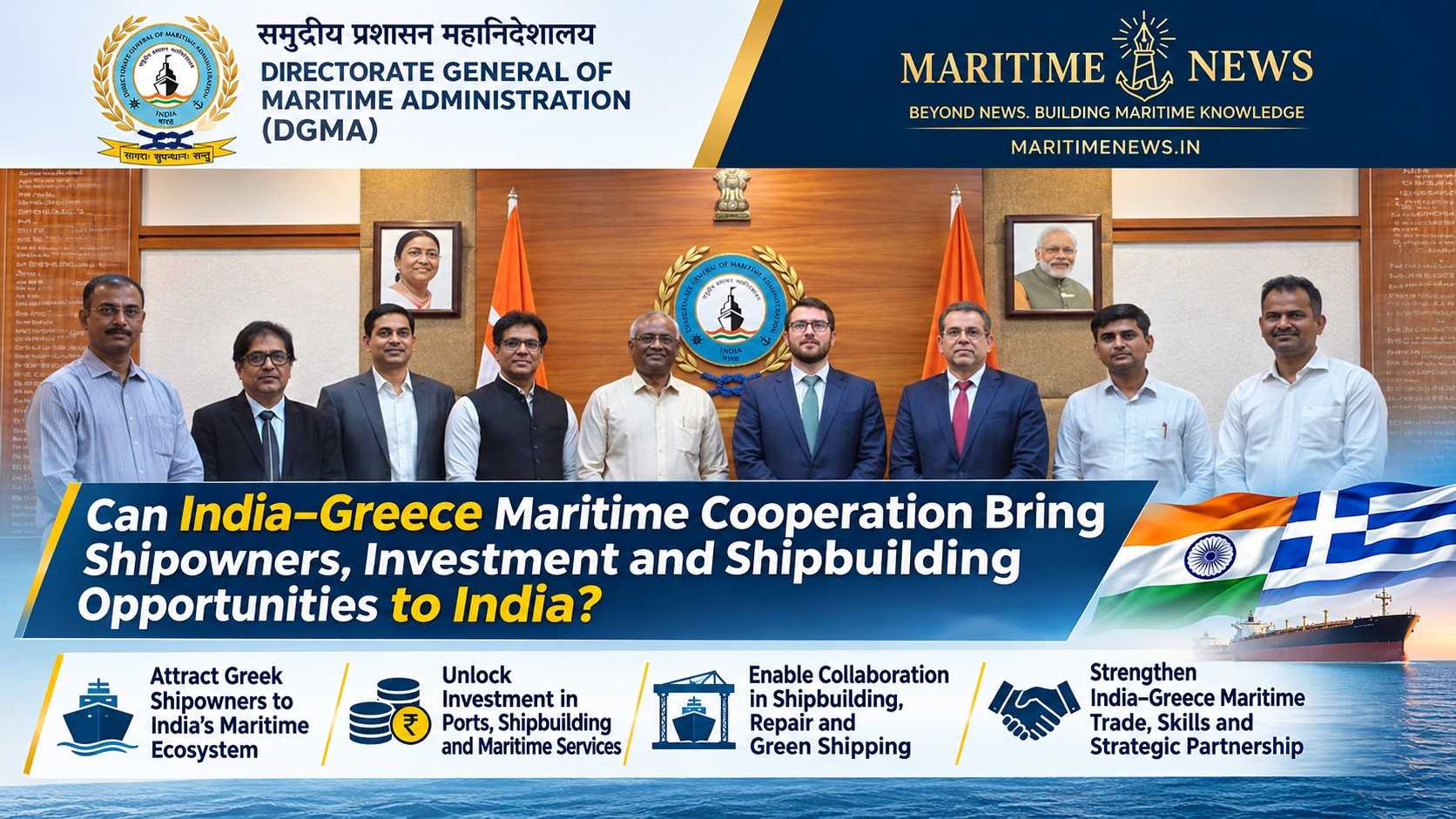
A meeting involving Silk SeARoad Maritime S.A., Sailors Union of India and Indian maritime administration officials explored GIFT City, Indian-flag registration, ship leasing and shipbuilding, placing commercial opportunities and seafarer employment at the centre of bilateral engagement.
Key Takeaways
- Silk SeARoad Maritime S.A. of Greece met Indian maritime industry representatives and MoPSW officials on 18 November 2026.
- Discussions covered GIFT City, Indian-flag registration, ship leasing, investment and shipbuilding opportunities.
- Sailors Union of India offered to facilitate engagement with government authorities, maritime institutions and industry stakeholders.
- The engagement builds on India’s earlier outreach to Greek shipping interests on ship leasing and maritime finance.
- Indian seafarer employment was identified as a potential benefit, but no specific hiring commitment was announced.
- The next measure of progress will be whether the discussions lead to identifiable commercial proposals, regulatory engagement or investment.
NEW DELHI, INDIA, 26 November 2026 (Maritime News): India’s efforts to attract international maritime investment received another business-level engagement on 18 November 2026, when representatives of Greece-based Silk SeARoad Maritime S.A., Sailors Union of India (SUI-BMS) and officials of the Ministry of Ports, Shipping and Waterways (MoPSW) discussed opportunities for cooperation in shipping, maritime finance and shipbuilding.
The meeting was attended by Andreas Zissimatos, Managing Director of Silk SeARoad Maritime S.A., Greece, accompanied by Dimitris Mitrou, Advisory Board Member. The Indian maritime industry and seafarer representation included R.P. Veettil, National President of Sailors Union of India; Capt. Rishi Sharma, CEO; and Capt. Jay Limbachiya, Commercial General Manager, GMOS.
The Government of India’s side included Capt. Abdul Kalam Azad, Nautical Adviser to MoPSW; Capt. Mahadev Dhandhiya, Nautical Surveyor-cum-Deputy Director General; Capt. Saurabh Bansal, Nautical Surveyor-cum-Deputy Director General; and Deependra Singh Bisen, Deputy Director General of Maritime Administration (DGMA).
The discussions covered opportunities in GIFT City, Indian-flag vessel registration, ship leasing, investment and the possibility of shipbuilding in India. Sailors Union of India assured cooperation in facilitating connections between the Greek delegation and relevant government authorities, maritime institutions and industry stakeholders.
No investment agreement, vessel-registration commitment, shipbuilding contract or specific employment arrangement was announced in the information made available about the meeting. The significance therefore lies in the areas identified for exploration and the possibility of translating those discussions into commercial engagement.
Why Is Greece Important to India’s Maritime Ambitions?
Greece has an established international shipping industry and a substantial shipowning and maritime services ecosystem. Its shipping companies, ship managers, financiers, brokers and associated service providers make the country a relevant international partner for India’s efforts to expand its shipping and maritime financial capabilities.
For India, engagement with Greek maritime businesses could create opportunities across several parts of the maritime value chain, including vessel ownership, leasing, financing, ship management, shipbuilding, repair and seafarer employment.
India’s engagement with Greece in maritime affairs is not new. The Ministry of Ports, Shipping and Waterways’ international-cooperation records identify an India–Greece Joint Working Group on shipping, with its second meeting held on 20 April 2022.
The Ministry’s country information has also identified Greece as a high-priority country for maritime engagement, reflecting the importance of strengthening institutional and commercial cooperation.
This background gives the November meeting a wider context: the relationship involves both government-level maritime dialogue and the need to develop practical business connections.
Can GIFT City Attract Greek Shipowners and Maritime Finance?
One of the important subjects discussed was the possibility of exploring opportunities through GIFT City, India’s International Financial Services Centre (IFSC).
GIFT City is being developed as a platform for ship ownership, leasing, financing, insurance, broking and related maritime financial services. The objective is to bring a larger share of maritime financial activity into India’s regulatory and financial ecosystem.
India has already engaged Greek shipping interests on this subject. On 27 May 2024, the International Financial Services Centres Authority (IFSCA), in coordination with the Embassy of India in Greece, organised a conference in Athens titled Opportunities for Ship Leasing and Financing at GIFT IFSC, India.
The conference presented the opportunities available to Greek shipowners and shipbrokers through India’s IFSC framework, including ship leasing and financing.
The November 2026 discussion therefore follows an earlier institutional effort to introduce GIFT IFSC to the Greek maritime industry.
The Government has also introduced regulatory measures intended to improve the operating environment for eligible IFSC-based maritime businesses. These include the exemption of eligible GIFT City IFSC units from specified licensing requirements under the Coastal Shipping Act, 2025, for chartering foreign vessels in notified operations.
Read Maritime News’ analysis of the GIFT City coastal shipping licensing exemption.
For Greek shipowners, the potential attraction is access to an Indian-based platform for structuring maritime financial and ownership activities. For India, the objective is to attract capital, specialist maritime services and business activity.
However, the November meeting should not be interpreted as confirmation that Silk SeARoad Maritime S.A. has decided to establish a GIFT City entity or undertake a specific leasing transaction.
Indian-Flag Registration: An Opportunity for Fleet Expansion?
Indian-flag registration was another subject discussed during the meeting.
Increasing the number of vessels registered under the Indian flag is an important part of India’s broader shipping ambitions. A stronger domestic fleet can support national shipping capacity, maritime services, employment and the country’s participation in international trade.
For an international shipowner, the decision to register a vessel under a particular flag involves several considerations, including regulatory requirements, taxation, operational flexibility, financing, insurance, safety standards and the commercial requirements of the vessel’s intended trade.
Engagement with Greek shipowners could therefore provide an opportunity to explain India’s registration framework and understand the commercial and regulatory factors influencing their decisions.
The discussion also needs to be considered alongside India’s evolving maritime administration and digital services. The Government’s e-Samudra initiative is intended to digitise services covering ship registration, mortgages, seafarer welfare, security and other maritime administration functions.
The policy challenge is to ensure that Indian registration is commercially attractive while maintaining safety, regulatory oversight and the protection of seafarers.
No vessel registration or flag-change commitment was identified in the meeting information supplied.
Could Greek Maritime Investment Support Indian Shipbuilding?
The possibility of shipbuilding in India was also discussed.
India is seeking to expand its shipbuilding and ship repair capabilities through policy support, industrial capacity development and international partnerships. Foreign shipowners and maritime companies could potentially contribute through orders, joint ventures, technical collaboration, investment and access to international markets.
For a Greek maritime company, engagement with Indian shipyards could provide an opportunity to assess the country’s manufacturing capabilities, infrastructure, workforce and commercial competitiveness.
For Indian shipyards, international relationships can potentially widen access to vessel orders and specialised technical requirements.
However, the distinction between interest and investment is important. The meeting information does not identify a proposed shipyard, vessel category, construction order, project value, investment amount or implementation timeline.
The discussion should therefore be treated as an exploration of possible cooperation rather than a confirmed shipbuilding project.
The next step for any potential cooperation would be to identify commercially viable projects and establish the technical, financial and regulatory requirements.
Will Indian Seafarers Benefit from Greater Greek Engagement?
The employment of Indian seafarers is an important dimension of the wider cooperation being explored.
India has a large maritime workforce, and international shipping companies provide employment opportunities for Indian officers, ratings and other maritime professionals. Stronger commercial relationships with foreign shipowners can potentially expand access to international fleets and maritime career opportunities.
Sailors Union of India has stated that it will facilitate connections between the Greek delegation and relevant government authorities, maritime institutions and industry stakeholders.
This role is significant because maritime investment should not be measured only by the capital it attracts or the vessels it registers. Its wider contribution should also be assessed through employment, professional development, training, working conditions and career progression for Indian seafarers.
For Indian maritime unions, the opportunity is to ensure that international commercial engagement also considers the workforce that operates and supports the global shipping industry.
Maritime News has previously reported on the importance of protecting Indian seafarers’ professional interests and employment opportunities, including its coverage of concerns raised over foreign maritime training and Indian seafarer employment.
No specific number of jobs, vessel berths or recruitment commitments was announced in connection with the 18 November meeting.
What Role Can Sailors Union of India Play?
The participation of Sailors Union of India introduces a workforce and industry facilitation dimension to the engagement.
According to the information provided, SUI-BMS assured cooperation by connecting the Greek delegation with relevant government authorities, maritime institutions and industry stakeholders.
Such facilitation could help international companies understand India’s maritime regulatory environment, identify potential commercial partners and engage with institutions relevant to their proposed activities.
It can also create an opportunity for seafarer representatives to bring workforce considerations into discussions that might otherwise focus primarily on investment, ownership and commercial operations.
The practical value of this role will depend on the follow-up process: which institutions are approached, what proposals are developed, and whether the discussions produce measurable outcomes for the maritime industry and Indian seafarers.
What Should Happen After the Meeting?
The next stage should move from general discussions towards clearly identified areas of cooperation.
Several matters could help establish whether the engagement develops into a substantive India–Greece maritime partnership:
GIFT City engagement: Determine whether Silk SeARoad Maritime S.A. wishes to examine the regulatory, financial and commercial framework available through GIFT IFSC.
Ship registration: Identify the requirements and commercial considerations relevant to any potential Indian-flag registration.
Ship leasing and financing: Explore whether specific vessel acquisition, leasing or financing proposals can be developed with Indian financial institutions and maritime businesses.
Shipbuilding and repair: Identify vessel categories, Indian shipyards and technical capabilities that could be relevant to Greek maritime interests.
Seafarer employment: Examine potential cooperation involving Indian seafarers, crewing requirements, training and professional development.
Institutional coordination: Establish a follow-up mechanism involving the relevant government authorities, industry participants, maritime institutions and SUI-BMS.
These are potential follow-up areas, not confirmed decisions or commitments arising from the meeting.
Conclusion: From Bilateral Engagement to Commercial Outcomes
The 18 November meeting involving Silk SeARoad Maritime S.A., Sailors Union of India and Indian maritime administration officials reflects continuing efforts to connect international shipping interests with India’s expanding maritime ecosystem.
The subjects discussed—GIFT City, Indian-flag registration, ship leasing, investment and shipbuilding—align with India’s broader ambition to strengthen its position in global shipping and maritime services.
The opportunity also extends beyond capital and vessel ownership. If commercial engagement develops, it could create opportunities for Indian shipyards, maritime service providers, financial institutions and seafarers.
But the success of the engagement will ultimately depend on what follows the meeting. Specific proposals, institutional coordination, investment decisions, vessel registrations, shipbuilding orders and employment outcomes will provide a more meaningful measure of progress than expressions of interest alone.
For India–Greece maritime cooperation, the next step is to convert dialogue into practical partnerships that deliver value across the maritime ecosystem.
Sources and References
External Sources
- IFSCA – Conference on Ship Leasing and Financing held in Athens, Greece, 27 May 2024
- Ministry of Ports, Shipping and Waterways – International Cooperation
- PIB – India Charts Course to Become Global Hub for Ship Ownership, Leasing and Maritime Finance, 10 September 2026
- PIB – Government Exempts IFSC GIFT City Units from Licensing Requirement under the Coastal Shipping Act, 2025
Internal Sources – Maritime News Archive
- India Moves to Build a Global Hub for Ship Ownership, Leasing and Maritime Finance Through GIFT City
- Government Eases Coastal Shipping Licensing for GIFT City Units
- Cochin Shipyard and Drydocks World Sign 50:50 JV to Build India’s Global Ship Repair Ambition
- GSUI Slams DG Shipping Over Ban on Foreign Maritime Training