
MRC Pune’s capacity-building programme for DGMA surveyors connects underwater acoustics, marine spatial planning and international regulatory developments, highlighting the growing importance of scientific expertise in maritime governance.
Key Takeaways
- MRC, Pune, concluded Day 1 of a two-day capacity-building programme for DGMA surveyors.
- The programme focuses on Underwater Radiated Noise Management and Marine Spatial Planning.
- Dr. (Cdr.) Arnab Das covered the UDA framework, MSP methodologies and noise and vibration acoustic analysis.
- Ms. J Catherine addressed IMO regulatory developments, standards and URN compliance frameworks.
- The programme reflects the growing connection between underwater research, maritime administration and marine environmental management.
- Earlier DGMA participation in an MRC–ICWA seminar in August 2026 provides evidence of a broader institutional engagement on underwater domain awareness.
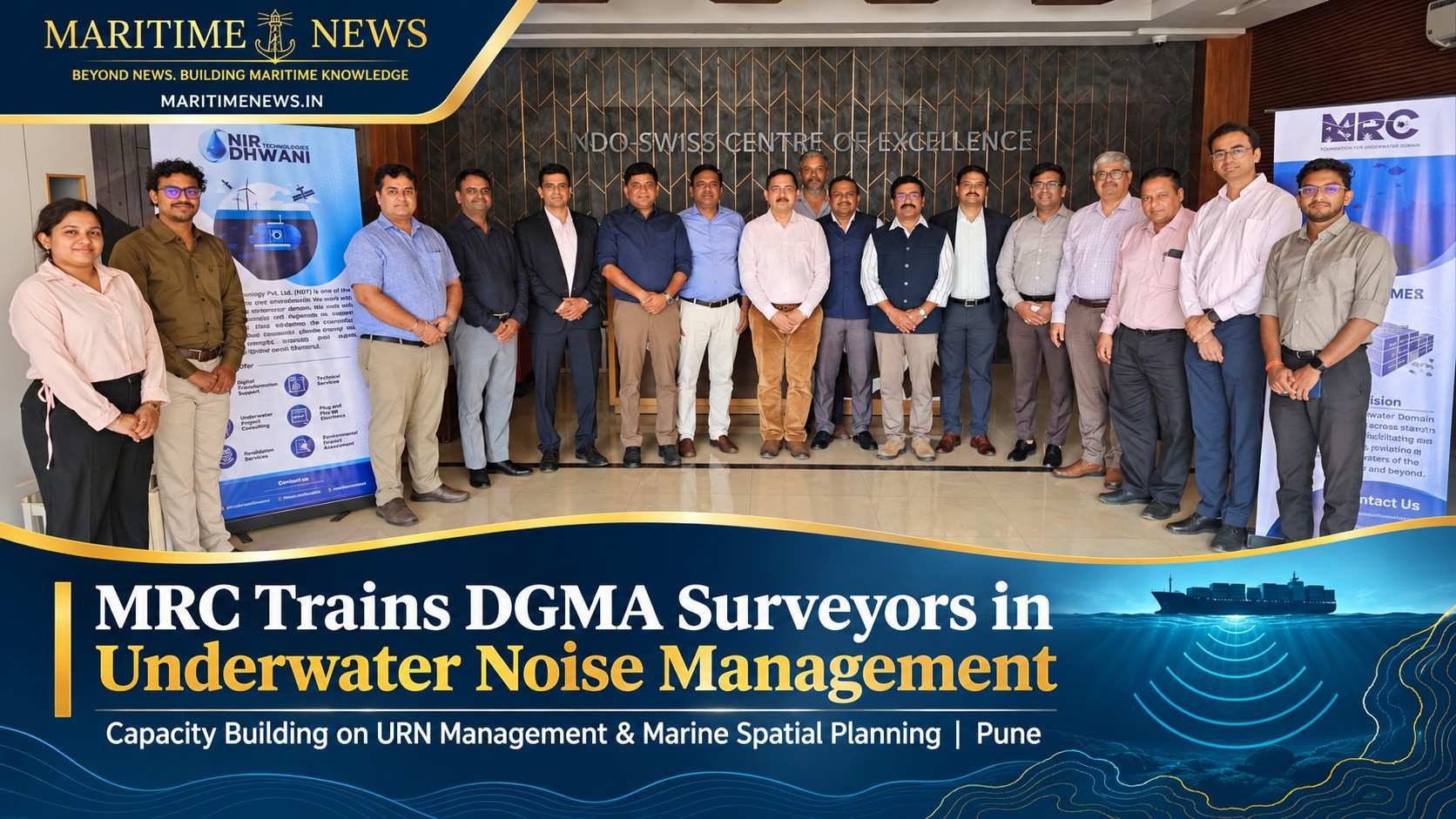
PUNE, MAHARASHTRA, INDIA, 26 November 2026 (Maritime News): The Maritime Research Center (MRC), Pune, has concluded Day 1 of a two-day Capacity Building Programme on Underwater Radiated Noise (URN) Management and Marine Spatial Planning (MSP) for surveyors of the Directorate General of Maritime Administration (DGMA).
The programme brings together technical research, underwater acoustic analysis, marine spatial planning methodologies and international regulatory developments in a specialised learning initiative for maritime administration personnel.
Sessions on the first day were led by MRC’s leadership. Dr. (Cdr.) Arnab Das, Founder and Director, addressed the Underwater Domain Awareness (UDA) framework, MSP methodologies, and noise and vibration acoustic analysis. Ms. J Catherine, Publications and Research Head, covered evolving International Maritime Organization (IMO) regulatory requirements, standards and compliance frameworks relating to underwater radiated noise.
The initiative is relevant to a wider maritime governance challenge: how technical understanding of the underwater environment can inform the assessment, planning and management of maritime activities.
Why Is Underwater Radiated Noise Becoming a Maritime Governance Issue?
Underwater Radiated Noise is the sound generated by ships and other human activities that propagates through the underwater environment. Commercial shipping, vessel machinery and propeller activity are among the sources that contribute to underwater sound.
The issue extends beyond the technical performance of a vessel. Anthropogenic underwater noise can affect marine animals that depend on sound for communication, orientation, navigation and other biological functions. Its management therefore connects shipping operations with marine environmental protection.
MRC’s research material on URN management discusses the subject across ship design and operational considerations, acoustic stealth applications and marine conservation concerns, including acoustic habitat degradation.
The research dimension is also relevant to India’s maritime geography. The Indian Ocean Region carries substantial commercial shipping activity and supports diverse marine ecosystems. Understanding underwater noise in this region requires research, acoustic measurement capabilities and context-specific assessment rather than relying only on generalised assumptions.
MRC’s research and knowledge resources on Underwater Radiated Noise provide technical background to the subject.
What Does the Underwater Domain Awareness Framework Cover?
Dr. (Cdr.) Arnab Das, Founder and Director of MRC, addressed the Underwater Domain Awareness framework, alongside Marine Spatial Planning methodologies and noise and vibration acoustic analysis.
MRC describes Underwater Domain Awareness as a framework that brings together stakeholders and capabilities across four interconnected dimensions:
- Maritime Security
- Blue Economy
- Marine Environment and Disaster Management
- Science and Technology, Research and Innovation
This approach is broader than underwater surveillance or security alone. It recognises the underwater domain as an area where maritime operations, environmental considerations, economic activity and scientific research intersect.
MRC’s institutional work is centred on advancing this framework through research, strategic partnerships, technology and capacity building. Its official institutional profile outlines the organisation’s role in bringing together stakeholders connected with these areas.
The broader relevance of underwater domain awareness has also featured in Maritime News’ coverage of the Indian Navy’s technology and underwater domain awareness initiatives.
How Can Marine Spatial Planning Support Sustainable Ocean Governance?
Marine Spatial Planning is a science-based approach to organising and managing activities within marine and freshwater spaces. It considers ecological, economic and social requirements while helping manage competing uses of marine areas.
Shipping routes, ports, fishing grounds, offshore energy installations, conservation areas and other maritime activities can place different demands on the same marine spaces. MSP provides a structured approach to understanding these interactions and supporting informed planning.
MRC’s Marine Spatial Planning programme describes MSP as an approach that integrates science, policy and technology for sustainable ocean governance.
For maritime administrators, understanding MSP is relevant to the assessment of marine activities, the management of spatial conflicts and the integration of environmental considerations into maritime planning.
MRC’s work also connects MSP with modelling and simulation, marine resource mapping and technology-enabled planning tools. Its research on MSP implementation through modelling and simulation provides further context to this approach.
Why Are IMO Regulations and URN Compliance Important?
Ms. J Catherine, Publications and Research Head at MRC, addressed evolving IMO regulatory requirements, standards and compliance frameworks relating to underwater radiated noise.
The IMO has been examining underwater noise from commercial shipping as an environmental concern. Its work includes non-mandatory guidance aimed at reducing underwater radiated noise from shipping to address adverse impacts on marine life.
For maritime professionals, the subject requires an understanding of the relationship between vessel design, machinery, propellers, operational conditions and underwater acoustic emissions. The regulatory discussion also raises questions about how noise-related considerations can be incorporated into technical assessment and maritime practice.
MRC’s learning resources include a dedicated course on Underwater Radiated Noise Management in the Tropical Waters of the Indo-Pacific Strategic Space, covering technological and policy interventions, acoustic habitat degradation, Marine Spatial Planning and capacity building.
The regulatory context is not entirely new to India’s maritime administration. In August 2026, DGMA participated in the MRC–Indian Council of World Affairs national seminar on advancing the UDA framework for India’s MAHASAGAR vision. The official DGMA account records discussions on Maritime Spatial Planning, anthropogenic underwater noise and the IMO-led GloNoise initiative, including India’s role in the initiative for the Indian Ocean Region.
That seminar was a separate engagement from the present capacity-building programme. However, it demonstrates an ongoing institutional interest in connecting underwater research, international maritime developments and policy considerations.
Read the DGMA account of the August 2026 MRC–ICWA seminar.
Why Does Capacity Building Matter for DGMA Surveyors?
The participation of DGMA surveyors gives the programme a direct administrative and technical dimension.
Maritime surveyors operate within a regulatory environment where vessel condition, technical compliance, safety and applicable international requirements are important considerations. Emerging subjects such as underwater radiated noise and marine spatial planning add further scientific and environmental dimensions to the knowledge base required across the maritime sector.
The value of specialised training lies in helping technical personnel understand the subject, interpret relevant standards and engage with the scientific methods and tools used to assess maritime activities.
Maritime News has previously examined the wider responsibilities of maritime surveyors in its coverage of the Casualty Investigation Code and the role of surveyors in maritime investigations.
The present programme adds another area of technical knowledge to this wider discussion on maritime administration and professional capacity.
MRC’s Wider Role in Underwater Research and Skilling
The programme is part of a broader institutional focus on underwater domain awareness, research and specialised training.
MRC identifies capacity building as one of the important elements of its work. Its skilling ecosystem includes learning modules and training initiatives covering underwater domain awareness, marine spatial planning, blue economy principles and related technical subjects.
The organisation’s published material also documents earlier capacity-building initiatives involving government and institutional participants. These include training programmes focused on underwater acoustics, maritime security and technology.
The broader objective is to develop specialised knowledge and encourage collaboration between research institutions, government agencies, industry and academia.
For India’s maritime sector, such engagement can help strengthen the connection between scientific research and the operational and regulatory needs of maritime institutions.
The Larger Maritime Policy Question
The growing attention to underwater radiated noise and marine spatial planning raises a wider question for India’s maritime development: how can the country expand shipping, ports, offshore activity and the blue economy while improving its understanding and management of the underwater environment?
Capacity-building programmes are one part of the response. They can help develop technical awareness among officials and professionals, but their long-term contribution depends on whether knowledge is translated into practical assessment, research collaboration, suitable tools and informed policy decisions.
The relationship between maritime operations and environmental protection has also been examined in Maritime News’ coverage of the international conference on marine conservation and sustainability marking 50 years of MARPOL.
Similarly, the technical research dimension connects with Maritime News’ coverage of the conference on advances in naval and ocean engineering at CUSAT.
Connecting Research, Regulation and Maritime Practice
MRC’s capacity-building programme for DGMA surveyors places underwater radiated noise management and Marine Spatial Planning within the broader framework of India’s evolving maritime governance requirements.
The first day’s sessions addressed the UDA framework, acoustic analysis, MSP methodologies and IMO regulatory developments. These subjects demonstrate why maritime administration increasingly requires engagement with scientific research and environmental considerations alongside conventional technical and regulatory responsibilities.
The larger test will be how such specialised knowledge contributes to maritime assessments, institutional capabilities and policy development. Stronger understanding of the underwater domain can support a more informed approach to maritime safety, sustainable shipping and the protection of marine ecosystems.
Sources and References
External Sources
- Maritime Research Center – Official Website
- MRC – About Us and Underwater Domain Awareness Framework
- MRC – Marine Spatial Planning
- MRC – Skilling Ecosystem
- MRC – Underwater Radiated Noise Management Research Note
- MRC – URN Management Learning Course
- DGMA – MRC–ICWA National Seminar on Underwater Domain Awareness, August 2026
Internal Sources – Maritime News Archive
- Naval Commanders’ Conference 2024: Underwater Domain Awareness and Maritime Technology
- Casualty Investigation Code and the Role of Surveyors
- DG Shipping Notice on Implementation of MARPOL Annex VI
- International Conference on Marine Conservation and Sustainability – 50 Years of MARPOL
- Conference on Advances in Naval and Ocean Engineering at CUSAT