
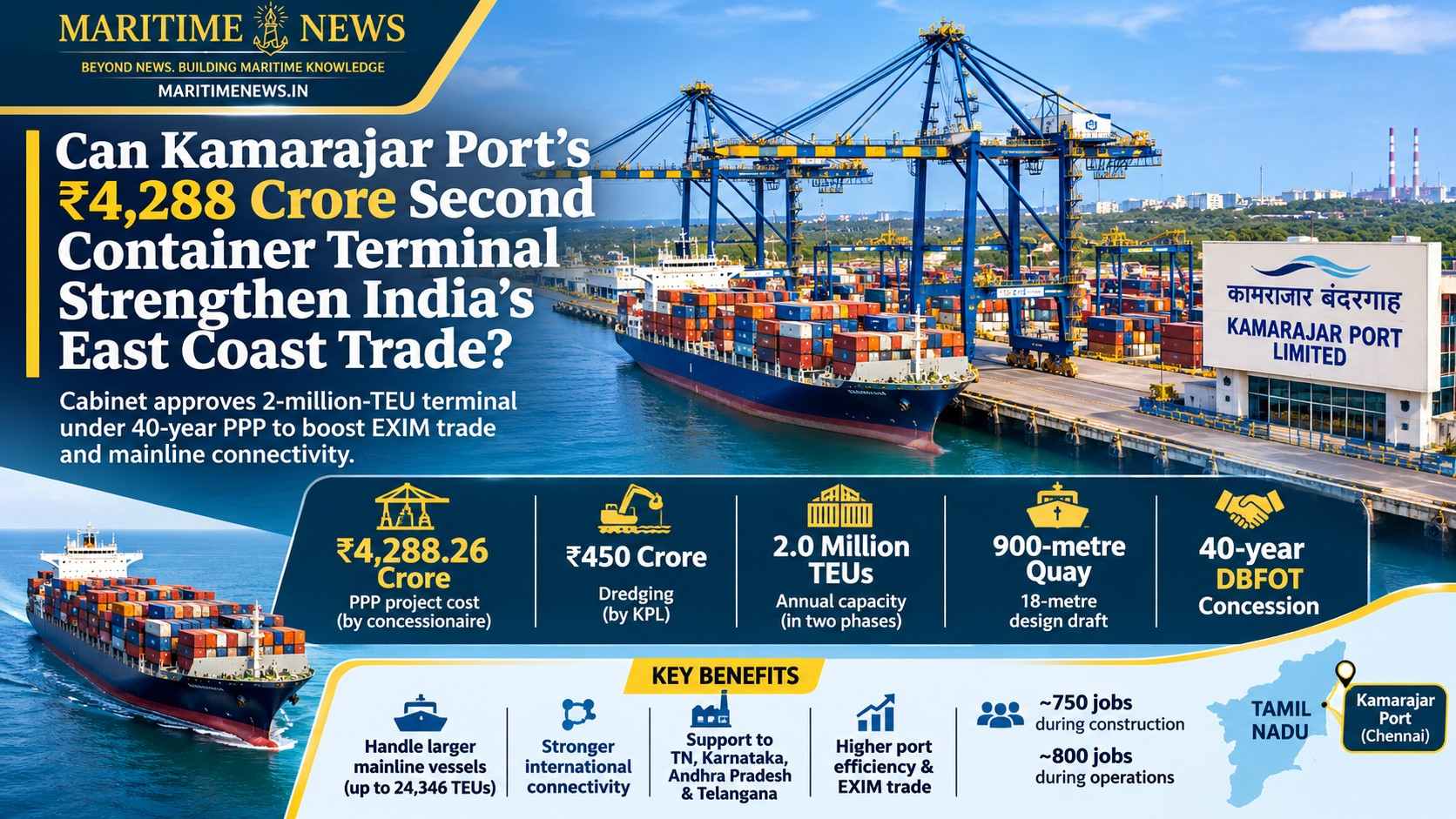
The Cabinet has approved a 2-million-TEU second container terminal at Kamarajar Port under a 40-year Design, Build, Finance, Operate and Transfer concession. While the selected private concessionaire will arrange the ₹4,288.26 crore PPP investment, the port is separately expected to bear an estimated ₹450 crore dredging cost. The project raises important questions about capacity expansion, mainline connectivity, concession economics and the long-term public value of port infrastructure.
Key Takeaways
- The Cabinet Committee on Economic Affairs, chaired by Prime Minister Narendra Modi, approved the second container terminal at Kamarajar Port Limited on 25 November 2026.
- The proposed terminal will have a 900-metre quay, an 18-metre design draft and an annual capacity of 2 million TEUs.
- The project will be developed in two phases: 1.1 million TEUs in Phase I and 0.9 million TEUs in Phase II.
- The estimated PPP project cost is ₹4,288.26 crore, including GST, to be financed by the selected concessionaire.
- Kamarajar Port Limited is separately expected to incur approximately ₹450 crore towards dredging.
- The concession will operate for 40 years under a DBFOT model, including a 48-month construction period.
- The concessionaire will recover its investment through user charges and bear revenue risk. The financial bid is based on royalty offered per TEU.
- The existing container terminal handled approximately 0.7 million TEUs against an installed capacity of 0.8 million TEUs in FY 2025–26, representing around 88% utilisation.
Kamarajar, Ennore, Chennai, Tamil Nadu, India, 25 November 2026 (Maritime News): India’s East Coast container infrastructure is set for a major capacity addition following the Cabinet Committee on Economic Affairs’ approval of the second container terminal at Kamarajar Port Limited (KPL), Tamil Nadu.
The project, approved on 25 November 2026, will be developed under the Public Private Partnership (PPP) mode on a Design, Build, Finance, Operate and Transfer (DBFOT) basis. The estimated PPP component is ₹4,288.26 crore, including GST.
The proposed terminal will have a 900-metre-long quay, a design draft of 18 metres and an annual container-handling capacity of 2 million Twenty-foot Equivalent Units (TEUs). It is intended to accommodate large container vessels, including vessels of up to 24,346 TEUs and 400 metres in length overall.
The expansion is intended to serve the growing export-import requirements of the Chennai–Ennore industrial and economic region and the wider southern hinterland.
However, the project is not simply a matter of adding container capacity. Its significance lies in the financing structure, the allocation of dredging expenditure, the 40-year concession, the royalty mechanism and the ability of Kamarajar Port to attract mainline container services.
The Cabinet’s approval also provides an opportunity to examine how India’s major ports are using private investment to expand infrastructure while retaining a role in public port development.
What Are the Main Specifications of the Second Container Terminal?
The project envisages a new container terminal with the infrastructure and equipment required to handle large container vessels and growing EXIM cargo volumes.
| Parameter | Project specification |
|---|---|
| Port | Kamarajar Port Limited |
| Location | Ennore, Chennai, Tamil Nadu |
| Total quay length | 900 metres |
| Berth width | 30 metres |
| Design draft | 18 metres |
| Total annual capacity | 2.0 million TEUs |
| Phase I capacity | 1.1 million TEUs |
| Phase II capacity | 0.9 million TEUs |
| Maximum vessel size specified | Up to 24,346 TEUs |
| Maximum vessel length specified | 400 metres |
| Contract model | DBFOT under PPP |
| Concession period | 40 years |
| Construction period | 48 months |
The terminal is designed to accommodate large mainline container vessels. The 18-metre design draft and the stated vessel dimensions are intended to improve the port’s ability to receive larger ships and strengthen its international shipping connectivity.
The proposed infrastructure will include berths, container stacking yards, internal roads, administrative facilities, a customs gate complex and utility networks.
The terminal will also require specialised cargo-handling equipment, including ship-to-shore cranes, electric rubber-tyred gantry cranes, rail-mounted gantry cranes, reach stackers and tractor-trailers.
The detailed tender scope identifies a phased equipment deployment programme, with equipment quantities and infrastructure requirements specified separately for Phase I and Phase II.
Why Does Kamarajar Port Need Additional Container Capacity?
The Cabinet approval identifies growing container traffic as the principal reason for the expansion.
Kamarajar Port handled approximately 49.08 million tonnes of cargo and 1,008 vessels during FY 2025–26. Its container traffic exceeded 7 lakh TEUs.
The existing container terminal has an installed capacity of 0.8 million TEUs per annum and handled approximately 0.7 million TEUs during the same financial year.
This represents utilisation of approximately 88%.
| Existing container terminal – FY 2025–26 | Volume |
|---|---|
| Installed capacity | 0.8 million TEUs |
| Container traffic handled | Approximately 0.7 million TEUs |
| Capacity utilisation | Approximately 88% |
Source: Cabinet Committee on Economic Affairs / PIB release dated 25 November 2026. Utilisation is approximately 87.5% when calculated from the rounded figures.
The Cabinet release also states that India’s container traffic grew at a compound annual growth rate (CAGR) of approximately 7% over the preceding five years, while Kamarajar Port’s container traffic grew at around 9.9%.
These figures indicate that KPL’s container traffic has been growing faster than the national rate cited in the release.
The additional terminal is therefore intended to provide capacity for future growth rather than simply replace existing facilities.
Which Industries Will Generate Container Cargo?
The project is expected to serve cargo-generating sectors across the Chennai–Ennore industrial region and the wider southern hinterland.
The Cabinet release identifies:
- Automobiles and auto components.
- Engineering goods.
- Electronics.
- Chemicals.
- Other manufactured products.
The relevant hinterland includes industrial and manufacturing activity across Tamil Nadu, Karnataka, Andhra Pradesh, Telangana and adjoining regions.
The terminal could provide an additional maritime gateway for manufacturers, exporters, importers and logistics service providers.
The actual distribution of cargo between Kamarajar Port and competing gateways will depend on shipping-line connectivity, inland transport costs, service frequency, terminal efficiency and the commercial terms offered to cargo owners.
How Will the ₹4,288 Crore Project Be Financed?
The financial structure is one of the most important aspects of the approval.
The estimated cost of the PPP component is ₹4,288.26 crore, including GST. The investment is to be arranged by the selected concessionaire under the DBFOT framework.
The Cabinet release divides the project cost as follows:
| Component | Estimated cost |
|---|---|
| Phase I | ₹2,429.32 crore |
| Phase II | ₹1,858.94 crore |
| Total PPP project cost | ₹4,288.26 crore |
| Separate dredging expenditure by KPL | ₹450 crore |
The two phases together account for the full estimated PPP project cost.
The distinction between the concessionaire’s investment and the port’s separate dredging expenditure is important.
Does the Project Have No Financial Implication for the Central Government?
The Cabinet release states that there will be no financial implication for the Government of India because the investment in the PPP component will be arranged by the selected concessionaire.
However, the same release separately indicates that Kamarajar Port Limited is expected to incur approximately ₹450 crore towards dredging.
Therefore, the statement about no financial implication for the Central Government should be understood in the context of the PPP component. It should not be interpreted as meaning that no public-sector expenditure is associated with the project.
The dredging cost is a separate project-related expenditure to be borne by KPL.
This distinction matters when assessing the overall economic structure of the terminal development. The concessionaire finances the terminal infrastructure under the PPP arrangement, while the port authority retains responsibility for the specified dredging expenditure.
The financial implications of dredging, including its timing, scope and relationship with the terminal’s construction schedule, will be relevant to the project’s overall implementation.
What Does the 40-Year DBFOT Concession Mean?
The project will be implemented under a Design, Build, Finance, Operate and Transfer model for a concession period of 40 years.
Under this arrangement, the selected concessionaire will be responsible for designing and developing the terminal, arranging the required financing, operating the facility and maintaining it during the concession period, subject to the concession agreement.
At the end of the concession period, the project assets will be dealt with in accordance with the transfer provisions of the agreement.
The proposed construction period is 48 months, with commercial operations scheduled to begin in phases.
How Will the Two Phases Be Implemented?
| Milestone | Phase I | Phase II |
|---|---|---|
| Capacity | 1.1 million TEUs | 0.9 million TEUs |
| Construction period | First 24 months | Months 25–48 |
| Commercial operations | From month 25 | From month 49 |
| Berth length | 500 metres | 400 metres |
Phase I is scheduled for completion within 24 months from the Date of Award of Concession. Commercial operations are expected to begin in the 25th month.
Phase II construction is scheduled between the 25th and 48th months, with full commercial operations expected from the 49th month.
The phased approach allows the first part of the terminal to become operational before the entire project is completed.
However, the actual schedule will depend on the date of award, financial close, site handover, clearances, dredging coordination, construction progress and installation of terminal equipment.
How Will the Private Concessionaire Be Selected?
The Cabinet has approved implementation through a transparent, open global bidding process.
The tender documents for the project identify it as an open competitive bidding process on a single-stage basis, involving technical and financial submissions.
The financial bid is based on the royalty offered per TEU of container cargo handled.
The concessionaire will be selected on the basis of the highest royalty per TEU offered to the port authority, subject to compliance with the eligibility and technical requirements.
This is a significant feature of the commercial model.
The port is not simply awarding a construction contract to the lowest-cost bidder. It is seeking a concessionaire capable of financing, constructing and operating the terminal while offering the highest royalty per unit of container traffic handled.
The royalty structure therefore connects the port’s potential revenue with the terminal’s container throughput.
What Does the Royalty-per-TEU Mechanism Mean?
Under the tender framework, bidders are required to quote royalty in Indian rupees per TEU of container cargo handled.
The concession agreement also provides for royalty per TEU to be indexed to the Wholesale Price Index (WPI).
The concessionaire’s commercial performance will depend on cargo volumes, tariffs, operating costs, financing obligations and the royalty payable to KPL.
The mechanism creates an important relationship between terminal traffic and the port authority’s revenue.
However, the actual financial outcome will depend on the royalty bid, the tariff framework, market conditions and the terminal’s ability to attract cargo.
The Cabinet release states that the concessionaire will recover its investment through user charges in accordance with the concession agreement and applicable tariff framework.
The tender material also provides for the concessionaire to carry revenue risk.
This means that lower-than-projected cargo volumes could affect the concessionaire’s ability to recover its investment and meet its commercial obligations.
What Do the Tender Conditions Reveal About the Project’s Commercial Risks?
The detailed tender material provides further insight into the obligations that prospective bidders must evaluate.
The estimated project value is ₹4,288.26 crore, while the bid security is approximately ₹42.88 crore.
The tender material identifies financial and technical eligibility requirements, including:
- Minimum net worth of ₹1,072.07 crore.
- Available Capital for Investment of ₹1,072.07 crore.
- Threshold technical capacity exceeding ₹8,576.52 crore, subject to the specified project-category conditions.
- Relevant port-sector or core-sector project experience.
- A qualifying operation and maintenance experience requirement, either within the bidding entity or through the prescribed arrangement.
The tender also requires a consortium structure to meet the specified eligibility conditions where applicable.
These requirements indicate that the project is intended for financially capable and technically experienced infrastructure developers and operators.
Who Bears the Construction and Operating Risks?
The tender and concession material allocate several responsibilities to the concessionaire.
| Risk or obligation | Allocation indicated in tender material |
|---|---|
| Project financing | Concessionaire |
| Terminal construction | Concessionaire |
| Container-handling equipment | Concessionaire |
| Operation and maintenance | Concessionaire |
| Revenue risk | Concessionaire |
| Site and sub-surface conditions | Concessionaire assumes specified risks |
| Insurance | Concessionaire |
| Dredging expenditure | Kamarajar Port Limited, estimated ₹450 crore |
The concessionaire is also required to meet construction milestones and maintain the prescribed performance security.
The tender material specifies liquidated damages for delays in meeting milestone obligations, calculated at 0.1% of the performance guarantee for each day of delay, subject to the stated aggregate cap.
These provisions are important because a 40-year concession involves long-term construction, financing, operational and market risks.
The allocation of risks must be examined not only at the time of bidding but throughout the concession period.
Will the Second Terminal Improve India’s East Coast Mainline Connectivity?
The ability to handle large container vessels is one of the principal strategic objectives of the project.
The proposed 18-metre design draft and the stated capacity to accommodate vessels of up to 24,346 TEUs and 400 metres in length are intended to improve Kamarajar Port’s ability to receive larger mainline vessels.
If the port attracts regular direct calls by such vessels, cargo owners could benefit from improved connectivity with international shipping routes.
The Cabinet release states that the project is expected to reduce dependence on foreign deep-water hub ports and associated feedering costs.
However, the extent of this benefit will depend on shipping-line decisions, cargo volumes, vessel deployment, route economics and the port’s ability to maintain competitive turnaround times.
A deep-draft terminal alone does not guarantee direct mainline services. Shipping lines also consider cargo concentration, hinterland connectivity, terminal productivity, service reliability and commercial costs.
The success of the terminal will therefore depend on the wider logistics ecosystem, not only the berth specifications.
What Could This Mean for Exporters and Importers?
The additional capacity could provide another gateway for containerised EXIM cargo from the Chennai–Ennore industrial region and the southern hinterland.
For manufacturers and exporters, the potential benefits include:
- Additional container-handling capacity.
- More options for port selection.
- Potential improvements in shipping connectivity.
- Greater ability to accommodate large vessels.
- Possible reduction in feedering dependence, subject to actual service deployment.
For importers, improved connectivity and terminal capacity could support the movement of machinery, electronics, chemicals, components and other industrial inputs.
For logistics service providers, the expansion could create opportunities across container transport, customs clearance, freight forwarding, warehousing, container handling and inland distribution.
The benefits will depend on how effectively the terminal integrates with road, rail, industrial and logistics infrastructure.
What Does the Project Mean for Employment and the Southern Hinterland?
The Cabinet release estimates that the project will generate employment for approximately 750 persons directly and indirectly during construction.
During the operational phase, employment is expected to increase by about 800 persons.
The project is also expected to support manufacturing and trade across Tamil Nadu, Karnataka, Andhra Pradesh, Telangana and adjoining regions.
The potential employment impact should be viewed across two stages.
Construction phase: Civil engineering, dredging-related activity, equipment installation, electrical systems, infrastructure development and associated services.
Operational phase: Terminal operations, equipment maintenance, cargo handling, safety, security, administration, technical services and supporting logistics activities.
The actual employment outcomes will depend on construction contracts, operational staffing, technology choices and the extent of local procurement.
How Does the Project Fit into Maritime India Vision 2030 and Maritime Amrit Kaal Vision 2047?
The Cabinet has identified the project as aligned with Maritime India Vision 2030 and Maritime Amrit Kaal Vision 2047.
The proposed terminal is intended to strengthen Kamarajar Port’s position as a container gateway on India’s East Coast.
The project also reflects a broader infrastructure strategy in which major ports use private-sector capital and operating expertise to expand capacity.
For India, the development of competitive container terminals is closely linked to EXIM trade, manufacturing, supply-chain efficiency and international shipping connectivity.
The wider port development programme can be followed through Maritime News’ coverage of port infrastructure projects and port developments.
The commercial and investment dimensions are also relevant to the wider discussion on maritime investment trends and maritime market analysis.
The Kamarajar project will need to demonstrate that additional port capacity translates into competitive services, stronger cargo connectivity and measurable benefits for the trade ecosystem.
What Should Be Monitored During Implementation?
The Cabinet approval establishes the project’s policy and investment framework. The next stage will be its translation into a concession award, financing, construction and commercial operations.
Several milestones will be important for monitoring:
- Publication and completion of the global bidding process.
- Selection of the concessionaire and disclosure of the winning royalty-per-TEU bid.
- Execution of the concession agreement.
- Achievement of financial close.
- Completion of the required environmental and other clearances.
- Coordination of the ₹450 crore dredging work by KPL.
- Construction progress against the Phase I and Phase II milestones.
- Installation and commissioning of container-handling equipment.
- Commencement of Phase I commercial operations.
- Achievement of full 2-million-TEU annual capacity.
- Actual container throughput, vessel calls and terminal productivity.
- Royalty revenue received by KPL and the terminal’s performance over the concession period.
The tender information supplied for this analysis records a bid submission deadline of 30 October 2026. Since the Cabinet approval was announced on 25 November 2026, the bid deadline has already passed. The latest tender status, bid opening, bidder participation and any subsequent amendments or award announcement should be verified independently before reporting that the concessionaire has been selected.
Can Kamarajar Port’s Second Container Terminal Deliver Long-Term Value?
The Cabinet approval of the ₹4,288.26 crore second container terminal represents a major proposed expansion of container-handling capacity at Kamarajar Port.
The 900-metre terminal, 18-metre design draft and 2-million-TEU annual capacity are intended to strengthen the port’s ability to handle large container vessels and serve the growing EXIM requirements of southern India’s industrial and manufacturing hinterland.
The DBFOT structure places the main PPP investment, construction and operating responsibilities with the selected concessionaire. The royalty-per-TEU mechanism also creates a potential revenue stream for the port authority linked to container throughput.
At the same time, the separate ₹450 crore dredging expenditure to be borne by KPL deserves attention when assessing the complete project economics.
The long-term value of the terminal will depend on more than the completion of construction. It will require sustained cargo growth, competitive tariffs, efficient operations, reliable shipping-line connectivity, effective hinterland logistics and transparent management of the 40-year concession.
For exporters, importers, shipping lines and logistics providers, the project could create another important container gateway on India’s East Coast.
For Kamarajar Port, the challenge will be to ensure that the additional capacity generates sustainable port revenue and strengthens its competitive position.
The real test of this ₹4,288 crore project will not be the capacity it builds, but the trade it attracts, the efficiency it delivers and the public value it creates over the next four decades.
Sources and References
External Sources
- Press Information Bureau, Government of India – Cabinet approves development of the Second Container Terminal at Kamarajar Port Limited under PPP Mode on DBFOT Basis, posted 25 November 2026. Primary source for Cabinet approval, project specifications, estimated cost, capacity, traffic data, employment estimates and implementation plan.
- InfraLens / BidEasy tender deep dive – Development of the Second Container Terminal at Kamarajar Port Limited under PPP Mode. Tender-document extraction covering eligibility requirements, bid security, concession terms, royalty mechanism, performance security, construction milestones and risk allocation. The original tender documents should be consulted for contractual verification.