
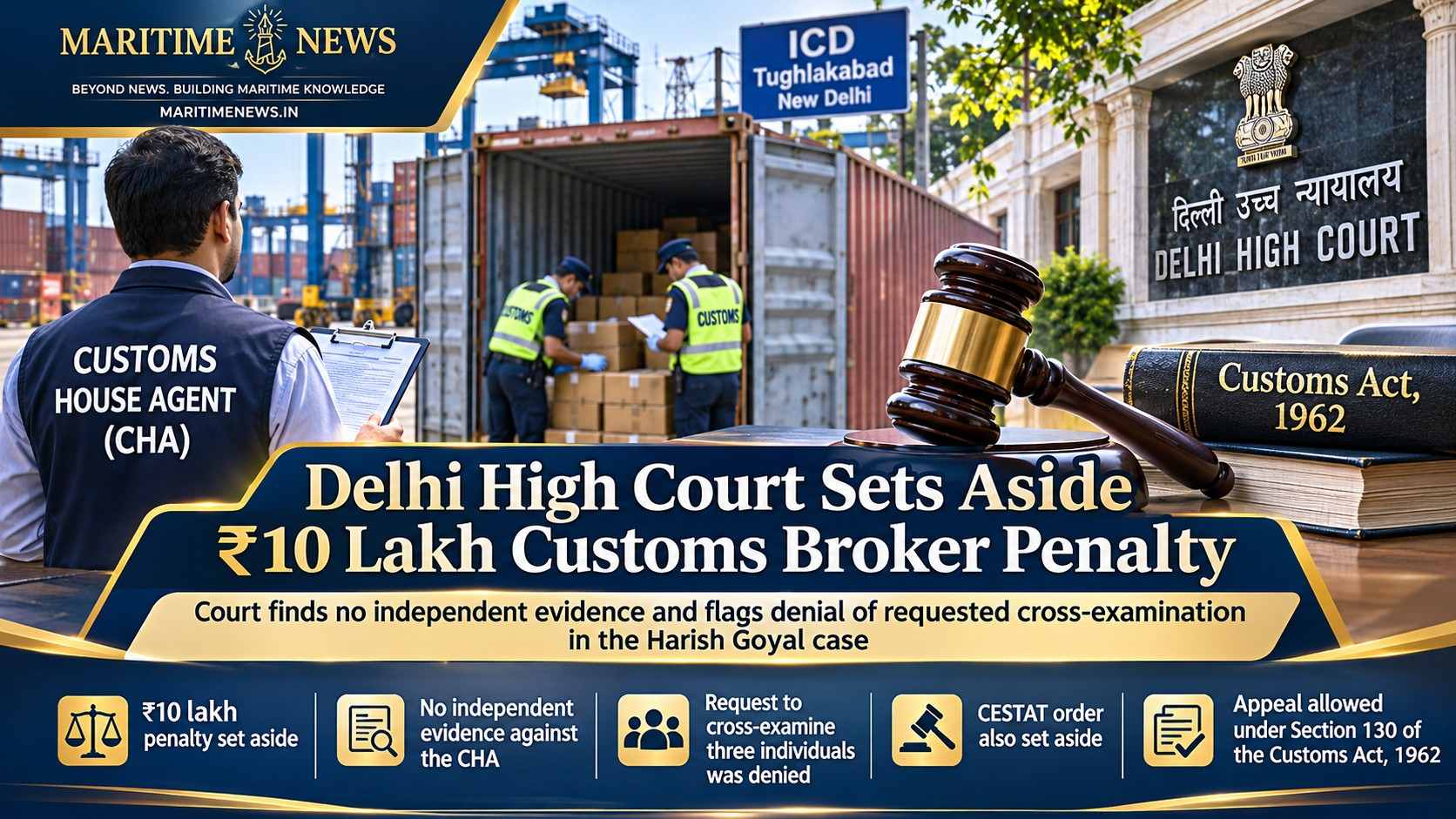
In Harish Goyal v. Commissioner of Customs, the Delhi High Court found that the evidence against a Customs House Agent rested on statements of co-noticees and related circumstances, while his request to cross-examine three individuals had been denied. The Court set aside the penalty and the CESTAT order.
Key Takeaways
- The Delhi High Court has set aside a ₹10 lakh penalty imposed on Harish Goyal, proprietor of Krishna Clearing & Forwarding Agency, Ludhiana, under Section 112(b)(i) of the Customs Act, 1962.
- The case arose from the seizure of two containers at ICD Tughlakabad in September 2016, after Chinese-made firecrackers were allegedly found concealed behind declared bicycle parts and pumps.
- The Court observed that there was no independent evidence against Goyal apart from statements of co-noticees.
- Goyal’s request to cross-examine three individuals whose statements were relied upon against him had been rejected by the adjudicating authority.
- The Court noted that CESTAT had proceeded on an incorrect factual premise when it recorded that Goyal had not sought cross-examination.
- The High Court held that cross-examination is not an absolute right but falls within the principles of natural justice and is consistent with Section 138B of the Customs Act.
- The Court allowed the appeal and set aside both the CESTAT order and the penalty order.
New Delhi, India November 25, 2026 (Maritime News): The evidentiary basis for imposing penalties on customs intermediaries has come under judicial scrutiny after the Delhi High Court set aside a ₹10 lakh penalty imposed on a Customs House Agent (CHA) / Customs Broker, holding that the case against him lacked independent evidence and that his request to cross-examine individuals whose statements were relied upon had been denied.
The judgment in Harish Goyal v. Commissioner of Customs, CUSAA 132/2022, was pronounced on 6 November 2026 by a Division Bench comprising Justice Avneesh Jhingan and Justice Shail Jain.
The case originated from the alleged import of Chinese-made firecrackers concealed behind declared bicycle parts and pumps in two containers examined by the Directorate of Revenue Intelligence (DRI) at the Inland Container Depot (ICD), Tughlakabad, New Delhi, in September 2016.
The Court’s decision raises an important question for the customs-clearance and EXIM ecosystem: what evidence is required to establish the liability of a CHA when the alleged involvement is based substantially on statements made by other persons and circumstantial material?
How Did the Alleged Misdeclaration Come to Light?
The litigation originated from two containers covered by Bill of Lading No. OOLU2023101170, dated 4 August 2016.
The consignment was declared to contain bicycle parts. On 5 September 2016, DRI officers examined the containers at ICD Tughlakabad and allegedly found Chinese-made firecrackers concealed behind a small quantity of bicycle parts and pumps. The goods were seized.
The following day, DRI officers searched the Ludhiana office premises of Harish Goyal, proprietor of M/s Krishna Clearing & Forwarding Agency, and seized documents, a mobile phone and a laptop.
During the investigation, statements were recorded from Goyal, Manish Srivastava, Deputy Manager (Imports) of Orient Overseas Line India Pvt. Ltd., and two Delhi-based Customs House Agents, Ajay Sagar and Purshottam.
The Department alleged that Goyal knew about the proposed misdeclaration, arranged meetings with the Delhi-based CHAs and facilitated the alleged use of the Importer Exporter Code (IEC) and KYC documents of M/s Kirat Sales.
A show-cause notice was issued to Goyal on 2 March 2017.
Why Was the CHA Penalised?
The Additional Commissioner of Customs, ICD Tughlakabad (Import), New Delhi, passed an Order-in-Original on 28 February 2018, holding that the import of prohibited goods through the alleged misuse of M/s Kirat Sales’ KYC documents had been facilitated by Goyal.
A penalty of ₹10 lakh was imposed under Section 112(b)(i) of the Customs Act, 1962.
The adjudicating authority did not establish Goyal’s direct role in the import of the seized consignment. However, it concluded that he had knowledge of the alleged misdeclaration and had arranged a meeting involving Rahul Sehgal, Saurabh Aggarwal and the two Delhi-based CHAs.
The authority also relied on the fact that Goyal’s office telephone number appeared in the contact details of M/s Rahul Traders in correspondence provided by the shipping line.
Goyal challenged the penalty before the Customs, Excise and Service Tax Appellate Tribunal (CESTAT). The Tribunal dismissed his appeal on 4 May 2022, leading him to approach the Delhi High Court under Section 130 of the Customs Act.
What Was the Dispute Over the Importer and Consignee?
The High Court examined the sequence of events concerning the identity of the importer and the consignee.
According to the shipping-line representative’s statement recorded during the investigation, the consignment was initially booked in the name of M/s Rahul Traders and the consignee was subsequently changed to M/s Kirat Sales.
The Bill of Lading was ultimately in the name of M/s Kirat Sales.
The Department’s case alleged that Rahul Sehgal, proprietor of M/s Rahul Traders, had planned the import of firecrackers under the description of freely importable bicycle parts, in connivance with Saurabh Aggarwal and Goyal.
The adjudicating authority had treated material collected from Rahul Sehgal’s premises, together with his failure to appear during the investigation, as evidence that he was the actual importer. A penalty of ₹41,16,424 was imposed on him under Section 112(b)(i).
However, the High Court noted that the penalty against Rahul Sehgal had subsequently been set aside by CESTAT on 17 August 2021.
The Court observed that the Department’s case identifying Rahul Sehgal as the actual importer had fallen, substantially eroding the foundation of the allegations against Goyal.
The Court considered this development alongside the absence of independent evidence against the CHA. It did not hold that the failure of a case against an alleged principal importer automatically extinguishes the liability of every other person.
Why Did the High Court Question the Evidence Against the CHA?
The High Court’s analysis identified a central weakness in the Department’s case.
In paragraph 13 of the judgment, the Court recorded that there was no evidence against Goyal except the statements of co-noticees.
The Court noted that the persons with whom Goyal had allegedly arranged the meeting had not been proceeded against for any role in the import of the consignment.
It further observed that the alleged knowledge of misdeclaration had been inferred from Jaskirat Singh’s statement and the fact that Goyal’s telephone number appeared in the contact details of M/s Rahul Traders.
The Court also noted that no documentary evidence directly indicating Goyal’s role in the import had come into the Department’s possession.
This distinction was central to the decision. The question was not merely whether Goyal had professional or communication links with the businesses involved, but whether the material on record established the conduct for which he had been penalised.
Cross-Examination: Why Did the Court Identify a Procedural Deficiency?
Another significant aspect concerned Goyal’s request to cross-examine three individuals whose statements had been relied upon against him.
He had specifically sought to cross-examine:
- Ajay Sagar
- Purshottam
- Jaskirat Singh
The adjudicating authority rejected the request, stating that cross-examination would serve no useful purpose and would delay the proceedings.
The High Court observed that CESTAT had proceeded on an incorrect factual premise by recording that Goyal had not sought cross-examination of these three individuals.
In paragraph 15, the Court clarified that cross-examination is not an absolute right. However, it falls within the ambit of the principles of natural justice and is consistent with Section 138B of the Customs Act.
The Court’s observation is important because the statements were being relied upon to establish Goyal’s alleged knowledge and involvement.
The decision does not establish that cross-examination must be permitted in every customs proceeding. It emphasises the relevance of the right in the circumstances of this case, particularly where statements formed the basis of the allegations and a specific request had been made.
Why Did the Court Examine the Treatment of Other Co-Noticees?
The High Court also considered the different treatment of persons allegedly connected with the same import transaction.
The penalty imposed on Saurabh Aggarwal had been set aside by CESTAT on 11 February 2020. The Court noted that the Tribunal had found no evidence against Aggarwal apart from Goyal’s statement.
The investigation against Jaskirat Singh had also been dropped during adjudication.
The Court questioned why Goyal’s penalty had been sustained when the evidentiary foundation against other persons had failed and no independent evidence directly establishing his role in the import had been obtained.
It concluded that, in the absence of independent evidence against Goyal, the different treatment of the appellant from the co-noticees could not be sustained.
What Does the Judgment Mean for Customs Brokers and the EXIM Ecosystem?
The judgment has relevance beyond the individual penalty because it examines how responsibility is attributed to an intermediary in an alleged misdeclaration case.
A typical import transaction may involve an overseas seller, importer, Customs Broker, shipping line, freight forwarder or NVOCC, port or terminal, Container Freight Station (CFS), Inland Container Depot (ICD) and Customs authorities.
Each participant performs a different function. Their presence in the same transaction does not, by itself, establish identical legal responsibility.
In Goyal’s case, the Department relied on statements, shipping-line correspondence, contact details and alleged meeting arrangements to establish his knowledge and involvement.
The High Court examined whether those materials were sufficient to sustain the specific penalty imposed on him.
For Customs Brokers, the decision underlines the importance of distinguishing between a professional relationship with an importer and evidence establishing participation in a customs contravention.
For shipping lines and logistics service providers, the case also illustrates how booking information, consignee amendments, correspondence and other transaction records may become part of the evidentiary material in a customs investigation.
The judgment does not make findings of wrongdoing against the shipping line, ICD operator, freight forwarder, NVOCC or other logistics participants. Its findings concern the penalty imposed on Goyal.
Maritime News has previously reported on operational concerns raised by Customs House Agents at ICD Patparganj in Can CWC’s Response Resolve Operational Concerns Raised by CHAs at ICD Patparganj?. While that report concerns a different matter, it provides additional context on the operational environment in which Customs Brokers and other clearance stakeholders work.
What Did the Delhi High Court Finally Decide?
The substantial question of law framed by the Court was whether Goyal had been rightly and justifiably penalised under Section 112(b)(i) of the Customs Act, 1962.
The Division Bench answered the question in favour of the appellant.
The Court set aside the CESTAT order dated 4 May 2022 and the penalty order imposed by the Customs authorities. It allowed the appeal.
The decision was pronounced on 6 November 2026 and is marked as reportable.
The ruling was based on the evidentiary and procedural deficiencies identified in the case, including the absence of independent evidence against Goyal, the denial of his specific request for cross-examination and the inconsistent treatment of co-noticees.
Beyond the ₹10 Lakh Penalty: The Importance of Evidence in Customs Enforcement
The significance of Harish Goyal v. Commissioner of Customs lies in the High Court’s examination of how an intermediary’s alleged involvement must be established before a penalty can be sustained.
The Court did not grant blanket immunity to Customs Brokers, nor did it hold that professional intermediaries cannot be penalised for facilitating customs violations.
Instead, it examined the evidence available against the individual appellant and the procedural safeguards applicable when statements of other persons are relied upon.
For India’s import-export and logistics ecosystem, the judgment reinforces an important distinction: responsibility must be established on the evidence relevant to each person, rather than inferred merely from association with an importer or participation in the broader transaction.
The decision places evidentiary sufficiency and procedural fairness at the centre of customs adjudication, while leaving the statutory powers of Customs authorities to proceed against persons where the legal requirements and supporting evidence are established.
Sources and References
External Sources
- Delhi High Court, Harish Goyal v. Commissioner of Customs, CUSAA 132/2022, judgment pronounced on 6 November 2026. Primary judicial source; eight-page reportable judgment.
Internal Sources – Maritime News Archive