

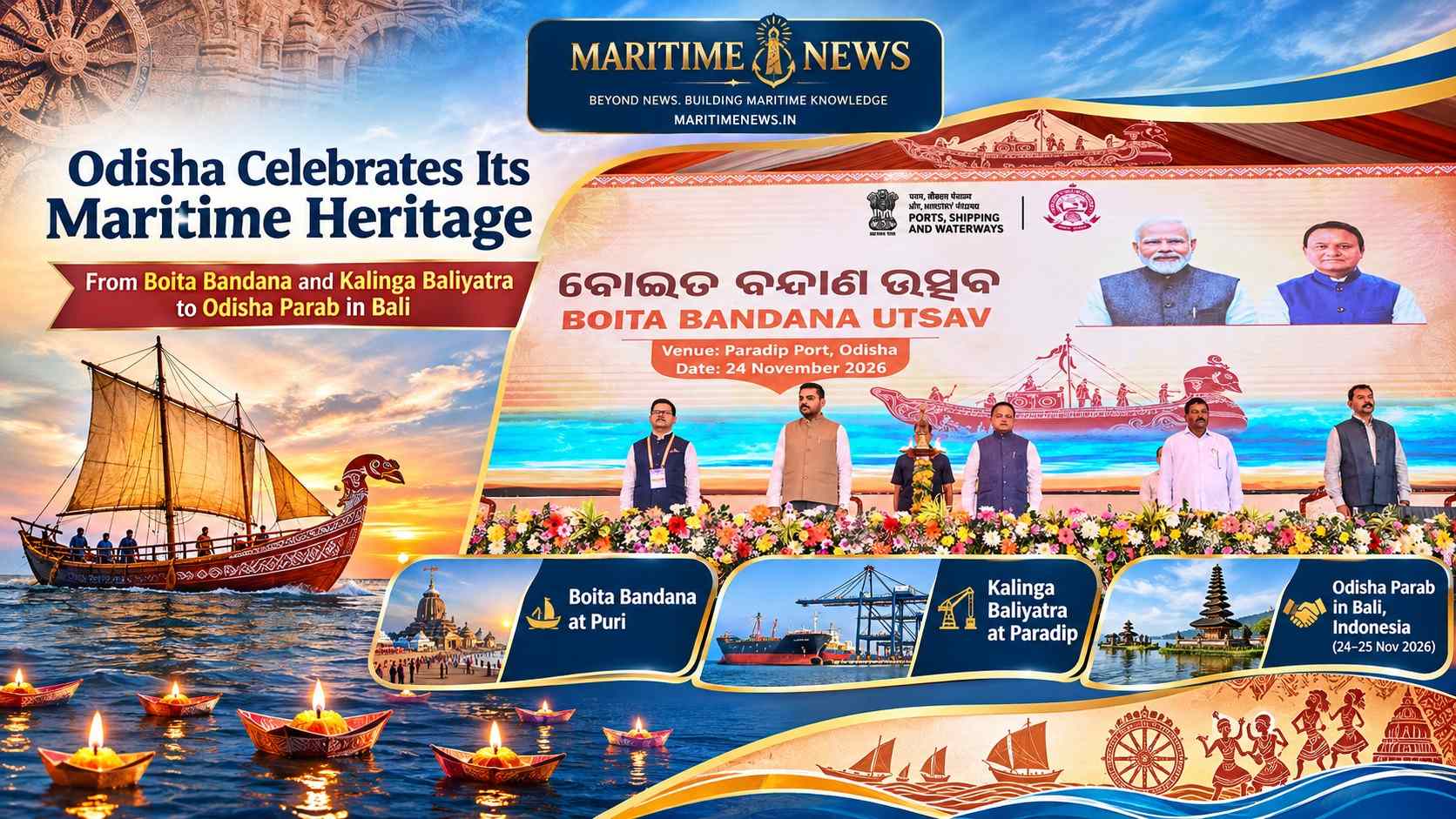
From Boita Bandana at Puri and Kalinga Baliyatra at Paradip to Odisha Parab in Bali, Indonesia, the state is bringing its historic seafaring traditions into contemporary cultural diplomacy, tourism and port-led economic development.
Key Takeaways
- Kartik Purnima celebrations across Odisha have brought renewed attention to the state’s maritime heritage and traditional overseas trading connections.
- BJP Member of Parliament Sambit Patra participated in the Boita Bandana ritual at Puri Beach and highlighted the historic voyages of Odisha’s Sadhabas.
- Chief Minister Mohan Charan Majhi inaugurated Kalinga Baliyatra 2026 at Paradip, describing the festival as a living symbol of Odisha’s maritime trade tradition.
- Odisha Parab is being organised in Bali, Indonesia, on 24–25 November 2026, drawing inspiration from the legacy of Bali Jatra and historic connections between Kalinga and Southeast Asia.
- The international event is being organised by Odisha’s Tourism Department in collaboration with the Consulate General of India in Bali, with support from FICCI.
- The developments connect maritime heritage with contemporary opportunities in tourism, investment, cultural exchange and port-led economic development.
- The larger challenge is to translate cultural recognition into sustained maritime education, heritage preservation, coastal livelihoods and economic partnerships.
Puri, Odisha, 24 November 2026 (Maritime News):On Kartik Purnima, Odisha’s relationship with the sea takes centre stage through traditional boat ceremonies, cultural celebrations and renewed public attention to its historic maritime identity.
This year, the celebrations have extended beyond religious and cultural observances. From Puri Beach, where BJP Member of Parliament Sambit Patra participated in Boita Bandana, to Paradip, where Chief Minister Mohan Charan Majhi inaugurated Kalinga Baliyatra 2026, Odisha’s maritime past has been brought into the contemporary public conversation.
At the same time, the state is taking this heritage beyond India’s coastline. Odisha Parab, a two-day international cultural and tourism event, is being organised in Bali, Indonesia, on 24 and 25 November 2026, highlighting the historical and cultural connections between Odisha and Southeast Asia.
These developments raise a larger question for India’s maritime sector: can the memory of ancient seafaring traditions become a foundation for contemporary maritime identity, international engagement, tourism, education and economic development?
For Odisha, the opportunity is to connect its cultural heritage with the modern maritime economy represented by ports, shipping, logistics, shipbuilding, coastal infrastructure and international trade.
What Does Boita Bandana Represent in Odisha’s Maritime History?
Boita Bandana, observed on Kartik Purnima, is associated with Odisha’s traditional maritime heritage and the memory of seafarers who undertook overseas voyages for trade.
The word Boita refers to a boat, while Bandana signifies paying tribute or offering respect. The ritual involves floating small boats, traditionally made from materials such as banana stems, paper or other natural materials, on rivers, ponds and other water bodies.
The observance is associated with the voyages of the Sadhabas, the traditional maritime traders of ancient Kalinga. According to the historical and cultural traditions commemorated through the festival, these traders travelled across the Bay of Bengal to Southeast Asia, establishing commercial and cultural connections with regions including Bali.
The voyages are traditionally associated with the seasonal wind patterns of the Northeast Monsoon, which provided favourable sailing conditions for journeys across the Bay of Bengal.
The festival therefore represents more than a symbolic boat-floating ceremony. It preserves a cultural memory of maritime trade, navigation, commercial exchange and contact between communities across the Indian Ocean region.
However, the historical chronology, geographical extent and commercial scale of individual voyages should be examined through historical, archaeological and documentary evidence rather than inferred solely from festival traditions.
Sambit Patra Highlights Odisha’s Seafaring Heritage at Puri
On Kartik Purnima, BJP Member of Parliament Sambit Patra participated in the Boita Bandana ritual at Puri Beach and highlighted Odisha’s historic relationship with maritime trade.
Explaining the significance of the festival, Patra said that Kartik Purnima is observed across India but holds particular importance in Odisha through the Boita Bandana tradition.
He explained the meaning of the term, with Boita referring to a boat and Bandana representing the act of honouring or paying tribute.
Patra recalled the voyages of the Sadhab Pua, who, according to Odisha’s maritime traditions, travelled to Southeast Asian countries in specially crafted vessels for commercial exchange.
He also referred to the timing of these voyages around the onset of the Northeast Monsoon, which historically provided favourable conditions for maritime navigation.
His remarks placed the festival within the larger context of Odisha’s maritime identity and the importance of remembering the region’s historic trading communities.
The participation of a national political representative also brought the subject into the wider discussion of India’s maritime heritage and its historical connections with Southeast Asia.
Source: ANI report – Sambit Patra Highlights Odisha’s Maritime Heritage on Kartik Purnima.
Paradip’s Kalinga Baliyatra Connects Maritime Heritage with Port-Led Development
While Puri marked Kartik Purnima through Boita Bandana, Paradip became another important centre of Odisha’s maritime heritage celebrations.
Chief Minister Mohan Charan Majhi inaugurated Kalinga Baliyatra 2026 in Paradip on 23 November, describing the festival as a living symbol of Odisha’s maritime trade tradition, the courage of the Sadhabas and the state’s historical relationship with the sea.
The Chief Minister recalled the commercial and cultural legacy associated with ancient Kalinga and emphasised the importance of reviving public awareness of Odisha’s maritime past.
He also connected this heritage with the state’s contemporary economic ambitions, describing Paradip as a gateway to the development of eastern India and an important driver of Odisha’s economic growth.
The Chief Minister called upon people to use traditional banana-leaf boats instead of plastic boats during the Boita Bandana ritual, linking cultural preservation with environmental responsibility.
The official announcement of the inauguration identified the festival as Kalinga Baliyatra 2026 and highlighted the importance of preserving Odisha’s maritime heritage.
Official source: Chief Minister of Odisha – Chief Minister Inaugurates Kalinga Baliyatra-2026 in Paradip, Celebrates Odisha’s Glorious Maritime Heritage.
From historical trading voyages to a modern maritime gateway
Paradip’s significance provides a contemporary connection to the maritime traditions being celebrated.
Unlike the traditional sailing vessels associated with the Sadhabas, modern Paradip operates as a major commercial port handling industrial cargo and supporting trade across domestic and international markets.
The port’s development is closely connected with Odisha’s industrial and logistics ambitions. Its role extends beyond cargo handling to port-led industrialisation, connectivity, energy infrastructure and emerging maritime services.
Maritime News has previously examined this development in Paradip Port Charts Expansion Path as Odisha Targets $1.5 Trillion Economy.
The port’s proposed industrial and maritime expansion has also been examined in Paradip Port Unveils ₹46,000 Crore Maritime Expansion Blueprint.
More recently, the approval of a dedicated green hydrogen jetty has highlighted Paradip’s potential role in the emerging clean-energy logistics chain. The development is covered in Centre Approves ₹797 Crore Green Hydrogen Jetty at Paradip Port.
The relationship between the festival and the modern port is therefore more than geographical. Both represent different periods in Odisha’s maritime relationship with the sea: one rooted in traditional commercial voyages and the other in modern port infrastructure and international trade.
Odisha Takes Bali Jatra’s Legacy to Indonesia Through Odisha Parab
The international dimension of this year’s celebrations is reflected in Odisha Parab, being organised in Bali, Indonesia, on 24 and 25 November 2026.
The event is being organised by the Odisha Tourism Department in collaboration with the Consulate General of India in Bali, with support from the Federation of Indian Chambers of Commerce and Industry (FICCI).
The Odisha delegation is led by Deputy Chief Minister Pravati Parida, accompanied by Minister of State for Odia Language, Literature and Culture Suryabanshi Suraj and senior government officials.
The initiative is inspired by the historic maritime and cultural connections between ancient Kalinga and Southeast Asia, particularly Bali.
The theme, “From the Shores of Kalinga to the Heart of Bali – One Sea. Centuries of Maritime Connections,” reflects the state’s intention to present its historical maritime identity to an international audience.
The programme includes:
- Traditional cultural performances.
- Odisha’s handicrafts and handlooms.
- Traditional Odia cuisine.
- Presentations on tourism destinations.
- Showcases of heritage sites and beaches.
- Wildlife and adventure tourism opportunities.
- Engagement with tourism and business stakeholders.
The event is intended to promote Odisha’s cultural heritage and tourism potential while creating opportunities for hospitality, investment, cultural exchange and business engagement.
The initiative is significant because it takes the traditional Bali Jatra narrative beyond domestic celebrations and places it within an international cultural and tourism platform.
Sources: Odisha Takes Bali Jatra Legacy to Indonesia with Two-Day Odisha Parab in Bali | Odisha Tourism – Odisha Parab, Bali.
Bali Jatra and the Historical Connections Between Kalinga and Southeast Asia
Bali Jatra is among Odisha’s most recognised cultural celebrations associated with its maritime past.
The festival commemorates the traditional voyages of the Sadhabas and the commercial and cultural relationships that Odisha’s historical traditions associate with Southeast Asian regions.
The Bay of Bengal served as an important maritime corridor connecting the eastern Indian coastline with ports and trading settlements across Southeast Asia.
Seasonal monsoon patterns influenced the movement of vessels, while maritime trade supported the exchange of commodities, knowledge, cultural practices and religious influences.
Odisha’s cultural memory preserves these connections through Boita Bandana and Bali Jatra.
The significance of taking Odisha Parab to Bali lies in the opportunity to present this shared heritage to communities in a region historically connected with the maritime traditions of the Indian subcontinent.
However, cultural connections should not automatically be interpreted as proof of uninterrupted political or commercial relationships between ancient Kalinga and modern Indonesia. The historical relationship requires careful examination through inscriptions, archaeological findings, historical records and cultural research.
For contemporary Odisha, the immediate opportunity is to use this shared heritage as a platform for people-to-people engagement, tourism promotion and institutional cooperation.
Can Maritime Heritage Become an Instrument of Cultural Diplomacy?
Odisha Parab demonstrates how historical memory can be used as an instrument of international engagement.
The initiative combines cultural presentation with tourism promotion and business outreach. By bringing traditional arts, cuisine, handlooms, handicrafts and tourism opportunities to Bali, the state is attempting to connect its historical identity with contemporary economic opportunities.
This approach is relevant to India’s broader maritime engagement with Southeast Asia.
The Indian Ocean and Bay of Bengal are not only commercial shipping spaces. They also represent centuries of movement involving traders, seafarers, cultural communities and religious traditions.
Cultural diplomacy can help strengthen contemporary relationships by highlighting historical connections and creating opportunities for tourism, education, institutional engagement and business partnerships.
For Odisha, the Bali initiative could support several areas of engagement:
- Tourism promotion between Odisha and Indonesia.
- Cultural exchanges involving artists, artisans and educational institutions.
- Cooperation between tourism businesses and hospitality operators.
- Investment opportunities in tourism infrastructure and related services.
- Research and documentation of historical maritime connections.
- Greater international visibility for Odisha’s ports and maritime economy.
The important question is whether such cultural initiatives will be supported by sustained institutional engagement and measurable follow-up.
Odisha’s Maritime Heritage Needs More Than Annual Celebrations
The renewed attention to Boita Bandana and Bali Jatra provides an opportunity to examine how Odisha can preserve and develop its maritime heritage beyond annual festival events.
Maritime heritage is not limited to traditional boats, cultural performances and historical narratives. It also includes the knowledge systems, navigation practices, coastal communities, port settlements, trading networks and technological developments that shaped maritime activity.
A sustained heritage programme could consider:
- Maritime museums and interpretation centres.
- Documentation of traditional boatbuilding and navigation knowledge.
- Research partnerships with universities and maritime institutions.
- Preservation of historical coastal sites and maritime records.
- Maritime heritage education for school and university students.
- Training and employment opportunities connected with the maritime sector.
- Responsible tourism involving coastal communities.
- Research into Odisha’s historical trading connections with Southeast Asia.
The 2nd Indian Lighthouse Festival, held in Odisha in 2024, had already brought maritime heritage, coastal tourism and community participation into the policy discussion. Maritime News covered the initiative in Lighthouse Tourism Conclave 2024: New Era for Maritime Heritage.
The earlier Boita Bandana ceremony at Paradip attended by President Droupadi Murmu also connected maritime heritage with port infrastructure and development projects.
These developments provide a foundation for a broader approach in which heritage preservation, maritime education, tourism and modern port development are treated as interconnected areas.
From Sadhabas to Modern Seafarers: Connecting Maritime Heritage with the Human Element
The traditional memory of the Sadhabas also provides an opportunity to discuss the people who sustain maritime activity today.
The Sadhabas are remembered as traders and seafarers who undertook voyages across the sea. Modern maritime operations depend on a much broader workforce, including seafarers, ship officers, marine engineers, port workers, logistics professionals, shipbuilders, customs brokers and other service providers.
The transition from traditional trading vessels to modern commercial shipping represents a major technological and institutional transformation. Yet the human element remains central to maritime trade.
Odisha’s maritime heritage can therefore become an educational platform for introducing younger generations to shipping, navigation, port operations, marine engineering, maritime law and logistics.
The state already has a growing port and industrial ecosystem around Paradip and other coastal locations. Linking heritage education with contemporary maritime skills could help create stronger awareness of career opportunities in the sector.
Such an approach would also ensure that maritime heritage is not confined to cultural symbolism but contributes to the development of future maritime professionals.
What Should Be the Next Step for Odisha’s Maritime Identity?
The celebrations at Puri and Paradip, together with Odisha Parab in Bali, have brought maritime heritage into public and international attention.
The next challenge is to convert this attention into a sustained programme.
The state could consider developing a coordinated maritime heritage strategy connecting the Tourism Department, Culture Department, port authorities, educational institutions, maritime organisations and coastal communities.
Such a programme could have five interconnected pillars:
1. Heritage preservation: Document traditional vessels, maritime routes, historical records, coastal settlements and cultural practices.
2. Maritime education: Introduce structured learning about Odisha’s maritime history alongside modern shipping, port operations and marine technology.
3. International cultural engagement: Develop continuing exchanges with Indonesia and other Southeast Asian countries through museums, universities, cultural institutions and tourism organisations.
4. Port-led economic development: Connect the maritime identity of Odisha with the development of Paradip and other ports, industrial infrastructure, logistics and trade.
5. Coastal community participation: Ensure that fishing communities, traditional boatbuilders, artisans, tourism operators and other local stakeholders benefit from heritage-related programmes.
The success of such an approach would depend on measurable outcomes rather than the number of annual festivals or cultural events conducted.
Can Odisha’s Maritime Past Shape Its Maritime Future?
Odisha’s Kartik Purnima celebrations have once again brought attention to the state’s maritime heritage. Sambit Patra’s participation in Boita Bandana at Puri, Chief Minister Mohan Charan Majhi’s inauguration of Kalinga Baliyatra at Paradip and the international presentation of Odisha Parab in Bali have created a wider narrative around the state’s historical relationship with the sea.
These events connect cultural memory with contemporary economic ambitions. Paradip represents the modern port-led development dimension, while Odisha Parab provides an international platform for cultural exchange and tourism promotion.
The opportunity before Odisha is to go beyond commemorating the voyages of the Sadhabas and develop a contemporary maritime identity that connects heritage with education, shipping, ports, logistics, trade, tourism and coastal livelihoods.
The state’s maritime past can provide cultural confidence and international visibility. Its future, however, will depend on investment, institutional coordination, infrastructure development, skilled people and sustained engagement with the global maritime economy.
The real measure of success will be whether Odisha can transform the legacy of its ancient seafarers into a living maritime ecosystem—one that preserves its history while creating opportunities for future generations.
Sources and References
External Sources
- ANI, BJP MP Sambit Patra Highlights Odisha’s Maritime Heritage on Kartik Purnima, 24 November 2026.
- Chief Minister’s Office, Government of Odisha, Chief Minister Inaugurates Kalinga Baliyatra-2026 in Paradip, Celebrates Odisha’s Glorious Maritime Heritage, 23 November 2026.
- MyCityLinks, Odisha Takes Bali Jatra Legacy to Indonesia with Two-Day Odisha Parab in Bali, 24 November 2026.
- Odisha Tourism, Odisha Parab – Bali, Indonesia, event dates 24–25 November 2026.
- OdishaRay, CM Majhi Recalls Odisha’s Maritime Glory at Paradip Boita Bandana Festival, 24 November 2026.
- The New Indian Express, CM Majhi Launches Kalinga Balijatra in Paradip, 24 November 2026.
Internal Sources – Maritime News Archive
- President Virtually Inaugurated a Multi-Modal Logistic Park in Odisha
- Key Maritime Projects Dedicated at 2nd Indian Lighthouse Festival
- Lighthouse Tourism Conclave 2024: New Era for Maritime Heritage
- Paradip Port Charts Expansion Path as Odisha Targets $1.5 Trillion Economy
- Paradip Port Unveils ₹46,000 Crore Maritime Expansion Blueprint
- Centre Approves ₹797 Crore Green Hydrogen Jetty at Paradip Port


