
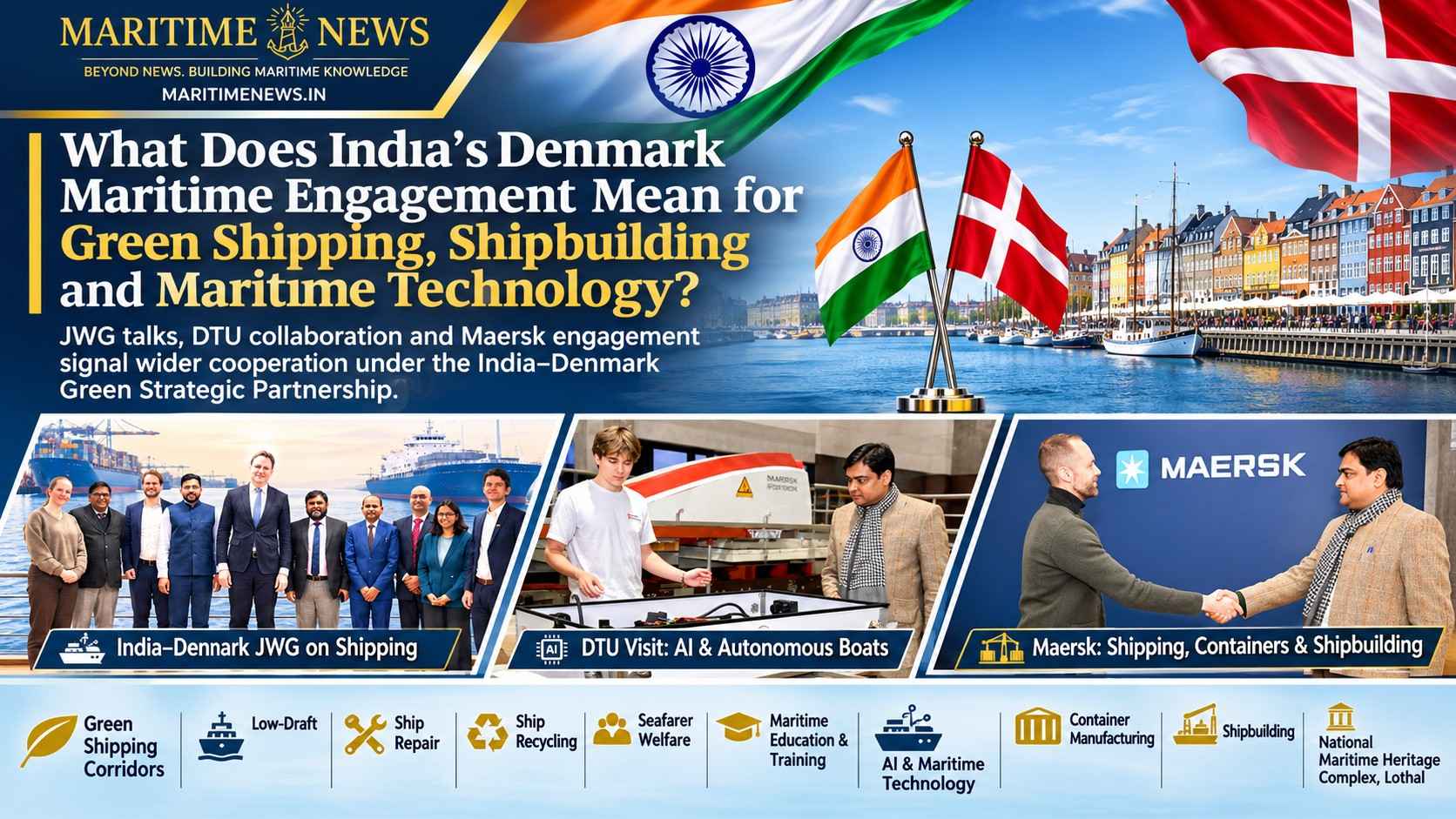
India’s latest maritime engagements in Denmark have brought together government-to-government cooperation, academic collaboration and industry engagement. From green shipping corridors and ship recycling to AI-enabled autonomous boats and Maersk’s interest in India’s maritime sector, the discussions indicate several areas of potential cooperation under the India–Denmark Green Strategic Partnership.
Key Takeaways
- The 7th India–Denmark Joint Working Group (JWG) on Shipping meeting was held in Copenhagen, focusing on strengthening bilateral maritime cooperation.
- Discussions included green shipping corridors, low-draft ships, ship repair, ship recycling, cooperation at the International Maritime Organization (IMO), seafarer welfare and India’s National Maritime Heritage Complex at Lothal.
- Minister of State for Ports, Shipping and Waterways Shantanu Thakur visited the Technical University of Denmark (DTU), where maritime education, advanced training and technological collaboration were discussed.
- DTU showcased its Float Forward Boats project, demonstrating the application of artificial intelligence in autonomous boat operations and sustainable energy utilisation.
- The Indian delegation also visited Maersk Headquarters to explore cooperation in container manufacturing, green shipping, port handling and shipbuilding.
- The engagements reflect potential opportunities across maritime policy, technology, education, manufacturing and shipping operations.
- The announcements establish discussions and institutional engagement, but do not confirm specific commercial contracts, investments or implementation agreements.
Denmark, Europe / India, 25 November 2026 (Maritime News): India’s maritime engagement with Denmark is expanding across policy, technology, education and commercial cooperation, with three recent engagements highlighting the potential of the bilateral relationship.
The Ministry of Ports, Shipping and Waterways has shared updates covering the 7th meeting of the India–Denmark Joint Working Group on Shipping in Copenhagen, a visit by Minister of State Shantanu Thakur to the Technical University of Denmark, and an engagement with Maersk Headquarters.
Taken together, these developments indicate that maritime cooperation between the two countries is not limited to conventional shipping relations. The discussions extend to green shipping corridors, low-draft vessel technology, ship repair, ship recycling, seafarer welfare, maritime education, artificial intelligence and shipbuilding.
The engagements are taking place under the framework of the India–Denmark Green Strategic Partnership.
For India’s maritime industry, the significance lies in whether these discussions can translate into practical cooperation, technology adoption, industrial participation and long-term capacity development.
What Was Discussed at the 7th India–Denmark Joint Working Group Meeting on Shipping?
The 7th meeting of the India–Denmark Joint Working Group on Shipping was held in Copenhagen, reaffirming both countries’ commitment to strengthening bilateral maritime cooperation.
The meeting was co-chaired by Praveen Nair, Joint Secretary (Ports), Ministry of Ports, Shipping and Waterways, representing India, and Brian Adrian Wessel, Director General of the Danish Maritime Authority, representing Denmark.
According to the Ministry’s announcement, discussions covered several areas of maritime cooperation:
- Green shipping corridors.
- Technical collaboration on low-draft ships.
- Ship repair.
- Ship recycling.
- Cooperation at the International Maritime Organization.
- Seafarer welfare.
- India’s upcoming National Maritime Heritage Complex at Lothal.
Both sides agreed to continue their engagement to strengthen maritime and shipping cooperation under the India–Denmark Green Strategic Partnership.
The range of subjects is significant because it connects environmental objectives with vessel technology, maritime services, international regulation, workforce welfare and heritage development.
However, the Ministry’s announcement does not specify individual project timelines, investment commitments or implementation agreements arising from the meeting.
Why Are Green Shipping Corridors Important?
Green shipping corridors are intended to support the development of lower-emission maritime routes through cooperation between ports, shipping companies, energy providers, technology developers and governments.
Such initiatives can involve alternative marine fuels, cleaner propulsion technologies, port-side energy infrastructure, operational improvements and coordinated regulatory approaches.
For India, cooperation with Denmark could provide opportunities to exchange technical knowledge and explore commercially viable models for reducing emissions from maritime transportation.
The important question is how these discussions will translate into specific routes, participating ports, vessel commitments, fuel infrastructure and measurable emission-reduction targets.
Without such details, the announcement represents an area of bilateral cooperation rather than an established green shipping corridor.
Can Low-Draft Vessel Technology Support India’s Maritime Requirements?
Technical collaboration on low-draft ships is another important area identified during the JWG meeting.
Low-draft vessels can be relevant to waterways, coastal areas and port approaches where water depth restricts the size or loading of conventional vessels.
For India, the potential applications could include coastal connectivity, inland waterways, smaller ports and cargo movement in locations with draft limitations.
The Ministry’s announcement does not identify a specific vessel design, development programme or deployment project. Further technical discussions would be necessary to determine the intended scope of cooperation.
Why Are Ship Repair and Ship Recycling Part of the Discussions?
The inclusion of ship repair and ship recycling broadens the partnership beyond new vessel construction.
Ship repair is an important part of maritime infrastructure, involving dry-docking, engineering, maintenance, component replacement and specialised technical services.
Ship recycling, meanwhile, involves environmental management, worker safety, hazardous-material handling and compliance with applicable international requirements.
For India, cooperation in these areas could support the development of technical capabilities, industrial standards and environmentally responsible maritime services.
The actual opportunities will depend on whether the two countries develop specific institutional, technical or commercial programmes.
What Does the Technical University of Denmark Visit Mean for India’s Maritime Education and Technology Sector?
A second dimension of the Denmark engagement involved Minister of State for Ports, Shipping and Waterways Shantanu Thakur’s visit to the Technical University of Denmark.
The Minister visited DTU along with a high-level official and business delegation for an interactive session with faculty members and students, focusing on sustainable practices and the use of technology in shipping and maritime operations.
During the visit, DTU President Anders Bjarklev briefed the delegation on the university’s Maritime Vision and its collaborative activities with IIT Bombay and IIT Madras.
The Minister highlighted the importance of specialised courses and advanced training in strengthening India’s maritime and shipping sector.
This aspect of the engagement is important because the adoption of advanced maritime technology requires more than access to equipment. It also requires trained personnel, research institutions, engineering expertise and industry-oriented education.
What Is the Float Forward Boats Project?
During the visit, the delegation also toured DTU’s Construct Lab, where students and faculty members presented their Float Forward Boats project.
The project demonstrated the use of artificial intelligence for autonomous boat operations while ensuring sustainable energy utilisation.
The demonstration illustrates the intersection of several emerging maritime technology areas:
- Artificial intelligence in vessel operations.
- Autonomous navigation and control.
- Sustainable energy utilisation.
- Marine engineering and design.
- Academic research and practical technology development.
The Ministry’s announcement does not provide detailed technical specifications, operational trials, commercial readiness or deployment plans for the project.
Nevertheless, the demonstration offers an opportunity to examine how academic institutions can contribute to future maritime technology development.
Why Does India Need Stronger Maritime Academic Collaboration?
India’s maritime transformation will require a workforce capable of operating and maintaining increasingly sophisticated vessels, propulsion systems, digital platforms and port infrastructure.
The collaboration involving DTU, IIT Bombay and IIT Madras could provide a platform for knowledge exchange and research cooperation.
The Minister’s emphasis on specialised courses and advanced training also highlights the importance of aligning maritime education with emerging industry requirements.
The potential areas of cooperation include marine engineering, autonomous vessel systems, artificial intelligence, alternative propulsion, maritime digitalisation and sustainable vessel operations.
However, the announcement does not confirm new joint degree programmes, funded research projects or formal training agreements. These would need to be established through specific institutional arrangements.
What Opportunities Did India Explore During the Maersk Headquarters Visit?
The third engagement involved a visit by Shantanu Thakur and a high-level official and business delegation to Maersk Headquarters.
The stated objective was to explore opportunities for strengthening maritime and shipping cooperation under India’s Maritime Vision 2047.
During the interaction, the Minister highlighted the government’s vision of making India a strong shipping nation, supported by enabling parliamentary acts, strategic investments and policy support for the maritime sector.
Maersk presented its vision for greater involvement in India’s maritime sector, identifying potential opportunities in:
- Container manufacturing.
- Green shipping.
- Port handling.
- Shipbuilding.
Both sides emphasised the importance of sustainability in driving the sector’s growth and development.
The Minister also toured the Maersk Museum.
The engagement is significant because it brings a major international shipping and logistics company into discussions concerning India’s longer-term maritime development priorities.
Could Container Manufacturing Become an Area of Cooperation?
Container manufacturing was one of the opportunities identified by Maersk during the interaction.
India’s ability to develop domestic container manufacturing capabilities could have implications for industrial development, supply-chain resilience and participation in the global container logistics ecosystem.
However, the Ministry’s update does not disclose a proposed manufacturing facility, investment amount, production capacity, technology-transfer arrangement or implementation timeline.
The discussion should therefore be understood as an identified area of potential cooperation rather than a confirmed manufacturing investment.
What Could Maersk’s Interest Mean for India’s Shipbuilding Sector?
Shipbuilding was another area identified by Maersk as a potential field for greater involvement in India.
The opportunity needs to be examined in the context of India’s wider ambitions to strengthen domestic shipbuilding and ship repair capabilities.
Maritime News has previously examined India’s five greenfield shipbuilding clusters and the proposed $10 billion investment opportunity.
The development of a competitive shipbuilding ecosystem requires more than shipyards. It also depends on component manufacturers, engineering services, trained workers, financing, technology, supply chains and long-term vessel demand.
The Naukosh initiative to connect India’s shipbuilding and ship repair ecosystem is another relevant development in this wider industrial context.
If international companies such as Maersk move from discussions to concrete investment or procurement arrangements, the implications could extend across shipyards, equipment manufacturers, marine engineering companies and the wider maritime supply chain.
At present, however, the Ministry’s update establishes an expression of interest and discussion, not a concluded commercial agreement.
How Does the India–Denmark Partnership Fit into Maritime Vision 2047?
India’s Maritime Vision 2047 provides a broader context for the engagements in Denmark.
The three updates cover complementary dimensions of maritime development:
| Engagement | Main area | Potential significance for India |
|---|---|---|
| India–Denmark Joint Working Group | Maritime policy and technical cooperation | Green shipping, low-draft vessels, ship repair and recycling |
| Technical University of Denmark | Education and research | Advanced training, AI, autonomous vessels and sustainable technology |
| Maersk Headquarters | Commercial and industrial cooperation | Container manufacturing, green shipping, port handling and shipbuilding |
Together, these areas reflect the importance of connecting government policy, academic research and commercial participation.
The development of India’s maritime sector will require coordination between ministries, regulators, ports, shipping companies, shipyards, academic institutions, technology providers and the maritime workforce.
International partnerships can support this process through technical cooperation, knowledge exchange and industrial participation. Their long-term value, however, depends on the implementation of clearly defined programmes.
What Does the Denmark Engagement Mean for Indian Seafarers and the Maritime Workforce?
Seafarer welfare was explicitly included in the India–Denmark Joint Working Group discussions.
This is an important element of the partnership because maritime transformation must account for the people who operate vessels, maintain equipment and support shipping operations.
As the sector adopts advanced propulsion systems, digital technologies and increasingly automated vessel operations, maritime training requirements are also likely to evolve.
The discussions on seafarer welfare and the Minister’s emphasis on specialised courses and advanced training provide two complementary dimensions of workforce development.
Future cooperation could explore:
- Advanced maritime training.
- Technical skills for new propulsion systems.
- Digital and autonomous vessel operations.
- Maritime safety and welfare.
- Research and industry-linked education.
- Knowledge exchange between maritime institutions.
The Ministry’s announcement does not identify specific welfare programmes or training commitments. These remain areas where further cooperation could be developed.
What Should India and Denmark Deliver After These Engagements?
The three engagements identify several promising areas of cooperation. The next stage should be measured by the development of practical outcomes.
For the India–Denmark Joint Working Group, the important questions include:
- Will specific green shipping corridors be identified?
- Will a technical cooperation programme for low-draft ships be developed?
- Will ship repair and ship recycling cooperation lead to industry-level projects?
- What follow-up mechanisms will address seafarer welfare and IMO-related cooperation?
- How will cooperation concerning the National Maritime Heritage Complex at Lothal progress?
For the academic engagement, the questions include:
- Will DTU, IIT Bombay and IIT Madras develop formal joint research or training programmes?
- Can autonomous vessel technologies be tested in Indian waters?
- Will specialised maritime courses be developed around AI, sustainable propulsion and digital operations?
- How will industry participation be incorporated into academic collaboration?
For the Maersk engagement, the key questions include:
- Will the discussions on container manufacturing lead to a formal investment proposal?
- Will Maersk identify specific opportunities in Indian shipbuilding?
- Could cooperation extend to port handling and green shipping projects?
- What role will Indian companies, shipyards and component manufacturers play?
- Will the proposed cooperation result in measurable investment, employment and technology transfer?
These questions distinguish diplomatic engagement from implementation. They also provide a framework for tracking the partnership’s progress.
Can India–Denmark Cooperation Translate into Tangible Maritime Outcomes?
The recent engagements in Denmark demonstrate the breadth of India’s maritime cooperation agenda.
The Joint Working Group meeting addressed green shipping corridors, low-draft vessels, ship repair, ship recycling, IMO cooperation and seafarer welfare. The Technical University of Denmark visit highlighted academic collaboration, advanced training and AI-enabled autonomous boat technology. The Maersk Headquarters engagement explored opportunities in container manufacturing, green shipping, port handling and shipbuilding.
Together, these developments connect three important pillars of maritime development: policy, technology and industry.
For India, the opportunity lies in using international cooperation to strengthen domestic capabilities, develop a skilled maritime workforce, improve environmental performance and expand participation in global shipping and shipbuilding.
However, announcements of discussions and expressions of interest should not be confused with completed agreements or investments.
The real measure of the India–Denmark Green Strategic Partnership will be the projects implemented, technologies adopted, skills developed, industrial investments realised and improvements delivered to the maritime workforce and the wider industry.
India’s maritime ambitions will not be measured by the number of international engagements it conducts, but by the capabilities and outcomes those engagements create at home.
Sources and References
External Sources
- Ministry of Ports, Shipping and Waterways, Government of India – official LinkedIn updates covering the 7th India–Denmark Joint Working Group on Shipping meeting, the Technical University of Denmark visit and the Maersk Headquarters engagement. Ministry’s official LinkedIn updates.
- India–Denmark Green Strategic Partnership – framework referenced in the Ministry’s announcement. The relevant official government document should be linked after verification.
- Technical University of Denmark – institutional information concerning its maritime research and education activities. The relevant official project and institutional pages should be linked after verification.
- Maersk – official corporate information on its maritime, shipping and logistics activities. Relevant corporate announcements should be linked if specific investment or project claims are subsequently established.