
Constitution Day Special | 26 November 2026, (Maritime News): India’s maritime identity is much older than the Constitution of the Republic. Its coastal communities, seafarers, shipbuilders, traders and ports have connected the Indian subcontinent with the world for centuries. However, the Constitution of India, adopted on 26 November 1949, gave the newly independent nation a framework to govern, develop and protect its maritime interests as part of a sovereign republic.
While the Constitution does not declare India a maritime power or guarantee its global leadership, it establishes something equally significant: the constitutional authority to regulate maritime shipping, navigation, ports, inland waterways, maritime education, ocean resources and international maritime relations.
On Constitution Day, it is worth examining how this constitutional architecture laid the foundation for India’s maritime industry and why its provisions remain relevant to India’s ambition of becoming a leading global maritime nation.
The Constitution Recognised Maritime Affairs as a National Responsibility
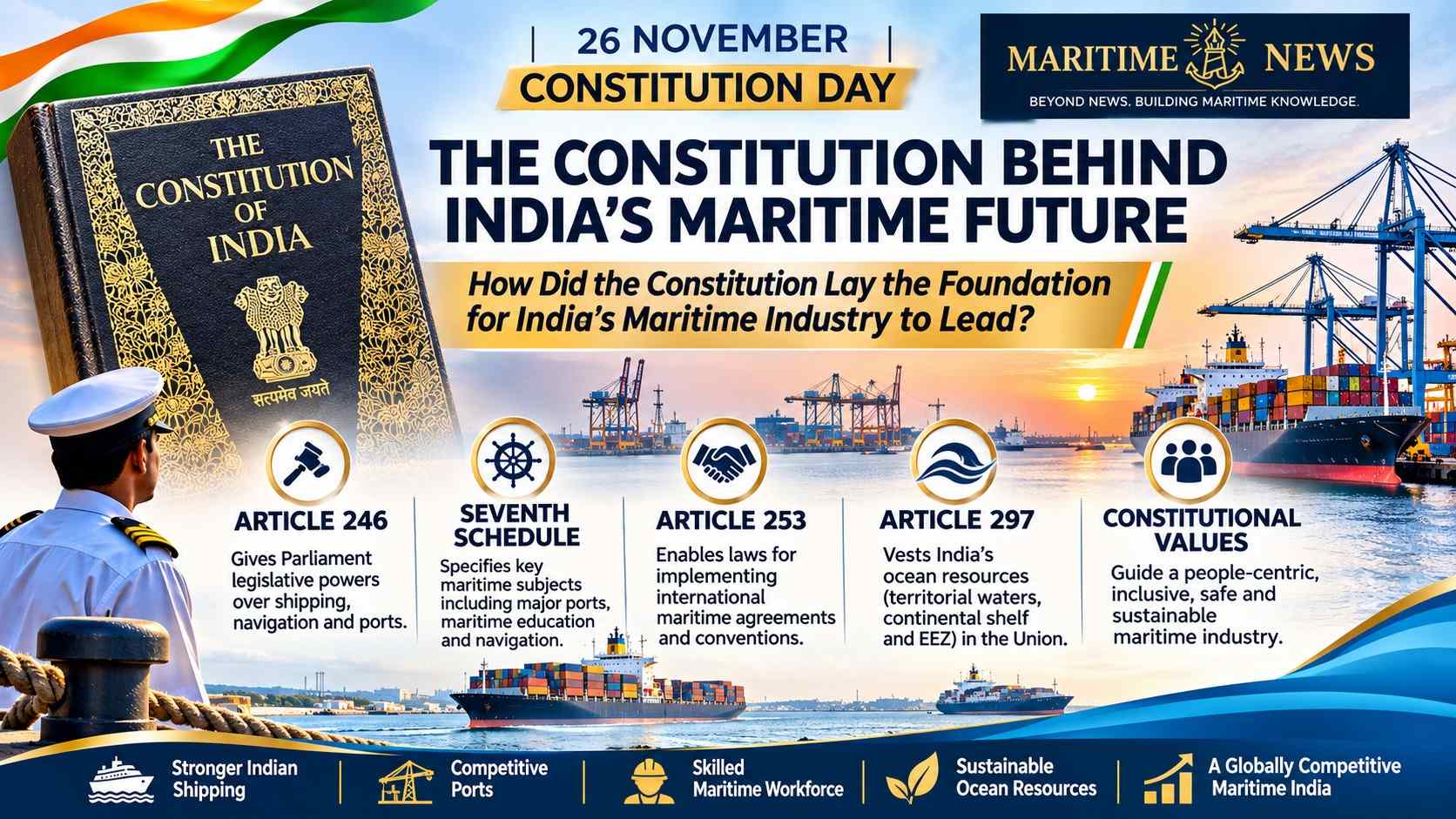
One of the most important constitutional provisions for India’s maritime industry is Article 246, read with the Seventh Schedule.
Article 246 distributes legislative powers between Parliament and State Legislatures through three lists: the Union List, the State List and the Concurrent List.
The Constitution places several critical maritime subjects under the Union List, giving Parliament exclusive legislative authority over these matters, subject to the Constitution.
These include:
- Entry 24: Shipping and navigation on designated national inland waterways for mechanically propelled vessels.
- Entry 25: Maritime shipping and navigation, including navigation on tidal waters, and education and training for the mercantile marine.
- Entry 26: Lighthouses, lightships, beacons and other navigational safety provisions.
- Entry 27: Major ports, their delimitation and the constitution and powers of port authorities.
- Entry 28: Port quarantine, seamen’s hospitals and marine hospitals.
- Entry 30: Carriage of passengers and goods by railway, sea or air, or by national waterways in mechanically propelled vessels.
These provisions are not merely administrative classifications. They establish the constitutional basis for national maritime legislation, institutional development, navigational regulation and the development of India’s shipping ecosystem.
Source: Constitution of India – Seventh Schedule, Union List.
Maritime Governance Is Built into India’s Federal Structure
India’s maritime industry cannot function through the Union Government alone.
Ports, coastal infrastructure, fishing communities, shipyards, industrial clusters, logistics networks and hinterland connectivity require coordination between the Centre and coastal States.
The Constitution provides for this division of responsibility.
Article 246 establishes the legislative relationship between the Union and States. While major ports and maritime shipping fall under the Union’s legislative domain, ports other than major ports are covered under Entry 31 of the State List.
This arrangement creates a federal maritime governance structure.
The Union Government can establish national shipping policy, regulate merchant shipping and develop major port institutions, while States have an important role in developing non-major ports and supporting coastal infrastructure.
This relationship is particularly important for maritime States such as Gujarat, Maharashtra, Goa, Karnataka, Kerala, Tamil Nadu, Andhra Pradesh, Odisha and West Bengal.
The development of India’s maritime economy depends on how effectively national maritime priorities are coordinated with State-level infrastructure, industrial development and coastal community interests.
Source: Constitution of India – Article 246 and Seventh Schedule.
Article 297: India’s Maritime Resources Belong to the Union
Another important constitutional provision is Article 297.
It establishes that lands, minerals and other things of value underlying India’s territorial waters, continental shelf and Exclusive Economic Zone vest in the Union and are held for the purposes of the Union.
It also provides for the vesting of other resources of India’s Exclusive Economic Zone in the Union.
Why does this matter to the maritime industry?
Because India’s maritime domain is not limited to shipping routes and port infrastructure. It also encompasses marine resources, offshore economic activity, seabed resources and the strategic management of ocean spaces.
Article 297 provides a constitutional foundation for national control over these resources.
For an economy increasingly looking towards offshore energy, marine research, ocean-based industries and the sustainable utilisation of marine resources, this provision carries considerable significance.
Source: Article 297 – Constitution of India.
International Maritime Relations Are Supported by Constitutional Powers
Maritime trade is inherently international.
Ships operate across national jurisdictions. Shipping companies work under international conventions. Ports connect domestic industries with global markets. Seafarers work across different flag states and jurisdictions.
The Constitution recognises the international dimension of governance.
The Union List includes:
- Entry 10: Foreign affairs.
- Entry 14: Entering into treaties and agreements with foreign countries and implementing international treaties, agreements and conventions.
- Entry 21: Piracies and crimes committed on the high seas and offences against the law of nations.
Article 253 further empowers Parliament to make laws for implementing treaties, agreements and conventions with other countries.
This is particularly relevant to India’s participation in the international maritime regulatory framework, including conventions concerning maritime safety, pollution prevention, seafarer welfare and shipping standards.
The constitutional framework therefore enables India to participate in international maritime governance while translating its international obligations into domestic legislation.
Source: Constitution of India – Seventh Schedule and Article 253.
The Constitution Recognises the Importance of the Mercantile Marine and Maritime Education
One of the most interesting aspects of the Seventh Schedule is Entry 25 of the Union List.
It specifically includes the provision of education and training for the mercantile marine and the regulation of such education and training.
This is significant because maritime development is not simply about constructing ports or purchasing ships.
A functioning maritime economy requires:
- Qualified seafarers.
- Maritime academies and training institutions.
- Marine engineers.
- Naval architects.
- Shipbuilding professionals.
- Port and terminal specialists.
- Maritime lawyers and surveyors.
- Logistics and shipping management professionals.
The inclusion of mercantile marine education in the Union List demonstrates that the Constitution recognised maritime human-resource development as an important national responsibility.
India’s maritime future cannot be separated from the capabilities, welfare, safety and professional development of its maritime workforce.
The constitutional framework provides the foundation for national regulation of maritime education and training, while the effectiveness of implementation depends on institutions, policies and legislation.
Constitutional Foundations Have Enabled the Development of Maritime Institutions
The Constitution establishes powers and responsibilities. Laws and institutions translate those powers into operational governance.
India’s maritime administration has developed through legislation, regulatory institutions and government organisations.
Among the important institutions and bodies are:
- Directorate General of Maritime Administration (DGMA).
- Directorate General of Shipping.
- Ministry of Ports, Shipping and Waterways.
- Indian Maritime University.
- Indian Ports Association.
- Inland Waterways Authority of India.
- National Shipping Board.
- Major Port Authorities.
These institutions have different mandates covering maritime administration, merchant shipping, maritime education, port management, inland waterways and industry development.
Their existence and responsibilities reflect the evolution of India’s maritime governance framework.
The constitutional foundation is therefore not an abstract legal arrangement. It has supported the development of an institutional ecosystem that governs one of the country’s most strategically important economic sectors.
From Constitutional Authority to Maritime Legislation
India’s maritime legislation demonstrates how constitutional powers have been translated into a regulatory framework.
Over the years, Parliament has enacted legislation covering merchant shipping, ports, inland vessels, ship recycling, admiralty jurisdiction and the carriage of goods by sea.
The recent legislative developments are particularly relevant.
The year 2025 witnessed the enactment of several important maritime laws, including:
- Merchant Shipping Act, 2025.
- Coastal Shipping Act, 2025.
- Carriage of Goods by Sea Act, 2025.
- Bills of Lading Act, 2025.
- Indian Ports Act, 2025.
The Merchant Shipping Act, 2025, seeks to consolidate and amend merchant shipping law, ensure compliance with India’s international maritime obligations and support the development of Indian shipping and the mercantile marine.
The Coastal Shipping Act, 2025, seeks to promote coastal shipping and encourage greater domestic participation in the sector.
These legislative developments demonstrate the continuing role of Parliament in shaping India’s maritime regulatory environment.
Sources: Ministry of Ports, Shipping and Waterways – Acts and Rules.
The Constitution Provides the Foundation for Maritime Security and Sovereignty
India’s maritime interests extend beyond commercial shipping.
The Constitution places defence and naval forces within the Union’s legislative domain.
The Union List also covers foreign affairs, piracy and other matters connected with national security and international jurisdiction.
Combined with Article 297, these provisions establish an important constitutional foundation for India’s maritime sovereignty.
This is particularly important in the context of:
- Protection of sea lanes.
- Maritime security.
- Port and coastal security.
- Protection of offshore resources.
- Prevention of piracy.
- Security of maritime trade.
- Strategic presence in the Indian Ocean Region.
For India, maritime security is inseparable from economic security. The movement of energy, raw materials, manufactured goods and essential commodities depends on secure maritime routes and functioning ports.
The Constitution’s Values Must Extend to the Maritime Workforce
The Preamble to the Constitution establishes the principles of Justice, Liberty, Equality and Fraternity.
It also describes India as a Sovereign, Socialist, Secular and Democratic Republic.
These are not values that should remain confined to political institutions or public administration. They should also inform the development of India’s maritime economy.
The maritime industry involves millions of people directly and indirectly: seafarers, dock workers, fishermen, port employees, shipyard workers, transport operators, customs brokers, logistics professionals and small maritime enterprises.
A maritime economy cannot be considered truly developed if its growth is disconnected from the dignity, safety, rights and opportunities of the people who sustain it.
The constitutional principles raise important questions for the industry:
- Are seafarers receiving adequate protection and access to justice?
- Are dock workers and port workers receiving safe working conditions?
- Are coastal communities participating in maritime economic development?
- Are small maritime businesses receiving fair opportunities?
- Is access to maritime education and professional development equitable?
- Is maritime growth environmentally and socially sustainable?
The Constitution does not prescribe a separate maritime welfare code. However, its fundamental rights and constitutional values provide an important framework within which maritime laws and policies must operate.
Can India’s Constitutional Framework Support Its Maritime Ambition Towards 2047?
India’s maritime ambitions are increasingly connected with its broader economic and strategic objectives.
The Government’s maritime development vision includes port expansion, shipbuilding, ship repair, coastal shipping, inland waterways, maritime logistics, cruise tourism and greater participation in international shipping.
The Ministry of Ports, Shipping and Waterways has outlined an ambition to expand India’s port capacity from approximately 2,600 million tonnes per annum to nearly 10,000 million tonnes per annum by 2047.
This is an important development target, but achieving it requires more than infrastructure investment.
India needs:
- A globally competitive Indian merchant fleet.
- Greater participation of Indian shipowners in international shipping.
- A stronger domestic shipbuilding and ship repair ecosystem.
- Competitive and technologically advanced ports.
- Improved coastal and inland waterway transportation.
- Greater investment in maritime research and innovation.
- Skilled maritime professionals and stronger seafarer welfare.
- Effective coordination between the Union and coastal States.
- Sustainable utilisation of marine and offshore resources.
- A stronger Indian presence in international maritime governance.
The Constitution provides the legal and institutional architecture within which these objectives can be pursued.
Source: PIB – India as a Top Maritime Nation, 4 April 2025.
11. The Constitutional Responsibility: Leadership Must Be Shared Across the Maritime Ecosystem
The constitutional framework gives the Union Government substantial responsibility for maritime shipping, navigation, major ports and maritime regulation.
However, maritime leadership cannot be achieved by government institutions alone.
It requires collaboration across the entire maritime value chain:
Trader / Manufacturer → Export Documentation → Customs Broker → Customs → Freight Forwarder / NVOCC → CFS / ICD → Logistics → Port / Terminal → Shipping Line → Overseas Buyer.
Every participant contributes to India’s maritime competitiveness.
Shipowners need a supportive regulatory and financial environment. Seafarers need professional protection and welfare. Ports need efficient infrastructure and connectivity. Shipbuilders need technology, finance and orders. Logistics companies need integrated systems. Coastal communities need meaningful participation in development.
The constitutional vision of India as a sovereign democratic republic must find expression in a maritime economy that is competitive, inclusive, accountable and sustainable.
This also creates an opportunity for industry associations, maritime institutions, professional bodies, research organisations and independent platforms to contribute to policy discussions and institutional development.
The Constitution Gave India the Framework; The Maritime Industry Must Build the Leadership
On 26 November 1949, India adopted a Constitution that established the foundations of its sovereign democratic republic.
Within that framework, maritime affairs received a clearly defined place.
Through Article 246 and the Seventh Schedule, Parliament received legislative authority over maritime shipping, navigation, major ports, maritime education and other related subjects. Article 297 established the Union’s constitutional position over valuable resources within India’s maritime zones. Article 253 provided the legislative mechanism for implementing international agreements.
Together, these provisions created the constitutional foundations for India’s maritime governance.
However, constitutional authority alone cannot guarantee global maritime leadership. That requires effective legislation, accountable institutions, investment, innovation, skilled professionals, competitive businesses and cooperation between the Union, States and maritime stakeholders.
The real significance of the Constitution for India’s maritime industry is therefore not simply that it gave the government powers to regulate the sector.
It created the framework within which India could develop its maritime resources, protect its maritime interests, participate in international shipping and build an industry serving national economic and strategic objectives.
The Constitution established the foundation. The responsibility of building India’s maritime future belongs to the institutions, industry and people who make that ecosystem work.
On this Constitution Day, India’s maritime industry has an opportunity to recognise that its future is not only about bigger ports, more ships or higher cargo volumes. It is also about constitutional values, institutional accountability, national sovereignty and the people behind every maritime operation.
Beyond News. Building Maritime Knowledge.
Maritime News Editorial Desk