
Deendayal Port Authority and Assam Petro-Chemicals Ltd are developing a planned 150-tonne-per-day e-methanol facility at Kandla, Gujarat, with an announced investment of ₹2,300 crore. The project aims to supply alternative marine fuel to vessels operating on the Asia–Europe trade corridor, linking renewable energy, industrial production, port infrastructure and employment.
Make us preferred source on Google
Key Takeaways
- The foundation stone for the proposed facility was laid at Deendayal Port Authority (DPA), Kandla, Gujarat, on September 26, 2026.
- The ₹2,300-crore project is a joint initiative of DPA and Assam Petro-Chemicals Ltd (APCL), headquartered in Namrup, Assam.
- The plant is planned to produce 150 tonnes of e-methanol per day using renewable power, water and biogenic carbon dioxide.
- The announced two-phase schedule targets 50 tonnes per day by January 2027 and an additional 100 tonnes per day by March 2027.
- The fuel is intended for vessels operating on the Asia–Europe International Trade Corridor.
- The Government expects the project to generate more than 3,500 direct and indirect jobs.
- The Government has cited an estimated production cost of US$750 per tonne, compared with a global rate of around US$1,300 per tonne; the underlying assumptions have not been detailed in the announcement.
- Project execution, renewable-energy sourcing, feedstock traceability, bunkering infrastructure, vessel demand and independently verified environmental performance will be important to its eventual success.
Kandla, Kutch, Gujarat, India September 29, 2026 (Maritime News): India is advancing its alternative marine-fuel ambitions with the planned development of a port-based e-methanol production facility at Deendayal Port Authority in Kandla, Gujarat.
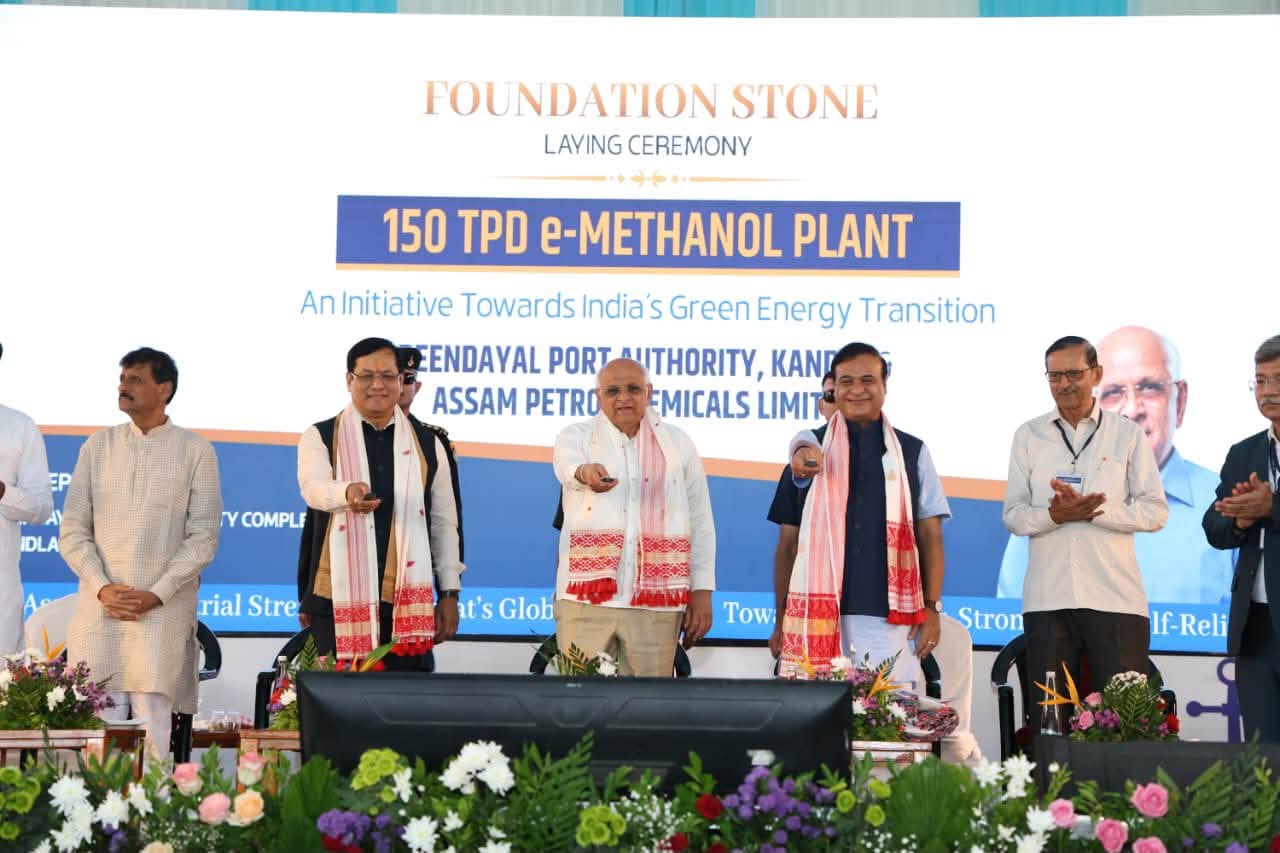
The foundation stone was laid on September 26, 2026, by Gujarat Chief Minister Bhupendra Patel, Union Minister for Ports, Shipping and Waterways Sarbananda Sonowal, and Assam Chief Minister Himanta Biswa Sarma.
According to the Ministry of Ports, Shipping and Waterways’ announcement , the proposed 150-tonne-per-day facility will be developed jointly by DPA and Namrup-based Assam Petro-Chemicals Ltd. The plant is designed to use renewable power, water and biogenic carbon dioxide to produce e-methanol for vessels operating on the Asia–Europe International Trade Corridor.
The project represents a further step following the memorandum of understanding signed by DPA and APCL in January 2026. The facility is planned as part of India’s wider maritime decarbonisation and clean-energy development efforts.
The foundation-stone ceremony marks a project milestone; the facility should not yet be described as operational.
Also Read: Edible Oil Import Duty Cut: Who Gets the Benefit — Importers, Refiners, Farmers or Consumers?
₹2,300 Crore Investment and Two-Phase Development
The proposed e-methanol plant at Kandla involves a total investment of ₹2,300 crore, with a planned production capacity of 150 tonnes per day. The project will be developed in two phases by Deendayal Port Authority (DPA) and Assam Petro-Chemicals Ltd (APCL).
| Project Component | Announced Details |
| Total Planned Capacity | 150 tonnes per day |
| Total Investment | ₹2,300 crore |
| Phase I Capacity | 50 tonnes per day |
| Phase I Investment | ₹1,200 crore |
| Phase I Target | January 2027 |
| Phase II Capacity | Additional 100 tonnes per day |
| Phase II Investment | ₹1,100 crore |
| Phase II Target | March 2027 |
| Project Partners | DPA and Assam Petro-Chemicals Ltd (APCL) |
| Location | Kandla, Gujarat |
Under the announced schedule, Phase I is targeted for January 2027, with the additional 100-tonne-per-day capacity planned for March 2027. These are projected milestones; commissioning and operational status will need to be confirmed as the project progresses.
The staged approach is intended to establish initial production capacity before adding the remaining output. Construction progress, equipment installation, utilities, feedstock availability, commissioning and fuel-quality verification will determine whether the schedule can be achieved.
The Government announcement provides the planned capacity, investment and phase targets, but does not detail the complete construction programme, financing disbursement schedule or commissioning criteria.
How the Plant Will Produce e-Methanol
The proposed facility is planned around three principal inputs:
- Renewable electricity: to power the production process and support hydrogen generation.
- Water: a key process input, including for hydrogen production.
- Biogenic carbon dioxide: the carbon source intended for e-methanol synthesis.
E-methanol is a synthetic fuel generally produced by combining hydrogen with a carbon source such as captured carbon dioxide. Its lifecycle greenhouse-gas performance depends on the electricity source, carbon origin, production efficiency, processing, transportation and eventual use.
The project announcement identifies renewable power, water and biogenic carbon dioxide as the intended inputs. It does not specify the detailed process configuration, electrolyser capacity, precise carbon source, lifecycle emissions methodology or independent certification arrangements.
These technical details will be necessary to assess the plant’s environmental performance and the extent to which its fuel qualifies as a lower-emission alternative.
Why E-Methanol Matters to Shipping
The maritime industry is examining alternative fuels as part of efforts to reduce greenhouse-gas emissions from vessel operations.
Methanol can be used in suitably designed or converted marine engines and fuel systems. E-methanol produced using qualifying renewable electricity and sustainable carbon inputs may offer a pathway to lower lifecycle emissions compared with conventional fossil marine fuels.
However, the environmental benefit cannot be established solely by describing the fuel as green. The electricity source, carbon feedstock, production pathway, transport and vessel use all influence its lifecycle emissions.
The Kandla facility is intended to connect domestic alternative-fuel manufacturing with international shipping demand. The Government has identified vessels operating on the Asia–Europe International Trade Corridor as the proposed market for its output.
For this ambition to translate into commercial operations, the plant will need to be supported by fuel storage, safe transfer systems, bunkering arrangements, compatible vessels and supply agreements with shipping companies.
Kandla’s Proposed Role as a Green-Fuel Gateway
The project could expand Kandla’s role beyond conventional cargo handling by adding planned alternative-marine-fuel production and supply capabilities.
A functioning port-based e-methanol ecosystem will require more than production capacity. It will depend on:
- Reliable renewable electricity and hydrogen production.
- A sustainable and traceable source of biogenic carbon dioxide.
- Adequate water supply and process-water management.
- Fuel storage, quality assurance and safe handling systems.
- Port-side transfer and bunkering infrastructure.
- Vessel compatibility, regulatory approvals and operating procedures.
- Commercial supply agreements with shipowners and operators.
DPA had previously announced progress on methanol bunkering capabilities at Kandla in April 2026, identifying methanol and e-ammonia among the alternative fuels being considered for maritime decarbonisation. This provides relevant context for the new production facility, although the earlier initiative does not establish that all storage, handling and bunkering infrastructure for the proposed plant is complete.
The connection between production and bunkering will be critical. A plant may produce fuel, but a port becomes a practical green-fuel hub only when that fuel can be safely stored, transferred and supplied to vessels at commercially viable terms.
Also Read: India’s Shipbuilding Modernisation Gets New Project Management Unit Under SbDS
Government’s Cost Competitiveness Claim
The PIB announcement states that the facility is expected to produce green methanol at approximately US$750 per tonne, compared with a global rate of around US$1,300 per tonne. The Government has presented this as a potential cost advantage for the project.
However, the announcement does not specify the benchmark’s source or date, fuel specification, production assumptions, financing basis, or whether the comparison includes storage, transport, certification and delivery to vessels.
The figures should therefore be treated as announced estimates, rather than verified market prices or guaranteed delivered-fuel costs.
For shipping companies considering alternative fuels, the relevant commercial comparison will include the total cost of fuel supplied at the port, vessel modifications or newbuild requirements, fuel availability, emissions compliance and operational reliability.
DPA–APCL Partnership Connects Gujarat and Assam
The facility is a joint initiative of Deendayal Port Authority and Assam Petro-Chemicals Ltd, based in Namrup, Assam.
According to Business Standard, the project’s capital contribution is structured in a 76:24 ratio between DPA and APCL. The report states that DPA’s contribution includes ₹567.32 crore in equity, 75 acres of land, desalinated water and renewable energy in the form of green hydrogen.
The partnership brings together a port authority with an established petrochemical producer, connecting Gujarat’s port infrastructure and industrial location with Assam’s chemical-sector capabilities.
The Government has described the project as an example of inter-State cooperation and a contribution to India’s clean-energy and maritime ambitions.
The announcement does not provide the complete shareholders’ agreement, governance structure, project-company arrangements, debt-equity details or allocation of operating responsibilities. These will be relevant to understanding the project’s financing, management and accountability during construction and operation.
Also Read: Vadhavan Port Tender Advances as NAPM Demands Project Halt and Independent Impact Assessment
More Than 3,500 Jobs Expected
The Government expects the project to generate more than 3,500 direct and indirect jobs. The announcement does not provide a detailed breakdown by construction phase, permanent plant employment, contractor positions or wider supply-chain roles.
Potential employment and business opportunities may arise across several activities:
| Activity | Potential workforce and business opportunities |
| Plant construction | Civil works, fabrication, electrical installation and project services |
| Equipment and engineering | Process equipment, instrumentation, automation and maintenance |
| Renewable-energy supply | Power generation, integration and operations |
| Carbon dioxide and water systems | Feedstock supply, treatment, handling and quality control |
| Port infrastructure | Land development, pipelines, storage and terminal operations |
| Fuel distribution | Tanker movement, storage, transfer and bunkering services |
| Plant operations | Process technicians, engineers, safety personnel and laboratory staff |
| Ancillary services | Training, inspection, logistics and other support businesses |
These are potential areas of activity, not confirmed job allocations. Actual employment will depend on procurement, construction contracts, staffing arrangements and operational requirements.
For communities in the Kutch region, important questions include how many jobs will be accessible to local workers, what technical qualifications will be required, and whether local suppliers and service providers can participate.
The Green-Fuel Supply Chain
The proposed facility would connect energy and industrial inputs with port operations and international shipping.
Proposed e-methanol value chain
Renewable electricity and water
Green hydrogen production
Biogenic CO₂ sourcing and conditioning
E-methanol synthesis and quality control
Storage and port-side fuel handling
Bunkering and delivery to compatible vessels
International shipping operations
Illustrative process based on the announced inputs and intended maritime-fuel use. The final plant configuration and operating arrangements have not been detailed in the announcement.
The chain involves renewable-energy providers, equipment manufacturers, engineering contractors, carbon-dioxide suppliers, storage operators, safety and certification bodies, shipping companies and trained workers.
The maritime connection extends to shipowners, managers and seafarers. Vessels must be designed or equipped to use the fuel, while crew training, fuel-handling procedures, emergency response and operational safeguards will be important before regular use.
Shipowners and Seafarers: The Demand Side
The project’s commercial viability will depend on whether shipping companies are willing and able to procure e-methanol at scale.
Shipowners and operators will need to assess fuel cost, availability, vessel compatibility, safety requirements, emissions accounting and reliability of supply. Depending on vessel design and operating arrangements, the transition may also require changes to fuel systems, maintenance procedures, crew training and onboard emergency preparedness.
Methanol is toxic and flammable, so its handling requires appropriate procedures, equipment, training and emergency response arrangements. The project announcement does not provide a specific seafarer-training or vessel-readiness plan.
The proposed Asia–Europe corridor supply role will therefore need to be supported by actual demand commitments, compatible vessels, bunkering infrastructure and applicable safety standards.
Environmental Performance Requires Transparent Measurement
The project is presented as a green-fuel initiative aligned with India’s Net Zero 2070 goal. The Government says the facility will use renewable power, water and biogenic carbon dioxide.
To independently assess its environmental performance, several details will matter:
- The source and additionality of renewable electricity.
- The origin and sustainability criteria of biogenic carbon dioxide.
- Water sourcing, consumption and treatment.
- Lifecycle greenhouse-gas emissions per tonne of fuel.
- Energy efficiency and conversion losses.
- Emissions and waste associated with construction and operation.
- Fuel certification, traceability and independent verification.
The announcement does not provide these technical assessments. They remain important implementation and transparency questions, rather than established project outcomes.
The distinction is significant: e-methanol’s potential climate benefit depends on its full production pathway, not simply the fuel’s name or the location of the facility.
Also Read: Kottayam Port Begins First Container Movement to Vizhinjam, Opening New Kerala EXIM Route
How the Project Fits into India’s Maritime Transition
The Kandla facility follows earlier efforts to develop alternative marine-fuel capabilities at the port. In April 2026, the Ministry of Ports, Shipping and Waterways reported that DPA was advancing methanol bunkering and exploring alternative fuels, including e-methanol and e-ammonia.
The January 2026 DPA–APCL memorandum of understanding established the project’s initial institutional framework, while the September foundation-stone ceremony marked a further development milestone.
The wider transition will require coordination between fuel producers, ports, shipowners, shipbuilders, equipment suppliers, regulators, energy providers and training institutions.
The PIB announcement also referenced other port-related industrial initiatives, including a DPA–Cochin Shipyard shipbuilding project at Vadinar and a proposed greenfield shipbuilding and repair cluster at Kuchhadi, Porbandar. These are separate projects and should not be conflated with the e-methanol facility.
Stakeholder Impact
| Stakeholder | Relevance to the Project | Key Issue to Track |
| Deendayal Port Authority | Project partner and port-side infrastructure provider | Investment, land, utilities, construction and operational readiness |
| Assam Petro-Chemicals Ltd | Project partner and chemical-sector participant | Technology, plant construction, production and operating performance |
| Government of India | Maritime and clean-energy policy oversight | Project monitoring, policy alignment and transparent reporting |
| Gujarat Government | State-level participation and local development context | Infrastructure coordination, local employment and regional benefits |
| Local communities and workers | Potential employment and service opportunities | Access to jobs, training, safety and local procurement |
| Renewable-energy providers | Electricity supply for production | Reliability, cost and renewable-energy verification |
| CO₂ and water suppliers | Essential production inputs | Traceability, sustainability, availability and resource management |
| Engineering and equipment companies | Plant construction and process systems | Delivery, commissioning, maintenance and technology performance |
| Ports and terminal operators | Storage, transfer and fuel-handling interface | Safe operations, infrastructure and bunkering readiness |
| Importers, exporters and traders | Potential indirect link through fuel and trade services | Future fuel costs and availability for shipping services |
| Freight forwarders and logistics providers | Potential cargo and fuel logistics activity | Storage, transport, handling and supply-chain coordination |
| Shipowners and managers | Potential buyers and users of e-methanol | Fuel price, vessel compatibility and supply commitments |
| Seafarers | Safe operation of vessels using alternative fuels | Training, procedures, protective systems and emergency readiness |
The project’s impact will depend on how these participants are connected through implementation, supply agreements, safety standards and measurable performance.
Accountability and Implementation Questions
The project’s announced scale and schedule make implementation monitoring important. The following questions provide a factual framework for assessing progress:
- Will the two phases meet the announced January and March 2027 targets?
- What is the detailed financing and project-governance structure between DPA and APCL?
- What renewable-power and green-hydrogen arrangements will support production?
- What is the source of the biogenic carbon dioxide, and how will it be verified?
- What is the basis of the Government’s stated US$750-per-tonne production-cost estimate?
- What storage, transfer and bunkering facilities are required before fuel supply begins?
- Are there confirmed shipping-company offtake or supply agreements?
- How will the project measure lifecycle emissions, water use and other environmental indicators?
- How many of the projected jobs will be permanent, and how many will be temporary or indirect?
- What training and safety arrangements will be available for plant workers, port personnel and seafarers?
These are implementation questions arising from the announced project parameters; they do not imply that the project has failed to address them.
MaritimeNews Insight
Kandla’s proposed e-methanol plant is a port-led industrial project with implications extending beyond fuel production. It connects renewable energy, chemical manufacturing, port infrastructure, maritime logistics and international shipping.
The announcement establishes the planned capacity, investment, partners, inputs, phases and intended market. The next test is execution: whether the facility is completed, whether its renewable inputs and environmental performance can be verified, and whether the fuel can be supplied commercially to vessels.
The project’s strategic significance will depend not only on producing e-methanol, but on building a dependable system around it — from feedstock and power to storage, bunkering, vessel readiness, trained personnel and actual fuel demand.
The central question is whether Kandla can move from a proposed green-fuel production site to a functioning, competitive and verifiable maritime-fuel supply hub.
What to Watch Next
- Project delivery: Construction and commissioning progress against the announced phase targets.
- Investment: Actual capital deployment and the division of financial and operational responsibilities.
- Production capacity: Whether the plant achieves the planned 150 tonnes per day.
- Renewable energy: The source, cost and reliability of electricity and green hydrogen.
- Feedstock: Traceability and sustainability of the biogenic CO₂ supply.
- Fuel economics: Verification of the announced production-cost estimate and actual delivered-fuel prices.
- Port readiness: Completion of storage, transfer, safety and bunkering infrastructure.
- Vessel demand: Confirmed supply agreements and compatibility with vessels using the Asia–Europe corridor.
- Employment: Actual direct and indirect jobs, local hiring and training opportunities.
- Environmental performance: Independently assessed lifecycle emissions, water use, certification and reporting.
Frequently Asked Questions (FAQs)
What is India’s first port-based e-methanol project?
It is a proposed 150-tonne-per-day e-methanol production facility at Deendayal Port Authority in Kandla, Gujarat, being developed jointly by DPA and Assam Petro-Chemicals Ltd. The foundation stone was laid on September 26, 2026.
How much will the e-methanol plant cost?
The announced total investment is ₹2,300 crore, split between ₹1,200 crore for Phase I and ₹1,100 crore for Phase II.
What is the plant’s planned production capacity?
The planned total capacity is 150 tonnes per day. Phase I is designed for 50 tonnes per day, with a further 100 tonnes per day planned in Phase II.
What will the plant use to produce e-methanol?
The PIB announcement identifies renewable power, water and biogenic carbon dioxide as the intended inputs. It does not provide the full technical design or detailed feedstock-sourcing arrangements.
When are the two phases expected to be completed?
The announced targets are January 2027 for Phase I and March 2027 for Phase II. These are projected milestones, not confirmation of commissioning.
Who are the project partners?
The project is a joint initiative of Deendayal Port Authority and Assam Petro-Chemicals Ltd, based in Namrup, Assam.
Which shipping route is the fuel intended to serve?
The September 2026 announcement identifies vessels operating on the Asia–Europe International Trade Corridor as the intended market. Actual supply will depend on commissioning, port fuel infrastructure, vessel compatibility and commercial arrangements.
How many jobs is the project expected to create?
The Government expects more than 3,500 direct and indirect jobs. The announcement does not provide a detailed breakdown by phase, occupation or location.
Is the plant already operational?
No. The September 26 announcement concerns the foundation-stone ceremony and planned construction phases. The facility should not be described as producing or supplying fuel until commissioning and operations are confirmed.
What is the environmental significance of e-methanol?
E-methanol produced using qualifying renewable electricity and sustainable carbon inputs can potentially reduce lifecycle greenhouse-gas emissions compared with fossil fuels. The actual benefit depends on the production pathway and verified lifecycle assessment; the project announcement does not publish a quantified emissions-reduction assessment.
Also Read: Modi’s BRICS Bilateral Push Deepens India’s Engagement Across Africa, ASEAN and Central Asia
India’s first announced port-based e-methanol facility at Kandla represents a planned ₹2,300-crore investment linking Deendayal Port Authority with Assam Petro-Chemicals Ltd. With a proposed capacity of 150 tonnes per day and a stated intention to supply vessels on the Asia–Europe corridor, the project places port infrastructure within India’s emerging alternative marine-fuel supply chain.
The foundation stone marks a significant project milestone, but the facility’s operational and environmental performance remain to be demonstrated. Construction progress, renewable-energy sourcing, biogenic CO₂ traceability, water management, fuel cost, bunkering readiness, vessel demand and employment outcomes will determine whether the project delivers on its stated ambitions.
For India’s maritime sector, the larger opportunity is to connect domestic industrial capability with the changing fuel requirements of international shipping. For Kandla, the task is to translate the planned facility into a safe, commercially viable and transparently measured green-fuel operation.
Sources
- Ministry of Ports, Shipping and Waterways / Press Information Bureau — India’s First Port-based e-Methanol Production Facility to Produce and Supply Green Fuel to Ships, September 26, 2026.
- Business Standard — Foundation Stone Laid for India’s First Port-based e-Methanol Plant, September 27, 2026.
- The Economic Times — Coverage of the Kandla e-methanol facility and foundation-stone ceremony.
- Press Information Bureau — Assam Petro-Chemicals Signs MoU with Deendayal Port to Set Up 150 TPD e-Methanol Plant at Kandla Port, January 29, 2026.
- Press Information Bureau — Kandla Port Advances Methanol Bunkering, Marks Key Step Toward Green Maritime Transition, April 9, 2026.
- The Week — Deendayal Port Authority, APCL Sign MoU for New e-Methanol Plant in Major Green Energy Push, January 29, 2026.
Make us preferred source on Google
Reporting by MaritimeNews Bureaus, Writing by Harpal S Naol; Editing by Jaspal Singh Naol.
2 thoughts on “India’s First Port-Based e-Methanol Plant Planned at Kandla: ₹2,300 Crore Project Targets Green Shipping Fuel Exports”