

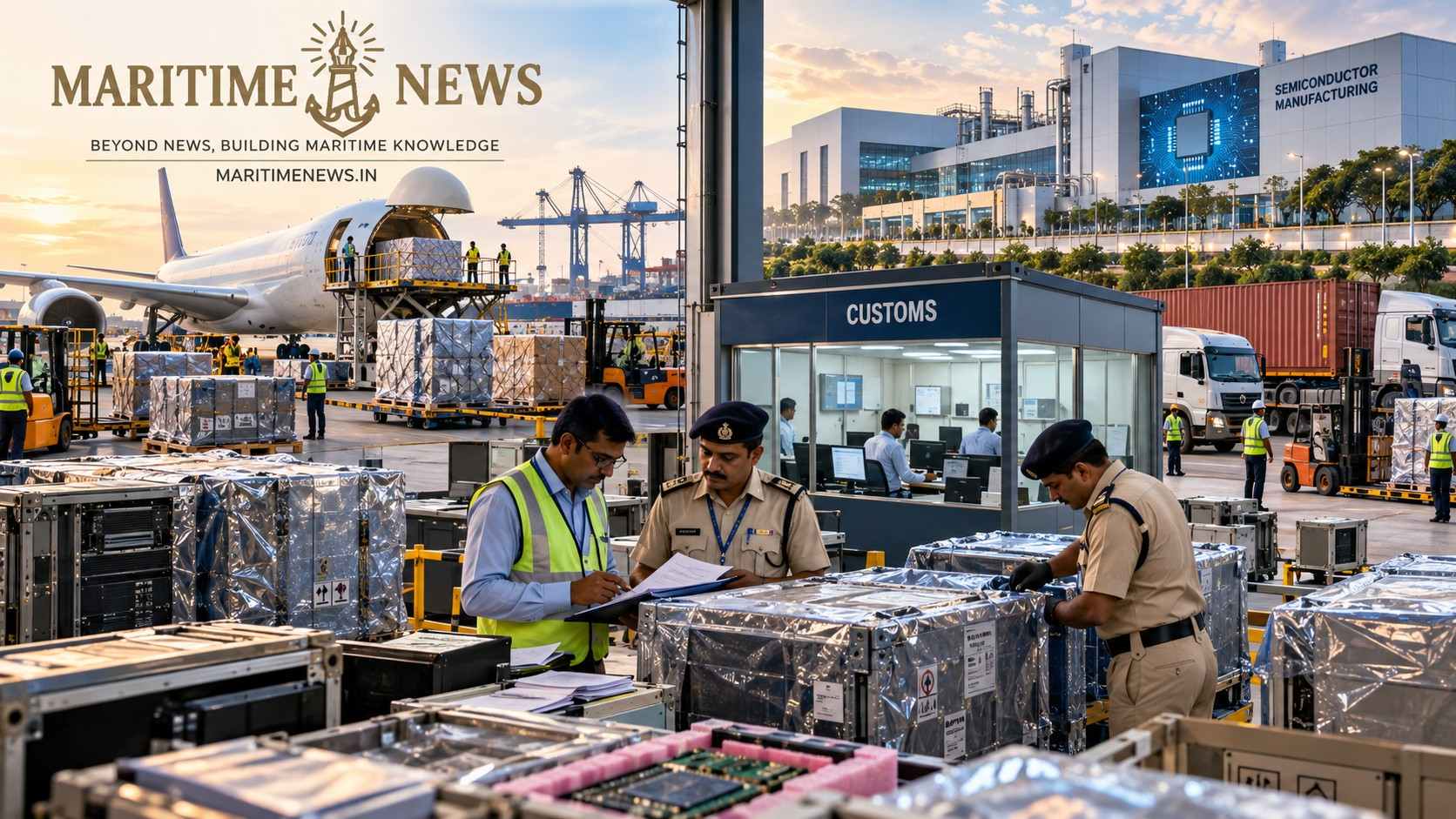
Industry concerns over Customs procedures, transportation and regulatory clearances at SEMICON India 2026 have put the spotlight on whether India’s trade facilitation systems can keep pace with its semiconductor ambitions
Make us preferred source on Google
Key Takeaways
- Semiconductor industry participants at SEMICON India 2026 raised concerns involving Customs procedures, transportation and regulatory permissions. (mint)
- Electronics and IT Minister Ashwini Vaishnaw said the Government would work with industry on the issues raised during country roundtables. (mint)
- The Department of Revenue said around 85% of cargo already moves without documentary assessment or physical examination, with higher facilitation rates under certain trusted-trader arrangements. (Fortune India)
- Industry-reported cases cited by Business Standard involved shipments of precision tools, raw materials, speciality chemicals and gases being held for weeks over issues including HSN codes and product tagging. (Business Standard)
- MeitY is expected to take the concerns to the Ministry of Finance and examine the possibility of a dedicated Customs green channel for certain semiconductor-related imports. (Business Standard)
- DPIIT is working on mapping regulatory requirements to the government departments responsible for particular semiconductor components and products. (Fortune India)
Also Read: India’s Shipbuilding Modernisation Gets New Project Management Unit Under SbDS
New Delhi, India, September 25, 2026 (Maritime News): India’s semiconductor manufacturing ambitions are increasingly moving from policy announcements to factories, equipment procurement and production. But as the industry expands, another part of the semiconductor ecosystem is coming under scrutiny: the movement and clearance of the cargo required to build and operate chip facilities.
At SEMICON India 2026 in New Delhi, industry participants raised concerns relating to Customs procedures, transportation and regulatory permissions. Electronics and IT Minister Ashwini Vaishnaw said the Government would work with industry stakeholders on the issues raised during country roundtables. (mint)
The concerns are significant because semiconductor manufacturing depends on highly specialised equipment, materials, chemicals and gases. A delay does not necessarily mean only a delayed consignment; depending on the item involved, it can affect installation, commissioning, maintenance or production schedules.
This makes the issue much broader than a conventional Customs-clearance question.
It becomes a supply-chain question.
Customs Says Facilitation Is Already High
The Government’s response at SEMICON India also provides an important counterpoint.
Anupam Prakash, Joint Secretary (Customs), Department of Revenue, said around 85% of cargo does not undergo documentary assessment or physical examination. According to his statement reported by Fortune India, the figure exceeds 95% in certain cases under the trusted-trader framework and can cross 99% in some others. (Fortune India)
Prakash also said importers can further reduce clearance times by filing an advance and complete Bill of Entry.
Customs has introduced automatic clearance for certain consignments where regulatory requirements involving other government agencies have to be met, he said.
The Department is also planning phased container scanning over the next two years, with the possibility of using AI-enabled scanning so that consignments that do not indicate risk can potentially be cleared without additional intervention. (Fortune India)
The picture therefore is not one of a Customs system in which every semiconductor consignment is physically examined.
The issue is more specific:
Where delays occur, are the procedures, knowledge, documentation and inter-agency processes sufficiently adapted to the unusual characteristics of semiconductor cargo?
Also Read: Vadhavan Port Tender Advances as NAPM Demands Project Halt and Independent Impact Assessment
Industry Reports Delays In Critical Semiconductor Shipments
A separate report by Business Standard gives more detail on the industry’s concerns.
According to government officials quoted by the publication, MeitY has been made aware of cases involving shipments of precision tools, raw materials, speciality chemicals and gases being held for weeks over procedural issues, including incorrect HSN codes and incorrect tagging of imported tools or raw materials. (Business Standard)
Officials also told the publication that some industry participants had reported instances where Customs officials at ports of entry insisted that packaging containing precision tools and raw materials be opened.
One official said that some precision tools and raw materials can only be opened in clean-room environments, creating a particular handling challenge. (Business Standard)
These are industry-reported cases rather than evidence that such treatment applies across semiconductor imports.
That distinction matters.
But the cases have been serious enough for MeitY to consider raising the matter formally with the Finance Ministry.
MeitY Moves Towards a Finance Ministry Intervention
According to Business Standard, MeitY is expected to write to the Ministry of Finance about the industry’s concerns over Customs delays.
The ministry is also considering whether a Customs green channel could be developed for certain precision tools and raw materials used by the semiconductor industry. The report said such a mechanism would require its own processes and procedures. (Business Standard)
The proposed approach would represent a shift from treating semiconductor cargo simply as another category of imports towards recognising the special operational requirements of critical semiconductor manufacturing equipment and inputs.
The details of any such green channel, including eligibility, documentation, risk controls and implementation, have not been established by the sources reviewed here.
The Problem Is Bigger Than Customs
Customs is only one part of the chain.
At SEMICON India 2026, the industry’s concerns also included transportation and permissions, according to Minister Ashwini Vaishnaw. (mint)
That means the operational chain looks more like:
Semiconductor manufacturer/importer
↓
Customs Broker
↓
Customs
↓
Freight Forwarder / NVOCC
↓
Port or Air Cargo Terminal
↓
Transport and Logistics Operator
↓
Factory / Semiconductor Facility
And the chain can become even more complicated when specialised equipment requires regulatory approval from another government department.
A shipment can therefore be Customs-ready but still encounter a problem elsewhere in the regulatory or physical logistics chain.
Regulatory Responsibility Is Also Fragmented
The issue of regulatory permissions has emerged separately from Customs clearance.
Dr Sumeet Jarangl, Joint Secretary, DPIIT, said at SEMICON India that regulatory requirements for semiconductor companies are distributed across several government departments.
DPIIT is working on a mechanism to map the requirements applicable to specific components and products and identify the departments responsible for them. The objective is to provide semiconductor and other deep-tech companies with greater clarity about the approvals applicable to their operations. (Fortune India)
This is important because a manufacturer may need to know before the shipment arrives:
- what the product is classified as;
- which HSN code applies;
- whether another department’s permission is required;
- which documentation must accompany it;
- whether special handling is required;
- where the shipment should be examined;
- and which agency has the final authority.
The absence of clarity can itself become a logistics cost.
Also Read: : Before India Maps “Vacant” Port Land, Who Will Map the People, Rights and Nature on It?
Customs Broker: The Interface Between Industry and Government
For the semiconductor industry, the Customs Broker can become a critical operational interface.
The broker is not responsible for manufacturing the imported equipment or deciding government policy. But the broker is often involved in classification, documentation, declarations and coordination during the clearance process.
An incorrect HSN classification or incomplete documentation can create delays.
At the same time, the semiconductor industry’s specialised products may present classification and identification challenges that require a deeper understanding of the actual equipment or material.
That creates a practical question:
Does the Customs ecosystem have sufficient product-specific knowledge for the next generation of semiconductor imports?
The industry concern reported by Business Standard suggests this is an area that government and industry are already discussing. (Business Standard)
Freight Forwarders and Logistics Operators Face a Different Problem
Even after regulatory clearance, semiconductor cargo may require specialised logistics.
Precision equipment can involve:
- high-value cargo;
- sensitive machinery;
- specialised packaging;
- controlled environmental conditions;
- time-sensitive delivery;
- oversized or project cargo;
- specialised installation schedules.
The sources reviewed do not provide a quantified estimate of the additional logistics cost created by the reported delays.
But the operational question is straightforward:
If a critical piece of semiconductor equipment is held at a gateway, who bears the cost of the additional storage, handling, transport rescheduling and production disruption?
That question needs to be answered at the transaction level rather than assuming that every delay affects every participant equally.
Also Read: India–MERCOSUR Trade Talks Open as South American Cargo Opportunity Expands
The Last-Mile Problem
A semiconductor shipment does not create value while sitting at a port or airport.
Its economic value is realised only after it reaches the manufacturing facility, is installed or used, and contributes to production.
This makes the last-mile connection particularly important.
Port / Airport → Customs → Customs Broker → Freight Forwarder → Logistics → Factory
Any delay between these points can potentially affect the commissioning or operation of a manufacturing facility.
For a new semiconductor plant, the consequences may be particularly sensitive because construction and commissioning involve multiple pieces of equipment arriving according to planned sequences.
The available sources, however, do not establish that the reported Customs cases caused any specific factory shutdown or production loss. Such a causal claim would require project-level evidence.
Government Coordination Can Also Reduce Delays
The experience cited by Kaynes Semicon provides another side of the story.
According to Fortune India, Raghu Panicker, CEO of Kaynes Semicon, said direct coordination between industry and government departments had helped resolve Customs, equipment-clearance and local-level issues.
He said Kaynes began shipping its first samples within 10 months of starting construction at its Sanand facility and obtained a DGFT licence in two days, despite initially expecting the process to take several weeks. (Fortune India)
That example suggests that the issue may not simply be whether a regulation exists.
It may also be about how quickly the relevant institution and company can identify the problem, understand the technical issue and resolve it.
Also Read: Hormuz Crisis Reshapes Gulf Shipping: What It Means for Indian Trade, Freight and Seafarers
A Potential Green Channel — But With Risk Controls
The reported proposal for a Customs green channel for certain semiconductor-related imports raises an important policy question.
A specialised facilitation route could potentially reduce clearance time for eligible precision tools and critical inputs.
But any such system would still need:
- clear eligibility criteria;
- accurate classification;
- documentation requirements;
- risk-based assessment;
- traceability;
- post-clearance verification where necessary;
- accountability for misuse.
The objective would therefore not simply be “less Customs.”
It would be more predictable, risk-based Customs for critical industrial cargo.
That is consistent with the direction described by the Department of Revenue, including trusted-trader facilitation, automatic clearance for certain consignments and planned technology-enabled scanning. (Fortune India)
Who Carries the Cost of a Delay?
This is the question that goes beyond the Customs counter.
| Point of disruption | Potentially affected stakeholder |
|---|---|
| Classification/documentation issue | Importer, Customs Broker |
| Customs assessment/examination | Importer, Customs Broker, terminal/logistics chain |
| Regulatory approval | Importer/manufacturer |
| Port or terminal delay | Importer, logistics operator, cargo owner |
| Transport delay | Freight Forwarder, logistics operator, importer |
| Equipment delivery delay | Semiconductor manufacturer/project |
| Factory commissioning delay | Project owner and associated contractors |
| Production interruption | Manufacturer and downstream customers |
This does not mean that every stakeholder bears the same cost or that Customs is legally responsible for all losses caused by a delay.
It means the trade chain needs to establish where the delay occurred, why it occurred, who controlled that point, and who ultimately absorbed the additional cost.
That is the difference between reporting that a shipment was delayed and understanding the economics of the delay.
Semiconductor Manufacturing Also Depends on Trade Infrastructure
India’s semiconductor strategy is often discussed through the lens of:
- fabs;
- packaging and testing;
- investment;
- technology;
- incentives;
- skilled workers.
But factories also require a functioning trade and logistics ecosystem.
That includes:
Importers → Customs Brokers → Customs → Freight Forwarders → Ports/Air Cargo → Logistics → Manufacturers
The industry concerns raised at SEMICON India demonstrate why this operational layer matters.
A semiconductor ecosystem cannot function entirely inside the factory.
Its supply chain begins much earlier.
The People Behind the Semiconductor Supply Chain
The immediate public discussion is about factories and technology, but the operational system also depends on people.
Customs officers inspect and clear cargo.
Customs Brokers prepare and coordinate documentation.
Freight forwarders organise movement.
Logistics workers move specialised equipment.
Port and airport workers handle cargo.
Engineers install and commission machinery.
Factory workers operate the production system.
The semiconductor ambition therefore creates employment not only inside fabs and packaging plants but across the industrial trade and logistics chain supporting them.
Also Read: Development of Non-Major Ports in India through Convergence
Government Responsibility: Facilitation and Accountability
The Government has now acknowledged two different aspects of the issue.
First, Customs officials have pointed to substantial existing facilitation, including the reported 85% overall figure and higher rates under trusted-trader arrangements. (Fortune India)
Second, MeitY is responding to industry-reported problems involving specific semiconductor shipments and is expected to engage the Finance Ministry on possible solutions. (Business Standard)
DPIIT is separately working on greater clarity around regulatory responsibilities. (Fortune India)
The implementation challenge is therefore becoming one of coordination between government departments, Customs, industry and logistics providers.
What Should Be Measured?
The semiconductor sector’s growth now provides an opportunity to measure the trade system alongside factory development.
Useful indicators would include:
- average Customs clearance time for semiconductor equipment;
- number of consignments held beyond defined service levels;
- most common classification/documentation errors;
- time taken for inter-agency approvals;
- number of shipments requiring physical examination;
- storage and demurrage generated by delays;
- time required to resolve disputes;
- use of trusted-trader mechanisms;
- use and performance of any future green channel;
- time from port/airport arrival to factory delivery.
Such measurements would help distinguish isolated operational problems from systemic bottlenecks.
MaritimeNews Insight
India’s semiconductor ambition is creating a new kind of trade requirement.
The country is not simply importing finished electronics. It is increasingly seeking to import the machinery, precision tools, materials, chemicals and other inputs required to build a domestic semiconductor manufacturing capability.
That changes the importance of the logistics chain.
The relevant question is not simply:
“How quickly can Customs clear cargo?”
It is:
“How quickly can a critical semiconductor input move from an overseas supplier to the Indian factory, through every regulatory and logistics checkpoint, without compromising safety, security or compliance?”
The answer involves Customs, Customs Brokers, freight forwarders, ports and airports, logistics operators, regulators and manufacturers together.
What to Watch
The next stage will be whether the Government’s discussions produce measurable operational changes.
Key developments to watch include:
- Whether MeitY formally approaches the Finance Ministry and CBIC on the reported concerns.
- Whether a semiconductor-specific Customs green channel is introduced.
- The eligibility criteria for any such mechanism.
- Whether Customs training is adapted for specialised semiconductor equipment and materials.
- DPIIT’s proposed mapping of regulatory requirements and responsible departments.
- Whether industry receives clearer advance guidance on classification and approvals.
- Whether clearance and delivery times improve in practice.
- Whether the benefits extend beyond large semiconductor companies to smaller suppliers and technology firms.
Frequently Asked Questions (FAQs)
Why are Customs procedures important to India’s semiconductor ambitions?
Semiconductor manufacturing depends on imported precision equipment, raw materials, speciality chemicals and gases. Delays in clearing such cargo can create operational difficulties for manufacturers.
Is Customs physically inspecting most semiconductor shipments?
The Department of Revenue’s Anupam Prakash said around 85% of cargo overall does not undergo documentary assessment or physical examination, with higher facilitation rates in certain trusted-trader cases. This is an overall cargo-facilitation figure and should not be interpreted as a semiconductor-specific clearance rate. (Fortune India)
What problems have semiconductor companies reported?
Business Standard reported industry concerns involving shipments held for weeks over issues such as incorrect HSN codes and product tagging, along with cases where packaging of precision tools and raw materials was reportedly required to be opened at ports. (Business Standard)
Is the Government proposing a green channel?
According to Business Standard, MeitY is expected to examine with the Finance Ministry the possibility of a Customs green channel for certain precision tools and raw materials used by the semiconductor industry. The details have not yet been established in the sources reviewed. (Business Standard)
What is DPIIT doing?
DPIIT is working on a mechanism to map regulatory requirements for specific semiconductor components and products to the government departments responsible for them. (Fortune India)
Who is responsible when semiconductor cargo is delayed?
Responsibility depends on the cause of the delay. Classification errors, documentation problems, Customs examination, regulatory permissions, terminal operations and transportation are different points in the chain and can involve different actors. A specific case would need to be examined before assigning responsibility.
Also Read: India Trade Deficit Widens Despite Strong Export Growth
SEMICON India 2026 has brought a less visible part of India’s semiconductor ambition into focus: the ability to move critical industrial cargo through India’s trade and regulatory system quickly and predictably.
The Government says substantial Customs facilitation is already in place and is pursuing further automation and risk-based processes. At the same time, industry-reported cases have prompted MeitY to consider additional intervention, including discussions around a possible green channel for certain semiconductor imports. (Fortune India)
The next test will not be another announcement.
It will be whether a precision tool, specialised material or critical piece of semiconductor equipment can move from supplier to Indian factory with the right balance of speed, security, compliance and accountability.
For India’s semiconductor ambitions, the factory may be the visible centre of the story.
But the supply chain gets it there.
Sources
- Fortune India — Semicon India 2026: India works to cut customs, regulatory delays for semiconductor industry
- Mint — SEMICON India 2026: Semiconductor industry flags customs, transport hurdles; govt promises action
- Business Standard — MeitY to flag Customs delays in chip shipments amid industry concerns
- SME Futures — Semiconductor industry flags Customs, logistics and regulatory hurdles at SEMICON India
- Motilal Oswal — Economy & Outlook coverage supplied for this report
- Communications Today — MeitY steps in as Customs checks delay semiconductor imports
- The Hindu BusinessLine — MeitY to take up semiconductor companies’ concerns with Finance Ministry
Editorial Note: The article distinguishes between official Customs facilitation data and industry-reported cases of delay. It does not treat the latter as evidence that all semiconductor cargo faces Customs delays, nor does it assign legal responsibility for individual losses without case-specific evidence.
Make us preferred source on Google
Reporting by MaritimeNews Bureaus, Writing by Harpal S Naol; Editing by Jaspal Singh Naol.
One thought on “SEMICON India 2026: Semiconductor Industry Flags Customs and Logistics Hurdles as India Scales Chip Manufacturing”