

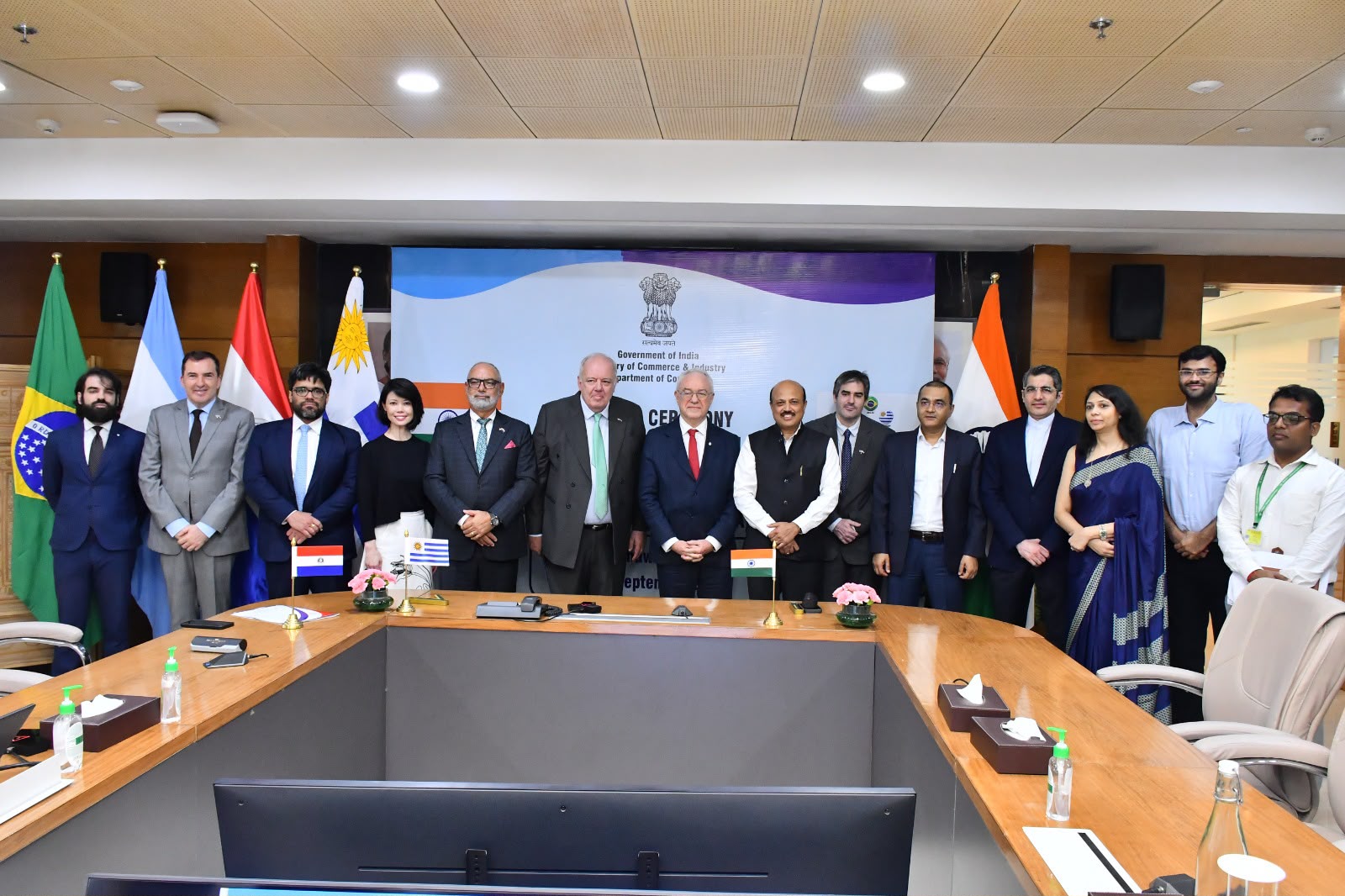
India and MERCOSUR have launched negotiations to expand their Preferential Trade Agreement while signing a protocol for electronic Certificates of Origin, opening a potentially wider market-access and maritime logistics opportunity between India and South America
Make us preferred source on Google
Key Takeaways
- India and MERCOSUR have launched negotiations to expand the existing Preferential Trade Agreement (PTA).
- The two sides are finalising the Terms of Reference that will determine the scope and structure of the expanded agreement.
- India and MERCOSUR have also signed a First Additional Protocol recognising electronic Certificates of Origin with the same legal validity as paper certificates.
- The existing PTA was signed in 2004 and entered into force in 2009, covering 450 tariff lines offered by India and 452 by MERCOSUR.
- TradeStat data from the Department of Commerce shows India’s imports from the four founding MERCOSUR States Parties—Argentina, Brazil, Paraguay and Uruguay—rose from ₹79,295.56 crore in FY2024–25 to ₹1,18,127.94 crore in FY2025–26, an increase of about 49%.
- Brazil accounted for ₹71,555.39 crore of imports in FY2025–26, while Argentina accounted for ₹43,765.06 crore.
- India’s imports from Bolivia rose sharply to ₹11,230.05 crore in FY2025–26; Bolivia’s status must, however, be distinguished from the four founding members because its accession to MERCOSUR is a separate institutional development.
- The expansion of trade will have implications not only for governments but for importers, exporters, Customs Brokers, freight forwarders, shipping lines, ports and logistics service providers.
- The electronic Certificate of Origin initiative could reduce documentation and processing burdens, but the ultimate value of greater market access will depend on the efficiency and cost of the physical maritime supply chain.
Also Read: Modi’s BRICS Bilateral Push Deepens India’s Engagement Across Africa, ASEAN and Central Asia
New Delhi, India September 15, 2026 (Maritime News): India and MERCOSUR have opened negotiations to expand their existing Preferential Trade Agreement, signalling an attempt to deepen economic relations between India and the South American trading bloc.
Union Minister of Commerce and Industry Piyush Goyal and Uruguay’s Minister of Foreign Affairs Mario Lubetkin, representing the Pro Tempore Presidency of MERCOSUR, announced the launch of negotiations on September 14, 2026.
According to the Press Information Bureau, both sides agreed to expand the current agreement into areas of mutual interest with the objective of creating greater benefits and opportunities for their respective private sectors.
The two sides are currently finalising the Terms of Reference, which will define the scope and structure of the future expanded agreement.
That means the September 14 announcement begins a negotiation process; it does not yet establish the final products, tariff concessions or market-access commitments that will form part of the expanded agreement.
A 2009 Trade Agreement Now Faces Expansion
The India–MERCOSUR PTA was signed on January 25, 2004, and entered into force on June 1, 2009.
Under the existing agreement, India provides preferential tariff concessions on 450 tariff lines, while MERCOSUR provides concessions on 452 tariff lines.
The agreement contains provisions covering tariff concessions, rules of origin, safeguard measures and dispute settlement.
MERCOSUR’s official institutional information identifies Argentina, Brazil, Paraguay and Uruguay as the founding States Parties to the Treaty of Asunción. Bolivia has subsequently undertaken the accession process, while Venezuela’s rights and obligations as a State Party are currently suspended under the Protocol of Ushuaia.
MERCOSUR also has Associated States, including Chile, Colombia, Ecuador, Guyana, Panama, Peru and Suriname.
This distinction matters when examining India’s trade data. Trade with a South American country does not automatically mean that the trade is covered by the India–MERCOSUR PTA.
Also Read: India and Vietnam Reaffirm Stronger Maritime and Defence Ties for Regional Security
India’s Trade Data Shows a Growing South American Opportunity
TradeStat, the Department of Commerce’s official trade-statistics platform, provides a useful indication of the scale and direction of India’s merchandise trade with South American markets.
TradeStat — Department of Commerce, Government of India
For the four founding MERCOSUR States Parties, the TradeStat data supplied for this analysis shows:
| Country | FY2024–25 imports | FY2025–26 imports | Change |
|---|---|---|---|
| Brazil | ₹46,130.16 crore | ₹71,555.39 crore | +55.12% |
| Argentina | ₹31,594.57 crore | ₹43,765.06 crore | +38.52% |
| Uruguay | ₹1,288.03 crore | ₹2,574.50 crore | +99.88% |
| Paraguay | ₹282.80 crore | ₹232.99 crore | −17.61% |
| Total | ₹79,295.56 crore | ₹1,18,127.94 crore | +48.97% |
The combined value therefore increased by approximately ₹38,832.38 crore in one year.
Brazil alone recorded an increase of more than ₹25,425 crore, while Argentina’s imports into India increased by more than ₹12,170 crore.
The data does not establish that the increase resulted from the PTA or from the latest negotiations. It does, however, demonstrate that the underlying commercial relationship with major MERCOSUR economies is already substantial.
Bolivia Adds Another Dimension
India’s imports from Bolivia increased from ₹3,107.90 crore in FY2024–25 to ₹11,230.05 crore in FY2025–26, an increase of approximately 261%.
Bolivia’s position requires separate treatment.
According to the MERCOSUR information supplied for this article, Bolivia signed its Protocol of Accession in 2015 and delivered its Instrument of Ratification in July 2024. It is required to incorporate the MERCOSUR normative acquis as part of the accession process.
Therefore, Bolivia should not simply be grouped with the four founding members when discussing the existing India–MERCOSUR PTA.
But its rapidly increasing trade with India adds another reason to watch how the regional economic relationship develops.
The Electronic Certificate of Origin Could Change the Day-to-Day Trade Process
While negotiations over the expanded agreement concern the scope of future trade, the second September 14 announcement deals with something much more practical: documentation.
India and MERCOSUR signed the First Additional Protocol to the India–MERCOSUR PTA to facilitate acceptance of electronic Certificates of Origin.
The PIB announcement states that electronic Certificates of Origin will have the same legal validity and identical value as paper certificates, subject to the applicable domestic legislation of the parties.
The certificates must be issued and electronically signed by duly authorised entities and officials in accordance with the respective domestic legal frameworks.
The protocol is intended to facilitate:
- paperless trade documentation;
- faster issuance and verification;
- lower transaction costs;
- reduced processing time; and
- modernised customs procedures.
The protocol follows discussions in the Joint Administrative Committee of the India–MERCOSUR PTA.
The fourth meeting, held on November 27, 2025, supported updating the agreement to facilitate digital Certificates of Origin. The proposal was subsequently adopted by mutual consent at the fifth meeting on April 9, 2026.
The protocol will enter into force after the respective internal procedures are completed and the parties notify one another.
Also Read: Hormuz Crisis Reshapes Gulf Shipping: What It Means for Indian Trade, Freight and Seafarers
Why This Matters to Importers and Exporters
For an importer or exporter, the value of a trade agreement is ultimately determined by what happens during an actual shipment.
A simplified export chain can look like:
Indian exporter → Customs Broker → Freight Forwarder → Port/Terminal → Shipping Line → South American Port → Importer
An import chain reverses the process:
South American exporter → Shipping Line → Indian Port → Customs Broker → Logistics Provider → Indian Importer
Every additional document, verification requirement, delay or manual process can add cost.
Electronic Certificates of Origin therefore have direct operational relevance for importers and exporters, particularly where preferential tariff treatment depends on establishing the origin of goods.
The real test will be whether the digital system produces measurable reductions in:
- documentation time;
- verification time;
- administrative cost;
- shipment delays; and
- errors requiring manual intervention.
Customs Brokers Will Be on the Front Line
The transition to electronic Certificates of Origin is particularly relevant to Customs Brokers, formerly commonly referred to as Customs House Agents.
They operate between importers/exporters and Customs and handle critical documentation and compliance processes.
For them, the significance of the protocol is not simply that a paper document disappears.
The practical questions will include:
- How will electronic Certificates of Origin be received?
- How will authenticity be verified?
- How will the document connect with customs declarations?
- How will discrepancies be handled?
- What happens when a certificate is electronically available but cannot be verified?
- Will different MERCOSUR countries follow interoperable processes?
The answers will determine whether paperless trade becomes genuinely simpler or merely shifts the documentation burden into another digital workflow.
Freight Forwarders Will Have to Convert Market Access into Routing Options
A broader India–MERCOSUR trade agreement could create additional business opportunities for freight forwarders.
Their role will extend beyond booking cargo.
They will have to evaluate:
- available shipping services;
- direct versus transshipment routes;
- vessel schedules;
- container availability;
- transit time;
- freight rates;
- documentation;
- cargo consolidation;
- destination handling; and
- coordination with overseas agents.
For a geographically distant market such as South America, shipping connectivity and transit economics can determine whether a negotiated tariff advantage is commercially meaningful.
A 10% tariff advantage, for example, cannot automatically be treated as a 10% reduction in the final landed cost.
Freight, insurance, port charges, customs-related costs, inland transport and other logistics expenses remain part of the supply chain.
Logistics Providers Complete the Last Mile
The trade agreement will also have consequences beyond ports.
Logistics Service Providers will connect the maritime leg to manufacturers, warehouses, distribution centres and final customers.
If India–MERCOSUR trade expands, potential additional demand could arise for:
- container movement;
- warehousing;
- CFS and ICD services;
- trucking;
- multimodal transportation;
- cargo consolidation;
- distribution;
- inventory management; and
- digital supply-chain services.
This makes logistics efficiency a central part of the trade-policy equation.
Market access without competitive logistics does not necessarily produce competitive exports.
The Maritime Question: How Will the Additional Cargo Move?
This is where the September 14 announcements acquire a wider maritime significance.
India and MERCOSUR are separated by thousands of nautical miles.
If the expanded agreement eventually generates substantial additional merchandise trade, the cargo will need to move through an international maritime network.
That raises several questions:
Shipping connectivity
Will more commercially viable services emerge between Indian and South American markets?
Transshipment
Which hubs will handle cargo that does not move directly between Indian and South American ports?
Indian ports
Which Indian gateways are best positioned to handle additional South America-bound container and bulk cargo?
Freight cost
Will greater trade volumes improve economies of scale and service frequency?
Transit time
Can Indian exporters offer delivery times competitive with suppliers from other regions?
Port and logistics efficiency
Can cargo move from factory to vessel and from vessel to final customer without excessive delay or cost?
These questions are not answered by the trade negotiations themselves. But they will become increasingly important if the negotiations result in expanded market access.
The South American Trade Picture Is Not Uniform
The TradeStat data also cautions against treating South America as a single homogeneous market.
India’s imports during FY2025–26 showed very different movements:
- Brazil: ₹71,555.39 crore
- Argentina: ₹43,765.06 crore
- Bolivia: ₹11,230.05 crore
- Uruguay: ₹2,574.50 crore
- Paraguay: ₹232.99 crore
Outside the MERCOSUR States Party group, India’s imports from Peru reached ₹79,062.27 crore in FY2025–26, while Ecuador recorded ₹1,123.23 crore.
Peru, however, is an Associated State of MERCOSUR, not a State Party, according to the MERCOSUR information supplied.
This reinforces an important point: India’s broader South American trade opportunity is larger than the India–MERCOSUR PTA alone.
The future policy question is therefore not merely how India can expand one agreement, but how its commercial and maritime connectivity with the wider South American region can develop.
Also Read: Kottayam Port Begins First Container Movement to Vizhinjam, Opening New Kerala EXIM Route
What It Means for India’s Maritime Ecosystem
The possible expansion of trade creates a chain of stakeholders.
| Stakeholder | Potential impact |
|---|---|
| Importers | More sourcing opportunities, preferential tariffs and simplified documentation |
| Exporters | Greater market access and potential new customers |
| Customs Brokers | Electronic origin documentation and compliance requirements |
| Freight Forwarders | New cargo flows, routing and consolidation opportunities |
| Shipping Lines | Potential additional India–South America cargo |
| Ports & Terminals | Additional container, bulk or break-bulk demand |
| CFS/ICDs | Additional cargo handling and documentation activity |
| Logistics Service Providers | Inland transport, warehousing and distribution demand |
| MSMEs | Potential access to previously difficult overseas markets |
This is why the trade negotiations should ultimately be viewed through the entire EXIM and logistics ecosystem, rather than only through tariff schedules.
Government’s Role: From Negotiation to Implementation
The immediate responsibility lies with the Ministry of Commerce and Industry, which is negotiating the expanded agreement with MERCOSUR.
But implementation will require coordination across multiple institutions.
Commerce Ministry
To negotiate market access, product coverage and the final structure of the expanded agreement.
DGFT
To support the operational framework for Certificates of Origin and exporter-facing digital processes.
CBIC and Customs
To implement and verify customs procedures associated with preferential imports and electronic origin documentation.
Ministry of Ports, Shipping and Waterways
To ensure that India’s maritime infrastructure and port ecosystem can support any sustained increase in South American trade.
Port Authorities
To provide efficient cargo handling and connectivity.
Industry and logistics stakeholders
Importers, exporters, Customs Brokers, freight forwarders and logistics service providers will have to translate the negotiated framework into actual shipments.
Also Read: Cochin Shipyard and Drydocks World Sign 50:50 JV to Build India’s Global Ship Repair Ambition
The Political and Institutional Accountability Question
The political decision is now clear: India wants to explore a broader trade relationship with MERCOSUR.
The next accountability question is implementation.
The eventual expanded agreement should be judged against measurable outcomes:
- How many additional tariff lines are covered?
- What is the value of India’s exports to MERCOSUR after implementation?
- What happens to India’s imports?
- How many Indian MSMEs use the agreement?
- How quickly are electronic Certificates of Origin processed?
- Do documentation costs fall?
- Does shipping connectivity improve?
- Do freight costs become more competitive?
- Which Indian ports gain additional cargo?
- Are Customs Brokers able to process electronic documentation efficiently?
- Are freight forwarders and logistics providers seeing greater cargo volumes?
- Does the benefit reach smaller exporters and importers?
These indicators will show whether the agreement moves from diplomatic commitment to commercial outcome.
People and Last-Mile Impact
The beneficiaries of a trade agreement are not limited to governments and large corporations.
An expanded India–MERCOSUR relationship could involve thousands of businesses and workers across the trade chain.
An exporter needs a buyer.
The buyer needs a competitive landed price.
The shipment needs a freight forwarder.
The documentation needs to be handled correctly.
Customs clearance needs to work efficiently.
The cargo needs a port.
The port needs shipping connectivity.
And once the vessel arrives, logistics providers need to deliver the cargo to its final destination.
If any link is inefficient, the benefit of the trade agreement can be diluted.
That is why importers, exporters, Customs Brokers, freight forwarders and logistics service providers must be part of the implementation conversation from the beginning, rather than being considered only after the agreement is signed.
Also Read: India Moves to Build a Global Hub for Ship Ownership, Leasing and Maritime Finance Through GIFT City
MaritimeNews Insight
India and MERCOSUR are opening two doors at the same time: one towards greater market access and another towards more efficient trade documentation.
The first could expand the volume and range of goods that India and MERCOSUR trade with one another.
The second could make the existing preferential trade framework easier to use.
But there is a third door that cannot be ignored:
the maritime and logistics corridor that physically connects the two markets.
The TradeStat numbers show that India already has substantial and growing merchandise trade with major South American economies, particularly Brazil and Argentina.
The challenge now is to ensure that future market access is supported by competitive shipping, efficient ports, reliable Customs processes, capable freight forwarding, efficient logistics and accessible trade facilitation for exporters and importers of all sizes.
The success of the expanded agreement should therefore not be measured only by the number of tariff lines negotiated.
It should ultimately be visible in cargo moving, businesses exporting, importers sourcing, documents clearing faster, logistics costs becoming more competitive and Indian companies reaching South American markets more effectively.
Way Forward
India and MERCOSUR should use the expansion negotiations to build an integrated trade-and-logistics corridor, with attention to the complete journey of goods.
1. Expand meaningful market access
The negotiations should identify products where preferential access can create genuine commercial opportunities for Indian exporters and MERCOSUR suppliers.
2. Make digital Certificates of Origin genuinely interoperable
The electronic protocol should be implemented in a manner that reduces—not merely digitises—administrative burdens.
3. Bring Customs Brokers into implementation discussions
The professionals handling real-world customs documentation should be consulted on operational requirements, verification and exception handling.
4. Engage freight forwarders and logistics providers
Their practical knowledge of routes, transshipment, freight costs and cargo handling can help identify supply-chain barriers that tariff negotiations alone cannot address.
5. Develop shipping connectivity
India should examine whether additional South America-bound services, better transshipment options or greater service frequency could emerge from expanding trade.
6. Track port-level outcomes
The government should track which Indian ports handle India–MERCOSUR cargo and whether infrastructure or connectivity constraints emerge.
7. Measure MSME participation
The agreement should not become primarily a facility for large trading houses. Smaller exporters should have access to information, documentation support and digital systems.
8. Publish an implementation scorecard
Once the expanded agreement is concluded and operational, India should periodically track:
Trade target → Actual trade → Cargo volume → Processing time → Logistics cost → Exporter participation → MSME participation → Corrective action.
That would turn the trade agreement into a measurable economic programme rather than a document whose success is judged only at the signing ceremony.
Frequently Asked Questions (FAQs)
What did India and MERCOSUR announce on September 14, 2026?
They announced the launch of negotiations to expand the existing India–MERCOSUR Preferential Trade Agreement.
What is the current India–MERCOSUR PTA?
It was signed on January 25, 2004, and entered into force on June 1, 2009. It provides preferential tariff concessions on 450 tariff lines offered by India and 452 by MERCOSUR.
What is the new electronic Certificate of Origin protocol?
It is the First Additional Protocol to the India–MERCOSUR PTA, designed to facilitate acceptance of electronic Certificates of Origin.
Will electronic Certificates of Origin have the same status as paper certificates?
Under the protocol, electronically issued Certificates of Origin will have the same legal validity and identical value as paper certificates, subject to the applicable domestic legislation.
Has the electronic protocol entered into force?
Not yet. The respective internal procedures must first be completed and the parties must notify each other.
Who are the founding MERCOSUR countries?
Argentina, Brazil, Paraguay and Uruguay are the founding States Parties to MERCOSUR.
Is Bolivia a MERCOSUR member?
Bolivia has undertaken the accession process and is identified by MERCOSUR as a new State Party following its accession arrangements. Its status should be distinguished from the four founding members when analysing the existing India–MERCOSUR PTA.
Is Peru a MERCOSUR member?
Peru is an Associated State, not a State Party.
Why is this important for Indian ports?
If the expanded agreement generates additional merchandise trade, more cargo may require shipping, port, transshipment and logistics services between India and South America.
Who will be affected apart from exporters and importers?
Customs Brokers, freight forwarders, shipping lines, port and terminal operators, CFS/ICD operators and logistics service providers will all be part of the physical and documentary trade chain.
Where does the trade data in this article come from?
The country-level import statistics used in this analysis are from TradeStat, Department of Commerce, Government of India. The underlying country datasets supplied for this article were used to calculate the comparative figures. TradeStat — Department of Commerce
Primary Sources
Government of India / PIB
Launch of negotiations for expansion of the India–MERCOSUR Preferential Trade Agreement
India and MERCOSUR sign First Additional Protocol for electronic Certificates of Origin
Trade Statistics
TradeStat — Department of Commerce, Government of India
MERCOSUR institutional information
The MERCOSUR country classification and accession information used in this article is based on the MERCOSUR information supplied for this report, including its distinction between States Parties and Associated States.
Make us preferred source on Google
Reporting by MaritimeNews Bureaus, Writing and Editing by Jaspal Singh Naol.
2 thoughts on “India–MERCOSUR Trade Talks Open as South American Cargo Opportunity Expands”